
Income Tax Notice for High Value Transactions: What Should You Do?

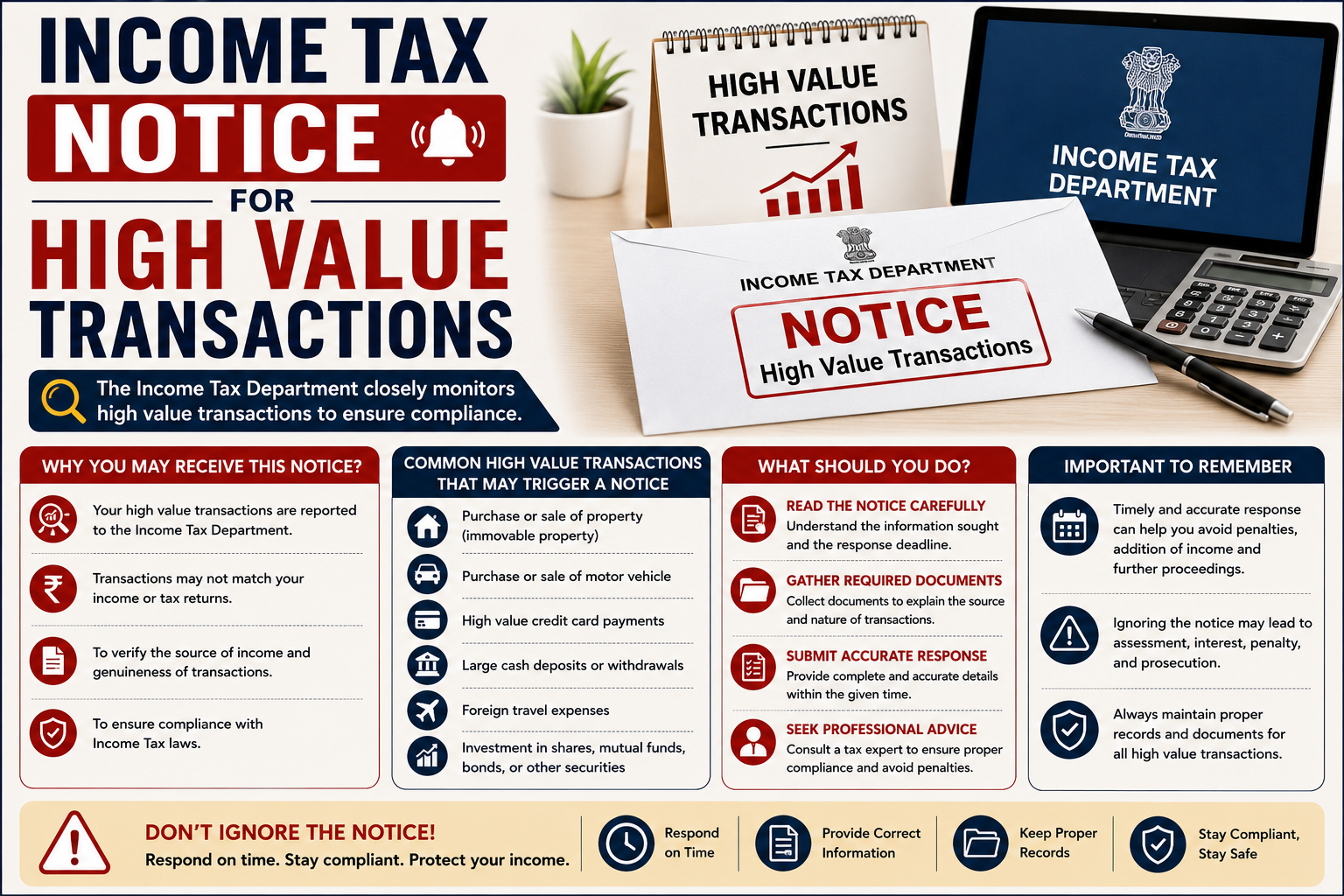
Receiving an Income Tax Notice for High Value Transactions does not automatically mean that the transaction is illegal or that tax evasion has been established. In many cases, the Income Tax Department seeks an explanation because information reported by a bank, financial institution, registrar, mutual fund, credit-card issuer or another reporting entity does not appear to match the taxpayer’s income-tax records.
The Income Tax Department uses information relating to financial transactions through systems such as the Annual Information Statement (AIS), SFT reporting and compliance/e-verification mechanisms. The AIS provides taxpayers with information about financial transactions and also allows feedback on reported information.
The correct response depends on the nature of the transaction, its source, the year involved, whether the amount was already disclosed and the exact wording of the communication.
What Is an Income Tax Notice for High Value Transactions?
An Income Tax notice or communication concerning a high value transaction is generally intended to obtain clarification about a financial transaction that has been reported to the tax authorities and requires verification or reconciliation with the taxpayer’s tax records.
Examples may include substantial:
- Cash deposits
- Cash withdrawals from certain accounts
- Property purchases or sales
- Credit-card payments
- Time deposits
- Investments in shares or securities
- Mutual fund investments
- Foreign currency transactions
- Certain purchases or sales of goods or services
Under the SFT framework, specified reporting entities furnish information regarding prescribed financial transactions to the Income Tax Department. The official SFT guidance lists several categories and applicable reporting thresholds.
A high-value transaction being reported does not by itself establish undisclosed income. The important question is whether the taxpayer can satisfactorily explain the transaction and establish its source and tax treatment.
Why Does the Income Tax Department Send These Notices?
A notice may arise because the Department’s information indicates a possible mismatch or requires verification.
Common situations include:
1. High-value transaction is not reflected in the ITR
For example, a taxpayer purchases an immovable property for a substantial amount but the corresponding source of funds or related transaction is not adequately reflected in the return or supporting records.
2. Cash deposits appear inconsistent with declared income
A taxpayer may have substantial cash deposits in a bank account while reporting comparatively low business or professional income.
This does not necessarily mean the deposits are unexplained. The taxpayer may have legitimate records showing that the cash represents business receipts, earlier withdrawals, agricultural income where legally applicable, loan proceeds, or another identifiable source.
3. AIS contains information that the taxpayer believes is incorrect
AIS can contain information reported by third parties. Taxpayers can provide feedback where information is incorrect or requires modification.
4. Transaction has been reported but tax treatment is unclear
A transaction may be genuine but still require clarification regarding whether it represents:
- Income
- Capital gains
- Loan
- Gift
- Sale proceeds
- Business receipts
- Investment
- Transfer between own accounts
- Reimbursement
- Redemption or withdrawal
5. Non-filing or compliance issues
The Compliance Portal can display e-campaigns relating to significant transactions, non-filing and high-value transactions.
What Are Some Common High-Value Transactions Reported to the Income Tax Department?
The SFT framework covers several prescribed transactions.
The official SFT guidance includes, among other categories, cash deposits of ₹10 lakh or more in specified non-current accounts during a financial year, cash deposits or withdrawals of ₹50 lakh or more in current accounts, certain credit-card payments, time deposits of ₹10 lakh or more, purchase or sale of immovable property where the transaction value or stamp valuation reaches ₹30 lakh or more, and certain investments and foreign-currency transactions.
These thresholds should not be treated as a universal definition of “high value” for every Income Tax proceeding. Different provisions and reporting mechanisms may apply depending on the transaction and the relevant tax period.
How Does AIS Relate to a High Value Transaction Notice?
The Annual Information Statement (AIS) is particularly important when dealing with financial-transaction-related communications.
AIS provides information received from various sources, including SFT and other financial information. Taxpayers can review the information and submit feedback where appropriate.
Before responding to a notice, it is therefore sensible to compare:
- The notice or communication.
- AIS.
- TIS, where applicable.
- Bank statements.
- ITR and computation of income.
- Investment records.
- Relevant transaction documents.
The objective should be to identify exactly what information has triggered the Department’s query.
What Should You Do After Receiving an Income Tax Notice?
Step 1: Authenticate the Notice
First verify that the communication is genuine.
Income Tax Department communications issued on or after 1 October 2019 are generally required to carry a unique Document Identification Number (DIN), and the Department provides an online facility for authentication.
Do not rely solely on an email attachment or message received through an unknown source.
Step 2: Read the Notice Carefully
Check:
- PAN
- Assessment Year or Tax Year
- DIN
- Section/provision mentioned
- Transaction concerned
- Amount involved
- Response deadline
- Documents requested
- Whether the communication is an e-campaign, e-verification, clarification request or formal proceeding
The nature of the communication determines how it should be handled.
Step 3: Check AIS and Other Tax Information
Review the relevant financial year in AIS and compare the reported transaction with your records.
If the information is incorrect, determine whether feedback can appropriately be submitted through the relevant AIS facility.
Step 4: Reconcile the Transaction
Prepare a transaction-wise reconciliation.
For example:
| Department Information | Taxpayer’s Records |
|---|---|
| Bank deposit | Source of deposit |
| Property purchase | Sale deed + payment trail |
| Credit-card payment | Bank statement + source |
| Mutual fund investment | Investment statement + bank trail |
| Share transaction | Demat/broker statement |
| Loan receipt | Loan agreement + bank statement |
Step 5: Collect Supporting Documents
Documents may include:
- Bank statements
- ITR acknowledgements
- Computation of income
- Audited financial statements, where applicable
- Sale/purchase agreements
- Property documents
- Loan agreements
- Gift documentation, where applicable
- Investment statements
- Demat statements
- Mutual fund statements
- Credit-card statements
- Invoices
- Cash book
- Ledger accounts
- Books of account
- Source-of-funds evidence
Only documents relevant to the particular transaction should be submitted.
Step 6: Prepare a Clear Written Explanation
A good response should directly answer the Department’s query.
Avoid submitting a generic statement such as:
“The transaction is genuine.”
Instead explain:
- What the transaction was.
- When it occurred.
- Why it occurred.
- Who the parties were.
- What was the source of funds.
- Whether it was disclosed in the ITR.
- Which documents establish the explanation.
Step 7: Submit the Response Through the Correct Portal
The Income Tax Department’s e-Proceedings facility allows taxpayers or authorised representatives to view and respond to notices, intimations and letters electronically.
The Department’s current guidance directs taxpayers to access relevant compliance/e-Proceeding services through the e-Filing portal.
Keep the acknowledgement, transaction ID and submitted documents safely for future reference.
Can You Ignore an Income Tax Notice for High Value Transactions?
No. A taxpayer should not casually ignore a tax communication.
The consequences depend on the nature of the communication and applicable legal provision. A failure to respond can result in the Department proceeding on the information available to it.
The response deadline printed in the notice is particularly important. The Income Tax Department states that responses submitted through e-Proceedings generally cannot simply be edited or withdrawn after submission, so the response should be prepared carefully.
What If the Transaction Is Genuine but Was Not Reported Correctly?
A genuine transaction can still create a tax issue if it was incorrectly reported, omitted from the return or not adequately explained.
For example, suppose a taxpayer purchased property using:
- ₹20 lakh from accumulated savings,
- ₹30 lakh from a documented bank loan, and
- ₹10 lakh from sale of an earlier investment.
If the Department sees a ₹60 lakh property transaction but the taxpayer cannot demonstrate the sources, clarification may be requested.
The appropriate response would be to establish each source with documentary evidence and explain the tax treatment of the underlying transactions.
What If the Information in AIS Is Wrong?
If the reported information is incorrect, the taxpayer should first examine the underlying transaction and reporting source.
AIS provides a mechanism for taxpayer feedback on information displayed in the statement.
For example, if a transaction is wrongly attributed to a taxpayer, the taxpayer should preserve evidence such as bank statements, transaction statements or correspondence supporting the correction.
However, submitting AIS feedback does not necessarily mean that every subsequent departmental proceeding automatically disappears. The exact circumstances and communication must be examined separately.
Income Tax Notice for Cash Deposits
Cash deposits are a frequent area of tax scrutiny.
A cash deposit should not be explained merely by stating that it was “cash in hand.” The taxpayer should be able to establish the source through appropriate records.
Depending on the facts, relevant evidence could include:
- Sales invoices
- Cash book
- Daily cash summaries
- Bank statements
- Stock records
- Books of account
- Previous withdrawals
- Loan documents
- Evidence of business receipts
For businesses, the explanation should also be consistent with turnover, gross profit, cash balance and books of account.
Income Tax Notice for Property Purchase
Property transactions can attract reporting because specified immovable-property transactions are covered by the SFT framework. The official SFT guidance provides a reporting threshold based on transaction value or stamp valuation for specified property transactions.
A taxpayer receiving a property-related query should examine:
- Sale deed
- Purchase agreement
- Stamp valuation
- Payment schedule
- Bank statements
- Home-loan documents
- Source of down payment
- TDS documentation, where applicable
- ITR disclosures
- Capital gains records, where relevant
The source of funds is often as important as the purchase itself.
What Are the Legal Consequences of an Unexplained Transaction?
The consequences depend on the facts and the specific statutory proceeding.
A high-value transaction is not automatically taxable as unexplained income merely because it appears in AIS or SFT data.
The Department may seek clarification, conduct verification or undertake assessment proceedings depending on the circumstances.
If the taxpayer cannot satisfactorily establish the nature and source of a transaction, more serious tax consequences may arise under the applicable law.
Accordingly, the response should be evidence-based rather than argumentative.
Which Law Applies: Income-tax Act, 1961 or Income-tax Act, 2025?
This is an important point for current taxpayers.
The Income-tax Act, 2025 came into force from 1 April 2026, replacing the Income-tax Act, 1961 for the tax years to which the new Act applies. However, an assessment year that began under the earlier Act continues to be governed by the earlier law.
The SFT framework has also been carried into the new Act. Section 508 of the Income-tax Act, 2025 deals with the obligation to furnish statements of specified financial transactions or reportable accounts.
Therefore, the correct provision depends on the relevant tax year/assessment year and the nature of the proceeding. A response should not blindly quote provisions from the old Act without checking the applicable period.
What Documents Should You Keep Ready?
For a high-value transaction notice, prepare a document file containing:
- Copy of the notice.
- DIN/authentication details.
- AIS/TIS information.
- Relevant bank statements.
- ITR acknowledgement and computation.
- Transaction agreement or invoice.
- Proof of source of funds.
- Relevant investment or loan statements.
- Books of account, where applicable.
- Any earlier correspondence with the Income Tax Department.
Organise the documents chronologically and refer to them clearly in the written response.
What Are the Common Mistakes Taxpayers Make?
1. Ignoring the notice
Silence can make the matter more difficult.
2. Responding without checking AIS
The taxpayer may miss the exact information that triggered the communication.
3. Providing an incomplete explanation
A statement without supporting evidence may not adequately establish the source or nature of a transaction.
4. Uploading irrelevant documents
More documents do not necessarily mean a better response. Documents should support specific factual assertions.
5. Giving contradictory explanations
The response should be consistent with bank records, ITR, books and transaction documents.
6. Missing the deadline
Always check the exact deadline stated in the communication.
7. Treating an e-campaign as equivalent to a final tax demand
Different departmental communications have different legal consequences. The nature of the communication must first be identified.
CTA
If you have received an Income Tax Notice for High Value Transactions, do not respond mechanically. First understand what information has triggered the query, reconcile it with your financial records and then prepare a precise documentary response.
For assistance with Income Tax notices, assessments and tax litigation in Patna and Bihar, Bihar Tax Consultant provides professional tax support.
Bihar Tax Consultant
BIIT Campus, near Sanchira Mandir, New Azimabad Colony, Patna, Bihar 800006
Mobile: 8789155395
Email: [email protected]
Website: bihartaxconsultnt.com
Book a Consultation before submitting a complex or high-value tax response.