
Income Tax Faceless Assessment Explained: Procedure, Notices, Rights & What Taxpayers Should Do

What Is Income Tax Faceless Assessment?
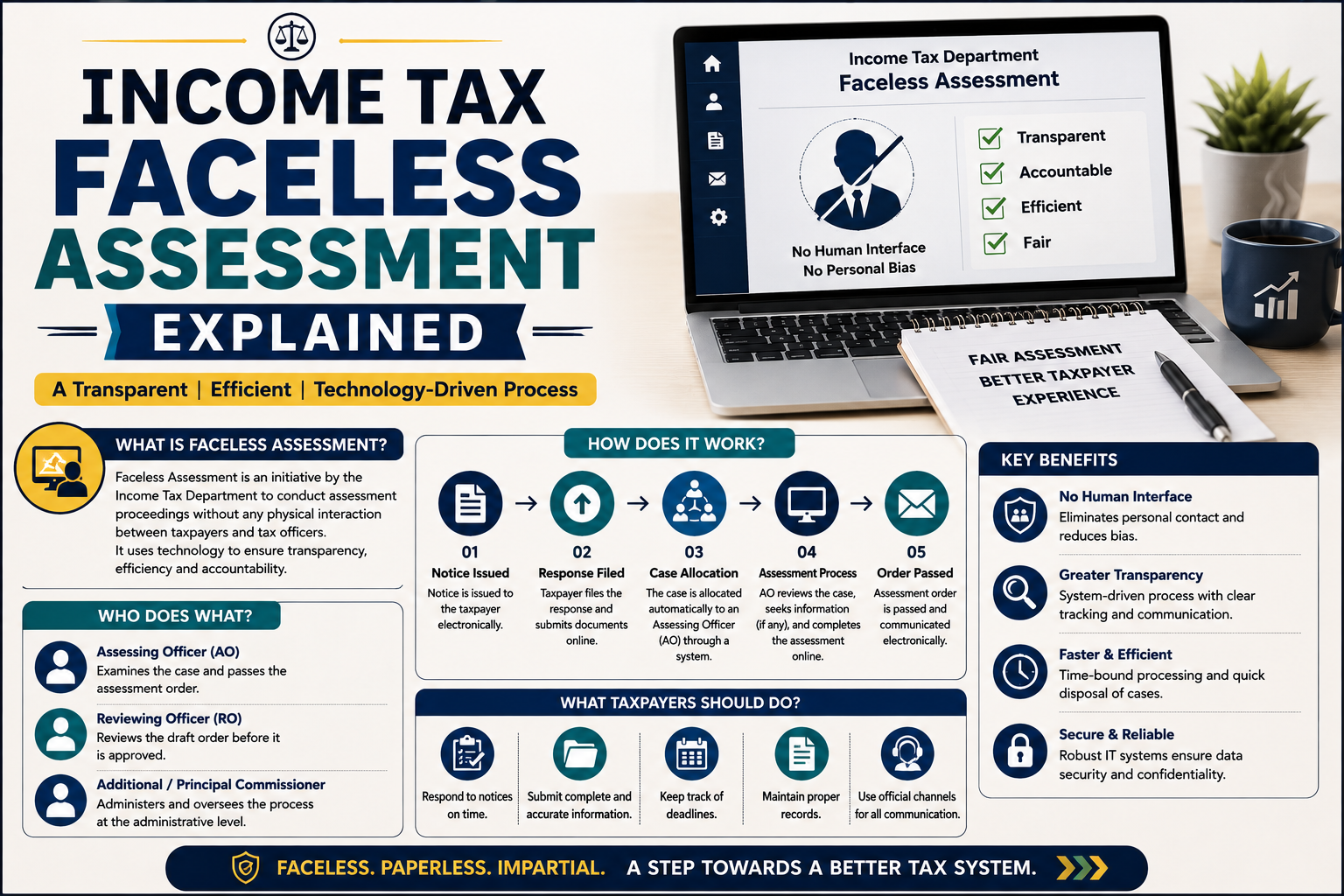
Income Tax Faceless Assessment is an electronic assessment process in which communication between the taxpayer and the Income Tax Department takes place primarily through the designated electronic system rather than through routine physical interaction with a jurisdictional Assessing Officer. The process uses designated assessment, verification, technical and review functions to conduct assessment proceedings electronically.
For proceedings relating to earlier tax years, the Income-tax Act, 1961 and its faceless-assessment framework, particularly Section 144B, may continue to apply under the transitional provisions. For tax years governed by the Income-tax Act, 2025, the corresponding faceless-assessment framework is contained in the new Act. The Income Tax Department has specifically stated that the existing faceless-assessment framework continues under the new Act.
Introduction
Receiving an Income Tax notice can be stressful, particularly when the proceeding is described as a faceless assessment.
Many taxpayers assume that “faceless” means that no action is required or that the Department will automatically complete the assessment from information already available in its records. That is incorrect.
A faceless proceeding is still a formal tax proceeding. The taxpayer may be required to provide explanations, documents, reconciliations and evidence within the prescribed time.
The major difference is the mode of interaction. Instead of routinely visiting an Income Tax office and dealing personally with a particular officer, communications and submissions are generally handled electronically.
The Income Tax Department describes the faceless system as an electronic process in which notices, questionnaires, responses and assessment communications are exchanged through the designated electronic platform.
This article explains how faceless assessment works, what happens after receiving a notice, what documents may be required, what rights taxpayers have and what mistakes should be avoided.
What Is Faceless Assessment Under Income Tax Law?
Faceless assessment is designed to conduct specified assessment proceedings through an electronic and structured system involving different functional units.
Under the earlier Income-tax Act, 1961, Section 144B provided the statutory framework for faceless assessment. It covered specified assessment, reassessment or recomputation proceedings and established the role of the National Faceless Assessment Centre along with assessment, verification, technical and review units.
The statutory framework provides for automated allocation of cases, electronic communication and electronic submission of responses.
The legal landscape changed from 1 April 2026, when the Income-tax Act, 2025 came into force and repealed the Income-tax Act, 1961, subject to transitional provisions.
The Income Tax Department has clarified that proceedings relating to earlier tax years continue under the old Act, while the new Act applies to tax years beginning on or after 1 April 2026. It has also confirmed that the existing faceless-assessment framework continues under the new Act.
Therefore, the exact statutory provision applicable to a taxpayer depends on which tax year and proceeding is involved.
Section 144B and the New Income-tax Act, 2025
Why is Section 144B still mentioned so often?
Section 144B of the Income-tax Act, 1961 became closely associated with faceless assessment.
For example, an assessment relating to an earlier Assessment Year may still be governed by the 1961 Act because of the transitional provisions of the Income-tax Act, 2025.
For proceedings governed by the new Act, the faceless-assessment provision is Section 273 of the Income-tax Act, 2025.
Section 273 provides for assessment, reassessment or recomputation in a faceless manner for specified cases and permits the Board to establish the National Faceless Assessment Centre and various functional units.
This distinction is important when preparing legal or tax advice in 2026.
How Does Faceless Assessment Work?
The exact procedure depends on the nature of the proceeding, but the process generally involves electronic communication and examination of information.
A simplified flow is:
Case selection → Electronic notice → Taxpayer response → Verification/technical examination, where required → Proposed determination → Opportunity to respond → Assessment order
The older Section 144B framework expressly provides for automated allocation of cases to assessment units and communication through the National Faceless Assessment Centre. It also permits requests for further information, verification and technical assistance.
Step 1: Case Is Selected for Assessment
A case may be selected for scrutiny or another assessment proceeding under the applicable legal framework.
Where the faceless framework applies, the case may be allocated through an automated system rather than being handled through the conventional model of a taxpayer approaching a particular jurisdictional officer.
The faceless scheme describes this as automated allocation involving technological tools and multiple functional units.
Step 2: Notice Is Issued Electronically
The taxpayer may receive an electronic notice requiring information, documents, explanations or other details.
Depending on the proceeding, notices can involve provisions dealing with scrutiny, information requirements, reassessment or best-judgment assessment.
A taxpayer should never ignore such communication merely because it has been received electronically.
The registered e-filing account and registered communication channels should therefore be monitored regularly.
Step 3: Taxpayer Submits an E-Response
The taxpayer is required to submit the response through the designated electronic system within the time specified in the notice.
A strong response should normally:
- Address each question separately.
- Explain the relevant facts.
- Provide documentary evidence.
- Reconcile figures with the Income Tax Return.
- Reconcile information with Form 26AS, AIS and other available records where relevant.
- Explain discrepancies rather than merely denying them.
- Attach supporting documents in an organised manner.
- Preserve the acknowledgement of submission.
A short response saying “the transaction is genuine” without supporting evidence may not adequately address the issue raised by the Department.
Step 4: Further Information or Verification May Be Requested
The assessment process may require additional information.
Under the earlier Section 144B framework, the assessment unit could request further information or documents and could also seek verification or technical assistance. The framework recognises assessment, verification, technical and review functions.
For example, a taxpayer may be asked to explain:
- A large bank transaction.
- A cash deposit.
- A property purchase.
- Capital gains.
- Unsecured loans.
- Share capital or investments.
- Business expenses.
- Foreign transactions.
- TDS discrepancies.
- Differences between reported income and third-party information.
Step 5: Proposed Variation and Opportunity to Respond
If the Department proposes an adjustment that is adverse to the taxpayer, the taxpayer may receive an opportunity to explain why the proposed variation should not be made.
This stage is extremely important.
The taxpayer should not treat a show-cause notice as a routine communication. It may be the taxpayer’s principal opportunity to place the complete factual and legal explanation on record before the assessment order is passed.
Can a Taxpayer Request a Personal Hearing in Faceless Assessment?
Yes, where the applicable faceless-assessment framework provides an opportunity to request a personal hearing in relation to a proposed variation, the taxpayer or authorised representative may request such hearing.
Under Section 144B of the Income-tax Act, 1961, where a variation is proposed and an opportunity is provided to the assessee to explain why the proposed variation should not be made, the assessee or authorised representative may request personal hearing. Where such request is received, the hearing is to be conducted through video conferencing or video telephony, subject to the statutory framework and applicable procedure.
Therefore, “faceless” does not necessarily mean “no hearing.”
It primarily means that the proceeding is conducted through an electronic interface rather than through ordinary physical interaction.
What Documents Are Required in a Faceless Assessment?
There is no universal document list because the requirements depend on the issue under examination.
However, taxpayers should generally keep the following readily available:
| Issue | Possible supporting documents |
|---|---|
| Salary income | Form 16, salary slips, employment records |
| Bank transactions | Bank statements, transaction explanations |
| Property transaction | Sale deed, purchase deed, payment proof |
| Capital gains | Purchase/sale documents, contract notes, statements |
| Business income | Books of account, invoices, ledgers, bank statements |
| Loans | Loan confirmation, bank statement, lender details |
| Investments | Demat statements, investment statements, purchase documents |
| TDS mismatch | Form 26AS, AIS, TDS certificates and reconciliation |
| Foreign transactions | Bank statements, remittance documents and relevant declarations |
| Large transactions | Source-of-funds evidence and supporting documentation |
The important principle is not simply to upload a large number of documents.
Every document should be connected to the issue raised in the notice.
What Happens If a Taxpayer Does Not Respond?
Ignoring a faceless assessment notice can seriously prejudice the taxpayer.
Where the taxpayer fails to comply with specified notices or requests for information, the applicable assessment framework may permit the Department to proceed further, including best-judgment assessment in appropriate circumstances.
Under Section 144B of the 1961 Act, for example, failure to comply with specified notices could result in a show-cause notice under Section 144 before completion of the assessment to the best of the officer’s judgment.
Accordingly, taxpayers should never assume that silence means the proceeding has ended.
If additional time is genuinely required, an application for extension should be considered where legally permissible rather than simply allowing the deadline to expire.
Important Rights of a Taxpayer
Faceless assessment does not remove the taxpayer’s procedural rights.
Depending on the applicable law and facts, important protections may include:
1. Right to respond
The taxpayer should have the opportunity to answer notices and proposed adverse issues within the prescribed framework.
2. Right to submit evidence
Relevant documents and explanations can be placed on record to support the taxpayer’s position.
3. Right to seek personal hearing where applicable
Where the statutory conditions are satisfied, the taxpayer may request a video-conference hearing in relation to a proposed variation.
4. Right to challenge an adverse order
An assessment order is not necessarily the end of the matter. Depending on the nature of the order and applicable law, statutory remedies such as rectification or appeal may be available.
5. Right to professional representation
A taxpayer may, where permitted, take assistance from an authorised representative or tax professional.
What Are the Common Mistakes in Faceless Assessment?
Mistake 1: Ignoring the e-filing account
Taxpayers sometimes discover notices only after the response deadline has passed.
Better approach: Regularly monitor the registered e-filing account and communication channels.
Mistake 2: Giving a generic reply
A generic statement such as “all income has been disclosed” may not answer a specific query.
Better approach: Respond point-by-point.
Mistake 3: Uploading documents without explanation
Documents without a clear explanation can make it difficult to understand the taxpayer’s position.
Better approach: Explain what each important document establishes.
Mistake 4: Failing to reconcile third-party information
AIS, Form 26AS, bank information and other data may not always appear identical to the taxpayer’s books or return.
Better approach: Identify and explain genuine discrepancies.
Mistake 5: Missing the show-cause stage
A proposed addition should be addressed seriously before the final order.
Better approach: Prepare a detailed factual and legal response supported by evidence.
Mistake 6: Treating every issue as purely factual
Some assessment disputes involve interpretation of provisions, jurisdiction, limitation, evidentiary principles or procedural requirements.
Better approach: Where the issue is legally complex, obtain professional advice before filing the response.
Hypothetical Example: Faceless Assessment of a Large Bank Transaction
This is a hypothetical example for illustration only.
Suppose Mr. A files his income tax return declaring total income of ₹12 lakh.
During assessment proceedings, information available with the Department indicates a bank transaction of ₹35 lakh.
Mr. A receives an electronic notice asking him to explain the transaction.
Instead of simply replying that the transaction is not taxable, he provides:
- Bank statement.
- Agreement relating to the transaction.
- Source-of-funds explanation.
- Relevant purchase/sale documentation.
- Ledger entries, where applicable.
- Tax treatment adopted in the return.
- A reconciliation explaining why the transaction does not represent undisclosed taxable income.
If the Department still proposes an adverse variation, Mr. A should carefully examine the proposed addition and use the opportunity provided under the applicable procedure to explain why the variation should not be made.
The lesson is simple:
A faceless assessment should be treated like a formal legal proceeding, not like an ordinary online query.
What Should You Do After Receiving a Faceless Assessment Notice?
A practical approach is:
Step 1 — Read the notice carefully
Identify the proceeding, relevant tax year, issues raised and response deadline.
Step 2 — Verify the communication
Check the notice through the official e-filing account and preserve a copy.
Step 3 — Identify every issue
Prepare a checklist of each transaction, discrepancy or explanation requested.
Step 4 — Collect evidence
Obtain bank statements, invoices, agreements, confirmations, returns, books and other relevant records.
Step 5 — Reconcile the information
Compare the notice with the return, books, Form 26AS, AIS and other relevant information.
Step 6 — Prepare a structured response
Answer every issue separately and support the explanation with evidence.
Step 7 — Review before submission
Check factual accuracy, calculations, attachments and legal arguments.
Step 8 — Submit within the prescribed time
Do not wait until the last moment.
Step 9 — Preserve acknowledgement
Keep the electronic acknowledgement and copy of the complete submission.
Step 10 — Respond to subsequent communications
A proceeding may involve more than one notice. Continue monitoring the account until the proceeding is concluded.
Does Faceless Assessment Mean the Taxpayer Never Meets an Officer?
Not necessarily.
The purpose of faceless assessment is to minimise or eliminate routine physical interaction and conduct the proceeding electronically.
However, the applicable framework may permit a taxpayer to request a personal hearing through video conferencing where the prescribed conditions are satisfied. Section 144B of the earlier Act expressly provided for such a mechanism.
Therefore, the term “faceless” should not be misunderstood as “without an opportunity to be heard.”
What Happens After the Assessment Order?
Once the assessment order is passed, the taxpayer should carefully examine:
- The income determined.
- Additions or disallowances.
- Tax and interest demand.
- Penalty proceedings, if initiated.
- Findings recorded by the Department.
- Whether the taxpayer’s explanations and evidence were properly considered.
- Whether any apparent mistake exists.
- Whether an appeal or another remedy should be considered.
The appropriate remedy depends on the order, facts, statutory provisions and applicable time limits.
A taxpayer should therefore obtain the complete order and demand-related documents before deciding the next step.
Faceless Assessment in 2026: Why the Tax Year Matters
One of the most important developments for taxpayers in 2026 is the introduction of the Income-tax Act, 2025.
From 1 April 2026, the new Act applies to tax years beginning on or after that date. The Income Tax Department has clarified that proceedings relating to earlier years continue under the earlier Act through transitional provisions.
This means that a taxpayer should not automatically assume that every current assessment is governed by the new Act.
For example, proceedings concerning an earlier Assessment Year may continue under the Income-tax Act, 1961, while proceedings concerning Tax Year 2026–27 and subsequent tax years fall within the new framework.
This distinction can affect the relevant statutory provisions, terminology and procedural analysis.
Frequently Asked Questions
1. What is Income Tax Faceless Assessment?
Income Tax Faceless Assessment is an electronic assessment process in which specified tax proceedings are conducted through designated electronic systems and functional units, reducing routine physical interaction between the taxpayer and tax authorities.
2. Is faceless assessment mandatory?
Where a particular proceeding falls within the cases specified for the applicable faceless-assessment framework, the proceeding is conducted in the prescribed faceless manner. The exact applicability depends on the relevant tax year and statutory framework.
3. What is Section 144B?
Section 144B of the Income-tax Act, 1961 provides the statutory framework for faceless assessment for specified proceedings. It remains relevant to proceedings governed by the 1961 Act, including certain earlier tax years covered by transitional provisions.
4. What is the corresponding provision under the Income-tax Act, 2025?
Section 273 of the Income-tax Act, 2025 deals with faceless assessment and provides for specified assessment, reassessment or recomputation to be conducted in a faceless manner.
5. Can I request a personal hearing?
Where the applicable statutory framework provides for it and a variation is proposed, the taxpayer may request a personal hearing. Under the Section 144B framework of the 1961 Act, such hearing is conducted through video conferencing or video telephony.
6. What happens if I fail to respond to a faceless assessment notice?
Failure to respond may result in the Department proceeding on the basis of the information available and, where applicable, taking steps under the best-judgment assessment provisions. The consequences depend on the nature of the notice and proceeding.
7. Can a faceless assessment order be challenged?
Yes, depending on the nature of the order and the applicable statutory framework, remedies such as rectification or appeal may be available. The appropriate remedy and limitation period should be examined from the actual order and facts.
8. Do I need a tax professional for faceless assessment?
Not every proceeding requires professional assistance. However, professional advice can be particularly useful where the notice involves substantial additions, complex transactions, reassessment, unexplained income, business disputes, international transactions, procedural issues or potential litigation.
9. Does faceless assessment mean there is no Assessing Officer?
No. The system uses designated tax authorities performing functions through different units. Under the earlier Section 144B framework, assessment, verification, technical and review units performed different functions.
10. Should I ignore an electronic notice if I believe it is incorrect?
No. Even if the taxpayer believes that the notice is factually or legally incorrect, the safer approach is generally to examine the notice and respond appropriately within the prescribed framework rather than simply ignoring it.
Key Takeaways
- Faceless assessment is an electronic tax assessment process, not an informal online query.
- Notices and responses are generally handled electronically.
- The taxpayer must carefully observe the response deadline.
- Documents should be organised and directly connected with the issues raised.
- A proposed adverse variation should be addressed seriously.
- Personal hearing through video conferencing may be available where the applicable statutory conditions are satisfied.
- Section 144B remains relevant to proceedings governed by the Income-tax Act, 1961.
- Under the Income-tax Act, 2025, Section 273 provides the faceless-assessment framework.
- Transitional provisions mean that earlier tax years can continue to be governed by the old Act.
- An adverse assessment order may have statutory remedies, including appeal or rectification, depending on the circumstances.
- Complex or high-value assessments should be reviewed carefully before a response is filed.