
Section 54 vs Section 54F: Key Differences, Eligibility, Exemption & Rules

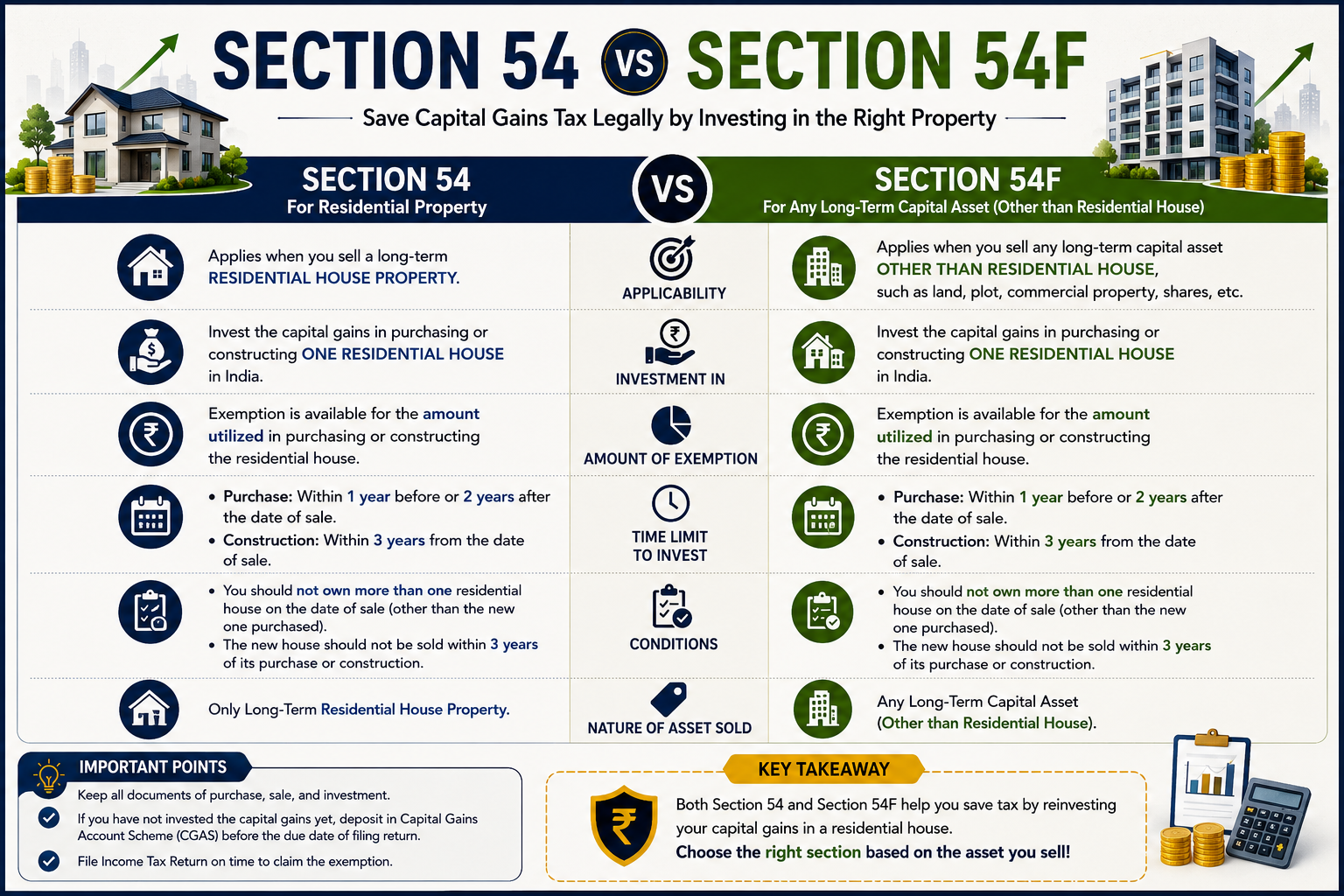
What Is the Difference Between Section 54 and Section 54F?
Section 54 primarily applies when an eligible Individual or HUF sells a long-term residential house and invests the capital gain in another residential house. Section 54F applies when an eligible Individual or HUF transfers a long-term capital asset other than a residential house and invests in one residential house in India.
The most important distinction is therefore the original asset being sold.
| Particular | Section 54 | Section 54F |
|---|---|---|
| Who can claim? | Individual / HUF | Individual / HUF |
| Original asset | Residential house property | Long-term capital asset other than residential house |
| Nature of gain | Long-term capital gain | Long-term capital gain |
| New asset | Residential house in India | Residential house in India |
| Purchase period | 1 year before or 2 years after transfer | 1 year before or 2 years after transfer |
| Construction | Within 3 years | Within 3 years |
| Full exemption | Generally linked to amount of capital gain invested | Can depend on proportion of net consideration invested |
| Ownership restriction | Specific statutory conditions apply | More restrictive conditions concerning ownership of other residential houses |
| ₹10 crore cap | Applies under the current Section 54 framework | Applies to the amount considered for exemption under Section 54F |
| CGAS | May be relevant | May be relevant |
The Income Tax Department’s current material confirms that Section 54 covers transfer of a residential house and reinvestment in another residential house, while Section 54F applies to a long-term capital asset other than a residential house.
Introduction
Selling an asset and reinvesting the proceeds in a residential property can sometimes reduce or eliminate capital gains tax.
Two provisions are particularly important:
- Section 54
- Section 54F
Although both provisions involve investment in a residential house, they are not interchangeable.
The biggest mistake taxpayers make is looking only at the fact that they are buying another house.
The first question should be:
What asset did you sell?
If the original asset is a qualifying residential house, Section 54 may be relevant.
If the original asset is a long-term capital asset other than a residential house, Section 54F may be relevant.
There are also important differences in how the exemption is calculated, the conditions relating to other residential houses, and the consequences of transferring the new property.
This guide explains the difference in practical terms.
What Is Section 54?
Section 54 provides an exemption from capital gains tax in specified circumstances where an eligible taxpayer transfers a long-term residential house property and purchases or constructs another residential house in India within the prescribed period.
The Income Tax Department describes Section 54 as providing relief where a taxpayer sells a residential house and acquires another house for residential purposes.
Who can claim Section 54?
The exemption is available to:
- An Individual
- A Hindu Undivided Family (HUF)
subject to the statutory conditions.
What must be sold?
The original asset must be a qualifying residential house property and the resulting gain must be long-term.
What must be purchased?
The taxpayer must purchase or construct a qualifying residential house in India within the prescribed period.
What Is Section 54F?
Section 54F provides relief where an eligible Individual or HUF transfers a long-term capital asset other than a residential house and invests in one residential house in India, subject to the statutory conditions.
For example, Section 54F may become relevant where a taxpayer sells:
- Land
- A plot
- Commercial property
- Certain shares or securities
- Other qualifying long-term capital assets
and invests in a residential house.
The Income Tax Department’s Section 54F guidance expressly states that the original asset must be a long-term capital asset other than a residential house.
Section 54 vs Section 54F: Detailed Comparison
1. Original Asset
This is the most important difference.
Section 54
The original asset is a residential house property.
Section 54F
The original asset is a long-term capital asset other than a residential house.
Therefore:
Sell house → potentially Section 54
Sell land/shares/another qualifying non-residential capital asset → potentially Section 54F
This distinction should be checked before calculating any exemption.
2. Nature of Capital Gain
Both provisions generally deal with long-term capital gains.
Therefore, simply selling an asset and buying another house does not automatically qualify for either exemption.
The taxpayer must first establish that the original asset qualifies as a long-term capital asset under the applicable law.
3. Who Is Eligible?
Both Section 54 and Section 54F are primarily available to:
- Individuals
- Hindu Undivided Families (HUFs)
They are not general exemptions available to every type of taxpayer.
A company or partnership firm cannot simply claim Section 54 or Section 54F because it has invested in residential property.
4. What Is the New Asset?
Both provisions involve investment in a residential house in India.
The relevant investment can generally take the form of:
- Purchase of a residential house, or
- Construction of a residential house
The timing requirements are important.
5. What Are the Purchase and Construction Time Limits?
Under the current framework, the general time windows are:
Purchase
The residential house can be purchased:
Within 1 year before the date of transfer, or
Within 2 years after the date of transfer.
Construction
The residential house can be constructed:
Within 3 years after the date of transfer.
The Income Tax Department’s capital-gains guidance gives these time periods for both Section 54 and Section 54F.
Example
If the original property is sold on 15 September 2026:
- Eligible purchase may generally fall within the prescribed one-year-before/two-years-after window.
- Construction should generally be completed within the prescribed three-year period.
The exact applicability should always be checked against the statutory provision and facts of the transaction.
6. How Is the Exemption Calculated Under Section 54?
Section 54 is comparatively straightforward.
Broadly, the exemption is limited to the lower of:
- The amount of eligible long-term capital gain; or
- The amount invested in the qualifying new residential house.
Example
Suppose:
- Long-term capital gain = ₹40 lakh
- Investment in new residential house = ₹35 lakh
Potential Section 54 exemption = ₹35 lakh
Taxable long-term capital gain = ₹5 lakh, subject to the applicable computation and other provisions.
If the taxpayer invests ₹45 lakh against a capital gain of ₹40 lakh, the exemption would generally be limited to the qualifying capital gain rather than ₹45 lakh.
The Income Tax Department’s Section 54 material similarly explains that exemption is restricted by the amount of capital gain and the cost of the new asset.
7. How Is the Exemption Calculated Under Section 54F?
Section 54F works differently.
The exemption can depend on the net consideration, rather than simply comparing the investment with the capital gain.
Where the entire net consideration is invested in the qualifying new residential house, the entire qualifying capital gain can generally be exempt.
Where only part of the net consideration is invested, the exemption is proportionate.
The Income Tax Department gives the formula broadly as:
Exemption = Long-Term Capital Gain × Cost of New Asset / Net Consideration
subject to the statutory conditions and applicable limits.
Section 54F Example
Hypothetical example only.
Suppose Ms. A sells a long-term capital asset other than a residential house.
Assume:
- Net consideration = ₹1 crore
- Long-term capital gain = ₹40 lakh
- Investment in new residential house = ₹60 lakh
The proportion invested is:
₹60 lakh / ₹1 crore = 60%
Potential exemption:
₹40 lakh × 60% = ₹24 lakh
Potential taxable capital gain:
₹40 lakh − ₹24 lakh = ₹16 lakh
This is why Section 54F can produce a different result from Section 54.
Why Is Section 54F More Complicated Than Section 54?
The main reason is that Section 54F links the exemption to the net consideration where the entire consideration is not invested.
Section 54 generally focuses on the relationship between:
Capital Gain ↔ Cost of New Residential House
Section 54F can involve:
Capital Gain ↔ Net Consideration ↔ Cost of New Residential House
This distinction is crucial for tax planning.
What Is the ₹10 Crore Limit?
The exemption under Section 54F is subject to a statutory ceiling of ₹10 crore for the amount of investment taken into account.
The Income Tax Department confirms that the ₹10 crore threshold was introduced from Assessment Year 2024-25 and affects the amount of investment considered for Section 54F exemption.
The current Section 54 framework also contains a ₹10 crore cap in relation to the investment considered for exemption.
Therefore, high-value property transactions require particular care.
A taxpayer should not assume that investing ₹15 crore in a new house will automatically produce an exemption based on the entire ₹15 crore.
Section 54 vs Section 54F: Ownership of Other Houses
This is another major difference that taxpayers should understand.
Section 54F contains specific restrictions concerning ownership of other residential houses.
The current Section 54F framework provides that the exemption does not apply where the assessee owns more than one residential house, other than the new asset, on the date of transfer of the original asset. It also contains restrictions relating to purchasing or constructing another residential house within the specified periods.
Therefore, before claiming Section 54F, taxpayers should review their entire residential-property ownership position.
Practical warning
Do not decide Section 54F eligibility merely by looking at the property being sold.
Check:
- Houses already owned
- Houses purchased after transfer
- Houses constructed after transfer
- The dates of those transactions
- Whether income from the property is chargeable under the relevant head
Can Section 54 Be Claimed if You Already Own Another House?
Section 54 is generally less restrictive than Section 54F on this particular issue, but its statutory conditions must still be examined.
The current Section 54 provision should be applied according to the facts and the relevant tax year.
A taxpayer should therefore avoid applying Section 54F’s ownership restrictions automatically to a Section 54 claim.
Section 54 vs Section 54F: Capital Gains Account Scheme
The Capital Gains Account Scheme (CGAS) can become important when the taxpayer has not utilised the eligible amount for the new residential property before the applicable income-tax return filing deadline.
Instead of allowing the unutilised amount to remain outside the prescribed mechanism, the taxpayer may need to deposit the qualifying amount into the Capital Gains Account Scheme, subject to the applicable conditions.
The amount must then be utilised within the prescribed period.
Important
Simply opening a CGAS account does not automatically guarantee an exemption.
The underlying Section 54 or Section 54F conditions must still be satisfied.
The Income Tax Department’s current guidance also addresses how old-Act CGAS deposits interact with the transition to the Income-tax Act, 2025.
What Happens If the New House Is Sold Too Early?
The new property generally has a three-year lock-in-related consequence under both provisions.
If the new asset is transferred within the prescribed period, the earlier exemption can be affected and the tax treatment must be reconsidered under the relevant provision.
The exact computation depends on the provision under which exemption was originally claimed and the circumstances of the subsequent transfer.
This is particularly important for taxpayers who purchase a house only to claim an exemption and later decide to sell it.
What Happens Under the Income-tax Act, 2025?
The Income-tax Act, 2025 came into effect from 1 April 2026.
However, the transition is important.
The Income Tax Department explains that where an exemption was originally claimed under Sections 54 or 54F of the Income-tax Act, 1961 and the new asset is transferred after 1 April 2026 but within the applicable lock-in period, the consequences can arise under the new Act while the original exemption conditions are determined under the old Act.
Why this matters
Consider a taxpayer who:
- Sold the original asset under the old Act;
- Claimed Section 54 or Section 54F exemption;
- Purchased the new house before 1 April 2026;
- Subsequently sells that house after 1 April 2026 but before the applicable lock-in period ends.
The transaction cannot simply be analysed under the new Act in isolation.
The transitional provisions need to be examined.
This is particularly important for property transactions spanning multiple tax years.
Can Section 54 and Section 54F Be Claimed Together for the Same Capital Gain?
Generally, a taxpayer cannot simply claim both provisions for the same capital gain as if they were two independent exemptions.
The appropriate provision depends on the nature of the original asset and the statutory conditions.
For example:
- Sale of qualifying residential house → Section 54 may be relevant.
- Sale of another qualifying long-term capital asset → Section 54F may be relevant.
The transaction should be analysed under the provision that actually applies.
Which Is Better: Section 54 or Section 54F?
There is no universal answer.
It depends primarily on:
- What asset was sold
- Amount of capital gain
- Net consideration
- Amount invested in the new house
- Existing residential properties
- Acquisition and sale dates
- Whether the taxpayer is an Individual or HUF
- Applicable tax year
- Compliance with the investment deadlines
Simple rule of thumb
If you sold a qualifying residential house: examine Section 54.
If you sold a qualifying long-term asset other than a residential house: examine Section 54F.
But this is only the starting point. The actual exemption must be calculated after testing all statutory conditions.
Side-by-Side Comparison
| Feature | Section 54 | Section 54F |
|---|---|---|
| Eligible taxpayer | Individual / HUF | Individual / HUF |
| Original asset | Residential house | Long-term capital asset other than residential house |
| Capital gain | Long-term | Long-term |
| New asset | Residential house in India | Residential house in India |
| Purchase | 1 year before / 2 years after | 1 year before / 2 years after |
| Construction | Within 3 years | Within 3 years |
| Basis for full exemption | Generally investment compared with capital gain | Investment of net consideration |
| Partial investment | Exemption generally limited by eligible investment | Proportionate exemption may apply |
| Other-house restriction | Different statutory conditions | Specific ownership restrictions |
| ₹10 crore ceiling | Applicable under current law | Applicable under current law |
| CGAS | Relevant where conditions require | Relevant where conditions require |
| New-house transfer | Early transfer can affect exemption | Early transfer can affect exemption |
The Income Tax Department’s current capital-gains material identifies Section 54 for residential-house transfers and Section 54F for long-term capital assets other than residential houses.
Practical Example: House Sale vs Land Sale
Hypothetical example only.
Example A — Selling a House
Mr. X sells a residential house and earns a long-term capital gain of ₹50 lakh.
He purchases another residential house for ₹45 lakh.
Because the original asset is a qualifying residential house, Section 54 may be the relevant exemption provision.
The potential exemption would generally be restricted to the lower eligible amount.
Example B — Selling Land
Mr. X instead sells a plot of land.
Suppose:
- Net consideration = ₹1 crore
- Long-term capital gain = ₹50 lakh
- New residential house investment = ₹70 lakh
Because the original asset is land rather than a residential house, Section 54F may be relevant.
Since the entire net consideration has not been invested, the proportionate-exemption formula may need to be applied.
The result can therefore differ substantially from Example A.
Common Mistakes Under Section 54 and Section 54F
Mistake 1: Choosing the section based only on the new house
The new house does not determine whether Section 54 or 54F applies.
The original asset is the starting point.
Mistake 2: Confusing capital gain with sale consideration
This is especially dangerous under Section 54F.
The calculation may involve net consideration, not simply the capital gain.
Mistake 3: Ignoring other residential houses
Section 54F has specific restrictions relating to ownership and subsequent acquisition/construction of residential houses.
Mistake 4: Missing the investment deadline
Purchase and construction have separate statutory windows.
Mistake 5: Forgetting CGAS requirements
Where the qualifying amount has not been utilised before the relevant return-filing deadline, the Capital Gains Account Scheme may become important.
Mistake 6: Assuming any property qualifies as a residential house
The nature of the new asset must satisfy the applicable statutory requirements.
Mistake 7: Ignoring the ₹10 crore ceiling
High-value investments require careful calculation.
Mistake 8: Selling the new property too early
Early transfer can trigger consequences for an exemption already claimed.
Mistake 9: Ignoring the 2026 transition
Transactions spanning the Income-tax Act, 1961 and Income-tax Act, 2025 require specific transitional analysis.
Mistake 10: Filing the return without reconciling the exemption
The investment, purchase date, capital gain and exemption claimed should be supported by documents.
Documents to Keep for Section 54 / 54F
A taxpayer should generally retain:
Original asset documents
- Purchase deed
- Previous ownership documents
- Acquisition cost evidence
- Improvement expenditure records
- Sale deed
Capital-gain computation
- Sale consideration
- Transfer expenses
- Cost of acquisition
- Cost of improvement
- Capital-gain calculation
New house documents
- Agreement to purchase
- Sale deed
- Construction agreement
- Construction invoices
- Payment records
- Bank statements
CGAS documents
- Deposit receipt
- Account details
- Withdrawal records
- Utilisation evidence
Tax records
- Income-tax return
- Capital-gain schedules
- Form 26AS
- AIS
- TDS records
Step-by-Step: How to Decide Between Section 54 and Section 54F
Step 1 — Identify the original asset
Ask:
Did I sell a residential house?
If yes, examine Section 54.
If no, and the asset is a qualifying long-term capital asset, examine Section 54F.
Step 2 — Confirm long-term status
Determine the applicable holding period and classification.
Step 3 — Calculate the capital gain
Do not start the exemption calculation until the underlying capital gain has been correctly computed.
Step 4 — Calculate net consideration
This is particularly important for Section 54F.
Step 5 — Review residential-house ownership
Check the taxpayer’s existing and proposed residential-property ownership.
Step 6 — Check purchase/construction dates
Confirm that the new house falls within the statutory window.
Step 7 — Check the investment amount
Determine how much was actually invested.
Step 8 — Check CGAS requirements
If applicable, verify whether an amount was deposited within the prescribed deadline.
Step 9 — Check the ₹10 crore limitation
This becomes important for high-value investments.
Step 10 — Review the final exemption before filing
Ensure that the return reflects the correct provision and amount.
When Should You Consult a Tax Professional?
Professional advice can be particularly useful where:
- The property was inherited.
- The asset was purchased many years ago.
- Multiple properties are owned.
- A plot of land is being sold.
- A commercial property is being sold.
- The sale consideration is substantial.
- There is a major difference between capital gain and net consideration.
- The taxpayer has already purchased another house.
- CGAS is involved.
- The transaction crosses the 2026 transition to the new Income-tax Act.
- The taxpayer has received an Income Tax notice regarding the exemption.
The objective should not simply be to claim the largest possible exemption.
The objective is to claim the exemption that is legally available and properly supported by evidence.
Frequently Asked Questions
1. What is the main difference between Section 54 and Section 54F?
Section 54 applies to specified long-term capital gains arising from transfer of a residential house, whereas Section 54F applies to long-term capital gains from transfer of a capital asset other than a residential house, subject to their respective conditions.
2. Can I claim Section 54F after selling a residential house?
Generally, no. Section 54F specifically concerns transfer of a long-term capital asset other than a residential house. A qualifying sale of a residential house should instead be examined under Section 54.
3. Can I claim Section 54 after selling land?
Generally, Section 54 is intended for transfer of a qualifying residential house. A long-term capital gain from sale of land may instead be examined under Section 54F if its conditions are satisfied.
4. Is Section 54F exemption always equal to the entire capital gain?
No. If the entire net consideration is not invested in the qualifying residential house, the exemption can be proportionate to the amount invested.
5. Can I buy a house before selling the original asset?
Yes, subject to the applicable statutory window. Under both provisions, qualifying purchase can generally occur within one year before the date of transfer.
6. How long do I have to construct the new house?
Generally, construction must be completed within three years after the date of transfer, subject to the applicable statutory conditions.
7. Can I own another house and still claim Section 54F?
Section 54F contains specific restrictions concerning ownership of residential houses. In particular, the current provision restricts the exemption where the assessee owns more than one residential house, other than the new asset, on the date of transfer.
8. What is the maximum investment considered under Section 54F?
The current Section 54F framework contains a ₹10 crore ceiling for the investment amount considered for the exemption.
9. What is CGAS and is it relevant to Section 54 and 54F?
The Capital Gains Account Scheme can be relevant where the taxpayer intends to claim an exemption but has not utilised the qualifying amount for the new residential house within the applicable period before the return-filing deadline. The underlying exemption conditions must still be satisfied.
10. Can I claim Section 54 and Section 54F for the same sale?
A taxpayer should not treat Sections 54 and 54F as two separate exemptions that can automatically be stacked against the same capital gain. The applicable provision depends on the nature of the original asset and the statutory conditions.
11. What happens if I sell the new house within three years?
An early transfer can affect the exemption claimed on the original transaction. The resulting tax treatment must be determined under the relevant provision and the circumstances of the subsequent sale.
12. Does the Income-tax Act, 2025 change Section 54 and 54F planning?
The 2026 transition is important. Exemptions originally claimed under the Income-tax Act, 1961 can continue to have consequences after 1 April 2026 where the conditions attached to the exemption are subsequently violated. The Income Tax Department specifically gives Section 54 and 54F as examples of such transitional situations.
Key Takeaways
- Section 54 and Section 54F are not the same exemption.
- The first question is what asset was sold.
- Section 54 generally applies to a qualifying long-term residential house.
- Section 54F generally applies to a qualifying long-term capital asset other than a residential house.
- Both provisions involve investment in a residential house in India.
- Purchase is generally permitted within one year before or two years after transfer.
- Construction is generally required within three years after transfer.
- Section 54 generally compares the capital gain with investment in the new house.
- Section 54F can provide proportionate exemption based on investment in relation to net consideration.
- Section 54F has specific restrictions relating to ownership of other residential houses.
- The ₹10 crore ceiling is important for high-value Section 54/54F investments.
- CGAS may become relevant where qualifying amounts remain unutilised.
- Selling the new house within the prescribed period can affect the earlier exemption.
- Transactions crossing the 2026 transition require careful examination under the old and new tax frameworks.
Confused Between Section 54 and Section 54F?
Choosing the correct capital-gains exemption depends on the asset sold, the amount of capital gain, net consideration, residential-property ownership, reinvestment amount and applicable statutory conditions.
If you are selling property, land or another long-term capital asset and want to determine whether Section 54 or Section 54F applies to your situation, professional tax advice can help you review the computation and supporting documents before filing your return.
Bihar Tax Consultant
BIIT Campus, near Sanchira Mandir, New Azimabad Colony, Patna, Bihar 800006
Mobile: 8789155395
Email: [email protected]Book a Consultation for assistance with capital-gains exemption and property-sale tax planning.