
GST Litigation in India: A Complete Guide to Disputes, Notices & Adjudication (2026)

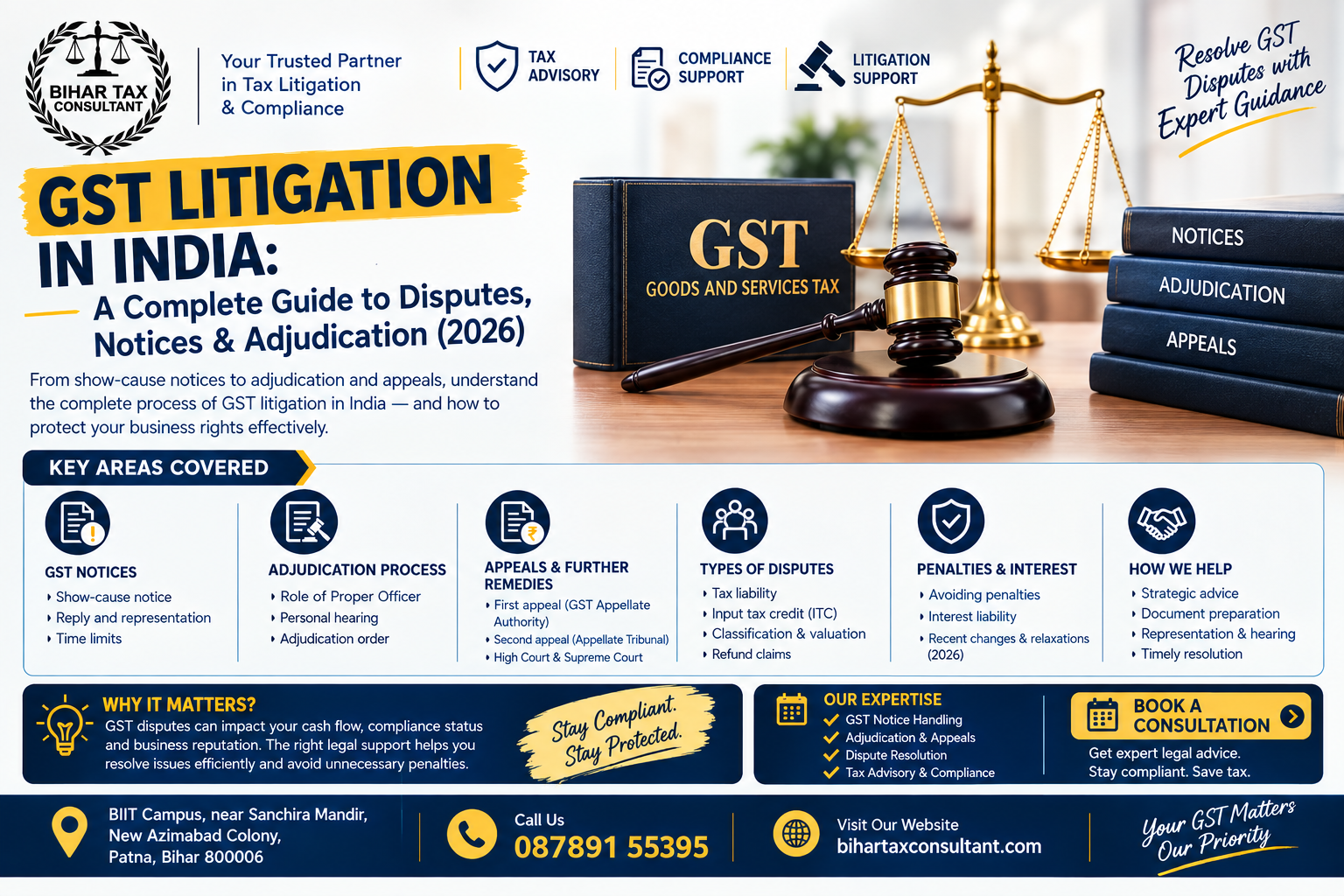
What Is GST Litigation in India?
GST litigation is the legal process of resolving disputes between taxpayers and GST authorities concerning tax liability, input tax credit, registration, refunds, classification, valuation, penalties, interest and other matters under GST law.
GST disputes may begin with a notice or investigation and proceed through adjudication, appellate proceedings, the GST Appellate Tribunal, High Courts or the Supreme Court, depending on the nature of the dispute and the applicable remedy.
Common GST litigation issues include:
- Wrongful GST demand.
- Input Tax Credit (ITC) denial.
- GST registration cancellation.
- Show Cause Notice (SCN).
- Tax classification disputes.
- E-invoice and e-way bill violations.
- GST refund rejection.
- Interest and penalty disputes.
- Alleged suppression or fraud.
- Search, inspection and seizure proceedings.
For businesses, GST litigation is not merely about paying tax. It involves protecting legal rights, presenting evidence, understanding procedural requirements and selecting the correct remedy.
This guide explains GST litigation in India, the adjudication process, common disputes, appeal procedure and practical steps taxpayers should take in 2026.
What Is GST Litigation?
GST litigation refers to legal disputes arising under the Goods and Services Tax framework.
A dispute may arise when a taxpayer disagrees with the GST Department regarding:
- Tax payable.
- Eligibility for input tax credit.
- Classification of goods or services.
- Applicable GST rate.
- Valuation of taxable supply.
- Registration or cancellation.
- Refund entitlement.
- Interest and penalties.
- Alleged tax evasion.
- Procedural or jurisdictional issues.
GST litigation can involve businesses of every size, including manufacturers, traders, service providers, e-commerce businesses, exporters, contractors, startups and other registered taxpayers.
Example
A company claims ₹8 lakh of eligible ITC in its GST returns.
The Department proposes to deny the credit, alleging that the supplier’s invoice details do not match the available records.
The company disputes the proposed denial and submits purchase invoices, payment evidence, goods-receipt records and reconciliation statements.
If the dispute is not resolved, the matter may proceed through adjudication and appeal.
The central objective of GST litigation is to determine the correct legal and factual tax position.
GST Litigation in India: Why Do Businesses Face Disputes?
GST has simplified indirect taxation in many respects, but its compliance framework is extensive.
Businesses must manage:
- GST registration.
- Tax invoices.
- Returns.
- Input tax credit.
- E-invoicing, where applicable.
- E-way bills.
- Reverse charge.
- GST refunds.
- Books of account.
- Supplier compliance.
- Records and reconciliations.
A mistake in one area can lead to a notice or demand.
For example, a business may have correctly paid GST but still face a dispute because the Department questions the classification, valuation or eligibility of the ITC claimed.
This is why GST compliance and GST litigation are closely connected.
Common Types of GST Litigation
1. GST Input Tax Credit Disputes
Input Tax Credit is one of the most frequent areas of GST litigation.
Businesses may face disputes involving:
- ITC mismatch.
- Supplier non-compliance.
- Ineligible credit.
- Blocked credit.
- Missing invoices.
- Incorrect reporting.
- Credit availed beyond prescribed time limits.
- Credit claimed without sufficient supporting evidence.
- Reversal of credit.
Example
A business purchases goods worth ₹10 lakh plus GST from a supplier.
The purchaser claims the eligible ITC.
Later, the Department questions the transaction because the supplier’s GST records do not match the purchaser’s claim.
The taxpayer may need to establish the genuineness of the transaction through invoices, payment records, receipt of goods and other relevant evidence.
Important point
An ITC dispute should not be handled merely by saying:
“The supplier has filed the return.”
The taxpayer should examine the precise statutory conditions applicable to the credit and the evidence supporting the transaction.
2. GST Show Cause Notice (SCN)
A GST Show Cause Notice is a formal communication requiring the taxpayer to explain why a proposed action should not be taken.
A notice may propose:
- Recovery of tax.
- Recovery of interest.
- Imposition of penalty.
- Reversal of ITC.
- Other action under the applicable GST provisions.
The notice should be examined carefully for:
- Relevant tax period.
- Tax amount.
- Grounds of proposed demand.
- Statutory provisions invoked.
- Documents relied upon.
- Response deadline.
- Hearing details.
- Proposed penalty or interest.
What should you do after receiving an SCN?
- Read the complete notice.
- Verify the notice through the GST portal.
- Identify the exact allegations.
- Collect supporting documents.
- Prepare a point-wise reply.
- Check calculations.
- Request a hearing where appropriate.
- Submit the reply within the prescribed time.
- Preserve the acknowledgement.
Ignoring a GST SCN can seriously affect the taxpayer’s ability to defend the case.
3. GST Tax Demand Disputes
A GST demand may arise from alleged:
- Short payment of tax.
- Non-payment of tax.
- Wrong classification.
- Incorrect valuation.
- Ineligible ITC.
- Incorrect exemption claim.
- Failure to comply with reverse-charge provisions.
- Other statutory violations.
The taxpayer should examine whether the demand is supported by the facts, documents and applicable provisions.
A demand should not be accepted automatically merely because it has been issued by a tax authority.
At the same time, a taxpayer should not ignore a valid demand or assume that every demand is legally invalid.
4. GST Registration Cancellation Disputes
GST registration is important for businesses that need to issue tax invoices, collect GST and claim eligible ITC.
A taxpayer may face cancellation proceedings due to:
- Non-filing of returns.
- Alleged fraudulent registration.
- Incorrect information.
- Violation of GST provisions.
- Other grounds specified in the law.
A cancellation notice should be addressed promptly.
The taxpayer may need to provide:
- Registration details.
- Return-filing evidence.
- Business documents.
- Explanation of discrepancies.
- Proof of genuine business activity.
- Other relevant documents.
Where an order has already been passed, the taxpayer should examine the available statutory remedy and applicable time limit.
5. GST Refund Litigation
GST refund disputes may involve:
- Export refunds.
- Inverted duty structure.
- Excess tax payment.
- Refund of accumulated ITC.
- Rejection of refund claims.
- Unjust enrichment.
- Documentation deficiencies.
A refund rejection should be examined with reference to the actual reason given by the Department.
A taxpayer may need to establish:
- Eligibility.
- Relevant invoices.
- Tax payment.
- Export documentation, where applicable.
- Correct calculation.
- Compliance with statutory conditions.
A refund dispute is not merely a cash-flow issue. It can become a formal tax litigation matter.
6. GST Classification and Rate Disputes
Businesses may face disputes over the correct classification of goods or services.
This can affect:
- GST rate.
- Exemption eligibility.
- HSN/SAC classification.
- Input tax credit.
- Tax liability.
- Interest and penalty.
For example, a product may be treated by the taxpayer as taxable at one rate, while the Department alleges that another classification applies.
The correct approach involves examining:
- Product characteristics.
- Nature of supply.
- Relevant tariff headings.
- Notifications.
- Exemption entries.
- Applicable circulars.
- Relevant judicial decisions.
Classification disputes can be technically complex and should be evaluated carefully.
GST Adjudication: What Does It Mean?
GST adjudication is the formal process through which a designated tax authority examines a dispute, considers the taxpayer’s explanation and evidence, and passes an order under the applicable GST law.
It is a critical stage in GST litigation because the adjudication order may determine:
- Tax liability.
- Interest.
- Penalty.
- ITC reversal.
- Other statutory consequences.
Simplified GST adjudication flow
Notice → Taxpayer reply → Hearing → Examination of evidence → Adjudication order → Appeal, if required
The precise procedure depends on the type of proceeding, applicable statutory provision and relevant tax period.
What Is the Difference Between a GST Notice and a GST Order?
| GST Notice | GST Order |
|---|---|
| Communicates a proposed action or requirement | Determines an issue or passes a formal decision |
| Invites explanation or compliance | Records the authority’s conclusion |
| Usually precedes adjudication | May follow adjudication |
| Requires timely response | May trigger appeal or other remedies |
| Does not automatically establish final liability | Can create tax demand or other consequences |
A notice and an order should not be treated as the same document.
A taxpayer should understand whether the communication is:
- An intimation.
- A notice.
- A Show Cause Notice.
- An order.
- A demand communication.
- An appellate decision.
Important GST Legal Provisions for Litigation
The following provisions are commonly relevant to GST disputes. The exact provision should always be verified against the applicable tax period and current law.
Section 16 — Eligibility and Conditions for ITC
Section 16 of the CGST Act deals with eligibility and conditions for input tax credit.
ITC disputes may involve whether the statutory conditions have been satisfied.
A taxpayer should examine the relevant legal conditions rather than relying only on invoice availability.
Section 17 — Apportionment and Blocked Credits
Section 17 deals with apportionment of credit and blocked credits in specified circumstances.
Disputes may arise where the Department alleges that the taxpayer claimed credit that is restricted or blocked under the law.
Section 29 — Cancellation or Suspension of Registration
Section 29 concerns cancellation or suspension of GST registration in specified circumstances.
A registration-related dispute should be examined with reference to the applicable procedure and available remedy.
Section 50 — Interest on Delayed Payment
Section 50 concerns interest on delayed payment of tax.
Interest disputes may involve:
- Delay in tax payment.
- Relevant tax period.
- Applicable computation.
- Statutory conditions.
- Whether the liability has been correctly determined.
Section 73 — Demand in Cases Other Than Fraud or Suppression
Section 73 of the CGST Act, 2017 historically dealt with recovery of tax not paid, short paid or wrongly refunded, or ITC wrongly availed or utilised, in cases other than fraud, wilful misstatement or suppression of facts.
For current 2026 cases, the taxpayer must check the applicable provisions and transitional framework.
Section 74 — Demand Involving Fraud or Suppression
Section 74 historically addressed specified cases involving fraud, wilful misstatement or suppression of facts.
Such proceedings can carry serious consequences, including higher penalties.
The taxpayer should examine the allegations and supporting evidence carefully.
Section 74A — Newer Demand Framework
Section 74A was introduced through the Finance Act, 2024 for specified GST demand proceedings relating to periods beginning from FY 2024–25, subject to the applicable legal framework.
Because GST litigation in 2026 can involve different tax periods, the correct statutory provision should be identified before preparing a reply.
Section 107 — Appeals to Appellate Authority
Section 107 provides the statutory framework for appeals to the Appellate Authority.
The taxpayer must check:
- Whether the order is appealable.
- The applicable limitation period.
- Pre-deposit requirements.
- Relevant documents.
- Grounds of appeal.
- Filing procedure.
Section 112 — Appeals to GST Appellate Tribunal
Section 112 concerns appeals to the Appellate Tribunal under the CGST Act.
The GSTAT framework and applicable procedural requirements should be checked for the relevant dispute and current stage of implementation.
GST Litigation Procedure: Step-by-Step
Step 1: GST Notice Is Received
The taxpayer receives a communication from the GST Department.
The first step is to verify the notice and understand the exact issue.
Step 2: Identify the Dispute
Determine whether the matter concerns:
- ITC.
- Tax liability.
- Classification.
- Registration.
- Refund.
- Interest.
- Penalty.
- Alleged fraud or suppression.
Step 3: Collect Supporting Evidence
Relevant evidence may include:
- GST returns.
- Tax invoices.
- Purchase and sales registers.
- Bank statements.
- E-way bills.
- E-invoice records.
- Agreements.
- Delivery documents.
- Reconciliation statements.
- Correspondence.
- Accounting records.
Step 4: Examine the Legal Position
Review the statutory provisions, notifications, circulars and relevant judicial decisions.
The legal analysis should be based on the tax period and facts of the case.
Step 5: Prepare a Detailed Reply
A GST reply should ideally:
- Respond to each allegation.
- Explain the factual position.
- Provide documentary support.
- Address the legal provisions.
- Explain discrepancies.
- Challenge incorrect assumptions.
- Include calculations where necessary.
Step 6: Attend the Hearing
Where a hearing is provided or requested under the applicable procedure, the taxpayer should prepare to explain the case clearly.
Step 7: Obtain the Adjudication Order
After considering the case, the authority may pass an order.
The taxpayer should examine the reasoning, findings and demand.
Step 8: Evaluate Appeal or Other Remedy
If the order is adverse, the taxpayer should determine whether to:
- File an appeal.
- Seek rectification where legally available.
- Consider another statutory remedy.
- Approach the High Court in appropriate circumstances.
Step 9: Comply With Applicable Requirements
Where an appeal is filed, applicable pre-deposit and other procedural requirements should be examined.
GST Appeal: What Should Taxpayers Know?
An appeal is a statutory remedy through which a taxpayer challenges an adverse GST order.
The appeal process may involve:
- Original adjudication order.
- First appellate authority.
- GST Appellate Tribunal.
- High Court on appropriate questions of law.
- Supreme Court, where applicable.
The exact route depends on the nature of the order and the legal framework.
Common Grounds of GST Appeal
A taxpayer may challenge an order on grounds such as:
- Incorrect interpretation of law.
- Incorrect factual findings.
- Failure to consider evidence.
- Wrong calculation of tax.
- Incorrect classification.
- Wrongful ITC denial.
- Violation of natural justice.
- Lack of jurisdiction.
- Improper application of penalty.
- Limitation-related issues.
An appeal should not merely repeat the original reply.
It should identify the errors in the order and explain the legal and factual grounds for setting aside or modifying it.
What Is GSTAT?
GSTAT stands for Goods and Services Tax Appellate Tribunal.
It is the appellate forum provided under the GST framework for specified disputes.
The GSTAT framework is important because it provides an appellate mechanism for GST matters beyond the first appellate stage.
The operational status, applicable rules, benches and filing requirements should be verified before filing a matter in 2026.
A practical GST litigation strategy should therefore consider:
- Whether the relevant tribunal forum is operational.
- Whether the order is appealable.
- The applicable limitation period.
- Pre-deposit requirements.
- Jurisdiction.
- Documents required.
- Filing procedure.
GST Litigation Before the High Court
The High Court may become relevant in appropriate GST matters.
However, a taxpayer should not assume that every GST dispute can be filed directly before the High Court.
Where an effective statutory appeal is available, the High Court may expect the taxpayer to use that remedy, subject to recognized exceptions.
High Court intervention may be considered in appropriate cases involving issues such as:
- Jurisdictional error.
- Violation of natural justice.
- Lack of authority.
- Procedural illegality.
- Fundamental legal issues.
- Exceptional circumstances.
The availability and suitability of a writ remedy depend on the facts and applicable law.
Common GST Litigation Mistakes
1. Ignoring GST notices
A notice should never be ignored simply because it was received online.
2. Filing a generic reply
A generic reply may fail to address the Department’s actual allegations.
3. Not reconciling ITC
The taxpayer should examine the difference between books, returns and available GST records.
4. Missing deadlines
GST proceedings have statutory time limits. Delay can affect available remedies.
5. Failing to preserve documents
A dispute may require evidence from earlier tax periods.
6. Accepting every demand without analysis
A taxpayer should understand the basis of the demand before deciding whether to accept or challenge it.
7. Ignoring hearing opportunities
Where a hearing is available, the taxpayer should prepare and participate appropriately.
8. Filing an appeal without proper grounds
An appeal should identify the errors in the impugned order.
9. Not checking pre-deposit requirements
Applicable pre-deposit requirements should be considered before filing an appeal.
10. Using outdated legal provisions
GST law changes over time. The correct provision must be checked for the relevant tax period.
GST Litigation in 2026: Important Developments
GST litigation in 2026 should be approached with attention to current legislation, tribunal developments, circulars and procedural changes.
1. GSTAT-related proceedings
The GST Appellate Tribunal framework is an important development in the GST dispute-resolution structure.
Taxpayers should verify the current operational and filing position before relying on the tribunal as a practical remedy.
2. Updated adjudication and appeal guidance
The Institute of Chartered Accountants of India published a practical guide on GST adjudication, appeals and GSTAT on 13 May 2026, including changes made through the Finance Act, 2026. This reflects the importance of checking the latest legal framework when preparing GST litigation advice. <Cite refs={[“turn0search1″,”turn0search3”]}/>
3. Current statutory provisions
GST litigation involving FY 2024–25 and later periods may require examination of the newer demand framework, including Section 74A where applicable.
4. Digital compliance evidence
GST litigation increasingly involves digital records such as:
- E-invoice data.
- E-way bills.
- GST portal filings.
- Electronic ledgers.
- Reconciliation reports.
- Supplier records.
Businesses should maintain reliable records to support their legal position.
Hypothetical Example: GST ITC Dispute
This is a hypothetical example for illustration only.
A manufacturing company claims ₹20 lakh in ITC during a financial year.
The GST Department issues a notice alleging that ₹5 lakh of the credit is not eligible because of discrepancies in supplier information.
The company reviews:
- Purchase invoices.
- Goods-receipt records.
- Supplier details.
- Bank payments.
- GST returns.
- ITC reconciliation.
- Applicable legal provisions.
The company submits a detailed reply explaining the transaction and supporting the eligible credit.
If the Department passes an adverse order, the company may consider the appropriate statutory remedy, including appeal, subject to applicable law and time limits.
The lesson: A well-organised evidence file and legally structured response can be crucial in GST litigation.
How Can Businesses Prevent GST Litigation?
GST litigation prevention begins with compliance.
Businesses should:
Maintain accurate GST records
Keep invoices, returns, ledgers, agreements and supporting documents organised.
Reconcile ITC regularly
Compare books, GST returns and relevant available records.
Review classification
Ensure goods and services are classified correctly.
Monitor GST notices
Check the GST portal and registered communication channels.
Track deadlines
Maintain a notice and appeal deadline register.
Review contracts
Tax treatment can depend on contractual terms and the nature of supply.
Seek advice on complex transactions
High-value transactions, related-party supplies, exports, reverse charge and classification issues may require professional review.
Conduct periodic GST audits or reviews
Identify discrepancies before they become formal disputes.
GST Litigation Lawyer in Patna and Bihar
Businesses in Bihar may face GST disputes involving:
- ITC.
- GST registration.
- Tax demand.
- Classification.
- E-way bills.
- E-invoicing.
- GST refunds.
- Penalties.
- GST adjudication.
- Appeals.
A GST legal professional can assist with:
- Reviewing GST notices.
- Preparing SCN replies.
- Analysing ITC disputes.
- Preparing adjudication submissions.
- Drafting appeal grounds.
- Reviewing demand orders.
- Examining procedural issues.
- Assisting with GST litigation strategy.
For complex or high-value disputes, professional advice should be obtained before filing a reply or appeal.
Frequently Asked Questions
1. What is GST litigation in India?
GST litigation is the process of resolving disputes between taxpayers and GST authorities concerning tax, ITC, registration, refunds, penalties, interest and other GST matters.
2. What is GST adjudication?
GST adjudication is the formal process through which the designated authority examines a GST dispute and passes an order under the applicable law.
3. What is a GST Show Cause Notice?
A GST Show Cause Notice is a formal communication requiring the taxpayer to explain why a proposed action, such as tax recovery or penalty, should not be taken.
4. How should I reply to a GST notice?
Read the notice, identify every allegation, collect evidence, prepare a point-wise reply, address the relevant legal provisions and submit within the prescribed time.
5. What are the common GST litigation disputes?
Common disputes include ITC denial, tax demand, classification, valuation, refund rejection, registration cancellation, interest and penalties.
6. What is Section 73 of the CGST Act?
Section 73 historically dealt with recovery of tax not paid, short paid or wrongly refunded, or ITC wrongly availed or utilised, in cases other than fraud, wilful misstatement or suppression of facts.
7. What is Section 74 of the CGST Act?
Section 74 historically dealt with specified demand proceedings involving fraud, wilful misstatement or suppression of facts.
8. What is Section 74A?
Section 74A was introduced through the Finance Act, 2024 for specified GST demand proceedings relating to periods beginning from FY 2024–25, subject to the applicable framework.
9. Can a GST demand order be challenged?
Yes, where an appeal or another legally available remedy applies. The taxpayer should check the order, limitation period, pre-deposit and applicable procedure.
10. What is GSTAT?
GSTAT is the Goods and Services Tax Appellate Tribunal, a statutory appellate forum for specified GST disputes.
11. Can I approach the High Court against a GST order?
In appropriate cases, High Court remedies may be available. The taxpayer should examine whether a statutory appeal is available and whether exceptional grounds justify writ proceedings.
12. How can I avoid GST litigation?
Maintain accurate records, reconcile ITC, monitor notices, follow statutory deadlines and seek professional advice on complex GST transactions.
Key Takeaways
- GST litigation involves disputes concerning tax, ITC, registration, refunds, penalties and other GST matters.
- GST notices should be addressed within the prescribed time.
- A detailed, evidence-based reply is important.
- GST adjudication determines the disputed legal and factual position.
- Adverse orders may be challenged through applicable statutory remedies.
- GSTAT is an important appellate forum under the GST framework.
- High Court remedies may be available in appropriate cases.
- GST law changes over time, so current provisions must be verified.
- GST litigation prevention begins with accurate compliance and record-keeping.
- Businesses in Bihar can seek professional assistance for GST notices, adjudication and appeals.
Conclusion
GST litigation in India can be complex because disputes often involve both technical tax questions and procedural requirements.
A GST notice should not be ignored, and a demand order should not be accepted without understanding its legal basis.
The most effective approach is to:
- Understand the dispute.
- Verify the applicable law.
- Collect supporting evidence.
- Prepare a structured response.
- Attend the hearing where appropriate.
- Examine the adjudication order.
- Use the correct appeal or legal remedy within the prescribed time.
Timely action, accurate records and sound legal analysis are essential for protecting taxpayer rights in GST litigation.
Professional Assistance for GST Litigation
If your business has received a GST notice, demand order, ITC dispute or adjudication communication, professional assistance can help you understand the legal position and prepare an appropriate response.
Bihar Tax Consultant
BIIT Campus, near Sanchira Mandir, New Azimabad Colony, Patna, Bihar 800006
Mobile: 8789155395
Email: [email protected]
Book a Consultation to discuss your GST litigation matter.