
Section 73 vs Section 74 of CGST Act: Key Differences Explained

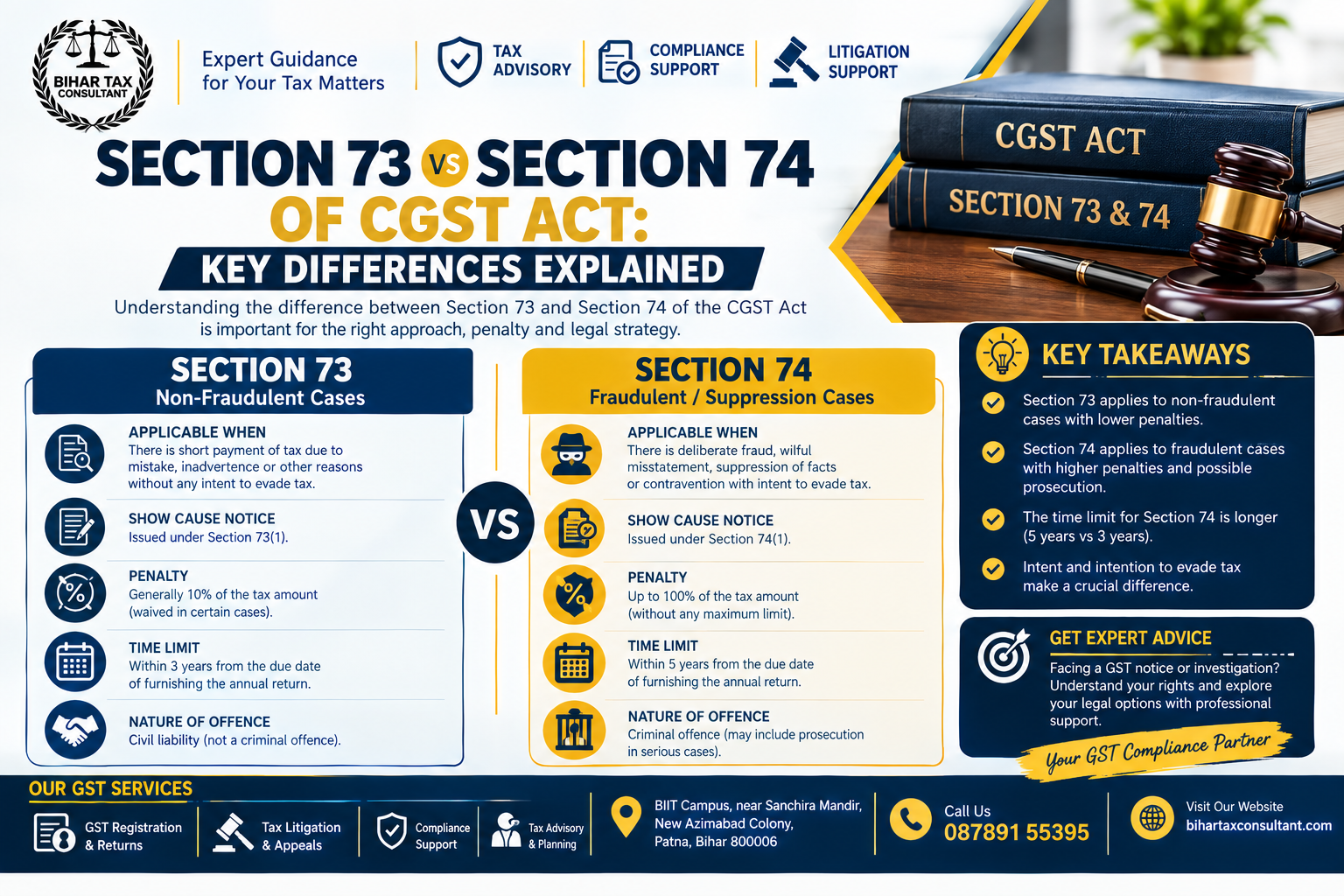
What Is the Difference Between Section 73 and Section 74?
Section 73 of the CGST Act, 2017 deals with specified GST tax short-payment, non-payment, erroneous refund or wrong availment/utilisation of input tax credit for reasons other than fraud, wilful misstatement or suppression of facts to evade tax. Section 74 deals with such cases involving fraud, wilful misstatement or suppression of facts to evade tax. <Cite refs={[“turn0search0″,”turn0search1”]}/>
The main differences concern:
- Nature of the alleged conduct.
- Applicable penalty.
- Time limit for issuing the order.
- Payment options before or after a show-cause notice.
- Legal consequences of the allegations.
Important for 2026: Sections 73 and 74, as amended, apply to tax periods up to Financial Year 2023–24. For tax periods from FY 2024–25 onward, Section 74A is the relevant demand provision. <Cite refs={[“turn0search0″,”turn0search1”]}/>
Introduction
Receiving a GST Show Cause Notice (SCN) can create serious concerns for a business owner.
The situation becomes more significant when the notice is issued under Section 74 rather than Section 73.
Why?
Because Section 74 involves allegations of fraud, wilful misstatement or suppression of facts to evade tax. These allegations can carry a higher penalty and a longer statutory time limit for determination of demand under the earlier framework. <Cite refs={[“turn0search0″,”turn0search1”]}/>
However, not every GST mistake amounts to fraud.
A genuine accounting error, incorrect tax calculation, inadvertent ITC mistake or classification dispute should not automatically be treated as deliberate tax evasion.
The distinction between Sections 73 and 74 is therefore important for taxpayers, GST practitioners, accountants and businesses facing departmental proceedings.
This article explains the legal differences, penalties, time limits, payment options, taxpayer rights and the significance of Section 74A under the current GST framework.
What Is Section 73 of the CGST Act?
Section 73 of the Central Goods and Services Tax Act, 2017 deals with determination of tax that has not been paid, has been short-paid, has been erroneously refunded, or where input tax credit has been wrongly availed or utilised for reasons other than fraud, wilful misstatement or suppression of facts to evade tax.
The provision applies to specified tax periods up to FY 2023–24. <Cite refs={[“turn0search0″,”turn1search1”]}/>
Examples of situations that may fall under Section 73
- A genuine calculation error in GST liability.
- An inadvertent short-payment of tax.
- An eligible ITC claim incorrectly calculated.
- An erroneous refund without the fraud-related grounds required for Section 74.
- A reporting or reconciliation error.
Whether a particular mistake falls under Section 73 depends on the facts and the applicable legal provisions.
Key characteristics of Section 73
- It concerns specified GST tax short-payment, non-payment, erroneous refund or wrong ITC.
- It applies where the fraud-related grounds of Section 74 are absent.
- It provides a statutory process for notice, representation and determination.
- The earlier framework provides a three-year period for issuing the order, subject to statutory provisions and exclusions.
- A penalty of 10% of tax or ₹10,000, whichever is higher, is specified in Section 73(9), subject to the statutory exceptions. <Cite refs={[“turn0search0″,”turn1search1”]}/>
What Is Section 74 of the CGST Act?
Section 74 of the CGST Act, 2017 deals with determination of tax not paid, short-paid, erroneously refunded or input tax credit wrongly availed or utilised by reason of fraud, wilful misstatement or suppression of facts to evade tax.
The provision applies to specified tax periods up to FY 2023–24. <Cite refs={[“turn0search1″,”turn1search0”]}/>
Examples of allegations that may arise under Section 74
- Deliberate concealment of taxable turnover.
- Deliberate use of false invoices to claim ITC.
- Wilful misstatement of facts to evade GST.
- Suppression of information required to be disclosed under GST law, with the intent to evade tax.
These are examples of allegations, not findings that a taxpayer is guilty. The Department must establish the legal grounds relied upon in the proceeding.
Key characteristics of Section 74
- It involves the fraud-related grounds specified in the section.
- The earlier framework provides a five-year period for issuing the order, subject to statutory provisions and exclusions.
- The penalty under Section 74(1) is equivalent to the tax specified in the notice, subject to statutory payment provisions.
- The taxpayer may have different payment options depending on whether payment is made before notice, within the prescribed period after notice, or after the order. <Cite refs={[“turn0search1″,”turn1search0”]}/>
Section 73 vs Section 74: Key Differences
| Basis | Section 73 | Section 74 |
|---|---|---|
| Nature of case | Tax not paid/short-paid, erroneous refund or wrong ITC for reasons other than fraud-related grounds | Same categories involving fraud, wilful misstatement or suppression of facts to evade tax |
| Relevant historical tax period | Up to FY 2023–24 | Up to FY 2023–24 |
| Main legal concern | Tax determination without the fraud-related grounds of Section 74 | Tax determination involving fraud-related grounds |
| Penalty under the principal provision | 10% of tax or ₹10,000, whichever is higher, under Section 73(9) | Penalty equivalent to tax under Section 74(1), subject to payment provisions |
| Order time limit | Three years from relevant annual-return due date or erroneous-refund date | Five years from relevant annual-return due date or erroneous-refund date |
| Payment before notice | Tax + interest, subject to Section 73(5) | Tax + interest + 15% penalty, subject to Section 74(5) |
| Payment after SCN | Tax + interest within 30 days can conclude proceedings without penalty under Section 73(8) | Tax + interest + 25% penalty within 30 days of notice can conclude proceedings under Section 74(8) |
| Payment after order | Applicable statutory provisions | Tax + interest + 50% penalty within 30 days of order communication can conclude proceedings under Section 74(11) |
| Current relevance | Historical periods up to FY 2023–24 | Historical periods up to FY 2023–24 |
The distinctions above are drawn from the statutory provisions reproduced by the CBIC Tax Information Portal. <Cite refs={[“turn0search0″,”turn0search1”]}/>
What Is the Penalty Under Section 73?
Under Section 73(9), the penalty is:
10% of the tax or ₹10,000, whichever is higher. <Cite refs={[“turn0search0″,”turn1search1”]}/>
Example
Suppose a taxpayer has a confirmed tax liability of ₹2,00,000 under Section 73.
The statutory penalty under Section 73(9) would be:
- 10% of ₹2,00,000 = ₹20,000.
- ₹10,000 minimum comparison.
The specified penalty would therefore be ₹20,000, subject to the applicable law and circumstances.
Is there a way to avoid penalty under Section 73?
Section 73(8) provides that where the person pays the tax and interest within 30 days of issue of the show-cause notice, no penalty is payable and proceedings in respect of that notice are deemed concluded, subject to the statutory conditions. <Cite refs={[“turn0search0″,”turn1search1”]}/>
This is one of the important payment-related provisions for cases under Section 73.
What Is the Penalty Under Section 74?
Section 74 involves a higher penalty structure.
Under Section 74(1), the penalty specified is equivalent to the tax specified in the notice, subject to the statutory payment provisions. <Cite refs={[“turn0search1″,”turn1search0”]}/>
Payment options under Section 74
The statutory framework provides different penalty levels depending on when payment is made:
| Stage | Statutory payment provision |
|---|---|
| Before service of notice | Tax + interest + 15% penalty |
| Within 30 days of notice | Tax + interest + 25% penalty |
| Within 30 days of communication of order | Tax + interest + 50% penalty |
These payment routes are provided in Section 74(5), Section 74(8) and Section 74(11). <Cite refs={[“turn0search1″,”turn1search0”]}/>
Example
Suppose the tax specified in a Section 74 proceeding is ₹5,00,000.
The statutory penalty amount can vary depending on the payment stage:
- Before notice: ₹75,000 at 15%.
- Within 30 days of notice: ₹1,25,000 at 25%.
- Within 30 days of order communication: ₹2,50,000 at 50%.
These are illustrative penalty calculations based on the statutory percentages. The taxpayer must also account for interest and the conditions applicable to the relevant payment route.
What Is the Time Limit Under Section 73?
Under Section 73(10), the proper officer is required to issue the order within three years from the due date for furnishing the annual return for the relevant financial year, or within three years from the date of erroneous refund, as applicable. <Cite refs={[“turn0search0″,”turn1search1”]}/>
Why does limitation matter?
A GST demand proceeding must be examined against the applicable statutory time limits.
A taxpayer should therefore check:
- Financial year involved.
- Relevant annual-return due date.
- Date of erroneous refund, if applicable.
- Date of notice.
- Date of order.
- Any applicable statutory exclusion or extension.
The exact limitation calculation can depend on the relevant legal provisions and circumstances.
What Is the Time Limit Under Section 74?
Under Section 74(10), the proper officer is required to issue the order within five years from the due date for furnishing the annual return for the relevant financial year, or within five years from the date of erroneous refund, as applicable. <Cite refs={[“turn0search1″,”turn1search0”]}/>
The notice under Section 74(2) must be issued at least six months before the time limit specified for issuance of the order under Section 74(10). <Cite refs={[“turn0search1″,”turn1search0”]}/>
Example
Suppose a historical GST proceeding relates to a financial year for which the relevant annual-return due date is known.
The Department and taxpayer must examine the five-year statutory period applicable to Section 74 and any exclusions or extensions provided by law.
This is why limitation should be calculated from the actual dates rather than estimated informally.
Why Is Section 74A Important in 2026?
The Finance (No. 2) Act, 2024 inserted Section 74A into the CGST Act.
Section 74A applies to determination of tax pertaining to FY 2024–25 onward, while Sections 73 and 74 apply to tax periods up to FY 2023–24. <Cite refs={[“turn0search0″,”turn0search1”]}/>
This is a major issue for current GST legal content.
A taxpayer receiving a notice for FY 2024–25 or a later financial year should not automatically assume that the notice must be issued under Section 73 or Section 74.
Practical implication
When analysing a GST notice, first identify:
- The financial year involved.
- The statutory provision cited.
- Whether Section 74A is applicable.
- Whether the allegations and statutory grounds support the provision relied upon.
- The relevant time limits and payment provisions.
The legal analysis should be based on the applicable tax period and law.
What Is a GST Show Cause Notice Under Section 73 or 74?
A GST Show Cause Notice is a formal communication requiring the taxpayer to explain why a proposed tax demand, interest or penalty should not be determined against them.
Under the CGST Rules, Rule 142 provides for an electronic summary of notices under Sections 73, 74 and 74A in Form GST DRC-01. <Cite refs={[“turn1search6”]}/>
A taxpayer may also receive a pre-notice communication in Form GST DRC-01A where the applicable procedure permits it. <Cite refs={[“turn1search6”]}/>
What should a taxpayer check in an SCN?
- Notice number and date.
- Financial year and tax period.
- Relevant section.
- Tax amount proposed.
- Interest calculation.
- Penalty proposed.
- Allegations supporting the provision.
- Documents and evidence relied upon.
- Reply deadline.
- Hearing details, where applicable.
- Whether the notice is legally and factually sustainable.
Can Section 74 Be Invoked for Every GST Mistake?
No.
Section 74 specifically concerns fraud, wilful misstatement or suppression of facts to evade tax.
A tax dispute or ITC discrepancy does not automatically establish these grounds.
The legal question is whether the facts and evidence support the allegations required under Section 74.
For example, a simple reconciliation difference may require explanation, but the mere existence of a difference does not by itself establish fraud.
The Supreme Court and High Courts have considered the importance of the statutory grounds and the need for proper examination of the facts in GST proceedings. The legal position must be evaluated against the relevant case law and the exact allegations in the notice.
What Does “Suppression of Facts” Mean Under Section 74?
The explanation to Section 74 defines “suppression” as non-declaration of facts or information required to be declared in the return, statement, report or other document furnished under the Act or rules, or failure to furnish information when asked for in writing by the proper officer. <Cite refs={[“turn0search1″,”turn1search0”]}/>
The phrase “to evade tax” is also important in the statutory wording.
Therefore, the Department’s allegation should be examined carefully.
A taxpayer should ask:
- What fact is alleged to have been suppressed?
- Was the fact required to be disclosed?
- Was it omitted from a return or document?
- Was there a written request for information?
- What evidence supports the allegation?
- How is the alleged suppression connected with tax evasion?
These questions can be relevant when preparing a response.
What Is Wrongly Availed or Utilised ITC?
Input Tax Credit (ITC) is a major area in GST disputes.
A notice may allege that the taxpayer wrongly availed or utilised ITC.
Examples of issues may include:
- Invoice mismatch.
- Missing documentation.
- Supplier-related discrepancies.
- Ineligible credits.
- Incorrect credit calculation.
- Credit claimed without satisfying statutory conditions.
However, wrong ITC does not automatically mean fraud.
The applicable provision depends on the facts, the legal conditions and whether the grounds of Section 74 are established.
For historical periods, the relevant statutory framework includes Sections 73 and 74. For FY 2024–25 onward, Section 74A may be relevant. <Cite refs={[“turn0search0″,”turn0search1”]}/>
Can a Taxpayer Pay Tax Before Receiving a GST Notice?
Yes, the statutory framework provides payment mechanisms before the service of notice.
Section 73
Under Section 73(5), the taxpayer may pay tax along with interest before service of notice and inform the proper officer in writing. <Cite refs={[“turn0search0″,”turn1search1”]}/>
Section 74
Under Section 74(5), the taxpayer may pay tax, interest and a penalty equivalent to 15% of tax before service of notice and inform the proper officer in writing. <Cite refs={[“turn0search1″,”turn1search0”]}/>
These provisions are subject to the applicable legal conditions.
A taxpayer should not assume that making a payment automatically resolves every issue or prevents the Department from examining any shortfall.
What Happens If a Taxpayer Pays After Receiving the Notice?
The statutory payment options differ between Sections 73 and 74.
Section 73
Under Section 73(8), payment of tax and interest within 30 days of issue of the show-cause notice can conclude proceedings in respect of that notice without penalty, subject to the statutory conditions. <Cite refs={[“turn0search0″,”turn1search1”]}/>
Section 74
Under Section 74(8), payment of tax, interest and a penalty equivalent to 25% of tax within 30 days of issue of the notice can conclude proceedings in respect of that notice, subject to the statutory conditions. <Cite refs={[“turn0search1″,”turn1search0”]}/>
The taxpayer should carefully check the date of issue and communication, the amount payable and the statutory conditions before relying on a payment route.
What If the GST Notice Is Incorrect?
A taxpayer may have factual or legal grounds to contest a GST notice.
For example:
- The wrong financial year is mentioned.
- The tax amount is incorrectly calculated.
- The alleged transaction did not occur.
- The ITC was eligible and properly documented.
- The notice relies on incorrect information.
- The statutory limitation period has expired.
- The allegations do not support the section invoked.
- The taxpayer’s earlier reply or documents were not considered.
The taxpayer should examine the notice and supporting records before deciding whether to submit a reply, seek clarification, request a hearing, pursue rectification or consider an appeal.
What Are the Rights of a Taxpayer in GST Proceedings?
Depending on the applicable law and circumstances, taxpayers may have important procedural protections.
1. Right to receive a notice
The taxpayer should receive the prescribed notice and relevant details of the proposed demand.
2. Right to submit a reply
The taxpayer can present facts, documents and legal submissions within the applicable procedure.
3. Right to challenge the allegations
Where the statutory grounds are not established, the taxpayer can contest the allegations.
4. Right to a hearing
The applicable GST adjudication provisions provide for an opportunity of hearing in appropriate cases.
5. Right to challenge an adverse order
An adverse order may be challenged through the statutory appellate framework, subject to the applicable requirements and limitation.
6. Right to seek professional assistance
A taxpayer may take assistance from an authorised representative or GST professional where permitted.
Section 73 vs Section 74: Practical Examples
Example 1: Genuine ITC Calculation Error
A registered business mistakenly claims ₹1,00,000 more ITC than eligible because of an accounting calculation error.
The Department proposes recovery.
If the facts do not involve fraud, wilful misstatement or suppression of facts to evade tax, the Section 73 framework may be relevant for the historical tax periods covered by that section.
This is an illustration, not a conclusion about any specific case.
Example 2: Alleged Fake Invoice Arrangement
A business is alleged to have deliberately used false invoices to claim ITC and evade GST.
The Department may examine whether the facts establish the fraud-related grounds required under Section 74 for the relevant historical period.
The taxpayer should examine the evidence, invoices, supplier records and legal allegations carefully.
Example 3: GST Notice for FY 2024–25
A taxpayer receives a demand notice relating to FY 2024–25.
The taxpayer should check whether Section 74A applies, because the amended law makes Section 74A relevant to tax periods from FY 2024–25 onward. <Cite refs={[“turn0search0″,”turn0search1”]}/>
How to Reply to a GST Show Cause Notice Under Section 73 or 74
A structured reply is important.
Step 1: Read the notice carefully
Identify the relevant section, tax period and allegations.
Step 2: Check the demand calculation
Verify tax, interest and penalty separately.
Step 3: Collect supporting documents
Examples include:
- GST returns.
- Tax invoices.
- Purchase and sales registers.
- E-way bills.
- Bank statements.
- ITC reconciliation.
- Supplier confirmations.
- Payment evidence.
- Earlier departmental communications.
Step 4: Prepare a factual explanation
Explain the transaction, accounting treatment and relevant facts.
Step 5: Address the statutory allegations
If Section 74 is invoked, examine whether the notice establishes the grounds of fraud, wilful misstatement or suppression of facts to evade tax.
Step 6: Examine limitation
Calculate the relevant statutory period.
Step 7: Consider payment or contest options
Assess whether payment under the applicable statutory provision is appropriate or whether a detailed reply is required.
Step 8: Submit the response within time
Keep proof of submission and copies of all documents.
Step 9: Attend the hearing where required
Prepare to address the Department’s questions and the issues in dispute.
Common Mistakes in Section 73 and Section 74 Proceedings
Mistake 1: Assuming every demand is a Section 74 case
The statutory grounds of Section 74 must be examined.
Mistake 2: Ignoring the financial year
FY 2024–25 onward requires examination of Section 74A.
Mistake 3: Missing the reply deadline
A taxpayer should not ignore a GST notice.
Mistake 4: Submitting a generic reply
A proper reply should address each allegation and provide evidence.
Mistake 5: Failing to reconcile ITC
ITC disputes often require detailed records and reconciliation.
Mistake 6: Ignoring limitation
The statutory time limits should be checked from the actual dates.
Mistake 7: Paying without understanding the legal consequences
Payment options under Sections 73, 74 and 74A differ.
Mistake 8: Not preserving documents
Relevant GST records should be retained in an organised manner.
GST Demand and Adjudication: What Happens After the Order?
After the proper officer issues an order, the taxpayer should examine:
- Tax determined.
- Interest.
- Penalty.
- Findings and reasons.
- Documents relied upon.
- Whether the order is within limitation.
- Whether the statutory procedure was followed.
- Available appeal or rectification options.
Section 75 contains general provisions relating to determination of tax, including provisions concerning appellate findings, limitation and adjudication. <Cite refs={[“turn0search2”]}/>
An appeal may be available under the applicable statutory framework. The exact remedy and time limit should be determined from the order and relevant law.
Why Professional GST Legal Assistance May Be Important
GST demand proceedings can involve both accounting and legal questions.
Professional assistance may be useful where a notice concerns:
- Large ITC claims.
- Alleged fake invoices.
- Suppression of turnover.
- Fraud allegations.
- Repeated departmental notices.
- Complex GST reconciliation.
- Limitation issues.
- Penalty disputes.
- Appeals against adjudication orders.
- DGGI or other investigative proceedings.
A tax professional can help review the notice, assess the factual record, prepare a structured response and identify the legal issues that may require further action.
Frequently Asked Questions
1. What is the main difference between Section 73 and Section 74?
Section 73 applies to specified GST tax short-payment, non-payment, erroneous refund or wrong ITC cases for reasons other than fraud, wilful misstatement or suppression of facts to evade tax. Section 74 applies where those fraud-related grounds are involved. <Cite refs={[“turn0search0″,”turn0search1”]}/>
2. What is the penalty under Section 73?
Under Section 73(9), the penalty is 10% of tax or ₹10,000, whichever is higher, subject to the statutory provisions. <Cite refs={[“turn0search0″,”turn1search1”]}/>
3. What is the penalty under Section 74?
Section 74(1) specifies a penalty equivalent to the tax specified in the notice. Payment provisions may permit conclusion of proceedings at different penalty levels. <Cite refs={[“turn0search1″,”turn1search0”]}/>
4. What is the time limit under Section 73?
For the historical tax periods covered by Section 73, the order is generally required within three years from the relevant annual-return due date or erroneous-refund date, subject to the applicable statutory provisions. <Cite refs={[“turn0search0″,”turn1search1”]}/>
5. What is the time limit under Section 74?
For the historical tax periods covered by Section 74, the order is generally required within five years from the relevant annual-return due date or erroneous-refund date, subject to the applicable statutory provisions. <Cite refs={[“turn0search1″,”turn1search0”]}/>
6. Can Section 74 be issued for a genuine mistake?
The question is whether the facts establish fraud, wilful misstatement or suppression of facts to evade tax. A genuine mistake does not automatically establish those grounds.
7. What is Section 74A?
Section 74A is the GST demand provision inserted by the Finance (No. 2) Act, 2024 for tax periods from FY 2024–25 onward. <Cite refs={[“turn0search0″,”turn0search1”]}/>
8. Can a taxpayer pay GST demand before receiving notice?
The statutory framework provides payment routes before notice under Sections 73 and 74, subject to their respective conditions. <Cite refs={[“turn0search0″,”turn0search1”]}/>
9. Can I challenge a GST Show Cause Notice?
A taxpayer may contest factual or legal allegations in a GST notice. The appropriate response depends on the notice, the evidence, the applicable law and the procedural stage.
10. Is a GST notice under Section 74 serious?
Section 74 involves allegations of fraud, wilful misstatement or suppression of facts to evade tax and has a higher penalty structure under the historical framework. The taxpayer should examine the actual allegations and evidence rather than assume the allegations are established. <Cite refs={[“turn0search1″,”turn1search0”]}/>
11. What documents are needed to reply to a GST notice?
Relevant GST returns, invoices, ITC reconciliation, books of account, bank statements, e-way bills and other supporting records may be required depending on the allegations.
12. Can a GST order be appealed?
An adverse GST order may be challenged through the applicable appellate framework, subject to statutory requirements and limitation.
Key Takeaways
- Section 73 and Section 74 deal with specified GST tax short-payment, non-payment, erroneous refund and wrong ITC cases.
- Section 73 applies to cases other than fraud-related grounds.
- Section 74 applies to cases involving fraud, wilful misstatement or suppression of facts to evade tax.
- Sections 73 and 74, as amended, cover tax periods up to FY 2023–24.
- Section 74A is relevant for tax periods from FY 2024–25 onward.
- Section 73 generally has a three-year order time limit under its historical framework.
- Section 74 generally has a five-year order time limit under its historical framework.
- The penalty structures differ significantly.
- Payment options depend on the applicable section and stage of proceedings.
- A GST notice should be reviewed carefully before payment or reply.
- Taxpayers should examine allegations, evidence, limitation and procedural compliance.
- Professional GST legal assistance may be useful in complex or high-value disputes.
Final CTA
Received a GST Show Cause Notice Under Section 73 or 74?
Understanding the applicable GST provision, penalty, time limit and legal grounds is important before responding to a demand notice.
Bihar Tax Consultant can assist with GST notice review, ITC disputes, demand proceedings, penalty matters and GST litigation support.
Address: BIIT Campus, near Sanchira Mandir, New Azimabad Colony, Patna, Bihar 800006
Mobile: 8789155395
Email: [email protected]
Book a Consultation to discuss your GST notice or tax dispute.