
GST Demand and Recovery Proceedings: What Every Taxpayer Must Know

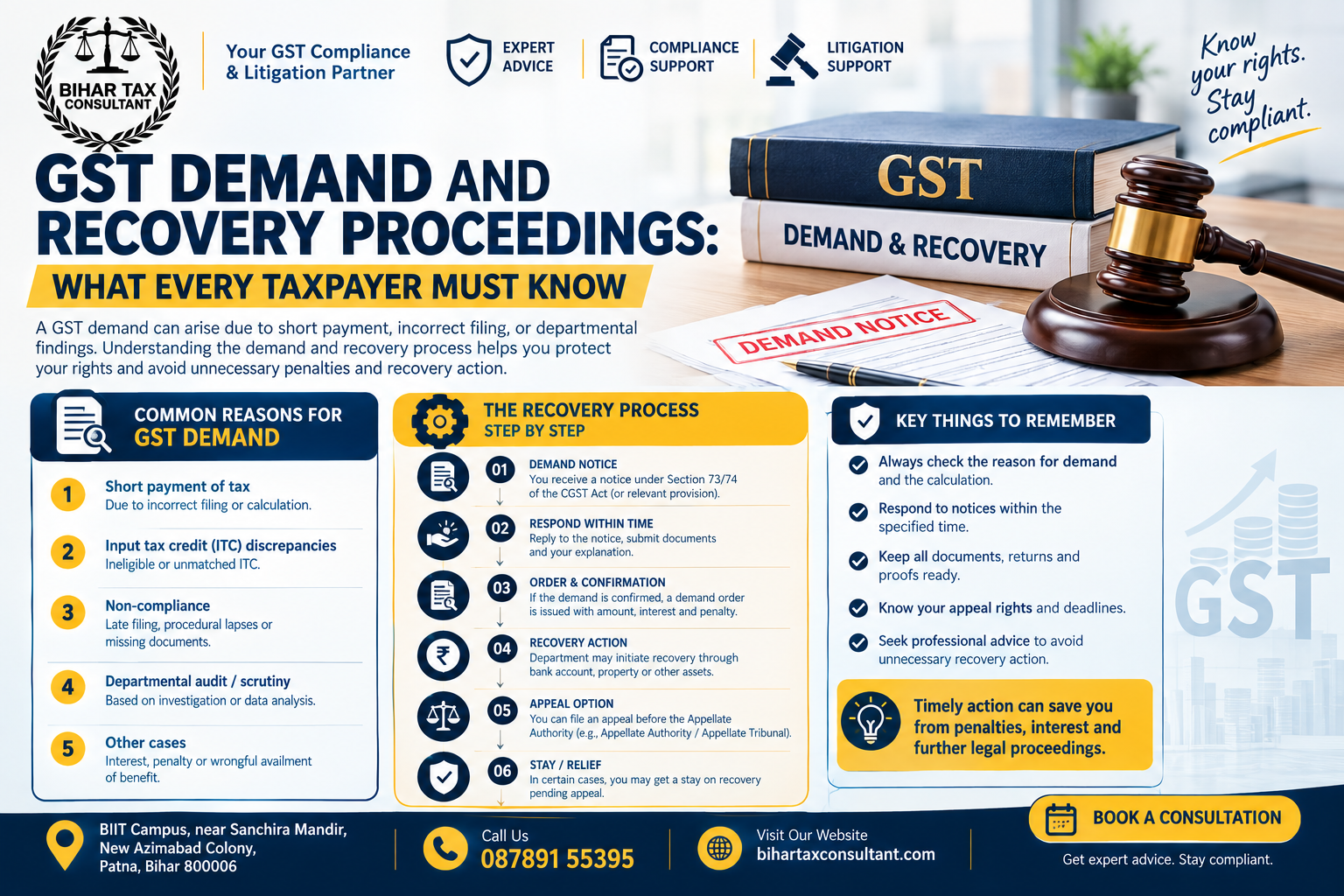
What Are GST Demand and Recovery Proceedings?
GST demand proceedings are the legal process through which the GST authorities determine tax, interest and applicable penalty that they believe a taxpayer is liable to pay. Recovery proceedings are the subsequent mechanisms used to collect an amount that has become payable and remains unpaid.
A GST demand can arise because of:
- Tax not paid or short paid
- Erroneous refund
- Input Tax Credit (ITC) wrongly availed or utilised
- Self-assessed tax remaining unpaid
- Tax collected from customers but not paid to the Government
- Other liabilities arising under the CGST/SGST/IGST framework
The distinction between demand and recovery is important. A tax officer cannot ordinarily treat an amount merely alleged during an investigation as automatically recoverable. CBIC has specifically clarified that recovery under Section 79 follows the applicable legal process and confirmation of the demand or another basis making the amount payable.
For taxpayers, the most important questions are:
What does the notice say? Which financial year does it cover? Which statutory provision has been invoked? What evidence supports the demand? What is the deadline? Should the taxpayer pay, reply, or appeal?
What Is a GST Demand?
A GST demand arises when the Department determines that a taxpayer is liable to pay an amount under the GST law.
A demand can include:
- Tax
- Interest
- Penalty
- Other amounts legally payable
The underlying issue may involve an alleged discrepancy in outward supplies, classification, tax rate, ITC, exempt supplies, place of supply, valuation, refunds or other GST compliance matters.
A demand is generally preceded by a statutory proceeding in which the taxpayer gets an opportunity to respond, subject to the particular provision and circumstances.
GST Demand vs GST Recovery: What Is the Difference?
These two terms are often used interchangeably, but they describe different stages.
| Stage | What it means |
|---|---|
| Investigation / verification | Department examines possible tax issue |
| Notice / SCN | Taxpayer is asked to explain the proposed liability |
| Adjudication | Officer considers the taxpayer’s response |
| Demand order | Tax, interest and applicable penalty are determined |
| Recovery | Steps may be taken to collect an amount that has become payable |
This distinction is important because a proposed demand is not automatically the same thing as a recoverable government due.
CBIC has expressly instructed officers that recovery of tax dues detected during search, inspection or investigation should not be undertaken merely because an issue has been detected; recovery under Section 79 follows the prescribed legal process and confirmation of the demand, unless the amount is otherwise payable under the Act.
Why Do GST Demand Proceedings Start?
Common triggers include:
1. Short payment of GST
The Department may allege that the taxpayer paid less tax than legally payable.
2. Non-payment of GST
A taxable transaction may allegedly have been omitted from the tax payment.
3. Wrong ITC
The Department may question whether ITC was legally available or whether it was wrongly availed or utilised.
4. Excess or erroneous refund
A refund may be alleged to have been granted incorrectly.
5. Tax collected but not paid
Section 76 deals specifically with tax collected from another person as representing GST but not paid to the Government.
6. Reconciliation differences
Differences between returns, books, e-invoices, e-way bills, GSTR-1, GSTR-3B, GSTR-2B or other data can trigger examination.
7. Classification or valuation disputes
Disagreement regarding the applicable tax rate, classification, exemption or valuation can result in demand proceedings.
Which GST Sections Deal With Demand?
The applicable provision depends significantly on the financial year involved.
Sections 73 and 74: Earlier GST Periods
Sections 73 and 74 of the CGST Act traditionally provided two demand frameworks.
Section 73 dealt with tax not paid, short paid, erroneously refunded or ITC wrongly availed/utilised for reasons other than fraud, wilful misstatement or suppression of facts.
Section 74 dealt with cases involving fraud, wilful misstatement or suppression of facts to evade tax.
CBIC’s GST FAQ explains this distinction.
However, taxpayers should not mechanically apply Sections 73 and 74 to every current GST notice.
Section 74A: The Important Change From FY 2024-25
One of the most important developments in GST demand litigation is the introduction of Section 74A.
Section 74A applies to determination of tax not paid, short paid, erroneously refunded or ITC wrongly availed/utilised for Financial Year 2024-25 onwards. The GST Council’s legislative proposal specifically introduced a common demand framework for these periods.
This means that a taxpayer dealing with a demand for FY 2024-25 or later must examine Section 74A rather than automatically assuming that the old Section 73/74 framework applies.
Importantly, although Section 74A provides a common framework for determination, the penalty consequences can still differ depending on whether fraud, wilful misstatement or suppression of facts to evade tax is established.
Why the Financial Year Mentioned in the Notice Matters
Suppose a taxpayer receives a GST demand notice in 2026.
The fact that the notice was issued in 2026 does not by itself tell you which demand provision should apply.
You must first identify the financial year to which the alleged tax liability relates.
For example:
- FY 2022-23 → Sections 73/74 may remain relevant.
- FY 2023-24 → Sections 73/74 remain relevant under the transitional legislative framework.
- FY 2024-25 onwards → Section 74A becomes the key demand provision.
The exact statutory position should always be checked against the notice and the applicable amendments.
What Is a GST Show Cause Notice?
A Show Cause Notice (SCN) is a formal communication requiring the taxpayer to explain why a proposed tax liability, interest and/or penalty should not be determined against them.
A proper response should not merely say:
“The demand is wrong.”
Instead, it should address:
- The factual allegations.
- The statutory provision invoked.
- The tax calculation.
- The supporting documents.
- The taxpayer’s reconciliation.
- The legal basis for the taxpayer’s position.
- Any procedural or jurisdictional objections.
- The proposed interest and penalty.
What Is DRC-01?
FORM GST DRC-01 is commonly associated with the summary of a GST demand/show-cause notice.
The taxpayer should not treat the form in isolation.
The underlying notice, relied-upon documents, computation and legal grounds should all be examined.
A demand can involve several components, so the taxpayer should reconcile:
Tax + Interest + Penalty + Other amounts
with the actual allegations in the notice.
What Is DRC-07?
FORM GST DRC-07 is associated with the summary of an order creating a demand.
It is therefore important to distinguish between:
SCN / proposed demand → adjudication → order → DRC-07 / demand summary → recovery
The exact documents and portal entries should be checked in the taxpayer’s GST account.
What Should You Do After Receiving a GST Demand Notice?
Step 1: Identify the financial year
This is one of the first things to verify.
A demand for FY 2023-24 may be governed by a different demand framework from a demand relating to FY 2024-25 onwards.
Step 2: Identify the provision invoked
Check whether the notice refers to:
- Section 73
- Section 74
- Section 74A
- Section 76
- Another statutory provision
Step 3: Understand the allegation
Determine exactly what the Department says is wrong.
For example:
- ITC mismatch
- Suppressed turnover
- Wrong tax rate
- Incorrect exemption
- Wrong classification
- Excess refund
- Wrong place of supply
Step 4: Reconcile the figures
Compare the Department’s calculation with:
- GSTR-1
- GSTR-3B
- GSTR-2B
- GSTR-9/9C, where applicable
- Books of account
- Sales register
- Purchase register
- E-invoices
- E-way bills
- Bank records
Step 5: Collect supporting evidence
The evidence should directly address the allegations.
Step 6: Check the limitation position
Demand notices are subject to statutory time limits.
Do not assume that a notice is valid merely because it has been issued.
Step 7: Prepare a point-by-point reply
Each allegation should receive a specific response.
Step 8: Attend the hearing where required
If an opportunity of personal hearing is provided or requested under the applicable framework, the taxpayer should use it appropriately.
Step 9: Preserve the submission record
Keep:
- Filed reply
- Supporting documents
- Acknowledgement
- Hearing records
- Orders
- Portal screenshots/downloads
Can GST Recovery Start Immediately After an Investigation?
Not ordinarily merely because an investigation has identified a possible liability.
CBIC Instruction No. 01/2022-23 specifically states that recovery under Section 79 should follow the legal process, including issuance of notice and confirmation of demand by an adjudication order, unless the amount otherwise becomes payable under the Act and rules.
The Instruction also clarifies that there should not be a situation in which recovery is made from the taxpayer during search, inspection or investigation merely because an issue was detected.
A taxpayer may, however, voluntarily make payment of a liability that has been ascertained, subject to the applicable law and circumstances.
What Happens If a GST Demand Order Is Passed?
Once an order determines an amount payable, the taxpayer should immediately examine:
- Tax amount
- Interest
- Penalty
- Reasoning in the order
- Evidence considered
- Evidence ignored
- Findings on each issue
- Date of communication
- Appeal deadline
- Amount admitted
- Amount disputed
- Recovery status
Do not wait until recovery action begins before examining the order.
When Does GST Recovery Start?
Section 78 provides the general rule concerning initiation of recovery proceedings.
Under the statutory framework, an amount payable pursuant to an order is generally required to be paid within three months from the date of service of the order, unless the proper officer, for reasons recorded in writing and in the interest of revenue, specifies a shorter period.
This makes the date of service of the order particularly important.
What Powers Does the Department Have Under Section 79?
Section 79 contains several recovery mechanisms.
Depending on the circumstances, recovery can involve:
- Deduction from money payable to the taxpayer.
- Detention and sale of goods under the control of the officer.
- Recovery from another person who owes money to the taxpayer.
- Other statutory recovery mechanisms.
For example, Section 79 permits a proper officer to issue a written notice to a person holding or owing money to the taxpayer and require payment to the Government to the extent specified.
Therefore, once a demand becomes recoverable, the consequences can extend beyond simply receiving another reminder.
Can a Bank Account Be Affected During GST Proceedings?
A taxpayer should distinguish between:
Provisional attachment during proceedings and recovery after a demand becomes payable.
Section 83 provides a separate mechanism for provisional attachment of property, including a bank account, in specified circumstances for protecting government revenue during certain proceedings. The provision is not the same thing as ordinary recovery under Section 79.
Therefore, if a taxpayer receives an attachment-related communication, the legal basis and stage of the proceedings should be identified immediately.
Can GST Recovery Continue If an Appeal Is Filed?
The taxpayer should not assume that simply filing an appeal automatically stops every recovery consequence.
Section 107 provides an important statutory protection.
For an appeal to the Appellate Authority, the appellant must pay:
- The admitted amount of tax, interest, fine, fee and penalty arising from the order; and
- 10% of the remaining disputed tax amount.
Once the statutory payment requirement under Section 107(6) is satisfied, recovery proceedings for the balance amount are deemed to be stayed under Section 107(7).
The exact calculation should therefore be made carefully from the demand order.
What Is the Time Limit for a GST First Appeal?
Under Section 107, a person aggrieved by an adjudication order may generally appeal to the Appellate Authority within three months from the date the order is communicated.
The Appellate Authority may allow a further period of one month where sufficient cause is established.
This is why the communication date should be recorded immediately after receiving a GST order.
What Happens After the First Appeal?
Depending on the outcome and applicable statutory framework, further remedies can include an appeal to the GST Appellate Tribunal (GSTAT) and, on appropriate substantial questions of law, further proceedings before the High Court.
Section 112 provides for appeals to the Appellate Tribunal, subject to the statutory conditions and pre-deposit requirements.
The GST Portal’s current FAQ also recognises appealable demand orders under Sections 73, 74, 74A and other assessment/demand provisions.
Can a Taxpayer Pay the Demand Instead of Litigating?
Yes, where the taxpayer accepts the liability or chooses settlement/payment under the applicable statutory mechanism.
However, payment should not be made blindly merely because a notice has been received.
Before making payment, the taxpayer should determine:
- Whether the demand is factually correct.
- Whether the tax has already been paid.
- Whether the ITC calculation is correct.
- Whether the demand is within limitation.
- Whether the applicable section is correct.
- Whether penalty has been correctly computed.
- Whether any statutory relief is available.
For some demand provisions, the law provides specific consequences for payment at different stages.
For example, Section 74A contains separate treatment for payment before or after notice/order, with different penalty consequences depending on the circumstances.
What If the Demand Is Based on an ITC Mismatch?
ITC disputes are among the common issues encountered in GST proceedings.
A taxpayer should examine:
- Purchase invoices
- Supplier GSTIN
- Taxable value
- GST charged
- GSTR-2B
- GSTR-3B
- Books of account
- Payment records
- Supplier return status
- Credit/debit notes
- Reconciliation statements
A simple mismatch does not automatically explain the legal reason for denial of ITC.
The taxpayer should identify exactly why the Department considers the credit inadmissible.
What If the Demand Is Based on Suppressed Turnover?
Where the Department alleges unreported turnover, the taxpayer should reconcile:
Books → GSTR-1 → GSTR-3B → E-invoices → E-way bills → Bank receipts
Differences can arise for legitimate reasons, including:
- Credit notes
- Advances
- Exempt supplies
- Non-GST supplies
- Timing differences
- Amendments
- Branch transfers
- Accounting adjustments
The taxpayer should explain the actual reason for the discrepancy with documentary evidence.
What If the Department Alleges Fraud or Suppression?
This requires particular attention.
For periods governed by Sections 73/74, fraud, wilful misstatement and suppression can determine whether Section 74 is invoked rather than Section 73.
For FY 2024-25 onwards, Section 74A provides a common demand framework but still differentiates penalty consequences based on whether fraud, wilful misstatement or suppression of facts to evade tax is established.
Therefore, an allegation of fraud should never be treated as a routine wording in a notice.
The factual and legal basis of the allegation should be examined carefully.
Common Mistakes During GST Demand Proceedings
1. Ignoring the notice
Failure to respond can result in the matter proceeding without an adequate defence.
2. Sending a generic reply
A general denial may not answer the Department’s specific allegations.
3. Paying immediately without checking the demand
Payment can have important legal and financial consequences.
4. Ignoring limitation
The date of the relevant financial year, annual return and notice/order can matter significantly.
5. Failing to reconcile GST data
Returns should be compared with books and transaction-level records.
6. Treating Section 73 and 74 as applicable to every current notice
FY 2024-25 onwards requires examination of Section 74A.
7. Missing the appeal deadline
A taxpayer generally has three months to appeal an order under Section 107, subject to the statutory condonation provision.
8. Ignoring a recovery communication
Once a demand becomes recoverable, the Department has statutory recovery mechanisms.
9. Not preserving evidence
Documents should be maintained in an organised case file.
10. Confusing investigation with recovery
A departmental investigation and a legally enforceable recovery are not necessarily the same stage.
Practical GST Demand Response Checklist
Before responding to a GST demand notice, prepare:
Tax records
- GSTR-1
- GSTR-3B
- GSTR-2B
- GSTR-9/9C where applicable
Accounting records
- Sales register
- Purchase register
- General ledger
- Trial balance
- Tax ledgers
Transaction evidence
- Tax invoices
- Credit/debit notes
- E-invoices
- E-way bills
- Bank statements
- Agreements/contracts
Legal documents
- SCN
- DRC-01
- Earlier correspondence
- Reply filed
- Hearing notices
- Adjudication order
- DRC-07
Appeal documents
- Demand calculation
- Grounds of appeal
- Pre-deposit calculation
- Supporting evidence
- Order communication date
Hypothetical Example: GST Demand Based on ITC Difference
This example is hypothetical and is intended only to explain the process.
A registered business receives a GST notice alleging that ₹8 lakh of ITC was wrongly availed.
The business believes the ITC is genuine.
Instead of simply replying:
“The ITC is correct.”
the business prepares:
- Supplier-wise invoice list.
- Purchase register.
- GSTR-2B reconciliation.
- GSTR-3B reconciliation.
- Tax payment evidence.
- Copies of relevant invoices.
- Supplier details.
- Explanation of timing differences.
- Legal submissions explaining eligibility.
If the Department continues with an adverse order, the business can examine the order and consider the applicable appellate remedy within the prescribed time.
The key lesson is:
A GST demand dispute should be answered with reconciliation + evidence + legal reasoning, not merely a general denial.
GST Demand and Recovery: What Every Business Should Remember
GST compliance does not end when the return is filed.
A business may subsequently face:
Notice → Reply → Hearing → Demand Order → Appeal → Recovery
The earlier the taxpayer identifies the issue, the more effectively the matter can usually be analysed.
Particular attention should be given to:
- Financial year
- Statutory provision
- Limitation
- Tax computation
- Interest
- Penalty
- Supporting evidence
- Hearing opportunity
- Appeal deadline
- Recovery status
When Should You Consult a GST Lawyer or Tax Professional?
Professional assistance can be particularly useful when:
- The demand is substantial.
- Fraud or suppression is alleged.
- ITC is disputed.
- Multiple financial years are involved.
- The notice raises complex classification issues.
- The Department relies on third-party data.
- A search or investigation preceded the demand.
- A demand order has already been passed.
- Recovery proceedings have started.
- An appeal needs to be filed.
- There is a question about limitation or jurisdiction.
A professional review can help separate the factual dispute, calculation dispute, legal dispute and procedural dispute instead of treating the entire demand as one issue.
GST Demand Proceedings in 2026: Important Legal Change
Taxpayers dealing with GST disputes in 2026 should be particularly careful about the distinction between older and newer financial years.
For FY 2023-24 and earlier periods, Sections 73 and 74 remain central to the demand framework under the applicable transitional provisions.
For FY 2024-25 onwards, Section 74A provides the newer common framework for determining tax not paid/short paid, erroneous refunds and wrongly availed/utilised ITC.
This makes the financial year mentioned in a GST notice one of the first things a taxpayer should verify.
Frequently Asked Questions
1. What is a GST demand notice?
A GST demand notice is a formal communication through which the Department proposes or seeks determination of tax, interest and applicable penalty arising from an alleged GST liability.
2. What is the difference between GST demand and GST recovery?
Demand concerns determination of an amount payable. Recovery concerns the statutory steps used to collect an amount that has become payable and remains unpaid.
3. What is Section 74A of the CGST Act?
Section 74A deals with determination of tax not paid, short paid, erroneously refunded or ITC wrongly availed/utilised for reasons pertaining to FY 2024-25 onwards.
4. Are Sections 73 and 74 still relevant?
Yes, they remain relevant for the periods to which they apply, particularly periods up to FY 2023-24 under the amended statutory framework. Section 74A applies to FY 2024-25 onwards.
5. Can GST recovery start during investigation?
CBIC has clarified that recovery under Section 79 should follow the prescribed legal process and confirmation of demand; mere detection of an issue during search, inspection or investigation does not by itself justify recovery.
6. How long do I have to appeal a GST demand order?
A person aggrieved by an adjudication order generally has three months from communication of the order to file an appeal under Section 107. A further one month may be condoned where sufficient cause is shown.
7. How much pre-deposit is required for a GST first appeal?
Section 107 generally requires payment of the admitted amount and 10% of the remaining disputed tax amount. Once the statutory requirement is satisfied, recovery of the balance is deemed stayed under Section 107(7).
8. What is DRC-07?
DRC-07 is the GST portal form associated with the summary of an adjudication order and the demand determined.
9. Can a GST demand be challenged?
Yes. Subject to the nature of the order and statutory provisions, a taxpayer can use the GST appellate mechanism, beginning with the Appellate Authority under Section 107 and potentially proceeding further under the applicable law.
10. Can the Department recover money from a third party?
Yes. Section 79 contains a mechanism under which the proper officer can require another person who owes or holds money for the taxpayer to pay the Government to the extent specified in the recovery notice.
11. What should I do if I receive a GST recovery notice?
First verify the underlying demand, order, amount, date of communication and recovery provision. If the demand is disputed, immediately examine the available appellate remedy and applicable pre-deposit requirements rather than ignoring the recovery communication.
12. Should I pay a GST demand or file an appeal?
That depends on the facts and the legal position. Before deciding, compare the demand with the returns, books, evidence, limitation position, applicable provision and available appellate remedies.
Received a GST Demand or Recovery Notice?
A GST demand can involve tax, interest, penalty, ITC disputes, limitation issues and potential recovery proceedings. The correct response depends on the financial year, provision invoked, facts, evidence and stage of the proceeding.
Bihar Tax Consultant can assist with reviewing GST demand notices, preparing responses, analysing demand orders and evaluating available GST appellate remedies.
Address: BIIT Campus, near Sanchira Mandir, New Azimabad Colony, Patna, Bihar 800006
Mobile: 8789155395
Email: [email protected]
Book a Consultation to have your GST demand or recovery matter reviewed.