
GST Appeal Form APL-01: Step-by-Step Filing Guide

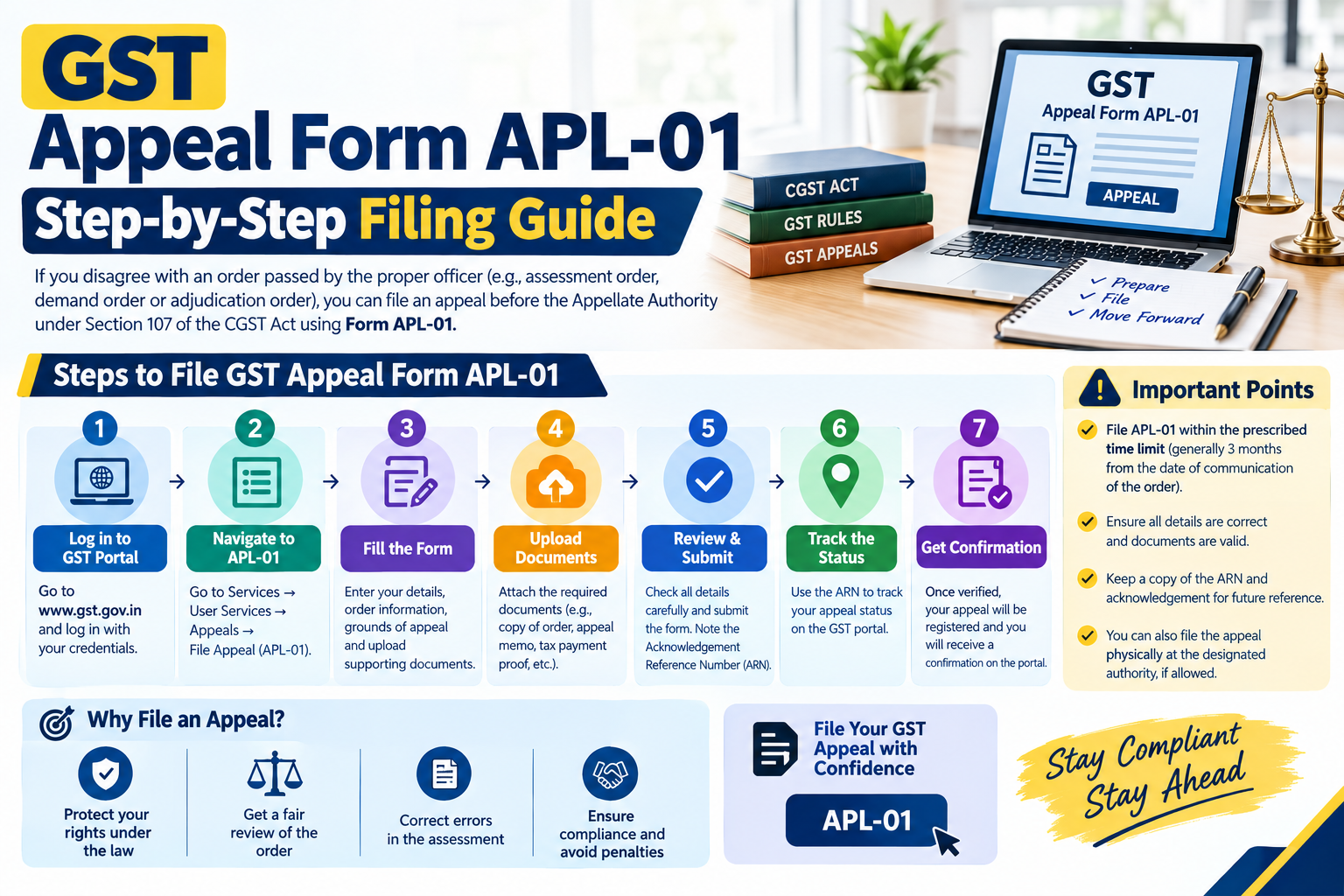
What Is GST Appeal Form APL-01?
FORM GST APL-01 is the prescribed form used by a taxpayer or other eligible person to appeal against a decision or order passed by an adjudicating authority before the GST Appellate Authority.
Under Section 107 of the CGST Act, an aggrieved person generally has three months from the date on which the decision or order is communicated to file an appeal. The Appellate Authority may condone a delay of up to a further one month where sufficient cause is established.
The GST Portal provides an online facility for filing the appeal. The prescribed pre-deposit generally includes the admitted amount in full and 10% of the remaining disputed tax, subject to the statutory framework. Once the required payment is made, recovery of the balance amount is treated as stayed under Section 107(7).
What Is Form GST APL-01?
GST APL-01 is the form through which an eligible taxpayer or unregistered person can approach the Appellate Authority against an appealable GST decision or order.
The GST Portal describes APL-01 as the form for an appeal to the Appellate Authority.
It is commonly relevant where a taxpayer is aggrieved by an order involving issues such as:
- GST demand
- Interest
- Penalty
- Assessment
- Certain refund-related orders
- Rectification-related orders
- Enforcement-related orders
- Other appealable decisions covered by the GST law
The exact appealability must always be checked against the particular order and applicable statutory provisions.
Who Can File GST APL-01?
A taxpayer or an unregistered person who is aggrieved by an appealable decision or order passed by an adjudicating authority may appeal to the Appellate Authority.
The GST Portal specifically confirms that both a taxpayer and an unregistered person can file an appeal where they are aggrieved by an eligible order.
Before starting the filing process, check:
- Whether an appealable order has actually been passed.
- Whether the person filing the appeal is entitled to appeal.
- Whether the appeal is within the prescribed limitation period.
- Whether the required admitted amount and pre-deposit have been paid.
- Whether the grounds of appeal are properly prepared.
What Is the Time Limit for Filing GST APL-01?
The normal limitation period is:
3 months from the date on which the decision or order is communicated to the taxpayer.
Where the taxpayer was prevented by sufficient cause from filing within this period, the Appellate Authority can allow filing within a further period of one month.
Simple example
Suppose an appealable GST order is communicated on 10 September.
The taxpayer should calculate the statutory three-month period from the date of communication and ensure that the appeal is filed within the applicable limitation period.
If the taxpayer misses the normal period, simply filing late does not automatically mean that the delay will be accepted. The taxpayer would need to establish sufficient cause for condonation.
Do not wait until the last day to prepare an appeal.
Is Pre-Deposit Required for GST Appeal?
Yes.
Section 107 requires the appellant to pay:
- The admitted amount of tax, interest, fine, fee and penalty arising from the impugned order, in full, and
- 10% of the remaining amount of tax in dispute arising from the order.
The statutory pre-deposit requirement specifically refers to the tax in dispute.
Example
Suppose an order determines:
- Tax disputed: ₹10,00,000
- Tax admitted: ₹1,00,000
- Remaining disputed tax: ₹9,00,000
The taxpayer would generally need to pay:
₹1,00,000 admitted tax + ₹90,000, being 10% of the remaining disputed tax
The exact computation should be checked against the order and the GST Portal before filing.
Does Filing an Appeal Stop GST Recovery?
Once the statutory requirements are fulfilled and the appeal is filed/admitted according to the applicable process, Section 107 provides for stay of recovery of the balance amount covered by the statutory mechanism.
The GST Portal FAQ also states that when the appeal is admitted, the balance disputed amount is flagged as non-recoverable on the portal.
However, taxpayers should not assume that merely preparing a draft appeal automatically stops recovery.
The statutory conditions and portal status should be checked carefully.
Which GST Orders Can Be Appealed Through APL-01?
The GST Portal’s current FAQ lists several categories of orders that can be appealed, including certain:
- Assessment orders under Section 62
- Assessment orders under Section 63
- Assessment orders under Section 64
- Orders relating to Section 64 proceedings
- Penalty orders under specified provisions
- Orders in remanded proceedings
- Orders under Sections 73, 74, 74A and 76
- Rectification orders
- Rejection of rectification applications
- Certain enforcement orders
- Confiscation-related orders
- Certain DRC-07-related orders
The exact appeal route depends on the nature of the order and applicable law.
GST APL-01 vs GST APL-02
These two forms should not be confused.
| Form | Purpose |
|---|---|
| GST APL-01 | Appeal filed by the taxpayer/appellant |
| GST APL-02 | Acknowledgement issued by the Appellate Authority |
CBIC’s appeal rules provide for APL-01 as the appeal form and APL-02 as the final acknowledgement indicating the appeal number.
Step-by-Step Guide to Filing GST Appeal Form APL-01
Step 1: Obtain and Review the GST Order
Before filing an appeal, download and carefully examine the order.
Identify:
- Order number
- Order date
- Date of communication
- Tax period
- Tax demanded
- Interest
- Penalty
- Other amounts
- Reasons for the demand
- Findings recorded by the officer
- Issues that need to be challenged
Do not begin with the APL-01 form alone.
The appeal should be built around the findings and legal conclusions in the impugned order.
Step 2: Check the Limitation Period
Calculate the three-month appeal period from the date the order was communicated.
If the normal period has already expired, examine whether the circumstances support an application for condonation within the additional period permitted by law.
Keep documentary evidence of the date of communication.
Step 3: Calculate the Amount Admitted and Disputed
Separate the demand into:
Admitted amount
The portion accepted by the taxpayer.
Disputed amount
The portion challenged in the appeal.
The pre-deposit calculation should then be made according to Section 107.
This step is important because an incorrect calculation can create problems during filing.
Step 4: Pay the Required Amount
The statutory requirement includes payment of the admitted amount and the prescribed pre-deposit on the disputed tax.
Keep the payment challan and transaction details.
The GST Portal’s FAQ specifically identifies the minimum 10% pre-deposit requirement for the disputed tax before filing the appeal.
Step 5: Log in to the GST Portal
The GST Portal provides the online appeal facility.
The current portal guidance gives the following broad navigation:
Services → User Services → My Applications → Application Type: Appeal to Appellate Authority → New Application.
Step 6: Select the Appropriate Order
Select the relevant order type and provide the order details requested by the portal.
The order identification should be checked carefully.
An incorrect order number or mismatch in the order details can create avoidable filing problems.
Step 7: Enter the Appeal Details
The APL-01 filing requires relevant information concerning the appellant, order and appeal.
Review:
- GSTIN, where applicable
- Name and address
- Order details
- Tax period
- Demand amounts
- Payment/pre-deposit details
- Grounds of appeal
- Prayer or relief sought
- Verification
How to Draft Grounds of Appeal
The grounds of appeal are one of the most important parts of APL-01.
A good ground should identify the specific error or grievance rather than simply stating that the order is wrong.
Weak approach
“The order passed by the officer is incorrect and should be cancelled.”
More structured approach
“The adjudicating authority erred in treating the disputed input tax credit as ineligible without properly considering the documentary evidence submitted by the appellant and the applicable statutory conditions.”
The precise ground must be based on the actual facts and documents of the case.
What Should the Grounds of Appeal Cover?
Depending on the case, grounds may address:
1. Factual errors
The order may have recorded an incorrect factual position.
2. Legal interpretation
The taxpayer may disagree with the interpretation of the applicable GST provision.
3. Evidence
Relevant invoices, returns, payment records or reconciliations may not have been properly considered.
4. Procedural issues
The taxpayer may challenge an order where the prescribed procedure or opportunity was not properly followed.
5. Calculation errors
The demand may contain an incorrect calculation of tax, interest or penalty.
6. Jurisdictional issues
Where supported by the facts and law, the appellant may challenge the authority or legal basis for the proceeding.
The grounds should be specific to the order rather than copied from a generic template.
What Documents Are Required for GST APL-01?
The documents depend on the nature of the dispute.
A practical checklist can include:
Core documents
- Copy of the impugned GST order
- GST APL-01 details
- Demand/order summary
- Pre-deposit/payment proof
- Relevant notices
- Show cause notice, where applicable
Supporting documents
Depending on the dispute:
- Tax invoices
- Purchase invoices
- Sales invoices
- E-way bills
- E-invoice records
- GSTR-1
- GSTR-3B
- GSTR-2B
- Electronic ledger extracts
- Bank statements
- Reconciliation statements
- Contracts
- Agreements
- Correspondence
- Books of account
- Other documentary evidence
The documents should support specific grounds rather than being uploaded without explanation.
Can Additional Evidence Be Filed at the Appeal Stage?
Additional evidence is not automatically admissible in every case.
The GST appeal rules provide specific circumstances in which additional evidence may be admitted, including situations where evidence was improperly refused earlier or where the appellant was prevented by sufficient cause from producing relevant evidence. The Appellate Authority or Tribunal must record reasons for admitting such evidence.
Therefore:
Do not assume that every document omitted during adjudication can automatically be introduced for the first time in appeal.
Where important evidence was not submitted earlier, the reason should be properly documented and legally addressed.
DSC or EVC: How Is APL-01 Signed?
The GST Portal FAQ states that an appeal can be filed using DSC or EVC, while DSC is mandatory for companies and LLPs.
Before filing, ensure that the required signing facility is active and available.
Technical problems should not be discovered on the final day of the limitation period.
Final Acknowledgement: Why APL-02 Matters
After submission, the taxpayer should monitor the acknowledgement process.
CBIC’s rules provide that the appeal is ultimately acknowledged in FORM GST APL-02, indicating the appeal number.
The GST Portal FAQ explains that where the order has not been uploaded, a self-certified copy may need to be submitted within seven days of filing APL-01; if submitted after seven days, the date of submission can affect the filing date.
Therefore, the taxpayer should not stop at clicking Submit.
Check whether the appeal has received the required final acknowledgement and appeal number.
What Happens After Filing APL-01?
The appeal can move through several stages.
The GST Portal identifies statuses such as:
- Appeal Submitted
- Appeal Admitted
- Appeal Rejected
- Hearing Notice Issued
- Reply Submitted
- Adjournment Granted
- Show Cause Notice Issued
- Appeal Order Passed
- Rectification-related statuses
- Remand-related statuses
These statuses are provided in the GST Portal’s appeal FAQ.
The taxpayer should therefore continue monitoring the case after filing.
Will There Be a Hearing?
The Appellate Authority is required to provide the appellant an opportunity of being heard under Section 107.
The authority can also grant an adjournment for sufficient cause, subject to the statutory restrictions.
A taxpayer should therefore prepare for the hearing based on:
- Grounds of appeal
- Evidence
- Department’s findings
- Applicable legal provisions
- Specific questions likely to arise
Can an Appeal Be Withdrawn?
The GST Portal FAQ states that an appeal application can be withdrawn subject to the stage of the proceedings. It also provides specific functionality for withdrawal through the case-details page.
However, withdrawal should not be treated as a casual administrative step.
Before withdrawing an appeal, the taxpayer should understand the consequences and any limitation issues affecting a possible subsequent filing.
Common Mistakes While Filing GST APL-01
1. Missing the three-month deadline
Limitation is one of the most serious issues in GST appeals.
2. Calculating pre-deposit incorrectly
The taxpayer should distinguish admitted tax from disputed tax.
3. Uploading an incomplete order
The complete impugned order and relevant supporting documents should be maintained.
4. Writing vague grounds
Generic statements do not adequately explain the grievance.
5. Ignoring the original adjudication record
The appeal should respond directly to the reasoning in the order.
6. Uploading documents without indexing
A large bundle of documents without a clear explanation can make the appeal difficult to follow.
7. Not preserving filing evidence
Keep:
- ARN
- Payment details
- Acknowledgement
- Uploaded documents
- Final APL-02
- Hearing notices
- Subsequent correspondence
8. Waiting until the last day
Portal issues, DSC problems or missing documents can create unnecessary risk.
9. Ignoring hearing notices
Filing the appeal is not the end of the process.
10. Treating APL-01 as a simple online form
The form is only the filing mechanism.
The quality of the grounds, evidence and legal arguments can be equally important.
Hypothetical Example: GST Demand Appeal
This example is hypothetical and intended only to explain the process.
ABC Traders receives a GST order creating a demand of ₹12 lakh.
The taxpayer accepts ₹2 lakh but disputes ₹10 lakh.
Before filing the appeal, the taxpayer:
- Reviews the order.
- Identifies each disputed issue.
- Calculates the admitted liability.
- Calculates the applicable pre-deposit.
- Collects invoices, returns and reconciliation statements.
- Drafts specific grounds of appeal.
- Logs into the GST Portal.
- Selects Appeal to Appellate Authority.
- Selects the relevant order.
- Completes APL-01.
- Uploads the supporting documents.
- Completes the required verification/signing.
- Submits the appeal.
- Monitors the acknowledgement and appeal number.
The taxpayer should then monitor the portal for hearing notices and subsequent orders.
GST APL-01 Filing Checklist
Before submitting the appeal, verify:
Order
☐ Correct order identified
☐ Complete copy available
☐ Date of communication verified
Limitation
☐ Three-month deadline calculated
☐ Delay, if any, separately examined
Financials
☐ Admitted amount identified
☐ Disputed tax calculated
☐ Required pre-deposit paid
Appeal drafting
☐ Grounds are specific
☐ Facts are accurate
☐ Relief/prayer is clear
☐ Legal provisions checked
Documents
☐ Order attached
☐ Notices attached where relevant
☐ Supporting evidence indexed
☐ Payment/pre-deposit evidence preserved
Filing
☐ GSTIN/details verified
☐ Order details verified
☐ DSC/EVC available
☐ APL-01 submitted
☐ ARN/acknowledgement saved
☐ APL-02/final appeal number monitored
What Happens If GST APL-01 Is Rejected at Admission?
The GST Portal FAQ states that an appeal application rejected at the admission stage can be re-filed once more through the portal using the original Order ID.
The reason for rejection should nevertheless be carefully examined before refiling.
A technical correction may be sufficient in some situations, while a substantive issue may require a different response.
GST Appeal Beyond APL-01
APL-01 is the first appellate-stage form for an appeal to the Appellate Authority.
It should not be confused with later-stage forms.
For example:
- APL-01 — Appeal to Appellate Authority
- APL-02 — Acknowledgement
- APL-05 — Appeal to Appellate Tribunal
- APL-08 — Appeal to High Court in specified circumstances
CBIC’s appeal rules prescribe these forms for the respective stages.
The appropriate appellate forum depends on the order and statutory framework.
Frequently Asked Questions
1. What is GST APL-01?
GST APL-01 is the prescribed form used to file an appeal before the Appellate Authority against an appealable GST decision or order.
2. What is the time limit for filing APL-01?
Generally, an appeal must be filed within three months from the date the decision or order is communicated. A further one-month period may be available for condonation where sufficient cause is established.
3. Is a 10% pre-deposit required?
Generally, yes. Section 107 requires payment of the admitted amount and 10% of the remaining disputed tax, subject to the statutory provisions.
4. Where do I file GST APL-01 online?
The GST Portal provides the appeal functionality under Services → User Services → My Applications → Appeal to Appellate Authority → New Application.
5. What is GST APL-02?
APL-02 is the final acknowledgement issued by the Appellate Authority indicating the appeal number.
6. Can an unregistered person file GST APL-01?
Yes. The GST Portal states that an unregistered person who is aggrieved by an appealable order can file an appeal.
7. Can I file an appeal after three months?
A further period of up to one month may be allowed where the Appellate Authority is satisfied that sufficient cause prevented timely filing.
8. Can I file additional evidence during appeal?
Additional evidence is subject to the conditions prescribed in the GST appeal rules and is not automatically admissible.
9. Can I use DSC or EVC?
The GST Portal states that APL-01 can be filed through DSC or EVC, with DSC mandatory for companies and LLPs.
10. Does filing an appeal stop recovery?
After the statutory requirements are fulfilled, Section 107 provides for stay of recovery of the balance amount. The GST Portal also states that, once the appeal is admitted, the balance disputed amount is flagged as non-recoverable.
11. Can I withdraw an APL-01 appeal?
The GST Portal provides a withdrawal facility subject to the stage of the appeal. An appeal cannot simply be treated as withdrawn at any stage without considering the applicable portal and statutory conditions.
12. What should I do if my APL-01 filing is rejected?
Check the reason for rejection. The GST Portal permits an appeal application rejected at admission stage to be re-filed once more using the relevant Order ID.
Key Takeaways
- GST APL-01 is the principal form for filing an appeal before the Appellate Authority.
- The normal limitation period is three months from communication of the order.
- A further one month may be available for condonation where sufficient cause is established.
- The taxpayer generally has to pay the admitted amount plus 10% of the remaining disputed tax as the statutory pre-deposit.
- The GST Portal provides an online APL-01 filing facility.
- Grounds of appeal should specifically address the errors in the impugned order.
- Supporting evidence should be organised and linked to the grounds.
- APL-02 is the final acknowledgement indicating the appeal number.
- Filing APL-01 is not the end of the appeal; taxpayers should monitor hearing notices and subsequent proceedings.
- Additional evidence at the appellate stage is subject to specific conditions.
- A rejected application can, subject to the portal rules, be re-filed once.
- Because limitation and pre-deposit requirements can directly affect an appeal, the order should be reviewed carefully before filing.