
Documents for GST Appeal: Complete Checklist for First Appeal Filing

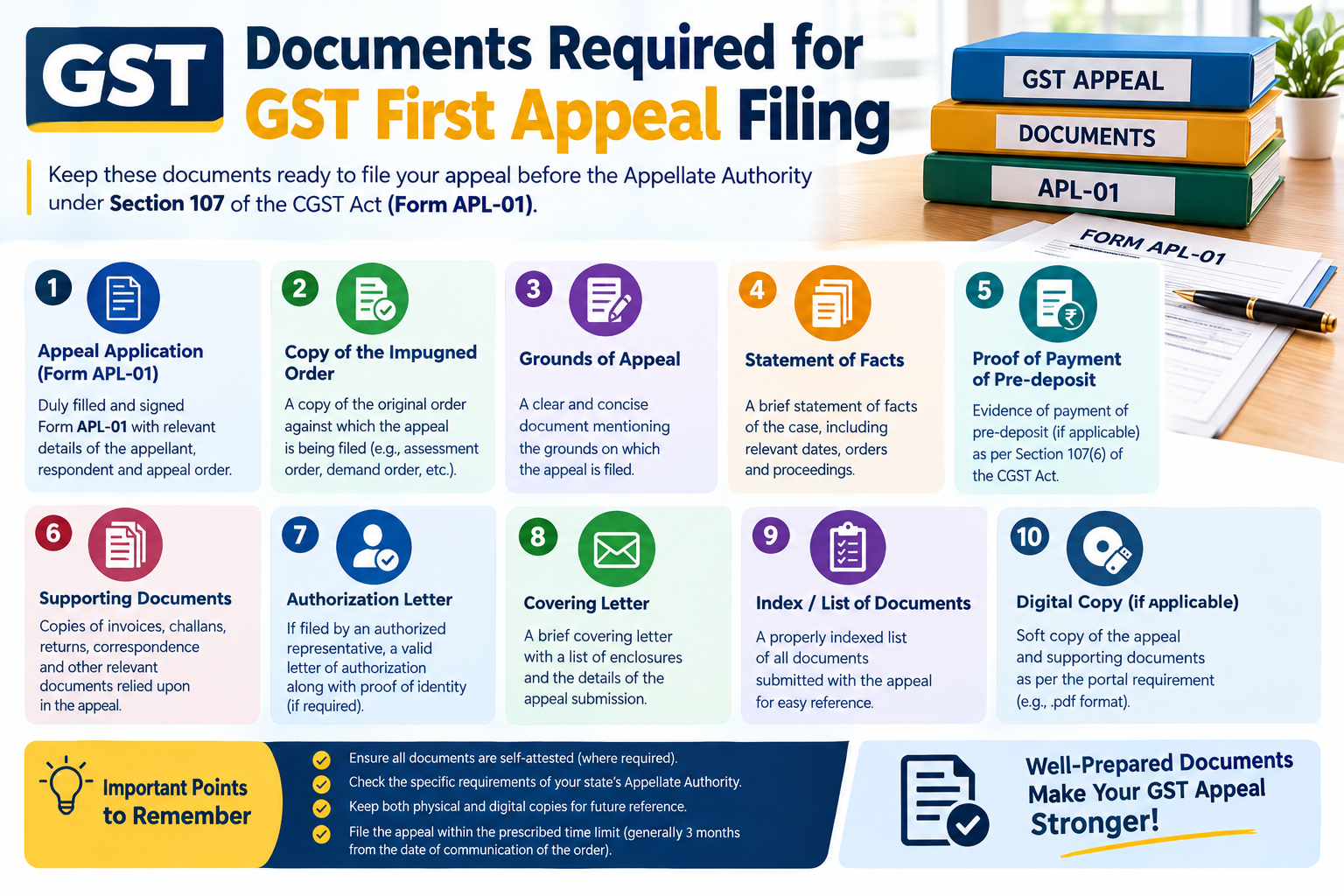
What Documents Are Required for a GST First Appeal?
The core documents for a GST first appeal generally include the order or decision being challenged, FORM GST APL-01, the grounds of appeal, statement of facts, verification, and relevant supporting documents/evidence. Under Rule 108, the appeal is filed in FORM GST APL-01 and the certified copy of the decision or order appealed against, along with supporting documents, is required to be submitted within seven days in the circumstances specified by the rule. The GST Portal also provides for electronic filing and issuance of a final acknowledgement in FORM GST APL-02.
The exact supporting documents depend on why the GST order is being challenged. For example, an ITC dispute may require invoices and reconciliation records, while a classification dispute may require contracts, product descriptions, technical literature or other evidence relevant to the classification issue.
Introduction
Receiving a GST demand, assessment order, penalty order or another appealable order does not necessarily end the dispute.
Where a taxpayer is aggrieved by an appealable order passed by an adjudicating authority, the GST law provides a first appellate remedy before the Appellate Authority.
However, filing an appeal is not simply a matter of submitting FORM GST APL-01.
A properly prepared appeal normally requires:
- The order being challenged
- Correct case and taxpayer details
- Statement of facts
- Grounds of appeal
- Supporting documentary evidence
- Details of admitted and disputed amounts
- Appropriate pre-deposit/payment information
- Verification and authorised-signatory requirements
- Compliance with the applicable filing procedure
A missing or poorly organised document can make an otherwise strong appeal more difficult to present.
This guide explains the documents for GST appeal, what is legally important, which documents are case-specific, and how taxpayers can prepare a practical GST first appeal document checklist.
What Is a GST First Appeal?
A GST first appeal is an appeal filed before the Appellate Authority against an appealable decision or order passed by an adjudicating authority.
Section 107 of the CGST Act provides that an aggrieved person may appeal within three months from the date on which the decision or order is communicated. The Appellate Authority may allow a further period of one month where sufficient cause prevented timely filing.
For taxpayer appeals, FORM GST APL-01 is the prescribed appeal form.
The GST Portal identifies APL-01 as the form for a taxpayer’s appeal to the Appellate Authority, while FORM GST APL-02 relates to acknowledgement of submission of the appeal.
Why Are Documents Important in a GST Appeal?
Documents are important because the appeal is not decided merely on the taxpayer’s disagreement with the order.
The taxpayer needs to demonstrate:
- What order is being challenged.
- What factual findings are disputed.
- Which legal or factual errors are alleged.
- What evidence supports the taxpayer’s position.
- What relief is being requested.
The documents should therefore correspond directly with the grounds of appeal.
For example, if the appeal challenges an ITC disallowance, simply attaching the GST registration certificate may not establish the underlying ITC claim. Relevant invoices, books, reconciliation statements, payment evidence and other case-specific records may be more important.
Documents for GST Appeal: Complete Checklist
The following checklist separates the core appeal documents from documents that may be required depending on the nature of the dispute.
| Document | Generally relevant? | Purpose |
|---|---|---|
| Copy of impugned GST order | Yes | Identifies the order being challenged |
| FORM GST APL-01 | Yes | Prescribed first-appeal form |
| Statement of facts | Yes | Explains factual background |
| Grounds of appeal | Yes | Sets out why the order is challenged |
| Verification | Yes | Formal verification of appeal |
| Supporting evidence | Case-specific | Proves factual/legal contentions |
| Pre-deposit/payment details | Where applicable | Demonstrates statutory appeal requirement |
| GST returns | Case-specific | Supports return/tax-position claims |
| Tax invoices | Case-specific | Supports supply/ITC claims |
| E-way bills | Case-specific | Supports movement/supply-related issues |
| GSTR-1/GSTR-3B records | Case-specific | Supports reporting/reconciliation |
| Ledger/accounting records | Case-specific | Supports financial and tax calculations |
| Correspondence with department | Case-specific | Establishes communications and submissions |
| SCN and reply | Case-specific | Shows earlier proceedings and taxpayer defence |
| Authorisation/representation documents | Where applicable | Establishes authorised representation |
| Additional evidence explanation | Where applicable | Explains why additional evidence is being produced |
The important point is that not every taxpayer needs every document in this table. The supporting-document set should be built around the specific order and grounds of appeal.
1. Copy of the GST Order Being Challenged
The first and most important document is the decision or order against which the appeal is being filed.
Rule 108 specifically refers to submission of a certified copy of the decision or order appealed against along with supporting documents.
The order should be reviewed carefully for:
- Order number
- Order date
- Date of communication
- Name/designation of the officer
- Tax period
- Tax demand
- Interest
- Penalty
- Fees or other amounts
- Reasons for the demand
- Findings recorded by the officer
- Sections/provisions relied upon
The date of communication is particularly important because the statutory appeal period is linked to communication of the decision or order.
2. FORM GST APL-01
FORM GST APL-01 is the principal form used by a taxpayer to file an appeal before the Appellate Authority.
The form captures important information including:
- GSTIN/Temporary ID/UIN
- Legal name
- Trade name
- Address
- Order number and date
- Details of the officer passing the order
- Date of communication
- Authorised representative
- Details of the dispute
- Amount under dispute
- Statement of facts
- Grounds of appeal
- Prayer
- Demand created, admitted and disputed
These fields are reflected in the prescribed APL-01 form.
Therefore, the information entered into APL-01 should be checked against the actual order and the taxpayer’s records before submission.
3. Statement of Facts
The statement of facts explains what happened before the dispute reached the appellate stage.
A useful statement of facts may cover:
- Nature of the taxpayer’s business
- Relevant tax period
- Transaction or issue involved
- Return filing history
- Notice issued by the department
- Reply/submissions made by the taxpayer
- Adjudication proceedings
- Findings in the impugned order
- Resulting demand or penalty
- Reason for challenging the order
The statement should focus on relevant facts rather than repeating every document attached to the appeal.
4. Grounds of Appeal
The grounds of appeal are among the most important components of a first appeal.
They should clearly identify the alleged errors in the order.
Depending on the case, grounds may concern:
- Incorrect interpretation of GST law
- Incorrect classification
- Wrong valuation
- Improper ITC disallowance
- Failure to consider submitted evidence
- Incorrect computation
- Procedural deficiencies
- Incorrect application of exemption provisions
- Incorrect levy of interest
- Incorrect imposition of penalty
- Violation of applicable statutory requirements
The grounds should be supported by the documents attached to the appeal.
A simple approach is:
Ground → Relevant fact → Supporting document → Legal position → Relief requested
This creates a clear connection between the appeal and the evidence.
5. Supporting Documents and Evidence
This is where the document checklist becomes case-specific.
There is no single universal bundle of evidence that will be appropriate for every GST appeal.
The relevant documents may include:
GST Returns
Depending on the dispute, relevant records may include:
- GSTR-1
- GSTR-3B
- Other applicable GST returns
- Return filing acknowledgements
These may be useful where the dispute concerns reporting, tax payment, outward supplies or ITC.
Tax Invoices
Invoices can be important in disputes involving:
- Input tax credit
- Outward supplies
- Tax rate
- Classification
- Value of supply
- Place of supply
Purchase and Sales Registers
These can help reconcile:
- Invoices
- GST returns
- ITC
- Taxable turnover
- Tax liability
GSTR-2A/GSTR-2B Records
Where ITC is disputed, relevant auto-generated statement data may help explain the taxpayer’s position, subject to the specific legal issue and relevant tax period.
Bank Statements and Payment Evidence
Where payment or transaction flow is relevant, bank records may provide supporting evidence.
E-Way Bills
These can be relevant to disputes concerning:
- Movement of goods
- Transportation
- Supply transactions
- Taxable turnover
- Transaction genuineness
Contracts and Agreements
For classification, valuation, composite/mixed supply, place-of-supply or contractual disputes, the underlying agreement may be important.
Correspondence With the Department
Keep copies of:
- Notices
- Replies
- Submissions
- Email correspondence
- Hearing submissions
- Adjournment requests
- Departmental communications
These records can help establish what information was already provided during adjudication.
6. Show Cause Notice and Reply
If the impugned order arose from a show-cause notice, the taxpayer should generally preserve:
- Show Cause Notice
- Annexures to the SCN
- Taxpayer’s reply
- Supporting documents submitted with the reply
- Additional submissions
- Hearing submissions
- Hearing-related communications
These documents help establish the procedural history of the dispute.
They can also become particularly important when the appeal argues that relevant evidence or submissions were not properly considered.
7. Pre-Deposit and Payment Details
A taxpayer should also keep evidence relating to the statutory pre-deposit and admitted amount.
Section 107 provides that an appeal cannot be filed unless the appellant has paid:
- The admitted amount of tax, interest, fine, fee and penalty arising from the order; and
- The prescribed percentage of the remaining disputed tax.
The statutory framework provides for 10% of the remaining disputed tax under Section 107(6), subject to the provisions applicable to the particular appeal.
The GST framework also provides that, after the required payment under Section 107(6), recovery proceedings for the balance amount are deemed to be stayed under Section 107(7).
Because the exact computation can depend on the nature of the demand, taxpayers should reconcile the order, admitted amount, disputed amount and payment before filing.
8. GST Registration and Taxpayer Details
A copy of the GST registration certificate may be useful as a supporting identification document, particularly where the appeal involves questions concerning:
- GSTIN
- Legal name
- Trade name
- Registration status
- Principal place of business
- Nature of business
However, it should not automatically be treated as a mandatory standalone document for every appeal.
The more important consideration is whether the document helps establish an issue raised in the appeal.
9. Books of Account and Reconciliation Statements
For disputes involving tax computation or ITC, relevant accounting records can be important.
Depending on the case, these may include:
- Purchase register
- Sales register
- General ledger
- Input tax credit ledger
- Output tax liability records
- Trial balance
- Reconciliation statements
- Tax working papers
For example, if an order alleges excess ITC, a properly prepared reconciliation may help connect invoice-level records with return data and accounting records.
10. Documents Related to ITC Disputes
For an ITC-related appeal, the evidence may include:
- Tax invoices
- Debit/credit notes
- Purchase register
- GSTR-2A/GSTR-2B records
- GSTR-3B records
- Payment evidence
- Goods receipt records
- E-way bills
- Purchase agreements
- Relevant correspondence with suppliers
- Reconciliation statements
The precise evidence required depends on the reason for ITC denial.
A document checklist should therefore be prepared around the actual reason stated in the GST order, rather than attaching every available business document.
11. Documents for Classification or Tax-Rate Disputes
Where the dispute concerns classification or applicable GST rate, useful evidence may include:
- Product descriptions
- Product catalogues
- Technical specifications
- Product photographs
- Purchase/sales invoices
- Contracts
- Agreements
- Industry literature
- Product composition details
- Relevant correspondence
- Expert/technical material, where appropriate
The objective is to provide evidence supporting the taxpayer’s proposed classification or tax treatment.
12. Documents for GST Valuation Disputes
For valuation-related disputes, relevant documents may include:
- Tax invoices
- Agreements
- Price lists
- Purchase orders
- Sales contracts
- Debit/credit notes
- Accounting records
- Transaction records
- Details of discounts
- Related-party documentation, where relevant
The evidence should demonstrate how the transaction value was determined and why the taxpayer disputes the department’s computation.
13. Can Additional Evidence Be Filed at the Appeal Stage?
Additional evidence requires particular care.
Under the GST appeal rules, an appellant is generally not permitted to introduce evidence before the Appellate Authority that was not produced during the earlier proceedings, except in specified circumstances.
The rules include situations such as:
- The adjudicating authority refused to admit evidence that should have been admitted;
- The appellant was prevented by sufficient cause from producing evidence;
- The appellant was prevented by sufficient cause from producing relevant evidence; or
- The order was passed without giving sufficient opportunity to produce relevant evidence.
The Appellate Authority must record reasons in writing for admitting additional evidence, and the other side must be given a reasonable opportunity concerning that evidence.
Therefore, taxpayers should not deliberately hold back important evidence during adjudication merely expecting to introduce it later in appeal.
14. Documents for GST Appeal: Recommended Folder Structure
A practical way to organise the appeal is to create a digital folder such as:
GST First Appeal – [GSTIN] – [Order Number]
Inside it:
Folder 01 – Order
- Impugned order
- Order annexures
Folder 02 – Earlier Proceedings
- SCN
- SCN annexures
- Reply
- Additional submissions
- Hearing records
Folder 03 – APL-01
- Draft APL-01
- Statement of facts
- Grounds of appeal
- Prayer
- Verification
Folder 04 – Tax Records
- GSTR-1
- GSTR-3B
- GSTR-2A/2B
- Ledgers
- Reconciliation
Folder 05 – Evidence
- Invoices
- E-way bills
- Agreements
- Payment records
- Other case-specific evidence
Folder 06 – Payment
- Pre-deposit/payment challans
- Payment confirmation
- Working of disputed/admitted amount
Folder 07 – Final Filing
- Submitted APL-01
- Provisional acknowledgement
- APL-02/final acknowledgement
- Appeal number
This organisation can make it easier to identify missing documents before filing.
15. GST First Appeal Filing Timeline
A taxpayer’s first appeal under Section 107 is generally required within three months from the date the decision or order is communicated.
The Appellate Authority may permit a further period of one month where sufficient cause prevented filing within the initial period.
The document preparation should therefore begin well before the deadline.
A practical sequence is:
Order received → Deadline calculated → Documents collected → Grounds prepared → Pre-deposit/payment checked → APL-01 prepared → Appeal submitted → Supporting documents completed → Final acknowledgement/appeal number
16. What Happens After Filing APL-01?
Under Rule 108, FORM GST APL-01 is filed for an appeal to the Appellate Authority and a provisional acknowledgement is issued.
The rule also provides for submission of a certified copy of the order and supporting documents within seven days in the prescribed circumstances. The appeal is treated as filed only when the final acknowledgement indicating the appeal number is issued.
The GST Portal FAQ similarly explains the final-acknowledgement process and the importance of timely submission of the required copy/documents where applicable.
Therefore, receiving a provisional acknowledgement should not be treated as the end of the filing process.
17. Common Mistakes When Preparing Documents for GST Appeal
Mistake 1: Attaching the order but not analysing it
The order should be read paragraph by paragraph and matched against the grounds of appeal.
Mistake 2: Filing without a clear statement of facts
The Appellate Authority should be able to understand the factual background without searching through dozens of documents.
Mistake 3: Using generic grounds
Grounds should address the actual findings in the order.
Mistake 4: Poor reconciliation
Where figures are disputed, the taxpayer should be able to explain how the figures in the appeal were calculated.
Mistake 5: Ignoring earlier submissions
The appeal should account for the SCN, reply and evidence already submitted during adjudication.
Mistake 6: Introducing new evidence without explanation
Additional evidence is subject to the conditions in the GST appeal rules.
Mistake 7: Missing the appeal deadline
The standard statutory period is three months, subject to the limited additional period for sufficient cause.
Mistake 8: Not checking the admitted and disputed amount
The figures should be reconciled with the impugned order and the statutory payment requirement.
18. Practical Example: GST Appeal Document Checklist
Hypothetical example:
Suppose ABC Traders receives a GST order creating a demand on the ground that certain input tax credit is not allowable.
ABC Traders decides to appeal.
A practical document set could include:
- Copy of the GST order
- SCN and annexures
- Reply to SCN
- Hearing submissions
- Relevant tax invoices
- Purchase register
- GSTR-2B records
- GSTR-3B records
- ITC reconciliation
- Payment evidence where relevant
- Statement of facts
- Grounds of appeal
- FORM GST APL-01
- Relevant pre-deposit/payment records
- Any additional evidence accompanied by an appropriate explanation where required
The exact list would depend on the findings recorded in the order.
The important principle is relevance, completeness and consistency, rather than simply attaching a large volume of documents.
19. GST First Appeal Document Checklist Before Filing
Before submitting the appeal, check:
Order
- Correct order obtained
- Order number verified
- Order date verified
- Communication date identified
- Demand amount reconciled
APL-01
- GSTIN correct
- Legal name correct
- Address correct
- Order details correct
- Statement of facts prepared
- Grounds of appeal prepared
- Prayer clearly stated
- Verification completed
Supporting Evidence
- SCN attached/reviewed
- Reply attached/reviewed
- Relevant invoices collected
- Returns checked
- Reconciliation prepared
- Contracts/agreements collected where relevant
- Payment evidence collected where relevant
- Case-specific evidence indexed
Payment
- Admitted amount checked
- Applicable pre-deposit calculated
- Payment records preserved
Filing
- Appeal filed within applicable time
- Supporting-document procedure completed
- Provisional acknowledgement preserved
- Final acknowledgement/APL-02 preserved
- Appeal number recorded
20. Frequently Asked Questions
What documents are required for a GST first appeal?
The core documents include FORM GST APL-01, the decision or order being challenged, statement of facts, grounds of appeal, verification and relevant supporting documents. The exact supporting evidence depends on the dispute. Rule 108 specifically refers to the certified copy of the order and supporting documents.
Is the GST order mandatory for filing an appeal?
The order being challenged is a fundamental document for the appeal. Rule 108 specifically provides for a certified copy of the decision or order appealed against along with supporting documents.
What is FORM GST APL-01?
FORM GST APL-01 is the prescribed form used by a taxpayer to appeal to the Appellate Authority.
How long do I have to file a GST first appeal?
Generally, an appeal under Section 107 must be filed within three months from the date the decision or order is communicated. A further period of one month may be allowed where sufficient cause prevented timely filing.
Do I need invoices for a GST appeal?
Invoices are not universally required for every GST appeal. They can become important where the dispute concerns ITC, supply, valuation, classification, tax rate or other transaction-specific issues.
Can I submit additional evidence during a GST appeal?
Additional evidence is restricted under the GST appeal rules. It may be admitted in specified circumstances, including where the taxpayer was prevented by sufficient cause from producing relevant evidence earlier. The Appellate Authority must record reasons for admitting such evidence.
Do I need to attach the GST return with the appeal?
Not necessarily in every case. Returns such as GSTR-1 or GSTR-3B should be included where they are relevant to the grounds of appeal or help establish the taxpayer’s factual position.
What is the difference between APL-01 and APL-02?
APL-01 is the taxpayer’s appeal form for approaching the Appellate Authority. APL-02 is the acknowledgement issued in relation to submission of the appeal.
Is a pre-deposit required for a GST first appeal?
Section 107 requires payment of the admitted amount covered by the provision and the prescribed pre-deposit on the remaining disputed tax before an appeal can be filed. The statutory provision specifies 10% of the remaining disputed tax.
What happens if documents are submitted after seven days?
Rule 108 provides that where the required hard copy and documents are submitted within seven days, the filing date is the date of the provisional acknowledgement; where submitted after seven days, the filing date becomes the date of submission of the documents.
Can a GST appeal be filed without professional help?
A taxpayer may handle an appeal depending on the circumstances and applicable procedure. However, disputes involving substantial tax demands, complex ITC issues, classification questions, multiple grounds or significant documentary evidence may require careful legal and tax analysis.
What is the most important document in a GST appeal?
There is no single document that is universally the “most important” beyond the prescribed appeal and order requirements. Practically, the impugned order, grounds of appeal and evidence supporting those grounds need to be consistent with each other.
Key Takeaways
- Documents for GST appeal depend heavily on the nature of the dispute.
- FORM GST APL-01 is used for a taxpayer’s first appeal before the Appellate Authority.
- The certified copy of the order being challenged and supporting documents are specifically addressed in Rule 108.
- Statement of facts and grounds of appeal should be prepared carefully.
- ITC disputes may require invoices, returns, reconciliation and transaction evidence.
- Classification or valuation disputes may require contracts, product information and transaction records.
- Additional evidence is subject to restrictions under the GST appeal rules.
- The normal Section 107 appeal period is three months from communication of the order, with a limited further period of one month for sufficient cause.
- The statutory pre-deposit/payment requirements should be checked before filing.
- Keep the provisional and final acknowledgements and appeal number safely after filing.
Need Help Preparing a GST First Appeal?
Preparing the right documents for GST appeal is only one part of the process. The order, statement of facts, grounds of appeal, supporting evidence and statutory payment requirements should all be reviewed together so that the appeal presents a consistent and properly supported case.
If you are preparing a GST first appeal against a demand, assessment, penalty or other appealable order, professional assistance can help with document review, appeal drafting, reconciliation and filing preparation.
Bihar Tax Consultant
BIIT Campus, near Sanchira Mandir, New Azimabad Colony, Patna, Bihar 800006
Mobile: 8789155395
Email: [email protected]
Website: bihartaxconsultant.comBook a Consultation