
GST Appellate Tribunal (GSTAT): Everything You Need to Know in 2026

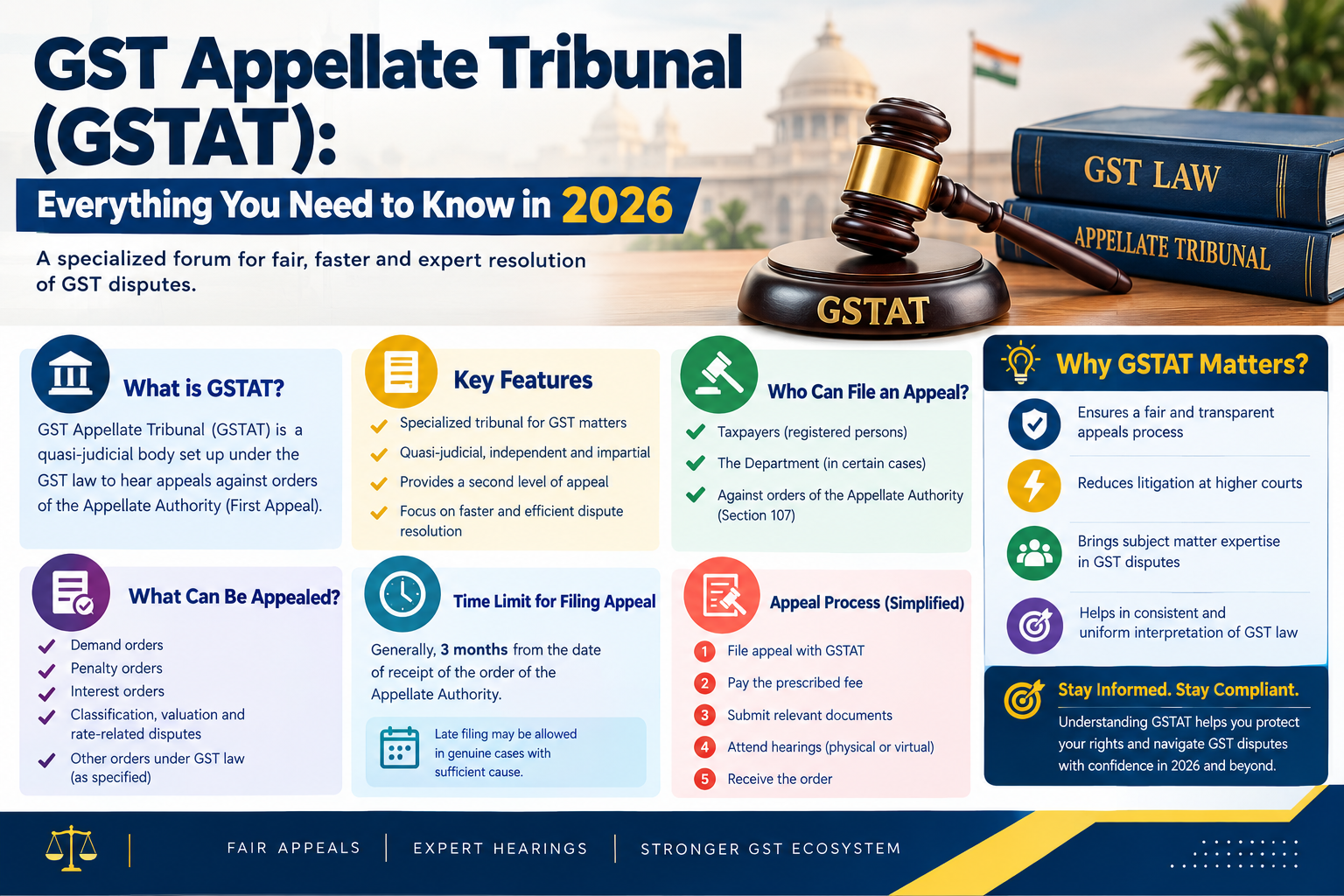
What Is GST Appellate Tribunal (GSTAT)?
The GST Appellate Tribunal (GSTAT) is the second appellate authority under India’s GST dispute-resolution framework. It hears appeals against eligible orders passed by the GST Appellate Authority or Revisional Authority under the CGST Act and corresponding State/UT GST laws.
GSTAT has been constituted under Section 109 of the Central Goods and Services Tax Act, 2017. The official GSTAT portal describes it as the second appellate authority for resolving disputes between taxpayers and tax authorities.
In 2026, GSTAT is no longer merely a proposed appellate mechanism. It has an operational digital filing system, benches, case-status facilities, cause lists and hearings. The official portal states that appeals are filed electronically and that hearings can be conducted in physical or hybrid/virtual mode.
For taxpayers in Bihar, this is particularly relevant because the Patna GSTAT Bench is operational and has its own official portal presence.
What Is GST Appellate Tribunal GSTAT?
GSTAT is the appellate forum that generally comes after the first appeal under the GST framework.
A simplified GST dispute pathway is:
GST Adjudicating Authority → First Appellate Authority → GSTAT → High Court → Supreme Court
The exact appellate route depends on the nature of the order and the statutory provisions involved.
GSTAT is therefore different from the first appellate authority.
For example, if a taxpayer challenges an adjudication order under Section 73 or another appealable provision, the taxpayer may first approach the Appellate Authority under Section 107.
If the taxpayer remains aggrieved by an eligible order passed by the Appellate Authority or Revisional Authority, the matter may proceed to GSTAT under Section 112.
Why Was GSTAT Created?
GST introduced a unified indirect-tax framework, but disputes inevitably arise regarding:
- Taxability
- Input Tax Credit
- Classification
- Valuation
- Place of supply
- Refunds
- Registration
- Penalties
- Demand proceedings
- Interest
- E-way bills
- Export and zero-rated supplies
- Exemptions
- Procedural compliance
Before the GST appellate tribunal became operational, taxpayers faced a significant gap in the intended appellate structure.
GSTAT is intended to provide a specialised appellate forum for GST disputes and promote consistency in interpretation and dispute resolution.
The GST Council has described operationalisation of GSTAT as an important step toward strengthening GST dispute resolution and providing greater certainty to taxpayers.
Is GSTAT Operational in 2026?
Yes.
This is one of the most important developments for GST taxpayers in 2026.
The official GSTAT website currently provides:
- E-filing
- Case status
- Cause lists
- Orders and judgments
- Benches
- E-Journal
- User guides
- Notices
- Digital case-management facilities
The GSTAT e-filing system states that appeals are filed electronically and that the system provides end-to-end case processing and case tracking.
GSTAT also began functioning through individual State Benches during 2026. For example, the Bengaluru Bench officially commenced court hearings on 5 August 2026.
Who Is the President of GSTAT?
The current President of GSTAT is Dr. Justice (Retd.) Sanjaya Kumar Mishra, who heads the Principal Bench at New Delhi.
The official GSTAT profile records that he previously served as Chief Justice of the Jharkhand High Court and Judge of the Uttarakhand High Court.
The GST Council’s records state that he was appointed President in 2024 and assumed office on 6 May 2024.
What Is the Jurisdiction of GSTAT?
GSTAT generally hears appeals against eligible orders passed by:
- The First Appellate Authority under Section 107
- The Revisional Authority under Section 108
- Corresponding authorities under applicable State/UT GST laws
Section 112 of the CGST Act provides the statutory framework for appeals to the Appellate Tribunal.
GSTAT can therefore become relevant after a taxpayer has already challenged an order at the first appellate stage.
GSTAT vs First Appellate Authority
These are two different stages.
| First Appellate Authority | GSTAT |
|---|---|
| First appellate stage | Second appellate stage |
| Generally Section 107 | Generally Section 112 |
| Appeal commonly filed in APL-01 | Appeal generally filed in APL-05 |
| Challenges adjudication orders | Challenges eligible appellate/revisional orders |
| Administrative appellate forum | Tribunal |
| First level of appeal | Second level of appeal |
A taxpayer should therefore identify exactly which order is being challenged before preparing the appeal.
When Can You File an Appeal Before GSTAT?
A person aggrieved by an eligible order passed under Section 107 or Section 108 may appeal to the Appellate Tribunal under Section 112, subject to the statutory conditions.
Section 112 provides a normal limitation period of three months from the date on which the order sought to be appealed against is communicated.
However, GSTAT’s initial operationalisation created a special issue for older appeals because the Tribunal became operational much later than GST itself.
The Government subsequently provided special arrangements and extensions for backlog appeals.
What Was the GSTAT Backlog Appeal Deadline in 2026?
The GSTAT portal currently records that the deadline for filing appeals under Section 112 was extended to 31 July 2026.
The portal states that taxpayers who faced technical problems with registration/e-filing could record their intent to file an appeal or application by that date, subject to the applicable instructions.
This was a special backlog/operationalisation measure, not a replacement for the ordinary statutory limitation period applicable to future appeals.
Therefore, taxpayers should not assume that every GSTAT appeal can be filed within a blanket July deadline.
For a new appeal, the limitation should be calculated from the relevant order and the applicable statutory provisions.
What Form Is Used for GSTAT Appeal?
For an appeal filed by a taxpayer before GSTAT, the principal form is:
FORM GST APL-05
The official GSTAT help centre confirms:
- APL-05 — taxpayer appeal
- APL-07 — appeal/application by Department
- APL-06 — cross-objections
- APL-02A Part A — provisional acknowledgement
- APL-02A Part B — final acknowledgement
- APL-04A — final order
The appeal is filed electronically through the GSTAT portal.
What Is the GSTAT Pre-Deposit Requirement?
This is one of the most important financial requirements.
For a taxpayer appeal before GSTAT, the official GSTAT portal states that a further 20% of the amount of tax in dispute, in addition to the pre-deposit made at the first appeal stage, is required.
Therefore, taxpayers should distinguish between:
First appeal
Generally involves the statutory pre-deposit under Section 107.
GSTAT appeal
Requires the additional statutory pre-deposit applicable under Section 112.
Example
Suppose the disputed tax is ₹20 lakh.
If the taxpayer has already made the required first-appeal pre-deposit and now approaches GSTAT, the additional GSTAT pre-deposit is generally calculated at 20% of the tax in dispute, subject to the statutory framework.
The exact amount should be verified from the impugned order, previous pre-deposit and GSTAT portal before filing.
Does GSTAT Pre-Deposit Mean the Entire Demand Must Be Paid?
No.
The statutory pre-deposit is not the same as payment of the entire disputed demand.
The purpose of the pre-deposit mechanism is to permit the appeal to proceed while providing the statutory protection associated with the appeal.
The taxpayer should nevertheless distinguish between:
- Admitted liability
- First-stage pre-deposit
- Additional GSTAT pre-deposit
- Disputed tax
- Interest
- Penalty
- Other components of demand
A proper demand reconciliation should be prepared before filing.
What Are the GSTAT Court Fees?
The GSTAT portal currently states that for specified demand and enforcement appeals, the court fee is:
₹1,000 for every ₹1 lakh of tax or input tax credit involved, or the difference in tax/ITC involved, or the amount of fine, fee or penalty determined in the order, subject to a maximum of ₹25,000.
For certain other order types, including refund, registration and specified recovery or other orders, the stated fee is ₹5,000.
Because the applicable fee depends on the order category, taxpayers should select the correct order type during e-filing.
How to File GSTAT Appeal Online?
GSTAT has been designed as a digital-first appellate tribunal.
The broad process is:
Step 1 — Review the impugned order
Identify the exact order being challenged.
Step 2 — Check limitation
Calculate the applicable filing deadline.
Step 3 — Identify disputed issues
Separate:
- Tax disputes
- ITC disputes
- Interest
- Penalty
- Procedural issues
- Questions of law
- Questions of fact
Step 4 — Calculate pre-deposit
Determine the additional statutory GSTAT pre-deposit.
Step 5 — Prepare the appeal
Prepare:
- Statement of facts
- Grounds of appeal
- Prayer
- Relevant legal provisions
- Supporting evidence
Step 6 — Register/login on GSTAT portal
The official GSTAT portal provides online registration and e-filing facilities.
Step 7 — Select the relevant appeal
Choose the appropriate appeal/application type.
Step 8 — Enter case details
The e-filing workflow includes:
- Order details
- Basic details
- Case details
- Appellant details
- Respondent
- Representative
- Demand details
- Document upload
- Checklist
- Final preview
Step 9 — Pay pre-deposit and court fee
Complete the required payment through the available payment mechanism.
Step 10 — Upload documents
Upload the appeal and supporting documents.
Step 11 — Review the final preview
Check every material detail before submission.
Step 12 — Submit the appeal
A provisional acknowledgement is generated after successful submission.
Step 13 — Respond to defects, if any
The GSTAT system provides a Refiling facility where defects are communicated to the appellant.
Step 14 — Obtain final registration
After scrutiny and registration, the final acknowledgement is issued.
What Documents Are Required for a GSTAT Appeal?
A strong GSTAT appeal generally requires more than the impugned order.
Depending on the case, documents can include:
Core documents
- Order-in-Original
- Order-in-Appeal
- Show Cause Notice
- Statement of demand
- APL-01
- APL-02
- APL-04
- Relevant adjudication order
GST records
- GSTR-1
- GSTR-3B
- GSTR-2B
- Electronic liability ledger
- Electronic credit ledger
- Electronic cash ledger
Transaction documents
- Tax invoices
- Purchase records
- Sales records
- E-way bills
- E-invoices
- Agreements
- Contracts
- Delivery documents
- Bank records
Legal documents
- Grounds of appeal
- Statement of facts
- Written submissions
- Case-law compilation
- Reconciliation statements
- Authorisation/Vakalatnama
The GSTAT’s May 2026 instructions specifically state that scrutiny officers should check whether APL-05 contains relevant copies of the SCN, Order-in-Original, Order-in-Appeal, statement of facts, grounds of appeal, pre-deposit and court fees where required. They also require an authorisation in favour of the tax professional or Vakalatnama for an advocate.
What Are the Grounds of Appeal Before GSTAT?
The grounds of appeal should identify the specific errors in the impugned order.
Potential grounds can involve:
1. Error of law
The authority may have incorrectly interpreted a GST provision.
2. Error of fact
The order may have misunderstood the underlying transaction.
3. Evidence ignored
Important documents or explanations may not have been properly considered.
4. Violation of natural justice
For example, an issue may arise regarding an opportunity to respond or be heard.
5. Incorrect ITC denial
The taxpayer may challenge denial of credit where statutory conditions and documentary evidence support the claim.
6. Incorrect tax classification
The dispute may concern classification of goods or services.
7. Incorrect valuation
The taxpayer may challenge the valuation adopted by the Department.
8. Incorrect penalty
The taxpayer may challenge the legal basis or quantum of penalty.
9. Limitation
Where supported by the facts, limitation can become an important legal issue.
The grounds should be drafted around the actual findings in the impugned order.
Can GSTAT Consider Questions of Fact?
Yes.
GSTAT is an appellate tribunal with a significant role in reviewing both factual and legal issues arising under GST.
The official GSTAT portal describes the Tribunal as the highest court in the country on questions of fact in GST litigation.
This makes the documentary record particularly important.
A taxpayer should therefore avoid assuming that only legal arguments matter.
A strong GSTAT appeal may require:
- Transaction reconstruction
- Invoice-level evidence
- Reconciliation
- Ledger analysis
- Contract interpretation
- Technical evidence
- Legal submissions
What Is the Role of the GSTAT Bench?
The Tribunal functions through its Principal Bench and State Benches.
The current framework provides for judicial and technical expertise.
The GSTAT portal explains that State Benches generally comprise:
- Judicial Members
- Technical Member (Centre)
- Technical Member (State)
The portal also provides for specialised bench structures and single-member arrangements in qualifying matters.
The GSTAT structure was modified over time through legislative amendments and implementation measures.
Can a Single Member Hear a GSTAT Appeal?
Certain appeals may be heard by a Single Member Bench, subject to the statutory and procedural conditions.
The GSTAT framework provides for single-member handling of specified matters involving lower-value disputes that do not involve a question of law, subject to the applicable conditions and approval mechanism.
The GSTAT’s 2026 bench orders also refer to matters involving tax liability or other issues below ₹50 lakh that do not involve a question of law being capable of allocation to a Single Bench, subject to the prescribed process.
This means the monetary value alone is not necessarily enough.
Whether a question of law is involved can also matter.
What Happens After Filing a GSTAT Appeal?
After submission, the case goes through scrutiny.
The broad process can involve:
E-filing → Provisional acknowledgement → Scrutiny → Defect notification, if any → Refiling → Registration → Listing → Hearing → Order
The GSTAT portal states that a provisional acknowledgement is generated after successful submission, while final acknowledgement follows scrutiny and registration.
If defects are identified, the appellant can receive notifications through email/SMS and can use the portal’s Refiling facility.
Are GSTAT Hearings Physical or Online?
GSTAT provides for hybrid hearings.
The official GSTAT portal states that hearings may be conducted physically or, with permission of the Member, electronically through virtual hearings.
This is particularly useful for taxpayers and professionals located away from the relevant bench.
The digital system is therefore intended to reduce the need for physical travel in appropriate cases.
What Happens If There Is a Defect in the GSTAT Appeal?
A defect does not necessarily mean that the appeal is finally rejected.
The GSTAT portal provides a refiling mechanism.
The appellant is notified of defects through registered communication and can access the Refiling tab to rectify them.
The correct response is to:
- Read the defect carefully.
- Identify what the Registry requires.
- Correct the relevant document or information.
- Re-upload where necessary.
- Re-submit within the applicable time.
Is Certified Copy of the Order Required?
The GSTAT’s 2026 filing instructions specifically address certified copies.
The instructions state that where a scanned copy of the Order-in-Original or Order-in-Appeal is attached and the scrutiny officer is satisfied from the endorsement that it is a certified copy, a defect should not be raised on that ground.
This reflects the practical adjustments introduced to facilitate digital filing.
Taxpayers should nevertheless retain the complete original/certified record wherever applicable.
Can a Tax Professional or Advocate Represent the Taxpayer?
Yes, subject to the applicable representation rules.
The GSTAT filing instructions specifically state that the taxpayer/appellant should upload an authorisation issued in favour of the tax professional or a Vakalatnama executed in favour of an advocate.
Representation becomes particularly important in disputes involving:
- Large tax demands
- Complex ITC disputes
- Classification disputes
- Valuation
- Fraud/suppression allegations
- Penalties
- Multiple tax periods
- Questions of law
- Significant documentary evidence
GSTAT Patna Bench: What Bihar Taxpayers Should Know
For Bihar taxpayers, GSTAT has a Patna Bench.
The official GSTAT Patna portal identifies Patna as a GSTAT State Bench and lists Manoj Shankar as Vice President, GSTAT, Bihar.
The Patna Bench’s current portal statistics show that it is receiving and registering GSTAT matters, demonstrating that the bench is operational.
This is significant for taxpayers in:
- Patna
- Gaya
- Muzaffarpur
- Bhagalpur
- Darbhanga
- Purnia
- Other parts of Bihar
Instead of depending exclusively on the Principal Bench at New Delhi, eligible Bihar matters can be handled through the jurisdictionally relevant GSTAT structure.
GSTAT 2026: Why the Tribunal Matters for Businesses
The operationalisation of GSTAT is important because GST disputes can involve substantial amounts.
A business facing a ₹10 lakh, ₹50 lakh or ₹1 crore GST dispute may need an appellate forum capable of examining:
- Detailed factual records
- GST returns
- ITC documentation
- Legal interpretation
- Departmental findings
- Taxpayer explanations
The GSTAT framework provides a dedicated appellate forum for these disputes.
For businesses, this means that GST litigation should increasingly be managed as a structured appellate process rather than simply as correspondence with the tax department.
Common GSTAT Appeal Mistakes
1. Missing the limitation period
A valid legal claim can face serious procedural difficulties if the appeal is not filed within the applicable period.
2. Incorrect pre-deposit calculation
The GSTAT pre-deposit is additional to the first-stage pre-deposit.
3. Filing without the complete appellate record
The Tribunal needs to understand what happened before it.
4. Generic grounds of appeal
Copy-paste grounds often fail to address the actual reasoning of the order.
5. Ignoring questions of fact
GSTAT can examine factual issues, making documentary evidence critical.
6. Poor reconciliation
ITC and demand disputes often depend on reconciliation between returns, invoices and departmental data.
7. Not checking defects
A defect notice should be addressed promptly.
8. Ignoring hearing notices
Filing the appeal is only the beginning.
9. Uploading poorly organised documents
Large volumes of evidence should be indexed and logically arranged.
10. Treating GSTAT as another GST portal form
A GSTAT appeal is a formal appellate proceeding and should be prepared accordingly.
Hypothetical Example: GSTAT Appeal Against ITC Denial
This example is hypothetical and for educational purposes only.
ABC Pvt. Ltd. receives an order denying ₹30 lakh of ITC.
The company challenges the order before the first Appellate Authority.
The Appellate Authority confirms the majority of the demand.
ABC Pvt. Ltd. then considers an appeal before GSTAT.
The company:
- Obtains the complete Order-in-Appeal.
- Calculates the limitation period.
- Reviews the first-stage pre-deposit already paid.
- Calculates the additional GSTAT pre-deposit.
- Reconciles purchase invoices with GSTR-2B and books.
- Reviews the SCN and adjudication order.
- Identifies factual and legal errors.
- Prepares a detailed statement of facts.
- Drafts grounds of appeal.
- Uploads the required documents.
- Pays applicable court fees.
- Files APL-05 electronically.
- Responds to any registry defects.
- Prepares for the GSTAT hearing.
The strength of the appeal will depend not merely on the amount disputed but on the quality of the evidence, legal grounds and explanation of the factual record.
GSTAT Appeal Checklist for Taxpayers
Before filing, verify:
Order
☐ Correct Order-in-Appeal identified
☐ Complete order available
☐ Communication date verified
Limitation
☐ Statutory deadline calculated
☐ Special transitional/backlog provisions checked, if applicable
Financial
☐ First appeal pre-deposit verified
☐ Additional GSTAT pre-deposit calculated
☐ Court fee calculated
Drafting
☐ Statement of facts prepared
☐ Grounds of appeal prepared
☐ Questions of law identified
☐ Relief/prayer clearly stated
Documents
☐ SCN
☐ Order-in-Original
☐ Order-in-Appeal
☐ GST returns
☐ Invoices
☐ Reconciliation
☐ Payment/pre-deposit evidence
☐ Authorisation/Vakalatnama
Filing
☐ GSTAT account created
☐ APL-05 selected
☐ Documents uploaded
☐ Court fee/pre-deposit paid
☐ Final preview checked
☐ Provisional acknowledgement saved
☐ Defects monitored
☐ Final registration/appeal number preserved
Frequently Asked Questions
1. What is GST Appellate Tribunal GSTAT?
GSTAT is the second appellate authority under the GST framework. It hears eligible appeals against orders passed by GST Appellate Authorities and Revisional Authorities.
2. Is GSTAT operational in 2026?
Yes. GSTAT has an operational e-filing system, benches, case-status facility, cause lists and hearings.
3. What form is used to file a GSTAT appeal?
A taxpayer generally files an appeal before GSTAT in FORM GST APL-05.
4. What is the GSTAT appeal time limit?
Section 112 generally provides a three-month period from communication of the order being challenged. Special provisions have applied to the backlog of appeals during GSTAT’s operationalisation.
5. What is the GSTAT pre-deposit?
The official GSTAT portal states that a taxpayer appeal requires an additional 20% of the tax in dispute, in addition to the pre-deposit made at the first appeal stage.
6. Is GSTAT filing online?
Yes. GSTAT provides an electronic filing system through its official portal.
7. Can GSTAT hearings be attended online?
Yes. GSTAT provides for hybrid hearings, with electronic/virtual participation permitted subject to the applicable procedure and permission.
8. What is APL-06?
APL-06 is the form used for filing cross-objections before GSTAT.
9. What is APL-07?
APL-07 is used for an appeal/application filed by the Department before GSTAT.
10. Can GSTAT examine questions of fact?
Yes. GSTAT has appellate jurisdiction over factual as well as legal issues within its statutory jurisdiction, and its official portal describes it as the highest court in India on questions of fact in GST litigation.
11. Is there a GSTAT Bench in Patna?
Yes. The official GSTAT website has a dedicated Patna Bench and identifies Manoj Shankar as Vice President, GSTAT, Bihar.
12. What happens if GSTAT finds defects in my appeal?
The appellant can be notified of defects and can use the GSTAT portal’s refiling facility to rectify them.
13. Can a GST lawyer represent me before GSTAT?
Representation by an authorised tax professional or advocate is possible subject to the applicable rules. GSTAT’s 2026 filing instructions require the relevant authorisation or Vakalatnama to be uploaded.
14. Is GSTAT the final court?
No. GSTAT is an appellate tribunal. Further appeal may lie to the High Court on specified substantial questions of law, and subsequently to the Supreme Court in appropriate cases.
Key Takeaways
- GST Appellate Tribunal GSTAT is India’s second appellate forum for eligible GST disputes.
- GSTAT is now operational in 2026 with an electronic filing and case-management system.
- Taxpayer appeals are generally filed in FORM GST APL-05.
- Section 112 generally provides a three-month limitation period from communication of the relevant order, subject to applicable provisions.
- A taxpayer generally needs to make an additional 20% pre-deposit of the tax in dispute at the GSTAT stage, in addition to the first-appeal pre-deposit.
- Court fees depend on the type and value of the appeal.
- GSTAT provides digital filing, case tracking, cause lists and hybrid hearings.
- The Patna GSTAT Bench is operational for Bihar taxpayers.
- A GSTAT appeal should contain a clear statement of facts, precise grounds, supporting evidence and a well-defined prayer.
- Registry defects should be monitored and corrected through the GSTAT refiling system.
- Complex GST disputes should be reviewed professionally before filing because limitation, pre-deposit, jurisdiction and appellate grounds can materially affect the case.