
GSTAT vs High Court: Where Should You File Your GST Appeal?

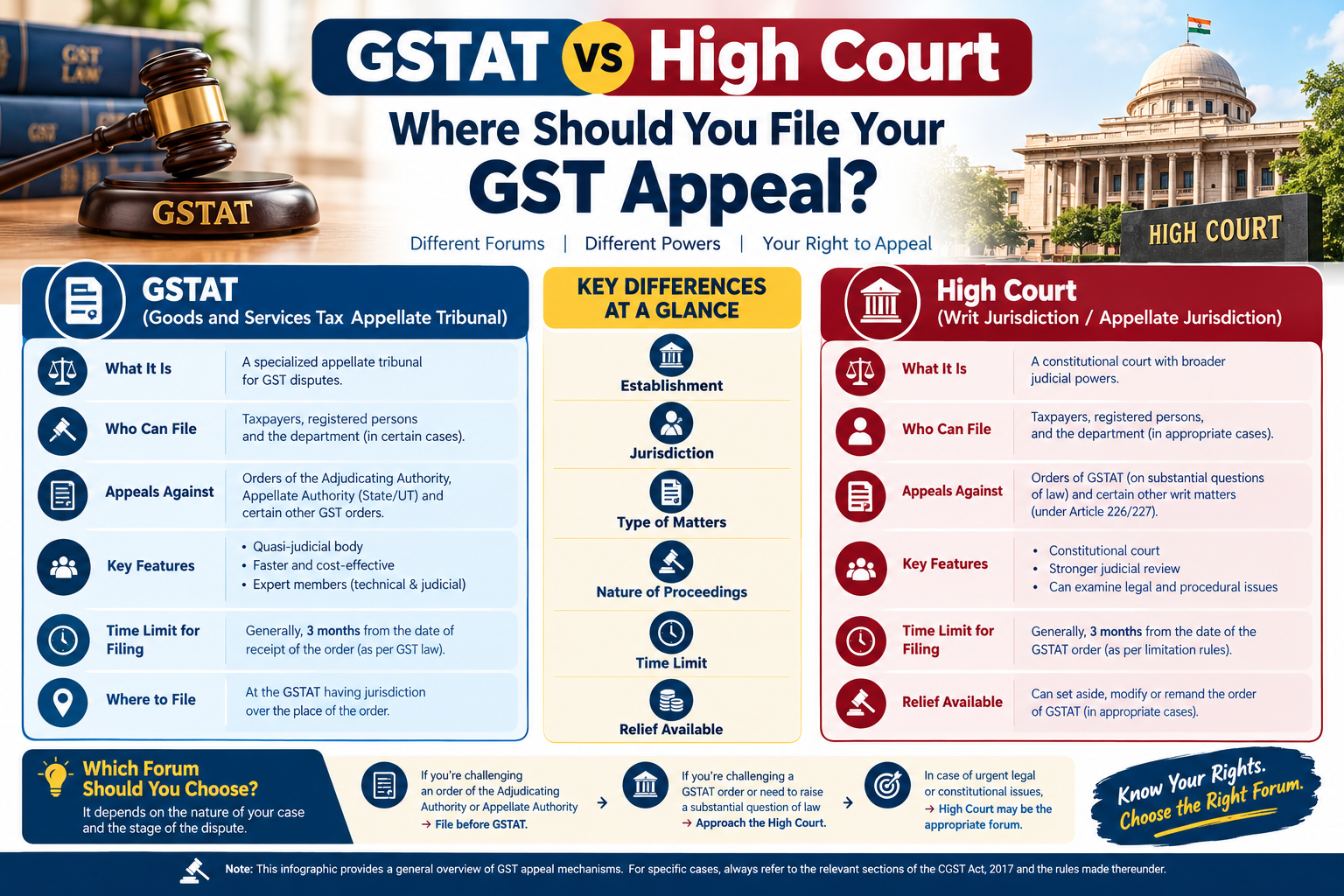
GSTAT or High Court?
The answer depends primarily on which order you are challenging and what kind of legal dispute you have.
If you are challenging an order passed by the first appellate authority under Section 107 or a revisional order under Section 108 of the CGST Act, the statutory second-appellate forum is generally the GST Appellate Tribunal (GSTAT) under Section 112.
If you are challenging an order of a State or Area Bench of GSTAT, Section 117 provides an appeal to the High Court where the case involves a substantial question of law. The statutory High Court appeal is therefore not simply a second opportunity to re-argue every factual issue decided by GSTAT.
For taxpayers in Bihar, this distinction is particularly relevant because the official GSTAT website now lists a Patna Bench and provides online case filing, case-status and order facilities.
Introduction
GST disputes can move through several stages before reaching finality.
A typical dispute may begin with an assessment, demand, penalty or other adjudication order. The taxpayer may then approach the first appellate authority under Section 107. If the appellate order is still adverse, the next statutory appellate forum is GSTAT under Section 112.
After GSTAT, a further statutory appeal to the High Court may arise under Section 117—but only where the statutory requirements, including the existence of a substantial question of law, are satisfied.
This makes the question “GSTAT vs High Court” slightly misleading if treated as a simple choice between two forums. In many GST disputes, they represent different stages of the appellate hierarchy.
Understanding this distinction can help taxpayers avoid filing before the wrong forum, missing limitation periods or framing a GSTAT dispute as though it were already a High Court appeal.
What Is GSTAT?
The Goods and Services Tax Appellate Tribunal (GSTAT) is the second appellate authority in the GST dispute-resolution structure.
Under Section 109, GSTAT hears appeals against orders passed by appellate or revisional authorities under Sections 107 and 108. The official GSTAT website describes it as the second appellate authority for GST disputes.
GSTAT is particularly important because GST disputes frequently involve a combination of:
- Questions of fact
- Interpretation of GST provisions
- Input tax credit disputes
- Classification issues
- Valuation disputes
- Taxability questions
- Demand and penalty disputes
- Documentary evidence
- Findings recorded by tax authorities
The GSTAT portal currently provides electronic filing and case-management facilities, and the official portal states that appeals before GSTAT are filed electronically.
What Is a High Court GST Appeal?
A High Court GST appeal under Section 117 of the CGST Act is different from an appeal before GSTAT.
Section 117 provides that a person aggrieved by an order of a State or Area Bench of the Appellate Tribunal may appeal to the High Court if the case involves a substantial question of law. The appeal is ordinarily required to be filed within 180 days from receipt of the Tribunal order, subject to the High Court’s power to entertain a delayed appeal where sufficient cause is shown.
The High Court formulates the substantial question of law and the statutory appeal is heard on the question so formulated, subject to the provisions of Section 117.
Therefore, a disagreement with every factual finding of GSTAT does not automatically create a Section 117 appeal.
GSTAT vs High Court: Key Difference
| Issue | GSTAT | High Court |
|---|---|---|
| Statutory provision | Section 112 | Section 117 |
| Typical starting point | Order under Section 107/108 | Order of State/Area GSTAT Bench |
| Main appellate role | Second appellate forum | Further appeal on substantial question of law |
| Facts | Can examine factual disputes | Section 117 appeal is focused on substantial questions of law |
| Limitation | Generally 3 months, subject to statutory extensions/condonation | 180 days from receipt of Tribunal order |
| Form | GST APL-05 | GST APL-08 |
| Pre-deposit | Statutory pre-deposit requirements apply | Section 117 does not prescribe the GSTAT-style statutory pre-deposit |
| Forum | GST Appellate Tribunal | Jurisdictional High Court |
| Further route | High Court in appropriate Section 117 cases | Supreme Court route may arise under applicable statutory provisions |
The statutory forms are reflected in the CGST Rules: APL-05 is prescribed for an appeal to the Appellate Tribunal, while APL-08 is prescribed for an appeal to the High Court.
When Should You File an Appeal Before GSTAT?
If your case has reached the first appellate authority and you remain aggrieved by the appellate order, Section 112 is the relevant statutory route to GSTAT.
Section 112 provides for an appeal against an order passed under Section 107 or Section 108. The current statutory framework provides a three-month period, with the legislation also containing provisions concerning notified dates and condonation of delay.
GSTAT may therefore be relevant when the dispute concerns:
- Whether tax was correctly demanded
- Whether input tax credit was correctly denied
- Whether a transaction constitutes a taxable supply
- Classification of goods or services
- Valuation
- Place-of-supply-related issues
- Taxability
- Penalty
- Interest
- Documentary evidence
- Findings of fact
- Interpretation of GST provisions
The exact grounds depend on the impugned appellate order and the record of the proceedings.
GSTAT Appeal Under Section 112: Important Pre-Deposit
One of the most important practical differences in the GSTAT route is the statutory pre-deposit.
Section 112(8) requires payment of:
- The admitted amount of tax, interest, fine, fee and penalty arising from the impugned order; and
- 10% of the remaining amount of tax in dispute, in addition to the amount already paid under Section 107(6), subject to the statutory ceiling.
The current Section 112 framework specifies a maximum of ₹20 crore for the 10% component. For an order demanding penalty without tax demand, a separate 10% requirement applies, along with the amount payable under the first-appeal provision.
Once the statutory amount under Section 112(8) is paid, recovery proceedings for the balance amount are deemed stayed during disposal of the appeal under Section 112(9).
Practical point
The pre-deposit calculation should be checked against the actual order because the amount can vary depending on:
- Admitted liability
- Disputed tax
- Interest
- Penalty
- Amount already deposited during the first appeal
- Whether the order involves tax demand or penalty alone
When Does the High Court Become Relevant?
The statutory High Court route under Section 117 generally arises after a State or Area Bench of GSTAT has passed an order.
The critical statutory requirement is a substantial question of law.
Section 117 specifically states that the High Court may admit an appeal if it is satisfied that the case involves a substantial question of law. The Court then formulates the question and hears the appeal in accordance with Section 117.
This means the High Court appeal should be analysed differently from a GSTAT appeal.
Examples of issues that may potentially raise questions of law include:
- Interpretation of a statutory GST provision
- Whether the Tribunal applied the correct legal test
- Interpretation of a notification or statutory rule
- Legal consequences arising from an admitted set of facts
- Whether the Tribunal’s decision involves a legally significant statutory interpretation issue
Whether a particular issue actually constitutes a substantial question of law depends on the pleadings, statutory provisions, factual findings and existing judicial authority.
It should not be assumed merely because a taxpayer disagrees with the GSTAT order.
Can You Directly Go to the High Court Instead of GSTAT?
The answer depends on the nature of the proposed proceeding.
For the ordinary statutory appellate hierarchy, Section 112 provides the route to GSTAT from orders covered by that provision, while Section 117 provides the statutory High Court appeal from specified GSTAT orders involving a substantial question of law.
A High Court also possesses constitutional jurisdiction under Article 226, which empowers High Courts to issue directions, orders and writs for specified constitutional and other legal purposes.
A writ proceeding, however, is conceptually different from a statutory Section 117 appeal. Whether a writ petition is appropriate depends heavily on the facts, the nature of the impugned action, the statutory remedies available and the circumstances of the case.
Accordingly, a taxpayer should not automatically treat Article 226 as a substitute for the ordinary GST appellate hierarchy.
GSTAT vs High Court: Facts or Questions of Law?
This is one of the most important distinctions.
GSTAT
GSTAT operates within the appellate framework and can deal with factual as well as legal aspects of a GST dispute within its statutory jurisdiction.
For example, a dispute may concern:
Whether the taxpayer actually possessed sufficient documentary evidence supporting an input tax credit claim.
That may require examination of invoices, books, returns, correspondence and other records.
High Court under Section 117
The statutory High Court appeal focuses on a substantial question of law.
For example:
What is the correct legal interpretation of a statutory provision when the relevant factual findings are already established?
The High Court does not function simply as another forum for repeating the entire factual appeal.
The statutory wording of Section 117 expressly links admission of the appeal to a substantial question of law.
What Is the Time Limit for GSTAT Appeal?
Section 112 generally provides a three-month period for an appeal to the Appellate Tribunal, subject to the specific statutory provisions concerning the commencement of limitation and condonation.
There has also been a significant transitional development concerning GSTAT’s operationalisation.
The Government extended the deadline for certain pending Section 112 appeals to 31 July 2026, following the earlier notified deadline of 30 June 2026. The GSTAT portal continues to display this historical transitional deadline.
Because that date has now passed, it should not be treated as the current deadline for a newly arising GSTAT appeal.
For a current dispute, the limitation position should be calculated from the relevant order and applicable statutory/notification framework.
What Is the Time Limit for a High Court GST Appeal?
Section 117(2) provides a 180-day period from the date the GSTAT order is received by the aggrieved person. The High Court may entertain a delayed appeal where sufficient cause for the delay is established.
This makes limitation management extremely important.
A taxpayer should preserve:
- Date of GSTAT order
- Date of communication/receipt
- Certified copy, where relevant
- Copy of the Tribunal order
- Date on which legal advice was obtained
- Draft grounds of appeal
- Proposed substantial questions of law
- Any explanation for delay
Which Form Is Used for GSTAT and High Court Appeals?
The prescribed forms are different.
GSTAT
An appeal to the Appellate Tribunal is filed in FORM GST APL-05 under the CGST Rules. The rules provide for electronic filing and supporting documentation requirements.
High Court
An appeal to the High Court under Section 117 is filed in FORM GST APL-08.
Using the correct form and following the applicable procedural requirements is important because appellate proceedings are highly document-driven.
What Is the GSTAT Filing Process?
The GSTAT rules provide for electronic filing of an appeal in APL-05.
A simplified workflow is:
Step 1: Examine the First Appellate Order
Read the order carefully and identify:
- Confirmed demand
- Dropped demand
- Findings on facts
- Findings on law
- ITC issues
- Penalty
- Interest
- Reasons for rejection
Step 2: Calculate Limitation
Determine the legally applicable filing deadline.
Step 3: Calculate the Pre-Deposit
Work out:
- Admitted liability
- Amount already paid
- Remaining disputed tax
- Applicable statutory pre-deposit
Step 4: Prepare Grounds of Appeal
The grounds should identify the specific findings that are challenged and explain why the order is legally or factually incorrect.
Step 5: Compile Supporting Documents
Relevant documents may include:
- Original adjudication order
- First appellate order
- Show cause notice
- Reply
- Written submissions
- Invoices
- GST returns
- Reconciliation statements
- ITC records
- Payment records
- Correspondence
- Evidence relied upon during proceedings
Step 6: File APL-05
The appeal is filed electronically in accordance with the applicable GSTAT procedure.
How Is a High Court GST Appeal Different?
A High Court appeal requires a different litigation strategy.
The first question should not simply be:
“Why is the GSTAT order wrong?”
The more relevant question is:
“What substantial question of law arises from the GSTAT order?”
The proposed grounds should therefore be carefully examined for:
- Statutory interpretation
- Legal errors
- Application of incorrect legal principles
- Questions arising from the Tribunal’s legal findings
- Substantial questions of law meeting Section 117 requirements
Section 117 requires the High Court to formulate the substantial question of law and provides that the appeal is heard on the question so formulated, subject to the statutory provision allowing consideration of another substantial question of law in specified circumstances.
GSTAT Patna Bench and Bihar Taxpayers
For taxpayers in Bihar, the forum question has a practical local dimension.
The official GSTAT website lists the Patna Bench and provides information on its case statistics, members, orders and proceedings.
The GSTAT’s broader structure includes a Principal Bench and State Benches across India. Its official website states that GSTAT provides online filing and case-management facilities.
This means that a Bihar taxpayer dealing with an appropriate second-stage GST appeal should examine the applicable GSTAT jurisdiction and current bench allocation rather than assuming that every dispute must be taken directly to the High Court.
What About the High Court in Bihar?
Once a statutory Section 117 appeal is maintainable from the relevant GSTAT State/Area Bench order and the jurisdictional requirements are satisfied, the appropriate High Court becomes relevant.
For Bihar-related GST litigation, the Patna High Court may become the relevant constitutional or statutory forum depending on the nature and jurisdiction of the proceeding.
However, the precise forum should be determined from:
- The GSTAT bench that passed the order
- Jurisdictional rules
- Nature of the dispute
- Statutory provision invoked
- Whether the proceeding is a Section 117 appeal or a writ proceeding
Can GSTAT Findings of Fact Be Challenged Before the High Court?
A factual disagreement by itself does not automatically satisfy Section 117.
The statutory test is whether the case involves a substantial question of law.
Therefore, when preparing a High Court appeal, it is important to distinguish between:
“The Tribunal reached the wrong factual conclusion.”
and
“The Tribunal’s conclusion gives rise to a substantial question of law because of the legal issue involved.”
The distinction can materially affect whether a Section 117 appeal is maintainable and how the memorandum should be drafted.
Is GSTAT the Final Court on Facts?
The GSTAT portal describes GSTAT as the highest court in the country on matters of fact in GST litigation.
This description reflects the statutory appellate structure: Section 117 does not provide a general rehearing of factual disputes before the High Court. Instead, the statutory High Court appeal is tied to substantial questions of law.
Therefore, the manner in which factual findings are challenged at the Tribunal stage can be extremely important.
Common Mistakes in GSTAT vs High Court Appeals
1. Treating GSTAT and High Court as Alternative Forums at the Same Stage
The statutory appellate hierarchy matters.
A Section 107 order and a GSTAT order do not ordinarily create the same appellate question.
2. Missing the Limitation Period
Even a potentially strong case can face procedural complications if limitation is not monitored carefully.
3. Treating Every Dispute as a Question of Law
A factual disagreement is not automatically a substantial question of law.
4. Ignoring the Pre-Deposit
The GSTAT appeal has specific statutory pre-deposit requirements under Section 112.
5. Repeating First-Appeal Grounds Without Addressing the Tribunal Order
The GSTAT order should be analysed specifically.
Similarly, a High Court appeal should engage with the Tribunal’s reasoning and identify the substantial question of law.
6. Filing Without Reviewing the Entire Record
GST litigation is highly document-dependent. A proper record can include:
- SCN
- Reply
- Order-in-original
- Appeal memorandum
- Written submissions
- Order-in-appeal
- GSTAT pleadings
- Evidence
- GST returns
- Reconciliations
- Supporting commercial documents
7. Assuming a High Court Filing Automatically Stops Recovery
A taxpayer should examine the applicable statutory provisions and seek appropriate interim relief where necessary. Section 119 specifically deals with amounts becoming payable notwithstanding appeals in the circumstances stated in that provision.
Hypothetical Example: GSTAT vs High Court
This is a hypothetical example for educational purposes.
Suppose a business receives a GST demand of ₹80 lakh.
The taxpayer challenges the demand before the first appellate authority under Section 107.
The appellate authority confirms most of the demand.
Stage 1 — GSTAT
The taxpayer challenges the appellate order before GSTAT under Section 112.
The taxpayer argues that:
- Certain transactions were incorrectly treated as taxable;
- Input tax credit was wrongly denied;
- Documentary evidence was not properly appreciated;
- The relevant statutory provision was incorrectly interpreted.
These issues can fall within the Tribunal’s appellate jurisdiction, subject to the applicable statutory requirements.
Stage 2 — High Court
Suppose GSTAT subsequently passes an adverse order.
The taxpayer then examines whether the Tribunal order gives rise to a substantial question of law under Section 117.
If such a question exists, a statutory High Court appeal may be considered within the Section 117 framework.
The taxpayer cannot assume that simply disagreeing with GSTAT’s factual conclusion automatically converts the matter into a Section 117 appeal.
GSTAT vs High Court: Practical Decision Framework
Before selecting or preparing the next appellate proceeding, ask:
Question 1
Which order am I challenging?
- Adjudication order?
- First appellate order?
- Revisional order?
- GSTAT order?
Question 2
What statutory remedy applies to that order?
The appellate provision should be identified before preparing the filing.
Question 3
Is the dispute primarily factual, legal or mixed?
This affects how the case should be framed.
Question 4
If GSTAT has already decided the matter, is there a substantial question of law?
This is central to Section 117.
Question 5
What is the limitation deadline?
Calculate it from the legally relevant communication/receipt date.
Question 6
What pre-deposit is required?
For GSTAT, Section 112(8) requirements should be calculated carefully.
Question 7
Is interim protection required?
If recovery is a concern, examine the applicable statutory position and whether an application for interim relief is necessary.
Documents to Keep Ready for GSTAT or High Court GST Litigation
A comprehensive litigation file may include:
- Show Cause Notice
- Reply to SCN
- Order-in-Original
- GST APL-01
- Order-in-Appeal
- GST APL-04
- GST APL-05
- GSTAT order
- GST APL-08, where applicable
- GST returns
- Electronic liability ledger
- Electronic credit ledger
- Electronic cash ledger
- Tax invoices
- Purchase and sales records
- E-way bills
- E-invoices
- Bank statements
- Reconciliation statements
- Contracts and agreements
- Correspondence with the department
- Written submissions
- Evidence relied upon before lower authorities
The exact documents required will depend on the nature of the dispute.
Why Professional Review Matters in GST Appeals
GST appeals are not merely form-filing exercises.
The legal strategy may involve determining:
- The correct appellate forum
- Limitation
- Pre-deposit
- Grounds of appeal
- Questions of fact
- Questions of law
- Evidence already on record
- Additional evidence requirements
- Recovery implications
- Interim relief
- Substantial questions of law
- Appropriate jurisdiction
The CGST Rules also regulate additional evidence before the Appellate Authority and Tribunal, meaning that taxpayers should not assume that every new document can automatically be introduced at the appellate stage.
GSTAT vs High Court: The Bottom Line
The GST appellate system is hierarchical.
GSTAT is generally the statutory second appellate forum for orders covered by Section 112.
The High Court route under Section 117 is a further statutory appeal from specified GSTAT State/Area Bench orders where a substantial question of law is involved.
Therefore, the practical issue is not simply “GSTAT vs High Court.”
The better sequence is:
Identify the impugned order → identify the statutory appellate stage → calculate limitation → determine the nature of the dispute → calculate applicable pre-deposit → frame appropriate grounds → select the correct forum.
For Bihar taxpayers, the official GSTAT website currently lists a Patna Bench, making it particularly important to verify the current Tribunal jurisdiction and filing procedure before initiating proceedings.
Legal remedies can vary significantly depending on the order, dates, facts, documents and statutory provisions involved. This article is for general informational purposes and should not be treated as case-specific legal advice.