- GST
- MCA
- NCLT Services
- Incorporation Of Private Limited Companies
- Incorporation of LLP
- Incorporation of OPC
- Incorporation of Section -8 Company
- Closure of Pvt. Ltd. Companies
- Annual Compliance – Pvt. Ltd
- Annual Compliance – OPC
- Annual Compliance – LLP
- Director Appointment
- Director – Resignation
- Share Transfer
- MOA Amendment
- Registered office Change
- DIN Services
- Others Services
- BUSINESS LICENSES
- Labour Law
- Courses
- Download

Annual Compliance – Pvt. Ltd
Your Trusted Legal & Taxation Partner Since 2012
Annual Compliance – Pvt. Ltd: Keep Your Company on Track
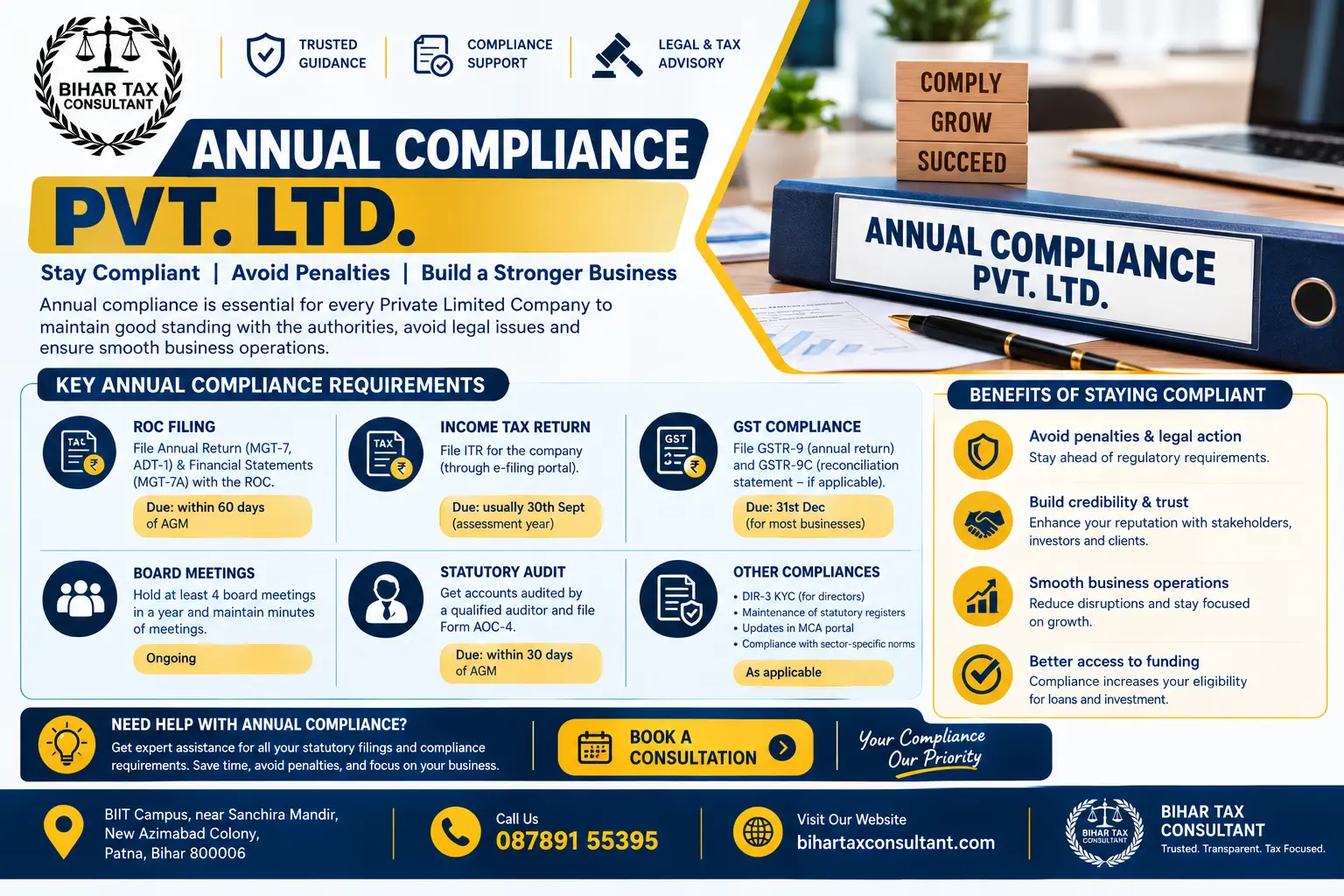
Annual Compliance – Pvt. Ltd
Annual Compliance – Pvt. Ltd means maintaining your company’s accounts, audit, meeting records and required statutory filings. Bihar Tax Consultant assists private limited companies in Patna and Bihar with compliance review, document preparation and ROC filing coordination. Start with your company’s actual records, applicable obligations and filing history.
Keep the paperwork organised so you can make informed decisions about what is due. Whether your company is newly incorporated, actively trading or reviewing pending filings, a company-specific compliance plan helps identify the work required and who will complete it.
Request a company compliance review. Call +91 8789155395 with your company name, CIN and financial year. We can help identify the records and scope needed for an initial review.
What does your company need to complete each year?
Annual compliance brings together financial reporting, corporate approvals and statutory disclosures. The applicable work depends on the company’s classification, transactions, previous filings and any exemptions. A useful review checks both what has been filed and whether the underlying accounts, approvals and company records support those filings.
- Preparation and reconciliation of accounting records for the financial year.
- Coordination of statutory audit with an eligible chartered accountant.
- Financial statements, Board’s report and applicable accompanying documents.
- Board and shareholder meeting notices, resolutions and minutes.
- Financial statement filing in the applicable AOC-4 form or variant.
- Annual return filing in MGT-7 or MGT-7A, as applicable.
- Review of statutory registers, shareholding records and directors’ disclosures.
- Separate review of tax obligations and filings triggered by company events.
Where should you start?
Choose the issue you need reviewed: this year’s annual filings, earlier pending years, or a company notice. Bring the relevant financial year, CIN and available acknowledgements. This helps define the scope before detailed documents are requested and avoids treating different compliance problems as one generic filing task.
- Current year review: organise accounts, audit work, approvals and applicable annual forms.
- Pending years: identify outstanding forms, missing records and any default requiring separate action.
- Notice received: preserve the complete notice, response deadline and related filing records.
Need help organising accounts, approvals and ROC filings?
We begin with the CIN, financial year and available records. The review identifies the applicable forms, missing documents, pending approvals and filing history. The agreed scope can include drafting, document coordination, filing assistance, tracking acknowledgements and responding to resubmission requirements.
Audit, professional certification and work reserved for qualified professionals are undertaken by the appropriately authorised professional. Company directors remain responsible for approving accurate records and disclosures. The engagement should identify who maintains accounts, conducts the audit, signs documents and submits each filing.
AOC-4 or MGT-7: which filings does your company need?
AOC-4 reports financial statements; MGT-7 or MGT-7A reports annual return information. They serve different purposes and are not interchangeable. The correct form and attachments must be selected against the company’s status and current MCA instructions, including any requirement for consolidated statements or XBRL filing.
| Requirement | General position | Planning point |
| Financial statements | Applicable AOC-4 form or variant | Generally within 30 days of AGM under section 137. |
| Annual return | MGT-7 or MGT-7A | Generally within 60 days of AGM under section 92; if no AGM, statutory rules still apply. |
| Annual general meeting | Section 96 | First AGM generally within 9 months of first financial year end; later AGMs within 6 months, with a 15-month maximum gap, subject to lawful extension. |
| Auditor appointment | ADT-1 where required | Review the appointment or reappointment event; do not assume a new appointment filing is required every year. |
| Director KYC | Revised DIN KYC framework | Track the applicable cycle and changes; it is distinct from annual company filings. |
These are baseline rules, not a universal calendar. An AGM extension and a filing-fee relaxation are different measures. Non-adoption of accounts, failure to hold an AGM, company classification and current circulars may alter the action required. Check dates before signing or filing.
No turnover this year? Does your company still need filings?
An active private limited company must examine its annual reporting and audit obligations even if it made no sales, earned no profit or has not started operations. Expenses, bank charges, capital contributions and loans may still need accounting treatment. A zero-turnover company should not be treated as exempt merely because it did not trade.
Dormant status, strike-off and closure are separate legal matters. If the company will not operate, discuss the appropriate route and outstanding liabilities rather than simply stop filing.
“Company mein business nahi hua, phir bhi annual filing karni hai?” An active company should still review its obligations. Zero turnover alone does not remove company-law reporting requirements. Start by checking its status, financial records and applicable filings.
Is your company eligible for small company relaxations?
Small company status can affect annual return forms and other compliance requirements. The classification must be checked each year against the applicable financial tests and statutory exclusions. A private limited company is not automatically a small company, and an MSME registration does not establish that status under the Companies Act.
MCA increased the financial limits with effect from 1 December 2025 to paid-up share capital not exceeding ₹10 crore and turnover not exceeding ₹100 crore. Both tests and the relevant statutory conditions must be satisfied. Holding and subsidiary companies, Section 8 companies and entities governed by a special Act are excluded under section 2(85).
Director KYC in 2026: what has changed?
The revised framework effective from 31 March 2026 replaces annual DIN KYC with a three-year cycle. Director KYC must therefore be assessed separately from the company’s annual returns. Filing history, DIN status and changes to contact or address information should be reviewed before deciding what is due.
The ICAI announcement explains the transition for directors whose KYC was completed, including the next cycle due by 30 June 2028. Confirm the current notification and each director’s position before relying on that date. This change does not remove annual company filing obligations.
What should you have ready before a compliance review?
Bring records for the relevant financial year and the last completed filing year. Complete records help reconcile accounts and company disclosures before approval. If a record is unavailable, identify the gap at the beginning so the required evidence can be collected without creating inconsistent statements or unsupported meeting dates.
- Certificate of incorporation, CIN, PAN, memorandum and articles.
- Previous financial statements, audit reports, Board’s reports and annual returns.
- Earlier MCA acknowledgements, SRNs, challans and any notices.
- Bank statements, ledgers, trial balance, invoices and expense records.
- Loan, asset, investment, deposit and related-party transaction details.
- GST, TDS and income-tax records relevant to reconciliation.
- Director and member details, shareholding changes and statutory registers.
- Meeting notices, attendance records, resolutions and signed minutes.
- Auditor appointment records, consents and appointment terms.
- Details of valid digital signatures and authorised signatories.
Never share a DSC token password or private key through an enquiry form. Signing arrangements can be agreed after the scope and authorised signatories are identified.
How do we help you move from records to completed filings?
1 Review the company profile
Confirm the company’s classification, financial year, filing history and relevant transactions.
2 Identify obligations and dates
Prepare a company-specific action list, including pending annual filings and separate event-based requirements.
3 Reconcile the records
Review accounts, shareholding, director details and previous disclosures for consistency.
4 Coordinate accounts and audit
Arrange the financial reporting and statutory audit work with the appropriate professionals.
5 Prepare approvals and documents
Organise the Board’s report, notices, resolutions and meeting records based on actual proceedings.
6 Submit and retain evidence
Complete the agreed filings, track payment and submission status, and preserve acknowledgements and final copies.
Does ROC filing complete your GST and income-tax compliance?
ROC filings report company-law information to the Registrar. Income-tax, TDS and GST compliance arise under separate legal frameworks. Filing an annual return with MCA does not discharge tax obligations, and filing tax returns does not complete ROC annual compliance. Each applicable obligation needs its own review and evidence of completion.
The compliance plan should also identify event-based matters such as director changes, share allotments, registered-office changes and charges. These should not wait for the annual filing exercise. Conditional requirements such as MSME-1, DPT-3, beneficial ownership reporting and CSR disclosures need separate applicability checks.
Pending filings from earlier years? Start with a clear review
Start with a year-wise review of outstanding forms, accounts and meeting records. The remedy depends on the actual default and company status. Additional filing fees and statutory penalties are separate issues, and a late filing does not automatically resolve every consequence of the original failure.
We can assist with organising the backlog, identifying notices and preparing the agreed corrective work. Do not invent or backdate approvals to make the filing history appear complete. Preserve the true chronology and obtain advice on any default requiring separate action.
What will your annual compliance work cost?
Professional fees depend on the accounting workload, company structure, audit coordination, number of pending years, applicable forms and additional advisory work. An itemised proposal should distinguish professional charges from statutory filing fees, additional fees, audit charges and any work outside the annual compliance scope.
Share the CIN, financial year, turnover, transaction volume and previous filing status for a scoped estimate. Completion time depends on record readiness, audit work, approvals and portal processing; a filing or approval date should not be assumed before review.
Which compliance mistakes can create extra work?
- Using one checklist for every private company without reviewing its classification.
- Assuming no turnover means no audit or annual filing requirement.
- Treating AOC-4 and the annual return as substitutes for each other.
- Using obsolete director KYC instructions or assuming ADT-1 is always annual.
- Ignoring changes to shares, directors, loans or the registered office.
- Relying on a payment receipt without checking final filing status.
- Allowing accounts, annual returns and statutory registers to show conflicting details.
Frequently asked questions
What is Annual Compliance – Pvt. Ltd?
It is the recurring review and completion of a private limited company’s accounting, audit, corporate records and statutory filing obligations, subject to the company’s classification and applicable law.
Is annual compliance required when turnover is zero?
An active private limited company must examine its annual reporting and audit obligations even with zero turnover. No business activity does not automatically create an exemption.
What is the difference between AOC-4 and MGT-7?
AOC-4 reports financial statements. MGT-7 reports annual return information. Eligible small companies and OPCs use MGT-7A instead of MGT-7.
When are financial statements filed with ROC?
Under the general rule in section 137, adopted financial statements are filed within 30 days of the AGM. Special situations and applicable circulars require separate review.
When is the annual return filed?
The general rule under section 92 is within 60 days of the AGM. Where no AGM is held, the statutory filing rule still applies and reasons must be addressed.
Is statutory audit the same as income-tax audit?
No. Statutory audit under company law and tax audit under income-tax law have different legal bases and applicability conditions. One should not be assumed to replace the other.
Is ADT-1 filed every year?
Do not assume it is an annual filing. Review the auditor appointment or reappointment, the appointment term and the applicable filing requirement.
Is director KYC required every year?
The revised framework effective from 31 March 2026 uses a three-year KYC cycle. Check each director’s filing history, DIN status and any changes requiring action.
Can pending filings from earlier years be reviewed?
Yes. A year-wise review can identify pending forms, missing accounts, notices and the corrective work required. Fees and consequences depend on the actual default.
Does ROC compliance include GST and income-tax returns?
They are separate obligations. Include tax work expressly in the engagement if required; ROC annual filings alone do not complete tax compliance.
Can a company in Bihar obtain assistance in Patna?
Bihar Tax Consultant assists companies in Patna and Bihar with document review, compliance planning and agreed filing coordination. The scope is determined after reviewing the company records.
What should I provide for an initial enquiry?
Provide the company name, CIN, financial year, basic activity details, previous filing status and any notice or urgent date. Detailed documents can be requested after the scope is discussed.
Ready to review your company’s compliance?
Know what needs attention before your next filing. For Annual Compliance – Pvt. Ltd assistance in Patna and Bihar, share your CIN, financial year and last completed filings with Bihar Tax Consultant.
Call +91 8789155395 to request a compliance review. If earlier filings are pending or a notice has arrived, mention the relevant year and any urgent date.
Bihar Tax Consultant – GST Registration – Company Registration
BIIT Campus, near Sanchira Mandir, New Azimabad Colony, Patna, Bihar 800006
Telephone: +91 8789155395
General information only, not legal advice. An enquiry does not create an advocate–client relationship. Advice and assistance require review and an agreed engagement. Filing acceptance, approval and completion periods are not guaranteed.
[/vc_column_text]
{ "@context": "https://schema.org", "@graph": [ { "@type": "ProfessionalService", "@id": "https://bihartaxconsultant.com/#business", "name": "Bihar Tax Consultant – GST Registration – Company Registration", "url": "https://bihartaxconsultant.com/", "telephone": "+918789155395", "address": { "@type": "PostalAddress", "streetAddress": "BIIT Campus, near Sanchira Mandir, New Azimabad Colony", "addressLocality": "Patna", "addressRegion": "Bihar", "postalCode": "800006", "addressCountry": "IN" }, "areaServed": [ { "@type": "City", "name": "Patna" }, { "@type": "State", "name": "Bihar" } ] }, { "@type": "WebPage", "@id": "https://bihartaxconsultant.com/annual-compliance-pvt-ltd/#webpage", "url": "https://bihartaxconsultant.com/annual-compliance-pvt-ltd/", "name": "Annual Compliance - Pvt. Ltd: Keep Your Company on Track", "description": "Annual Compliance - Pvt. Ltd in Patna, Bihar. Get help with ROC filings, company records and audit coordination. Discuss your requirements: +91 8789155395.", "inLanguage": "en-IN", "about": { "@id": "https://bihartaxconsultant.com/annual-compliance-pvt-ltd/#service" }, "breadcrumb": { "@id": "https://bihartaxconsultant.com/annual-compliance-pvt-ltd/#breadcrumb" } }, { "@type": "Service", "@id": "https://bihartaxconsultant.com/annual-compliance-pvt-ltd/#service", "name": "Annual Compliance - Pvt. Ltd", "serviceType": "Private limited company annual compliance assistance", "url": "https://bihartaxconsultant.com/annual-compliance-pvt-ltd/", "provider": { "@id": "https://bihartaxconsultant.com/#business" }, "areaServed": [ { "@type": "City", "name": "Patna" }, { "@type": "State", "name": "Bihar" } ], "description": "Assistance with compliance review, company records, document preparation, audit coordination and applicable ROC annual filings." }, { "@type": "BreadcrumbList", "@id": "https://bihartaxconsultant.com/annual-compliance-pvt-ltd/#breadcrumb", "itemListElement": [ { "@type": "ListItem", "position": 1, "name": "Home", "item": "https://bihartaxconsultant.com/" }, { "@type": "ListItem", "position": 2, "name": "MCA", "item": "https://bihartaxconsultant.com/mca/" }, { "@type": "ListItem", "position": 3, "name": "Annual Compliance - Pvt. Ltd", "item": "https://bihartaxconsultant.com/annual-compliance-pvt-ltd/" } ] } ]}FAQ JSON LD{ "@context": "https://schema.org", "@type": "FAQPage", "@id": "https://bihartaxconsultant.com/annual-compliance-pvt-ltd/#faq", "mainEntity": [ { "@type": "Question", "name": "What is Annual Compliance - Pvt. Ltd?", "acceptedAnswer": { "@type": "Answer", "text": "It is the recurring review and completion of a private limited company’s accounting, audit, corporate records and statutory filing obligations, subject to the company’s classification and applicable law." } }, { "@type": "Question", "name": "Is annual compliance required when turnover is zero?", "acceptedAnswer": { "@type": "Answer", "text": "An active private limited company must examine its annual reporting and audit obligations even with zero turnover. No business activity does not automatically create an exemption." } }, { "@type": "Question", "name": "What is the difference between AOC-4 and MGT-7?", "acceptedAnswer": { "@type": "Answer", "text": "AOC-4 reports financial statements. MGT-7 reports annual return information. Eligible small companies and OPCs use MGT-7A instead of MGT-7." } }, { "@type": "Question", "name": "When are financial statements filed with ROC?", "acceptedAnswer": { "@type": "Answer", "text": "Under the general rule in section 137, adopted financial statements are filed within 30 days of the AGM. Special situations and applicable circulars require separate review." } }, { "@type": "Question", "name": "When is the annual return filed?", "acceptedAnswer": { "@type": "Answer", "text": "The general rule under section 92 is within 60 days of the AGM. Where no AGM is held, the statutory filing rule still applies and reasons must be addressed." } }, { "@type": "Question", "name": "Is statutory audit the same as income-tax audit?", "acceptedAnswer": { "@type": "Answer", "text": "No. Statutory audit under company law and tax audit under income-tax law have different legal bases and applicability conditions. One should not be assumed to replace the other." } }, { "@type": "Question", "name": "Is ADT-1 filed every year?", "acceptedAnswer": { "@type": "Answer", "text": "Do not assume it is an annual filing. Review the auditor appointment or reappointment, the appointment term and the applicable filing requirement." } }, { "@type": "Question", "name": "Is director KYC required every year?", "acceptedAnswer": { "@type": "Answer", "text": "The revised framework effective from 31 March 2026 uses a three-year KYC cycle. Check each director’s filing history, DIN status and any changes requiring action." } }, { "@type": "Question", "name": "Can pending filings from earlier years be reviewed?", "acceptedAnswer": { "@type": "Answer", "text": "Yes. A year-wise review can identify pending forms, missing accounts, notices and the corrective work required. Fees and consequences depend on the actual default." } }, { "@type": "Question", "name": "Does ROC compliance include GST and income-tax returns?", "acceptedAnswer": { "@type": "Answer", "text": "They are separate obligations. Include tax work expressly in the engagement if required; ROC annual filings alone do not complete tax compliance." } }, { "@type": "Question", "name": "Can a company in Bihar obtain assistance in Patna?", "acceptedAnswer": { "@type": "Answer", "text": "Bihar Tax Consultant assists companies in Patna and Bihar with document review, compliance planning and agreed filing coordination. The scope is determined after reviewing the company records." } }, { "@type": "Question", "name": "What should I provide for an initial enquiry?", "acceptedAnswer": { "@type": "Answer", "text": "Provide the company name, CIN, financial year, basic activity details, previous filing status and any notice or urgent date. Detailed documents can be requested after the scope is discussed." } } ]}