
Capital Gain on Agricultural Land in India: Tax Rules, Exemptions & Section 54B

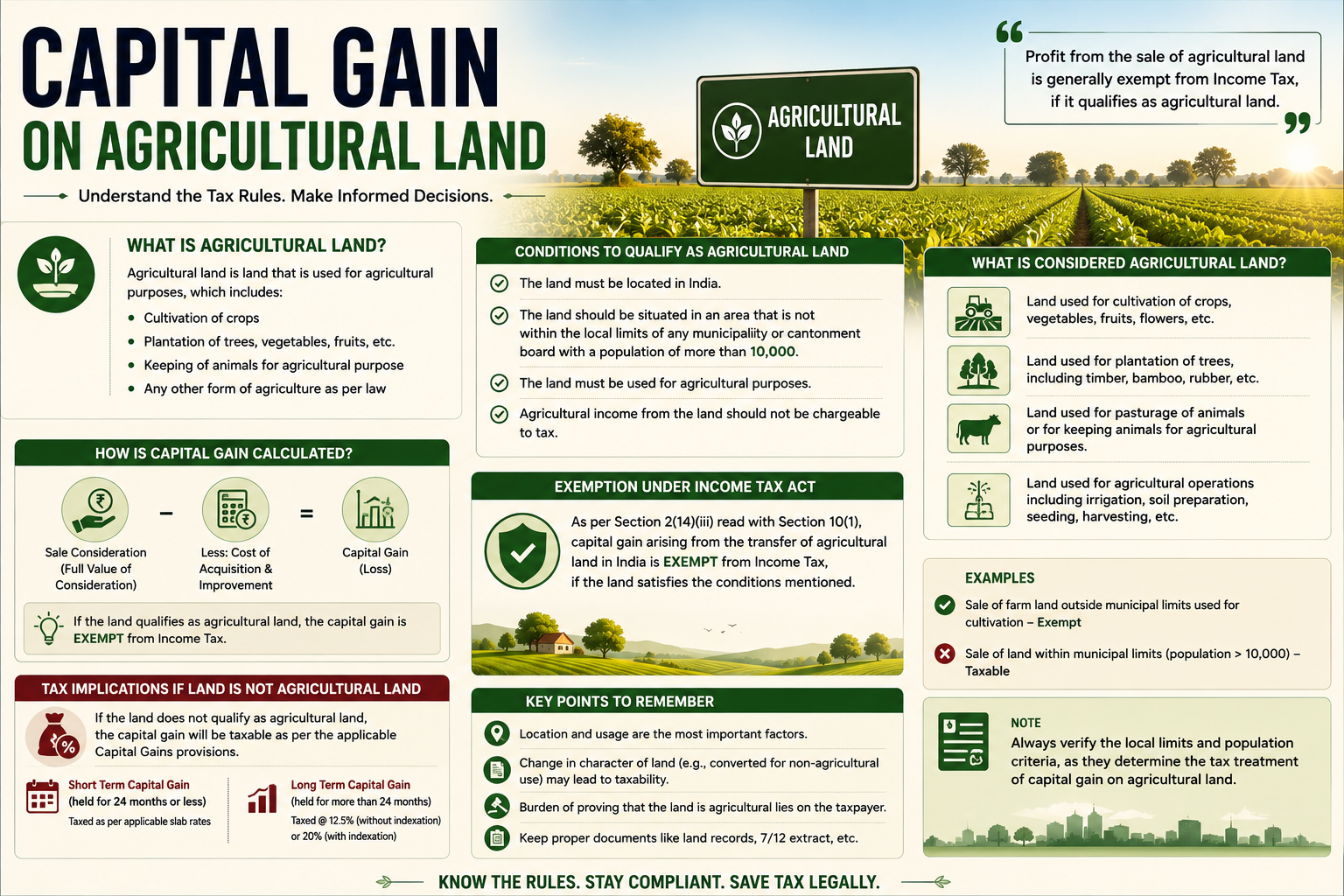
Is Capital Gain on Agricultural Land Taxable?
It depends on whether the agricultural land qualifies as a “capital asset” under the Income-tax law.
Agricultural land in India that qualifies as rural agricultural land is generally excluded from the definition of a capital asset. Consequently, gain from its sale is generally not taxable as capital gains.
However, agricultural land situated within specified urban areas or within specified distances of qualifying municipalities/cantonment boards can be treated as a capital asset. Gain from its transfer can then be taxable under the head “Capital Gains.”
This distinction is extremely important.
Simply calling land “agricultural land” in a sale deed does not by itself settle the income-tax treatment. The location of the land, applicable municipal limits, population criteria, notified distance and other relevant facts must be examined.
Further, where agricultural land is a capital asset and is transferred, an eligible individual or HUF may potentially claim relief under Section 54B by purchasing another agricultural land within the prescribed period, subject to the statutory conditions.
Introduction
Agricultural land transactions can involve substantial amounts and often create confusion about income-tax liability.
A common assumption is:
“It is agricultural land, so there is no capital gains tax.”
That statement is not always correct.
For income-tax purposes, agricultural land is broadly divided into two important categories:
- Rural agricultural land — generally outside the definition of a capital asset.
- Urban agricultural land — may qualify as a capital asset and therefore may attract capital gains tax.
The Income Tax Department itself explains that rural agricultural land is excluded from the definition of capital asset, whereas urban agricultural land can be subject to capital gains taxation.
The classification therefore needs to be established before calculating the tax.
What Is Agricultural Land for Income-Tax Purposes?
The Income-tax Act does not simply treat every piece of land used for farming identically.
Under the capital-asset definition, agricultural land in India is excluded from “capital asset” status unless it falls within specified areas connected with municipalities or cantonment boards or specified distances from them.
Under the Income-tax Act, 1961, Section 2(14)(iii) contains the relevant framework.
Broadly, agricultural land can become a capital asset where it is:
- Situated within the jurisdiction of a municipality or cantonment board having the prescribed population; or
- Situated within the specified distance from such municipality or cantonment board, subject to the statutory conditions.
The existing statutory text refers to municipalities/cantonment boards having a population of at least 10,000 and provides for specified distances, with the maximum distance being 8 kilometres, subject to Central Government notification and the applicable population criteria.
Rural Agricultural Land vs Urban Agricultural Land
This is the most important distinction.
| Particular | Rural Agricultural Land | Urban Agricultural Land |
|---|---|---|
| Capital asset? | Generally no | Generally yes |
| Sale normally taxable as capital gain? | Generally no | Potentially yes |
| Capital-gain computation required? | Generally no | Yes, if taxable |
| Section 54B relevance | Generally unnecessary because no capital gain | Potentially relevant |
| Location test important? | Yes | Yes |
The Income Tax Department expressly states that rural agricultural land is not treated as a capital asset, whereas transfer of urban agricultural land can give rise to taxable capital gains.
How Is Rural Agricultural Land Determined?
This is often more complicated than simply asking whether crops are grown on the land.
The location of the land must be examined against the statutory conditions.
Important questions include:
- Is the land situated within municipal limits?
- What was the population of the relevant municipality/cantonment board under the applicable census?
- Is the land located outside those limits?
- How far is it from the relevant municipal/cantonment limits?
- Is there a Central Government notification applicable to the area?
- What was the applicable legal position on the relevant date?
The distance and population tests can therefore be decisive.
A taxpayer should not rely solely on revenue records describing the land as agricultural.
Does the Land Being Used for Farming Automatically Make It Tax-Free?
No.
Actual agricultural use is an important factual consideration, but the capital-asset definition also contains a location-based test.
For example, land may actually be used for cultivation but still fall within the statutory definition of a capital asset because of its location.
Conversely, qualifying rural agricultural land can remain outside the capital-asset definition.
Therefore, the tax analysis should consider both:
Nature/use of land + statutory location test
What Is Capital Gain on Sale of Agricultural Land?
Where agricultural land qualifies as a capital asset, the gain from its transfer can be taxable as capital gain.
A simplified computation is:
Full Value of Consideration
Less: Eligible transfer expenses
Less: Cost of acquisition
Less: Eligible cost of improvement
= Capital Gain
The applicable computation provisions depend on the relevant tax year and statutory framework.
The Income Tax Department’s current capital-gains material recognises deductions for cost of acquisition, cost of improvement and expenditure incurred wholly and exclusively in connection with transfer.
Is Agricultural Land a Short-Term or Long-Term Capital Asset?
If the agricultural land is a capital asset, the applicable holding-period rules must be examined.
For land or building, the general threshold for long-term classification is more than 24 months.
Accordingly:
- Held for 24 months or less → generally short-term.
- Held for more than 24 months → generally long-term.
The distinction matters because the tax rate and applicable capital-gains provisions can differ.
What Is Section 54B?
Section 54B provides relief from capital gains arising from the transfer of qualifying agricultural land where the taxpayer purchases another agricultural land and satisfies the statutory conditions.
The provision is particularly relevant to individuals and HUFs.
The Income Tax Department states that Section 54B can apply to capital gains arising from transfer of agricultural land, whether the gain is short-term or long-term, provided the prescribed conditions are satisfied.
This is an important distinction.
Section 54B is not limited only to long-term capital gains.
Who Can Claim Section 54B?
The benefit is available to:
- Individual taxpayers
- Hindu Undivided Families (HUFs)
The agricultural land being transferred must satisfy the prescribed agricultural-use requirement.
Under the Section 54B framework, the land must have been used for agricultural purposes by the assessee or, in specified cases, by the assessee’s parent or HUF during the two years immediately preceding the date of transfer.
What Are the Main Conditions for Section 54B?
Broadly, the following conditions need to be examined:
1. The taxpayer must be an individual or HUF
A company or ordinary partnership firm cannot simply claim Section 54B merely because it owns agricultural land.
2. The transferred asset must be qualifying agricultural land
The land must satisfy the statutory requirements.
3. Agricultural use for the preceding two years
The land must have been used for agricultural purposes by the assessee or qualifying person during the required period.
4. Purchase of another agricultural land
The taxpayer must purchase another agricultural land within two years after the date of transfer.
5. Investment must satisfy the statutory conditions
The amount of relief is linked to the amount of capital gain and the qualifying investment.
The Income Tax Department’s Section 54B guidance confirms these principal conditions.
How Much Exemption Is Available Under Section 54B?
The exemption is generally the lower of:
- Capital gain arising from the transfer of the original agricultural land; or
- Amount invested in the new agricultural land, including qualifying CGAS deposit where applicable.
For example:
Capital gain: ₹15 lakh
Investment in new agricultural land: ₹10 lakh
Potential Section 54B exemption:
₹10 lakh
Taxable capital gain:
₹5 lakh
The Income Tax Department uses the same lower-of-capital-gain-or-new-investment principle in its Section 54B guidance.
What Happens If the New Agricultural Land Is Sold Within 3 Years?
This is an important Section 54B condition.
If the new agricultural land acquired for claiming the exemption is transferred within three years from the date of its acquisition, the earlier tax benefit can effectively be withdrawn through the statutory cost-adjustment mechanism.
The Income Tax Department’s Section 54B guidance illustrates that the amount of exemption previously claimed is deducted from the cost of acquisition of the new agricultural land when it is transferred within the specified period.
Therefore, taxpayers should not assume that purchasing another agricultural property permanently eliminates the earlier capital-gains liability.
What If I Cannot Purchase New Agricultural Land Before Filing My Return?
The Capital Gains Account Scheme (CGAS) can become relevant in qualifying circumstances.
Where the taxpayer intends to claim an exemption but has not yet utilised the amount within the applicable statutory period, the prescribed deposit mechanism may need to be considered before the relevant return-filing deadline.
However, simply depositing money into a capital-gains account does not automatically create an exemption.
The taxpayer must satisfy the underlying Section 54B conditions and subsequently use the amount in accordance with the law.
Example: Sale of Urban Agricultural Land
Hypothetical example for illustration only.
Mr. A owns agricultural land near a growing city.
The land is actually used for cultivation, but its location falls within the statutory area that causes it to be treated as a capital asset.
He sells it for:
Sale consideration: ₹80 lakh
Suppose, after considering the applicable cost and transfer expenses, his capital gain is:
₹25 lakh
Because the land is a capital asset, the gain can potentially be taxable.
Mr. A then purchases another agricultural land for:
₹20 lakh
If all Section 54B conditions are satisfied, the potential exemption may be limited to the lower amount:
₹20 lakh
Therefore:
Capital gain = ₹25 lakh
Potential Section 54B exemption = ₹20 lakh
Remaining taxable gain = ₹5 lakh
The actual computation must be performed under the applicable law and facts.
Example: Sale of Rural Agricultural Land
Hypothetical example for illustration only.
Ms. B owns agricultural land in a rural area that satisfies the statutory exclusion from the definition of capital asset.
She sells the land for ₹60 lakh.
Even though she has made a substantial economic gain, the transfer is generally not taxable under the capital-gains head if the land qualifies as rural agricultural land excluded from the definition of capital asset.
However, documentation establishing the land’s location and status should be retained.
Does Stamp Duty Value Matter for Agricultural Land?
It can.
Where agricultural land is treated as a capital asset and the transfer falls within the relevant immovable-property provisions, the taxpayer may need to examine the applicable stamp valuation provisions, including Section 50C under the Income-tax Act, 1961 where relevant.
The current ITR framework reflects the Section 50C mechanism and its 110% tolerance threshold for specified cases.
Therefore, a taxpayer should compare:
Actual consideration vs applicable stamp-duty value
before finalising the capital-gains computation.
What Documents Should Be Kept When Selling Agricultural Land?
A taxpayer should maintain documents establishing both ownership and agricultural status.
Important records can include:
Land ownership documents
- Sale deed
- Purchase deed
- Mutation records
- Jamabandi/Khatiyan or equivalent revenue records
- Title documents
- Inheritance documents, where applicable
Agricultural-use evidence
- Land revenue records
- Crop records
- Agricultural receipts
- Irrigation records
- Electricity bills for agricultural use
- Mandi receipts
- Evidence of agricultural operations
Sale documents
- Agreement to sell
- Registered sale deed
- Sale consideration details
- Stamp valuation
- Registration records
Capital-gains records
- Original acquisition cost
- Improvement expenses
- Brokerage
- Legal expenses
- Valuation documents
- TDS records
Section 54B documents
- Purchase deed for new agricultural land
- Payment records
- Capital Gains Account Scheme documents, where applicable
Does Agricultural Income Become Capital Gain When Land Is Sold?
These are separate tax concepts.
Agricultural income and capital gain from transfer of agricultural land should not be confused.
Income generated from agricultural operations can be considered under the agricultural-income provisions.
A gain arising from transfer of land, on the other hand, must first be examined to determine whether the land is a capital asset.
If qualifying rural agricultural land is excluded from the capital-asset definition, the resulting transfer gain is generally outside capital-gains taxation.
If the land is a capital asset, the gain can fall under the capital-gains provisions.
What If Agricultural Land Is Converted Into Non-Agricultural Land?
Conversion can complicate the tax analysis.
The taxpayer may need to examine:
- Date of conversion
- Nature of conversion
- Local land laws
- Actual use
- Approval/order of competent authority
- Development activity
- Sale date
- Whether the property was held as a capital asset or business stock
A change in land-use classification should therefore be reviewed before calculating the tax consequences of a sale.
What If Agricultural Land Is Acquired by Inheritance?
Inherited agricultural land requires additional care.
The taxpayer should examine:
- Previous owner’s acquisition date
- Cost of acquisition
- Applicable succession rules
- Holding period
- Whether the land qualifies as rural agricultural land
- Relevant valuation records
- Documents establishing inheritance
The fact that the present owner acquired the property by inheritance does not by itself make the eventual sale tax-free.
The capital-asset status of the land remains a critical question.
What If Agricultural Land Is Sold to a Developer?
A sale to a builder or developer does not automatically make the agricultural land taxable.
The first question remains:
Was the land a capital asset for income-tax purposes?
However, transactions with developers can involve additional complexities such as:
- Joint development agreements
- Development rights
- Advance payments
- Multiple owners
- Conversion of land use
- Stamp-duty valuation
- Timing of transfer
- Consideration received in cash or kind
Such transactions should be reviewed before signing the agreement rather than only when filing the return.
Can Section 54B Be Claimed for Rural Agricultural Land?
Generally, the question does not arise in the same way because qualifying rural agricultural land is outside the definition of a capital asset and therefore its transfer generally does not produce taxable capital gains.
Section 54B becomes relevant where there is capital gain arising from transfer of agricultural land that qualifies as a capital asset and the other statutory conditions are met.
Common Mistakes in Agricultural Land Capital-Gains Tax
Mistake 1: Assuming every agricultural land sale is tax-free
Agricultural use alone does not answer the capital-asset question.
Better approach: Check the statutory location test.
Mistake 2: Ignoring municipal limits
Land near a city may fall within the statutory definition of a capital asset.
Better approach: Verify municipal/cantonment limits and applicable distance.
Mistake 3: Relying only on revenue records
Revenue records are important, but income-tax treatment requires examination of the applicable statutory conditions.
Mistake 4: Missing Section 54B conditions
Buying another agricultural land does not automatically guarantee exemption.
Better approach: Verify eligibility, agricultural-use requirement, purchase period and investment amount.
Mistake 5: Selling the replacement land too early
Transfer within the prescribed three-year period can affect the earlier exemption.
Mistake 6: Ignoring stamp valuation
Where the land is a capital asset, deemed-consideration rules can become relevant.
Mistake 7: Failing to preserve agricultural-use evidence
Evidence of cultivation can become important when the tax position is questioned.
Mistake 8: Treating inheritance as automatically tax-free
Inherited property can still produce taxable capital gains if it qualifies as a capital asset.
Step-by-Step Checklist Before Selling Agricultural Land
Step 1: Establish the land’s location
Obtain the exact location and survey/khasra details.
Step 2: Check municipal/cantonment status
Determine whether the land falls within or near a qualifying municipality/cantonment board.
Step 3: Determine whether the land is a capital asset
This is the fundamental tax question.
Step 4: Collect ownership documents
Keep purchase, inheritance and mutation records.
Step 5: Establish agricultural use
Preserve appropriate evidence of cultivation and agricultural activity.
Step 6: Determine the acquisition cost
Review the original purchase or inherited-property cost under the applicable provisions.
Step 7: Check stamp value
Compare actual consideration with applicable valuation rules.
Step 8: Calculate capital gain
Consider eligible acquisition cost, improvement cost and transfer expenses.
Step 9: Examine Section 54B
If eligible, determine whether purchasing replacement agricultural land can reduce the taxable gain.
Step 10: Consider CGAS where applicable
If the reinvestment has not yet occurred, review the Capital Gains Account Scheme requirements before the relevant deadline.
Step 11: Check TDS
For qualifying property transactions, determine whether the buyer has a TDS obligation.
Step 12: Report the transaction correctly
Disclose the transaction in the appropriate income-tax return.
Capital Gain on Agricultural Land in 2026
The legislative transition beginning 1 April 2026 makes the applicable tax year particularly important.
The Income-tax Act, 2025 now governs tax years beginning on or after 1 April 2026, while transitional provisions preserve the treatment of specified earlier-year matters under the Income-tax Act, 1961.
The new Act also contains a specific provision dealing with exemption for capital gains from transfer of agricultural land where qualifying replacement agricultural land is purchased. Section 83 of the Income-tax Act, 2025 provides the new framework corresponding to the earlier Section 54B concept.
Accordingly, for transactions occurring around or after the 2026 transition, the taxpayer should identify:
- Relevant tax year
- Date of transfer
- Applicable Act
- Transitional provisions
- Applicable exemption provision
- Date of acquisition of replacement land
This is particularly important for transactions where the sale, reinvestment or exemption period crosses the legislative transition.
Frequently Asked Questions
1. Is capital gain on agricultural land taxable?
It depends. Qualifying rural agricultural land in India is generally excluded from the definition of capital asset, so its transfer is generally not taxable as capital gains. Agricultural land falling within the specified urban/location criteria can be a capital asset and its transfer can result in taxable capital gains.
2. What is rural agricultural land?
Rural agricultural land is agricultural land in India that falls outside the specified municipal/cantonment and notified-distance criteria under the capital-asset definition. Such qualifying land is generally excluded from “capital asset.”
3. Is agricultural land near a city taxable when sold?
Potentially, yes. Agricultural land near a municipality or cantonment board may fall within the specified distance criteria and therefore may be treated as a capital asset. The exact location and applicable notification must be checked.
4. What is Section 54B?
Section 54B provides capital-gains relief to an eligible individual or HUF transferring qualifying agricultural land and purchasing another agricultural land within the prescribed period, subject to the statutory conditions.
5. Can Section 54B apply to short-term capital gains?
Yes. The Income Tax Department’s guidance states that Section 54B can apply to capital gains from transfer of agricultural land whether the gain is short-term or long-term.
6. How long do I have to purchase new agricultural land under Section 54B?
Generally, the replacement agricultural land must be purchased within two years after the date of transfer, subject to the statutory conditions.
7. What happens if I sell the new agricultural land within three years?
The earlier Section 54B benefit can be affected. The statutory mechanism can reduce the cost of acquisition of the new land by the amount of exemption previously claimed, potentially increasing the capital gain on its subsequent transfer.
8. Does agricultural land have to actually be cultivated?
For Section 54B, the statutory agricultural-use condition is important. The original land must have been used for agricultural purposes during the specified preceding period. Evidence supporting agricultural use should therefore be retained.
9. Does the sale deed calling land “agricultural land” make it tax-free?
No. Income-tax treatment depends on the statutory definition and facts, particularly the location-based capital-asset test.
10. Is inherited agricultural land exempt from capital gains?
Not automatically. The taxpayer must first determine whether the inherited land qualifies as a capital asset. If it is qualifying rural agricultural land, its transfer is generally outside capital-gains taxation; if it is taxable agricultural land, capital-gains provisions can apply.
11. Can I claim Section 54B if I buy another agricultural land?
Potentially, if the taxpayer and original land satisfy the statutory conditions and the new agricultural land is purchased within the prescribed period. The exemption is generally limited to the lower of qualifying capital gain and qualifying investment.
12. What documents should I keep for an agricultural land sale?
Keep ownership documents, revenue records, evidence of agricultural use, acquisition records, sale deed, stamp valuation, improvement expenses, transfer expenses and, where applicable, documents relating to replacement agricultural land and Section 54B/CGAS compliance.
Key Takeaways
- Not every agricultural land sale is taxable.
- Qualifying rural agricultural land in India is generally excluded from the definition of a capital asset.
- Agricultural land within specified municipal/cantonment areas or notified distances can be treated as a capital asset.
- The location of the land is therefore critical.
- Actual agricultural use alone does not determine the income-tax treatment.
- Where taxable capital gains arise from agricultural land, Section 54B can provide relief to eligible individuals/HUFs who purchase qualifying replacement agricultural land.
- Section 54B can apply to qualifying short-term as well as long-term capital gains.
- Replacement agricultural land generally has to be purchased within two years under the Section 54B framework.
- Selling the replacement land within three years can affect the earlier exemption.
- Stamp valuation and other property-sale provisions should be examined where the land is a capital asset.
- The Income-tax Act, 2025 introduces the corresponding agricultural-land reinvestment exemption framework under Section 83 for applicable tax years from 1 April 2026.
- Property transactions involving city limits, conversion, inheritance, developers or large consideration should be reviewed professionally before the transaction is finalised.
Selling Agricultural Land? Check Your Tax Position Before the Sale
Whether capital gain tax applies to agricultural land depends on more than the description in the sale deed. Location, municipal limits, distance from qualifying urban areas, agricultural use, acquisition history and the applicable exemption provisions can all affect the tax treatment.
If you are selling agricultural land or have already received a notice regarding its tax treatment, professional review can help you determine whether the land is a capital asset, calculate the capital gain and evaluate available relief such as Section 54B.
Bihar Tax Consultant
BIIT Campus, near Sanchira Mandir, New Azimabad Colony, Patna, Bihar 800006
Mobile: 8789155395
Email: [email protected]Book a Consultation for agricultural-land capital-gains and income-tax assistance.