
Capital Gain on Commercial Property in India: Tax Rate, Calculation, Section 50C & Exemptions

Is Capital Gain Tax Applicable on Commercial Property?
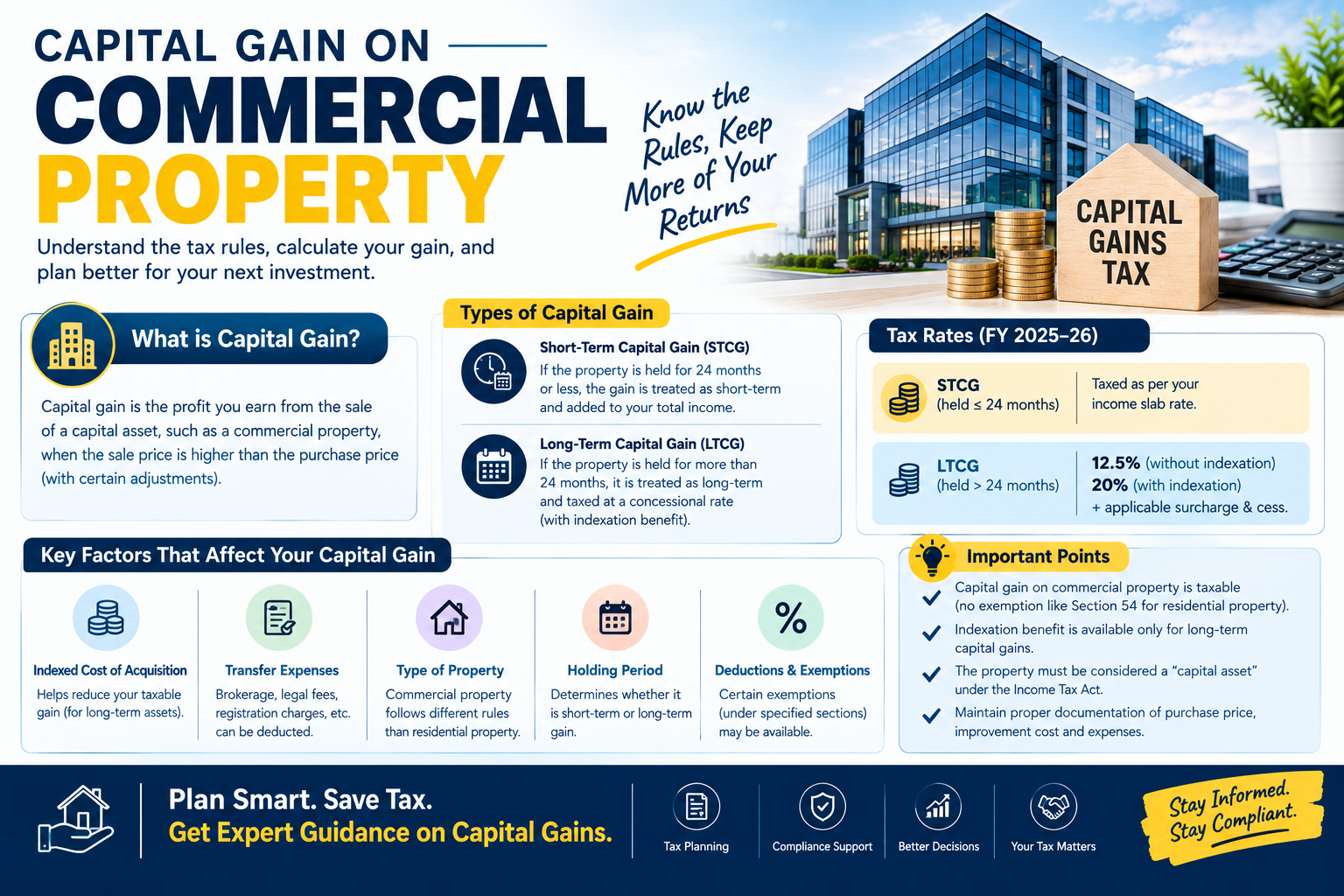
Yes. Sale of a commercial property can result in taxable capital gains if the property is held as a capital asset. The tax treatment depends on whether the property is a short-term or long-term capital asset, the taxpayer’s status, acquisition and transfer dates, cost, improvement expenses, stamp-duty value and applicable exemptions.
For land or building, the general long-term holding period is more than 24 months. Long-term capital gains from transfers on or after 23 July 2024 are generally taxed at 12.5% without indexation. However, resident individuals and HUFs transferring land or building acquired before 23 July 2024 have a beneficial option to compare the 12.5% regime with the earlier 20% indexed-cost method.
Commercial property requires additional care where the asset has been used in a business and depreciation has been claimed, because the tax computation can be affected by the special rules applicable to depreciable assets.
Introduction
A commercial property may be one of the most valuable assets owned by a business or investor.
Examples include:
- Shops
- Offices
- Commercial buildings
- Warehouses
- Showrooms
- Business premises
- Commercial plots
- Certain industrial properties
When such a property is sold at a profit, many taxpayers assume that the tax is simply:
Sale price − Purchase price = taxable profit
That approach can be incorrect.
The calculation can involve:
- Period of holding
- Original acquisition cost
- Cost of improvement
- Transfer expenses
- Stamp-duty value
- Whether depreciation was claimed
- Whether the property is a capital asset or stock-in-trade
- Taxpayer’s residential/status category
- Date of acquisition
- Date of transfer
- Reinvestment exemptions
- Capital losses
The distinction between a commercial property held as an investment/capital asset and a property held as stock-in-trade by a real-estate business is particularly important.
What Is Capital Gain on Commercial Property?
Capital gain on commercial property is the taxable profit arising from the transfer of commercial land, building or another qualifying property that is held as a capital asset.
Under the general capital-gains framework, the gain is broadly determined after considering the relevant full value of consideration and deducting eligible transfer expenses, acquisition cost and improvement cost, subject to special provisions and exemptions. The Income Tax Department describes this basic capital-gain computation under Section 45 and the associated provisions.
Simple formula
Capital Gain = Full Value of Consideration − Eligible Transfer Expenses − Cost of Acquisition − Eligible Cost of Improvement
The actual computation can differ where special provisions such as those relating to stamp-duty valuation or depreciable assets apply.
Is Commercial Property Always a Capital Asset?
No.
The same type of property can have different tax treatment depending on how it is held.
Example
A person purchases an office building as a long-term investment and later sells it.
The office may be a capital asset.
On the other hand, a property developer holding commercial units as part of its ordinary business inventory may hold them as stock-in-trade.
The tax consequences can therefore differ.
Before calculating capital gains, the first question should be:
Was the commercial property held as a capital asset or as stock-in-trade?
This classification should be established from the facts, accounting treatment, business activity and applicable law.
What Is the Holding Period for Commercial Property?
For land or building, the general threshold for long-term classification is more than 24 months.
| Holding period | General treatment |
|---|---|
| 24 months or less | Short-term capital asset |
| More than 24 months | Long-term capital asset |
The Income Tax Department confirms the 24-month threshold for immovable property.
This distinction is important because long-term and short-term capital gains are subject to different tax treatment.
What Is Short-Term Capital Gain on Commercial Property?
If commercial land or building is held for 24 months or less, the gain is generally treated as short-term capital gain.
For ordinary commercial property, short-term capital gains are generally taxed at the applicable rates for the taxpayer rather than the special 12.5% long-term rate.
Therefore, an individual, company, firm or other taxpayer may have a different final tax liability depending on its applicable tax regime.
What Is Long-Term Capital Gain on Commercial Property?
If commercial land or building is held for more than 24 months, the gain is generally long-term capital gain.
For transfers taking place on or after 23 July 2024, the general LTCG rate is 12.5% without indexation.
However, an important grandfathering provision applies to eligible resident individuals and HUFs.
Where a resident individual or HUF transfers land or building acquired before 23 July 2024, the taxpayer can compare the tax under the new 12.5% regime with the earlier 20% indexed-cost computation and use the beneficial outcome permitted by law.
Important
The 12.5% rate should therefore not be presented as a universal answer for every commercial-property transaction.
The acquisition date, transfer date, taxpayer status and nature of the asset must be checked.
How Is Capital Gain on Commercial Property Calculated?
A simplified calculation is:
Step 1: Determine the relevant sale consideration.
Step 2: Check whether the stamp-duty value affects the deemed consideration.
Step 3: Deduct eligible transfer expenses.
Step 4: Determine the applicable cost of acquisition.
Step 5: Add eligible cost of improvement.
Step 6: Determine whether the gain is short-term or long-term.
Step 7: Apply the correct tax regime.
Step 8: Check whether an exemption or reinvestment provision is available.
What Is Section 50C and How Does It Affect Commercial Property?
Section 50C can become extremely important when commercial land or a building is sold for a consideration lower than its prescribed stamp-duty value.
Under the Income-tax Act, 1961 framework, Section 50C contains a deemed-consideration mechanism for specified transfers of land or building.
This means the taxpayer cannot always assume that the amount written in the sale deed will be the only figure relevant for capital-gains computation.
Example
Suppose:
- Actual sale price: ₹80 lakh
- Stamp-duty value: ₹87 lakh
The difference is ₹7 lakh.
The taxpayer should check the applicable statutory tolerance/safe-harbour provisions before calculating the capital gain.
The current capital-gains framework recognises the 110% tolerance threshold in the relevant Section 50C context.
Where the applicable threshold is exceeded, the deemed-value provisions can affect the computation.
Why commercial-property sellers should be careful
Commercial properties can have significant differences between:
- Negotiated market price
- Circle/stamp value
- Actual property condition
- Rental potential
- Location
- Existing tenancy
- Encumbrances
A large valuation difference should therefore be reviewed before the return is filed.
Can a Commercial Property Be Sold Below Market Value?
Yes, a property can be sold for a price below what the owner believes is its market value.
But the income-tax consequences must still be examined.
The taxpayer should maintain evidence explaining the transaction where there is a substantial difference between the actual consideration and the applicable stamp valuation.
Relevant evidence may include:
- Registered sale agreement
- Valuation report
- Property condition
- Location-related factors
- Existing tenancy
- Litigation or encumbrances
- Market comparables
- Sale negotiations
A valuation dispute should not simply be ignored.
What Happens If Depreciation Was Claimed on the Commercial Property?
This is one of the most important differences between commercial property and an ordinary investment property.
Suppose a business owns a commercial building and uses it for business purposes. Depreciation may have been claimed under the applicable tax provisions.
When such a depreciable asset is sold, the capital-gains computation can be affected by the special rules applicable to depreciable assets.
Under the Income-tax Act, 1961, Section 50 provides a special computation mechanism for capital gains arising from transfer of depreciable assets forming part of a block of assets.
The calculation is therefore not necessarily based simply on:
Sale Price − Original Purchase Price
Instead, the block-of-assets mechanism and written-down value have to be examined.
Practical implication
If a company purchased a commercial building for ₹1 crore many years ago and claimed depreciation over the years, the relevant tax computation can be substantially different from that of an investor who did not claim depreciation.
This is an area where professional review is particularly important.
What If the Commercial Property Is Held as Stock-in-Trade?
If a property developer or real-estate business holds commercial property as stock-in-trade, the transaction should not automatically be treated as a capital-gains transaction.
The income may instead fall under the applicable business-income framework.
The correct classification depends on the facts, including:
- Nature of the taxpayer’s business
- Purpose for which the property was acquired
- Accounting treatment
- Pattern of transactions
- Development activity
- Intention at acquisition
- Actual use of the property
A business regularly constructing and selling commercial units may therefore have a substantially different tax position from an investor selling one commercial office after holding it for many years.
Can Section 54 Be Claimed on Sale of Commercial Property?
Generally, Section 54 is not the provision for a sale of a commercial property.
Section 54 is designed for specified long-term capital gains arising from the transfer of a residential house property, subject to its conditions.
Therefore, a taxpayer should not assume that selling an office, shop or commercial building automatically qualifies for Section 54.
The Income Tax Department’s exemption guidance specifically describes Section 54 as applying to long-term capital gains arising from transfer of a residential house property by an eligible individual or HUF.
Can Section 54F Apply to Commercial Property?
Potentially, yes.
Section 54F is different from Section 54.
It applies, subject to conditions, where an eligible individual or HUF transfers a long-term capital asset other than a residential house and invests in a qualifying residential house in India.
Because commercial property is generally not a residential house, a qualifying sale of commercial property can potentially fall within Section 54F, provided all statutory conditions are satisfied.
The exemption can depend on:
- Amount of capital gain
- Net consideration
- Amount invested in the new residential property
- Existing residential-house ownership
- Purchase/construction dates
- Other statutory conditions
It is therefore not an automatic exemption.
What Is the Section 54F Investment Period?
For a qualifying transaction, Section 54F broadly permits:
- Purchase of a residential house within one year before the transfer, or
- Purchase within two years after the transfer, or
- Construction within three years after the transfer.
The section also contains conditions concerning ownership of other residential houses and the amount that can be considered for the exemption.
The current Section 54F framework also contains a ₹10 crore ceiling for the relevant investment/net-consideration calculation.
Can Section 54EC Be Used After Selling Commercial Property?
In qualifying cases, yes.
Section 54EC can provide an exemption from specified long-term capital gains arising from transfer of land or building or both, where the taxpayer invests in specified bonds within the prescribed conditions and period.
The Income Tax Department lists Section 54EC specifically among the capital-gains exemption provisions applicable to transfer of land or building.
The eligibility, investment limit, lock-in period and qualifying bonds should be verified for the relevant transaction.
What About the Capital Gains Account Scheme?
If a taxpayer intends to claim an exemption such as Section 54F but has not yet utilised the relevant amount within the prescribed framework, the Capital Gains Account Scheme (CGAS) may become relevant.
The Income Tax Department explains that CGAS can be used in specified exemption situations, including Sections 54 and 54F, subject to the statutory conditions.
A taxpayer should not assume that simply depositing money into CGAS automatically creates an exemption.
The underlying exemption conditions still have to be satisfied.
What Is the Tax Treatment If the Commercial Property Is Sold by a Company?
A company selling a commercial property may have a different tax computation from an individual.
Important questions include:
- Is the property a capital asset or stock-in-trade?
- Was depreciation claimed?
- Is it part of a block of assets?
- When was it acquired?
- When was it transferred?
- Is the company resident or non-resident?
- Are any specific exemptions available?
- Does the transaction trigger TDS or other compliance requirements?
The resident individual/HUF grandfathering benefit for land/building acquired before 23 July 2024 should not simply be extended to companies. The statutory eligibility must be checked.
Is TDS Applicable on Sale of Commercial Property?
Yes, in specified transactions.
Under the current framework, TDS provisions apply to transfers of immovable property other than agricultural land when the statutory threshold is met.
The Income-tax Act, 2025’s Section 393 framework provides for TDS at 1% of the consideration or stamp-duty value, whichever is higher, with a ₹50 lakh threshold for the specified category.
Important distinction
TDS is not the same as capital-gains tax.
TDS is an amount collected at source by the buyer.
The seller still has to:
- Calculate the actual taxable gain.
- Report the transaction correctly.
- Claim credit for eligible TDS.
- Pay any balance tax, if applicable.
What Documents Are Required for Commercial Property Capital Gains?
A taxpayer should preserve a complete transaction file.
Acquisition documents
- Original purchase deed
- Agreement to purchase
- Allotment documents
- Payment records
- Stamp-duty records
Improvement documents
- Construction invoices
- Renovation bills
- Contractor payments
- Architect fees
- Capital expenditure records
Sale documents
- Agreement to sell
- Sale deed
- Registration documents
- Sale consideration details
- Buyer details
Valuation documents
- Stamp-duty valuation
- Valuation reports
- Relevant property valuation evidence
Business/depreciation records
Where the property was used in business:
- Fixed asset register
- Depreciation schedule
- Written-down value
- Block-of-assets records
- Financial statements
Tax records
- Income-tax returns
- Form 26AS
- AIS
- TDS certificates
- Capital-gain computation
- Exemption documents
How to Calculate Capital Gain on Commercial Property: Step-by-Step
Step 1: Establish ownership
Identify the actual owner and taxpayer.
Step 2: Determine how the property was held
Was it:
- Investment?
- Business asset?
- Stock-in-trade?
Step 3: Check whether depreciation was claimed
If the property was a depreciable business asset, examine the relevant block-of-assets rules.
Step 4: Determine the acquisition date
This establishes the holding period and can affect the applicable tax regime.
Step 5: Determine the transfer date
The date of transfer is particularly important because the capital-gains regime changed from 23 July 2024.
Step 6: Determine the holding period
More than 24 months generally means long-term treatment for land/building.
Step 7: Check sale consideration and stamp value
Review whether Section 50C or the corresponding applicable provisions affect the consideration.
Step 8: Calculate eligible costs
Review acquisition cost, qualifying improvement expenditure and transfer expenses.
Step 9: Apply the correct capital-gains regime
For qualifying LTCG transfers on or after 23 July 2024, the general rate is 12.5% without indexation, subject to applicable exceptions and grandfathering.
Step 10: Check exemptions
Consider whether Section 54F, 54EC or another provision applies.
Step 11: Reconcile TDS
Check the TDS reported by the buyer against Form 26AS/AIS and supporting certificates.
Step 12: Report the transaction correctly
The transaction should be disclosed in the appropriate income-tax return and schedules.
Hypothetical Example: Sale of a Commercial Office
This is a hypothetical example for illustration only.
A resident individual purchased a commercial office in 2018 for ₹60 lakh.
He later spent ₹10 lakh on qualifying capital improvements.
In 2026, he sells the office for ₹1.30 crore.
Assume:
- The property is a capital asset.
- It was held for more than 24 months.
- The seller is a resident individual.
- The office was not part of a depreciable block of business assets.
- The stamp-duty value and actual consideration need to be compared.
- The acquisition was before 23 July 2024.
The taxpayer should not simply calculate:
₹1.30 crore − ₹60 lakh = ₹70 lakh gain
Instead, he should review:
- Eligible transfer expenses.
- Cost of improvement.
- Stamp-duty value.
- Long-term classification.
- The 12.5% post-23 July 2024 regime.
- Whether the grandfathering comparison using 20% with indexation is beneficial.
- Whether Section 54F or Section 54EC is available.
- TDS deducted by the buyer.
The final tax liability can therefore differ substantially from a basic sale-price-minus-purchase-price calculation.
Hypothetical Example: Commercial Building on Which Depreciation Was Claimed
This is a hypothetical example for illustration only.
A company purchased a commercial building for ₹2 crore and used it as its business premises.
Over several years, depreciation was claimed under the applicable tax provisions.
The company subsequently sells the building for ₹3 crore.
It would be incorrect to assume that the taxable gain is simply:
₹3 crore − ₹2 crore = ₹1 crore
The tax treatment has to consider the applicable rules for depreciable assets and the block of assets, along with the relevant written-down value and other statutory provisions.
This is why the tax computation for a commercial building used in business can differ significantly from that of an investor holding a commercial property as an investment.
Common Mistakes in Commercial Property Capital-Gains Tax
1. Treating every commercial property as a capital asset
A property held as stock-in-trade can have different tax treatment.
2. Ignoring depreciation
For business assets, depreciation history can materially affect the computation.
3. Using only the sale-deed amount
Stamp-duty valuation may affect the taxable consideration.
4. Automatically applying 12.5%
The applicable regime depends on the transaction date, asset, taxpayer and other facts.
5. Assuming indexation is always available
The general indexation benefit was removed for transfers on or after 23 July 2024, subject to the specific grandfathering provision for eligible resident individuals/HUFs transferring qualifying land/building acquired before that date.
6. Assuming Section 54 applies to an office or shop
Section 54 concerns qualifying residential-house transfers; commercial-property sellers should instead examine provisions such as Section 54F where applicable.
7. Ignoring TDS
The buyer’s TDS should be reconciled with the seller’s tax records.
8. Not keeping improvement bills
Unsupported improvement claims can create problems during assessment.
9. Ignoring the property classification
The tax result can differ substantially between an investment property, business asset and stock-in-trade.
10. Calculating tax before checking the acquisition date
For properties acquired before 23 July 2024, the acquisition date can be particularly important for determining whether the grandfathering comparison is available.
What Happens If the Property Is Sold at a Loss?
A commercial property transaction does not necessarily produce a capital gain.
If the allowable computation results in a loss, it may be a short-term or long-term capital loss, depending on the nature of the asset and holding period.
The ability to set off or carry forward the loss is governed by the applicable capital-loss provisions and conditions.
Therefore, a taxpayer should not assume that a property sale at a price below the original purchase price automatically means that no tax filing or reporting is required.
What If the Commercial Property Was Inherited?
Inherited commercial property requires additional examination.
The taxpayer may need to establish:
- Previous owner’s acquisition cost
- Date of previous acquisition
- Date of inheritance
- Improvement expenditure
- Ownership documents
- Succession documents
The tax treatment can depend on the specific mode of acquisition and the applicable cost and holding-period rules.
What If the Commercial Property Is Owned by Multiple Persons?
Where commercial property is jointly owned, the capital gain generally needs to be examined with reference to the ownership shares and the applicable taxpayer for each share.
Important documents include:
- Sale deed
- Ownership percentage
- Purchase agreement
- Sale consideration allocation
- TDS allocation
- Separate tax-return reporting
The tax calculation should be reconciled with the legal ownership structure.
Capital Gain on Commercial Property After the 2026 Tax-Law Transition
The Income-tax Act, 2025 applies to tax years beginning on or after 1 April 2026, while transitional provisions preserve the treatment of matters relating to earlier tax years under the previous framework where applicable.
This is important for commercial-property transactions because a sale may occur after the transition even though:
- The property was purchased many years earlier.
- An exemption was claimed under the earlier Act.
- A CGAS deposit was made under the earlier framework.
- A depreciation history exists from earlier years.
The applicable tax year and transitional provisions should therefore be identified before finalising the computation.
Can Commercial Property Capital Gain Be Reduced Legally?
Potentially, yes—but only through provisions permitted by law.
Legitimate tax planning may involve:
- Correctly determining acquisition cost.
- Claiming eligible improvement expenditure.
- Deducting qualifying transfer expenses.
- Applying the correct stamp-duty-value rules.
- Checking available capital-loss set-off.
- Examining Section 54F eligibility.
- Examining Section 54EC eligibility.
- Applying the grandfathering provision where legally available.
- Correctly accounting for depreciation and block-of-assets rules.
Tax planning should be based on the actual transaction rather than an attempt to artificially reduce the sale consideration.
Frequently Asked Questions
1. Is capital gain tax applicable on sale of commercial property?
Yes, generally, if the commercial property is held as a capital asset and a taxable gain arises on transfer. The final tax depends on the nature of the property, holding period, taxpayer status and applicable provisions.
2. What is the LTCG rate on commercial property?
For qualifying long-term capital gains from transfers on or after 23 July 2024, the general rate is 12.5% without indexation. Eligible resident individuals/HUFs transferring land or building acquired before 23 July 2024 can use the statutory beneficial comparison with the earlier 20% indexed-cost method.
3. Is commercial property held for more than 24 months a long-term asset?
Generally, yes. Land or building held for more than 24 months is treated as a long-term capital asset, subject to the applicable law and facts.
4. Can Section 54 be claimed on sale of a commercial property?
Generally, Section 54 is not the applicable exemption for a commercial property, because it is designed for qualifying residential-house transfers. Section 54F may be relevant in qualifying cases involving a long-term asset other than a residential house.
5. Can Section 54F apply to sale of an office or shop?
Potentially, yes, if the statutory conditions are satisfied. Section 54F applies to specified long-term capital assets other than a residential house and provides relief where the taxpayer invests in a qualifying residential house in India.
6. What happens if depreciation was claimed on the commercial property?
The special rules applicable to depreciable assets may affect the computation. The block of assets and written-down value can become relevant, so the calculation should not automatically be based on the original purchase price.
7. Does Section 50C apply to commercial property?
Section 50C can apply to specified transfers of land or building where the declared consideration is lower than the prescribed stamp valuation, subject to the statutory conditions and tolerance provisions.
8. Is TDS applicable on sale of commercial property?
Specified transfers of immovable property can attract TDS where the statutory threshold is met. Under the current framework, the relevant threshold is ₹50 lakh and the specified rate is 1% of consideration or stamp-duty value, whichever is higher.
9. Can capital-gains tax be saved by purchasing another house?
Potentially. Section 54F may provide relief to an eligible individual or HUF selling a qualifying long-term asset other than a residential house, including potentially commercial property, if all statutory conditions are satisfied.
10. Can Section 54EC bonds be used after selling commercial property?
Potentially, where the transaction qualifies as a transfer of land or building and the statutory Section 54EC conditions are satisfied.
11. What documents are needed to calculate capital gains on commercial property?
Typically, the purchase deed, sale deed, payment records, improvement bills, stamp valuation, valuation reports, depreciation records where applicable, TDS records and exemption-related documents should be reviewed.
12. Is commercial property sold by a property developer taxed as capital gain?
Not necessarily. If the property is held as stock-in-trade in the ordinary course of the developer’s business, the income may be treated under the business-income framework rather than capital gains. The facts and accounting treatment must be examined.
Key Takeaways
- Commercial property can create taxable capital gains when sold if it is held as a capital asset.
- The first question is whether the property is a capital asset, business asset or stock-in-trade.
- Land/building generally becomes long-term after more than 24 months.
- For qualifying transfers on or after 23 July 2024, LTCG is generally taxed at 12.5% without indexation.
- Eligible resident individuals/HUFs selling land/building acquired before 23 July 2024 can use the beneficial comparison with the earlier 20% indexed-cost method.
- Section 50C can affect the sale consideration where stamp-duty value is higher.
- Depreciation claimed on a commercial business asset can materially change the computation.
- Section 54 generally concerns residential-house property; Section 54F may be relevant for qualifying commercial-property sales.
- Section 54EC may provide relief through qualifying bond investment.
- TDS and capital-gains tax are separate matters.
- Commercial-property transactions involving large values, depreciation, valuation differences or reinvestment should be reviewed before filing the return.
Professional Assistance
Commercial-property transactions can involve substantial tax exposure, particularly where the property has been depreciated, the stamp-duty value differs from the negotiated price, the property was acquired many years ago, or the seller wants to claim a reinvestment exemption.
A tax professional can help review:
- Capital-gain computation
- Section 50C implications
- Depreciation/block-of-assets treatment
- Section 54F and 54EC eligibility
- TDS reconciliation
- Acquisition and improvement costs
- Capital-loss implications
- Income-tax return reporting
- Assessment or notice issues arising from the transaction
For a substantial commercial-property sale, getting the tax computation reviewed before finalising the transaction or return can help identify issues while they are still manageable.
Selling a Commercial Property? Review the Tax Before Filing
Commercial-property transactions can involve Section 50C, depreciation, stamp-duty valuation, TDS and reinvestment exemptions. The correct tax treatment depends heavily on how the property was held and the dates involved.
Bihar Tax Consultant can assist with reviewing your commercial-property capital-gain computation, applicable exemptions, TDS reconciliation and income-tax reporting.
Address: BIIT Campus, near Sanchira Mandir, New Azimabad Colony, Patna, Bihar 800006
Mobile: 8789155395
Email: [email protected]
Book a Consultation to review the tax implications of your commercial-property sale.