
GSTAT Pre-Deposit Fees & Filing Fees: Latest Rules for GST Appeals in 2026

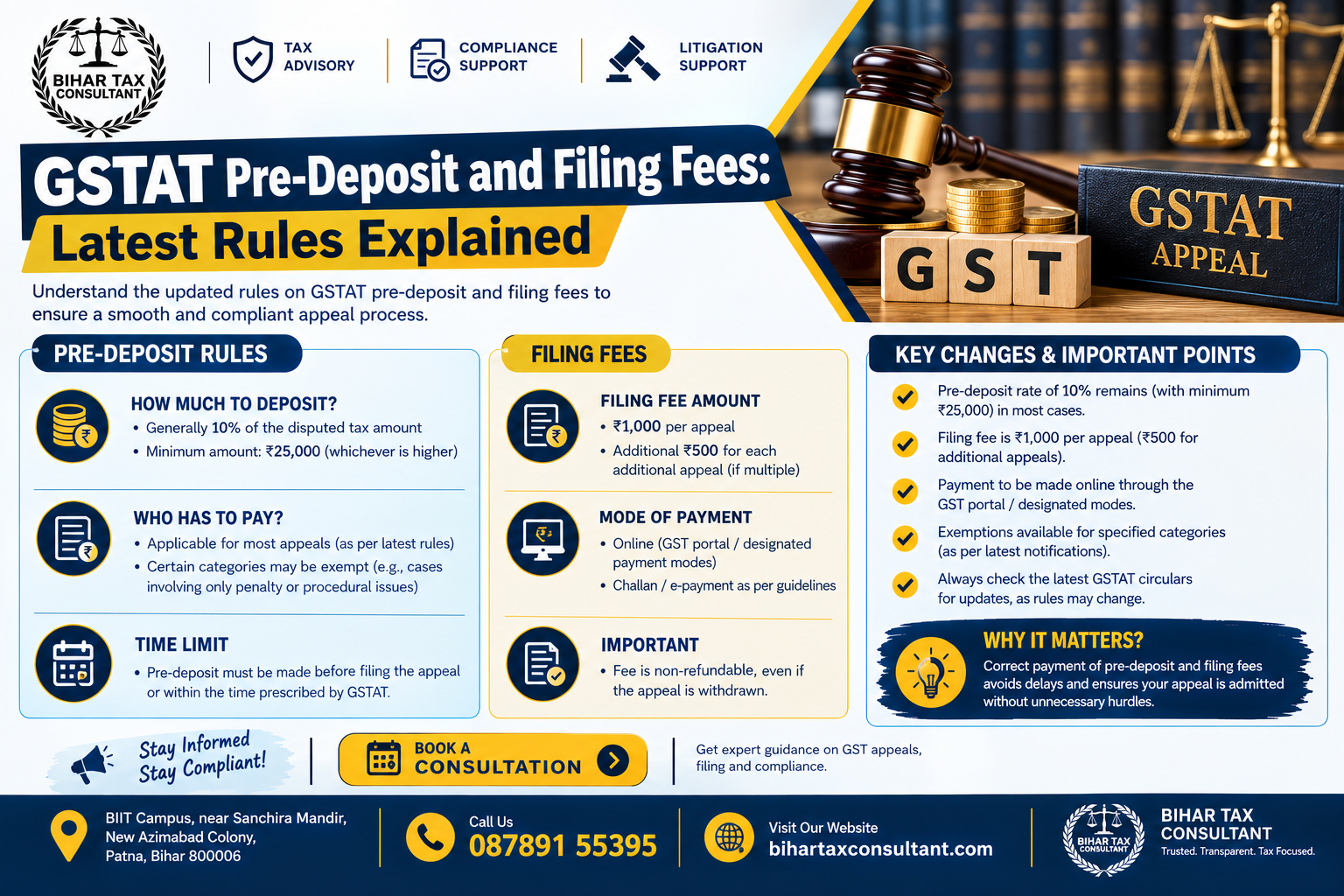
How Much Is the GSTAT Pre-Deposit?
For an appeal to the Goods and Services Tax Appellate Tribunal (GSTAT) under Section 112 of the CGST Act, the appellant generally has to:
- Pay the full amount of admitted tax, interest, fine, fee and penalty, and
- Pay an additional 10% of the remaining disputed tax, over and above the amount already paid at the first appellate stage under Section 107(6).
The additional GSTAT-stage pre-deposit is subject to a maximum of ₹20 crore under the CGST provision. The same framework applies to the corresponding State/UT tax component; for IGST matters, the applicable calculation needs to be examined according to the statutory treatment of the disputed tax.
The reduction of the GSTAT-stage pre-deposit from 20% to 10%, together with the reduction of the cap from ₹50 crore to ₹20 crore, was made effective from 1 November 2024.
Importantly, GSTAT pre-deposit fees and GSTAT filing fees are not the same thing. The pre-deposit is a statutory payment connected with the disputed demand, while the filing fee is a separate procedural fee.
What Are GSTAT Pre-Deposit Fees?
The phrase “GSTAT pre-deposit fees” is commonly used by taxpayers and businesses, but technically the pre-deposit is not simply a court filing fee.
It is a statutory pre-condition for filing an appeal before the GST Appellate Tribunal.
Section 112(8) of the CGST Act requires payment of:
- The admitted amount covered by the impugned order, and
- An additional 10% of the remaining disputed tax, subject to the prescribed maximum.
Once the statutory payment required under Section 112(8) is made, recovery of the balance amount is deemed to be stayed under Section 112(9), subject to the statutory framework.
Therefore, taxpayers should distinguish between:
Pre-deposit → statutory payment linked to the disputed demand
and
Filing fee → procedural fee for presenting the appeal
GSTAT Pre-Deposit: Latest 10% Rule
The GSTAT pre-deposit regime changed significantly from 1 November 2024.
Earlier, Section 112(8) required an additional pre-deposit of 20% of the remaining disputed tax, subject to a higher maximum.
The Finance (No. 2) Act, 2024 reduced this to:
10% of the remaining amount of tax in dispute
with a maximum of ₹20 crore under the CGST provision.
This means that the GSTAT-stage payment is 10%, not another 20%.
However, the important point is that this 10% is in addition to the pre-deposit already made at the first appellate stage.
Is GSTAT Pre-Deposit 10% or 20%?
This is one of the most searched questions.
Short answer:
The GSTAT-stage pre-deposit is 10%.
But when both appellate stages are considered together, the taxpayer may have deposited:
10% at first appeal + 10% at GSTAT = 20% of the disputed tax
subject to the statutory caps and the precise composition of the demand.
The GST Council’s official material confirms that the Finance (No. 2) Act, 2024 rationalised the pre-deposit requirement and reduced the GSTAT-stage amount to 10% of the disputed tax.
Example
Suppose:
- Disputed tax = ₹1 crore
- First appeal pre-deposit = ₹10 lakh
- Additional GSTAT pre-deposit = ₹10 lakh
Therefore:
Total pre-deposit across both stages = ₹20 lakh
The GSTAT-stage payment itself is ₹10 lakh, not ₹20 lakh.
What Is the Maximum GSTAT Pre-Deposit?
For the CGST component, Section 112(8) currently provides a maximum of ₹20 crore for the additional GSTAT-stage pre-deposit.
The corresponding statutory treatment of CGST, SGST/UTGST and IGST should be checked separately when calculating a large disputed demand.
Practical point
A taxpayer should not simply apply “10% of the total demand.”
The calculation should identify:
- Admitted tax
- Disputed tax
- Interest
- Fine
- Fee
- Penalty
- Amount already deposited under Section 107(6)
- Applicable statutory cap
What Is the Difference Between GSTAT Pre-Deposit and Filing Fee?
This distinction is extremely important.
| Particular | GSTAT Pre-Deposit | GSTAT Filing Fee |
|---|---|---|
| Nature | Statutory pre-condition | Procedural fee |
| Main provision | Section 112(8) | Rule 110(5), CGST Rules |
| Basic calculation | 10% of remaining disputed tax | ₹1,000 per ₹1 lakh of relevant amount |
| Maximum | ₹20 crore under the CGST provision | ₹25,000 |
| Purpose | Condition for filing + protection against recovery of balance | Processing/filing the appeal |
| Refund treatment | Subject to appellate outcome and statutory provisions | Generally a filing fee, not the disputed tax deposit |
The current GSTAT Procedure Rules’ fee schedule cross-references Rule 110(5) of the CGST/SGST/UTGST Rules for GSTAT appeals.
How Much Is the GSTAT Filing Fee?
The GSTAT filing fee is calculated separately from the pre-deposit.
Under Rule 110(5) of the CGST Rules, the fee for filing or restoration of an appeal is generally:
₹1,000 for every ₹1 lakh of tax or input tax credit involved, or the relevant amount of fine, fee or penalty determined in the order, subject to a minimum of ₹5,000 and a maximum of ₹25,000.
For an order involving no demand of tax, interest, fine, fee or penalty, the applicable filing fee is ₹5,000 under the amended framework.
Example
Suppose the relevant disputed amount for fee calculation is:
₹8 lakh
At ₹1,000 per ₹1 lakh:
Filing fee = ₹8,000
If the relevant amount were very large, the fee would still be restricted by the ₹25,000 maximum.
GSTAT Filing Fee vs Pre-Deposit: Example
Suppose a taxpayer has:
- Disputed tax = ₹1 crore
- Admitted tax = ₹5 lakh
- First-appeal pre-deposit already paid = ₹10 lakh
At GSTAT:
Step 1 — Admitted amount
The admitted amount must be paid as required by Section 112(8).
Step 2 — GSTAT pre-deposit
10% of the remaining disputed tax:
₹1 crore × 10% = ₹10 lakh
Step 3 — Filing fee
The prescribed filing fee is calculated separately under Rule 110(5), subject to the minimum and maximum.
Thus, the taxpayer may have three distinct payment components:
Admitted liability + GSTAT pre-deposit + filing fee
They should not be treated as one payment for calculation purposes.
What Is the GSTAT Pre-Deposit for Penalty-Only Orders?
A significant later development concerns orders involving penalty without any demand of tax.
The GST Council recommended inserting a specific pre-deposit requirement for such cases because the earlier framework did not generally require a pre-deposit where there was no tax demand.
The amended Section 112(8) provides that where an order demands penalty without involving a demand of tax, an appeal cannot be filed unless the appellant pays 10% of the penalty, in addition to the amount payable under the applicable first-appeal provision.
The effective date should be checked against the notification applicable to the particular appeal. Current 2026 practitioner and procedural material reflects this penalty-only pre-deposit as operational from 1 October 2025.
Why is this important?
A taxpayer should not assume:
“There is no tax demand, so no pre-deposit is required.”
Penalty-only appeals now require separate analysis.
Does GSTAT Pre-Deposit Include Interest and Penalty?
The statutory language requires payment in full of the admitted portion of tax, interest, fine, fee and penalty arising from the impugned order.
However, the additional 10% GSTAT-stage calculation is linked to the remaining amount of tax in dispute.
Therefore, taxpayers should separate:
- Admitted liability
- Disputed tax
- Disputed interest
- Disputed penalty
- Fine/fee
- Any special penalty-only situation
The amount should be calculated from the actual impugned order rather than applying a blanket percentage to the entire demand.
Can GSTAT Pre-Deposit Be Paid Through Input Tax Credit?
The mode of payment should be checked carefully.
A pre-deposit is a monetary payment made as a condition for pursuing the appeal. The GST portal’s appeal mechanism checks the amount payable against the relevant demand and pre-deposit requirements.
Taxpayers should not assume that available ITC can automatically be used for every appeal-related payment.
The payment route displayed by the GST portal for the particular demand and appeal should be followed, and the taxpayer should preserve the payment evidence.
Where an amount was previously paid through FORM GST DRC-03, special portal treatment can be relevant because such payment may not initially be linked to the Demand ID. GSTN has issued an advisory explaining how the system checks amounts already paid against the demand and requires only the balance where the required amount has already been partly or fully discharged.
What Happens to the Balance Demand After GSTAT Pre-Deposit?
Section 112(9) provides an important protection.
Once the amount required under Section 112(8) has been paid, recovery proceedings for the balance amount are deemed to be stayed until disposal of the appeal, subject to the statutory framework.
This means that the taxpayer generally does not need to make a separate payment of the entire disputed demand merely to stop recovery once the statutory pre-deposit requirement has been satisfied.
Important distinction
Stay of recovery does not mean the disputed demand has been cancelled.
It means recovery of the balance is stayed while the appeal is pending under the applicable statutory conditions.
What Form Is Used to File a GSTAT Appeal?
An appeal to the GST Appellate Tribunal is filed in FORM GST APL-05.
The CGST Rules provide for electronic filing of the appeal, with the prescribed documents and fee.
Current GSTAT procedure also operates through the Tribunal’s electronic filing system.
The GSTAT Procedure Rules, 2025 provide the procedural framework for appeals and other applications before the Tribunal.
What Documents Are Required for GSTAT Filing?
A GSTAT appeal should be prepared as a complete appellate record.
Important documents may include:
- Order-in-Original
- Order-in-Appeal
- Show Cause Notice
- Statement of facts
- Grounds of appeal
- Relevant GST returns
- Invoices
- E-way bills, where relevant
- Reconciliation statements
- Ledger extracts
- ITC documentation
- Relevant correspondence
- Evidence supporting factual grounds
- Proof of pre-deposit
- Proof of filing fee
- Authorisation/vakalatnama
- Other documents required by the Tribunal
The GSTAT portal and procedural rules should be checked for the current filing requirements.
What Is the Time Limit for Filing a GSTAT Appeal?
Under Section 112(1), an aggrieved person generally has three months from the date on which the order sought to be appealed against is communicated to file an appeal before the Appellate Tribunal.
The Act also contains provisions allowing delayed appeals to be admitted where the prescribed conditions for condonation are satisfied.
Why limitation matters
A taxpayer should calculate the limitation period from the actual communication date rather than relying on the date remembered from the proceedings.
A delay can create a separate procedural issue even where the underlying tax case is strong.
GSTAT Backlog Appeals: Special 2026 Consideration
GSTAT has become operational, and special arrangements were made for backlog appeals.
The Government notified a specific opportunity for filing certain backlog appeals, with 30 June 2026 being the relevant deadline for specified older orders.
That deadline is particularly important because it is now past as of September 2026.
Therefore, taxpayers dealing with an older order should not assume that the ordinary three-month period alone answers the limitation question. The communication date, order category and any applicable transitional notification must be examined.
How to Calculate GSTAT Pre-Deposit: Step-by-Step
Step 1 — Obtain the impugned order
Start with the actual Order-in-Appeal or other order against which the GSTAT appeal is proposed.
Step 2 — Identify admitted liability
Determine what portion of tax, interest, fine, fee or penalty is admitted.
Step 3 — Identify disputed tax
Separate the tax amount actually under dispute.
Step 4 — Check the first-appeal pre-deposit
Determine how much was already paid under Section 107(6).
Step 5 — Calculate the additional GSTAT pre-deposit
Generally:
10% × remaining disputed tax
subject to the statutory maximum.
Step 6 — Check penalty-only provisions
If the order contains only penalty and no tax demand, separately examine the penalty-only pre-deposit requirement.
Step 7 — Calculate filing fee
Calculate the applicable Rule 110(5) filing fee separately.
Step 8 — Verify portal calculations
Before final submission, reconcile the amount shown by the GSTAT/GST system with the legal calculation.
Step 9 — Preserve payment evidence
Save challans, payment references and acknowledgements.
Step 10 — File APL-05 and monitor defects
Filing the form is not necessarily the end of the process. Monitor the portal for defect notices, acknowledgements and subsequent hearing communications.
Worked Example: GSTAT Pre-Deposit Fees
Hypothetical example for illustration only.
Assume a taxpayer receives an appellate order containing:
- Total tax demand: ₹2 crore
- Disputed tax: ₹1.5 crore
- Admitted tax: ₹50 lakh
- First-appeal pre-deposit already paid: ₹15 lakh
GSTAT-stage pre-deposit
10% of disputed tax:
₹1.5 crore × 10% = ₹15 lakh
The taxpayer therefore needs to satisfy the applicable admitted-liability requirement and the additional GSTAT-stage pre-deposit requirement.
Filing fee
If the relevant amount for Rule 110(5) produces a fee above ₹25,000, the statutory maximum applies.
Therefore:
Filing fee = ₹25,000
The taxpayer should not confuse this ₹25,000 filing fee with the ₹15 lakh GSTAT pre-deposit.
They are two different amounts serving different purposes.
Common Mistakes Regarding GSTAT Pre-Deposit Fees
Mistake 1: Assuming GSTAT requires another 20%
The GSTAT-stage statutory pre-deposit was reduced to 10% from 1 November 2024.
Mistake 2: Forgetting the first-appeal deposit
The GSTAT 10% is additional to the amount paid under Section 107(6).
Mistake 3: Treating the entire demand as disputed tax
The 10% calculation should focus on the applicable remaining disputed tax, not automatically the entire demand.
Mistake 4: Confusing filing fee with pre-deposit
The ₹25,000 filing-fee ceiling is not the same as the ₹20 crore pre-deposit ceiling.
Mistake 5: Ignoring penalty-only orders
A penalty-only order requires separate examination under the amended provisions.
Mistake 6: Ignoring the limitation date
A correct pre-deposit calculation cannot cure a limitation problem automatically.
Mistake 7: Not reconciling earlier payments
Amounts already paid through the demand mechanism can affect what the portal requires.
Mistake 8: Filing APL-05 without a complete record
A Tribunal appeal should contain coherent facts, grounds and documentary support.
Mistake 9: Relying only on portal calculation
Portal functionality is important, but the taxpayer should independently verify the legal calculation.
Mistake 10: Failing to preserve proof
Payment challans, acknowledgement numbers and filing records should be retained.
GSTAT Pre-Deposit Fees: Practical Checklist
Before filing the appeal, verify:
Legal
Is the order appealable before GSTAT?
Is the correct appellant identified?
Is the correct GSTAT Bench/forum identified?
Has limitation been calculated?
Financial
Admitted amount calculated
Disputed tax identified
Section 107(6) pre-deposit verified
Additional 10% GSTAT pre-deposit calculated
₹20 crore statutory cap considered
Penalty-only provisions checked where relevant
Filing fee calculated separately
Documents
Order-in-Original
Order-in-Appeal
SCN
Statement of facts
Grounds of appeal
Supporting documents
Payment proof
Authorisation/vakalatnama
Filing
Form GST APL-05 completed
Required documents uploaded
Fee paid
Pre-deposit paid
Acknowledgement preserved
Defects monitored
Why GSTAT Pre-Deposit Calculation Requires Care
A GSTAT appeal is not simply a matter of paying 10% and uploading APL-05.
The taxpayer must first establish what amount is actually disputed.
For example, an order may contain:
- Tax demand
- Interest
- Penalty
- Late fee
- Other amounts
- Multiple tax periods
- Multiple GSTINs
- Multiple statutory provisions
The correct pre-deposit therefore depends on the structure of the impugned order.
A mistaken calculation can result in:
- Filing defects
- Additional payment requirements
- Delay in admission
- Confusion regarding recovery
- Procedural complications
For high-value GST disputes, the calculation should be reviewed before the appeal is submitted.
GSTAT Pre-Deposit Fees vs First Appeal Pre-Deposit
| Stage | Provision | General pre-deposit |
|---|---|---|
| First appeal | Section 107(6) | 10% of disputed tax |
| GSTAT appeal | Section 112(8) | Additional 10% of remaining disputed tax |
| Cumulative ordinary tax-dispute deposit | Both stages | Generally 20% |
| GSTAT-stage cap | Section 112(8) | ₹20 crore under CGST provision |
| GSTAT filing fee | Rule 110(5) | ₹1,000 per ₹1 lakh, subject to ₹5,000 minimum and ₹25,000 maximum |
The two 10% deposits should not be confused with each other. The second-stage deposit is made in addition to the first-stage deposit.
Does Payment of GSTAT Pre-Deposit Guarantee Success?
No.
Pre-deposit is a statutory procedural requirement for pursuing the appeal.
It does not mean that:
- The taxpayer’s grounds are accepted.
- The demand is legally incorrect.
- The appeal will automatically succeed.
- The Tribunal has decided the merits.
The merits of the dispute still depend on the facts, evidence, statutory provisions, notifications, circulars and legal arguments presented before GSTAT.
What Happens If GSTAT Decides in the Taxpayer’s Favour?
Where the appeal is ultimately decided in favour of the taxpayer, the treatment of the pre-deposit is governed by the applicable statutory provisions.
Section 115 of the CGST Act provides for interest on delayed refunds of amounts paid pursuant to an order in specified circumstances. The exact refund process and interest entitlement should be examined against the final order and applicable law.
Therefore, taxpayers should preserve proof of every pre-deposit made during the litigation.
Frequently Asked Questions
1. What are GSTAT pre-deposit fees?
GSTAT pre-deposit is the statutory amount that an appellant must pay before filing an appeal before the GST Appellate Tribunal. Under Section 112(8), the additional GSTAT-stage amount is generally 10% of the remaining disputed tax, subject to the statutory cap.
2. Is GSTAT pre-deposit 10% or 20%?
The GSTAT-stage pre-deposit is 10%. Because a taxpayer generally already paid 10% at the first appellate stage, the cumulative deposit across the two stages can generally reach 20% of disputed tax.
3. What is the maximum GSTAT pre-deposit?
The additional GSTAT-stage pre-deposit is capped at ₹20 crore under the CGST provision.
4. Is GSTAT filing fee different from pre-deposit?
Yes. The filing fee is a separate procedural charge. Under Rule 110(5), the fee is generally ₹1,000 per ₹1 lakh of the relevant amount, subject to a minimum of ₹5,000 and maximum of ₹25,000.
5. What form is used for GSTAT appeal?
The appeal is filed in FORM GST APL-05 through the prescribed electronic filing process.
6. What is the GSTAT appeal time limit?
The general limitation under Section 112(1) is three months from communication of the order to the person filing the appeal, subject to the statutory provisions concerning delayed filing.
7. Does GSTAT pre-deposit stay recovery?
Payment of the amount required under Section 112(8) results in recovery proceedings for the balance being deemed stayed under Section 112(9), subject to the statutory conditions.
8. Is there a pre-deposit for a penalty-only GSTAT appeal?
Yes, penalty-only orders require separate examination. The amended law introduced a 10% penalty pre-deposit requirement for specified orders involving penalty without a tax demand.
9. Can an amount already paid through DRC-03 affect the required pre-deposit?
It can, depending on how the payment is reflected against the relevant demand. GSTN has specifically addressed situations where DRC-03 payments had not initially been linked to the Demand ID and explained how the system checks amounts already paid before requiring any balance payment.
10. Is the GSTAT filing fee refundable if the appeal succeeds?
The filing fee and statutory pre-deposit are different. The treatment of the pre-deposit after a successful appeal should be examined under the applicable refund provisions; the filing fee should not be treated as equivalent to the disputed-tax deposit.
11. Can I file GSTAT appeal without paying the pre-deposit?
Generally, no. Payment of the amount prescribed under Section 112(8) is a statutory condition for filing the appeal, subject to any applicable judicial order or specific statutory exception.
12. Is GSTAT operational now?
Yes. GSTAT has been operationalised and its electronic filing system is being used for Tribunal appeals. The GST Council has published information on GSTAT constitution, benches and orders, while current procedural material reflects electronic filing and the GSTAT Procedure Rules, 2025.
Key Takeaways
- GSTAT pre-deposit fees are not the same as GSTAT filing fees.
- The GSTAT-stage pre-deposit is generally 10% of the remaining disputed tax.
- This 10% is additional to the first-appeal pre-deposit under Section 107(6).
- The GSTAT-stage CGST pre-deposit has a ₹20 crore maximum.
- The cumulative ordinary pre-deposit across first appeal and GSTAT can therefore be 20% of disputed tax, subject to the statutory caps and facts.
- GSTAT filing fee is separate and is generally ₹1,000 per ₹1 lakh, subject to a ₹5,000 minimum and ₹25,000 maximum under the current amended Rule 110(5) framework.
- Penalty-only orders require separate examination because a specific pre-deposit requirement now applies.
- Appeals are filed through FORM GST APL-05.
- The general Section 112 limitation is three months from communication of the order, subject to statutory condonation.
- Payment of the required pre-deposit can trigger the statutory stay of recovery of the balance disputed amount.
- The pre-deposit calculation should be based on the actual disputed tax and impugned order, not simply the total demand.
- Taxpayers should preserve proof of pre-deposit, filing fee and GSTAT acknowledgement.
Key Takeaways
AEO-ready answer:
GSTAT pre-deposit fees are separate from GSTAT filing fees. For a normal tax-demand appeal, the GSTAT-stage pre-deposit is generally 10% of the remaining disputed tax under Section 112(8), in addition to the first-appeal deposit under Section 107(6), subject to the applicable statutory cap. The filing fee is calculated separately under Rule 110(5) and is generally ₹1,000 per ₹1 lakh of the relevant amount, subject to a ₹5,000 minimum and ₹25,000 maximum.
Final CTA
Need Help Calculating GSTAT Pre-Deposit Fees?
A GSTAT appeal involves more than simply paying 10% and filing Form APL-05. The disputed tax, admitted liability, previous pre-deposit, statutory cap, filing fee, limitation period and supporting documents should all be checked before filing.
Bihar Tax Consultant can assist with GST dispute review, GSTAT pre-deposit calculation, appeal preparation, documentation and GST litigation support.
Address: BIIT Campus, near Sanchira Mandir, New Azimabad Colony, Patna, Bihar 800006
Mobile: 8789155395
Email: [email protected]
Book a Consultation to review your GSTAT appeal, pre-deposit requirement and filing strategy.
Legal update note: The article reflects the position verified against current GST Council, CBIC, GSTAT and GST portal materials available in September 2026. The GSTAT procedural framework was updated through the GSTAT (Procedure) Rules, 2025, and the June 2025 corrigendum corrected, among other things, the reference for interlocutory-application fees from Rule 118(2) to Rule 119(2).