
Difference Between CIT(A), ITAT, High Court and Supreme Court in Income Tax Cases
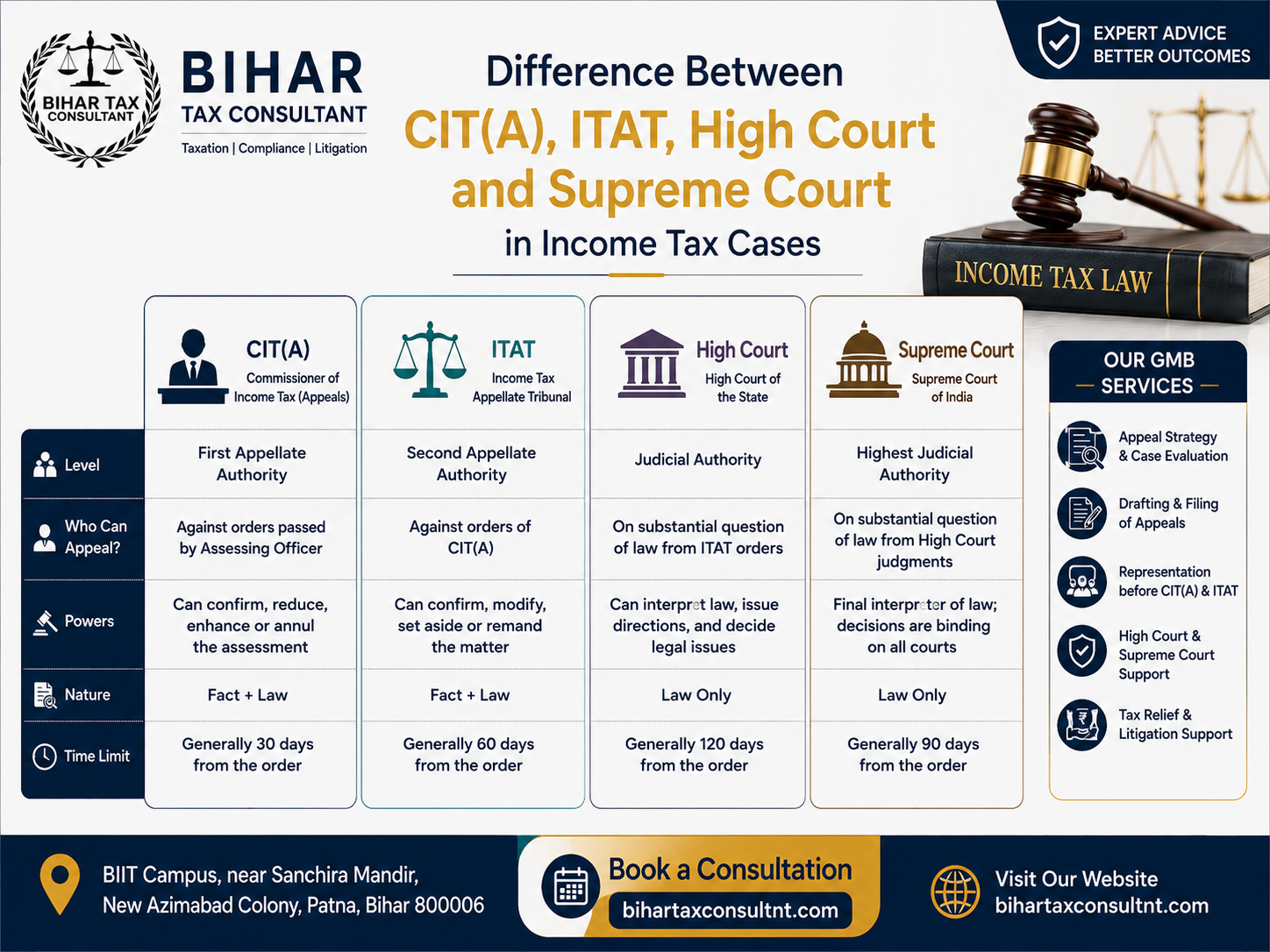
Difference Between CIT(A), ITAT, High Court and Supreme Court in Income Tax Cases
Receiving an adverse Income Tax assessment order does not necessarily mean that the tax dispute has reached its end.
Indian income-tax law provides multiple appellate stages through which an assessee or, in appropriate circumstances, the Revenue can challenge an order. However, CIT(A), ITAT, High Court and Supreme Court are not interchangeable forums. Each has a different jurisdiction, function and role in the appellate hierarchy.
A taxpayer may therefore need to understand:
- Where the first appeal should be filed
- When a matter goes to ITAT
- What issues can be taken before the High Court
- When the Supreme Court can be approached
- Whether the dispute involves facts, law or both
- What happens to an earlier order during further appeal
- Which statutory framework applies to the particular assessment year
The Income Tax Department confirms that the appellate hierarchy remains structurally the same under the Income Tax Act, 2025: Assessing Officer → JCIT(A)/CIT(A) → ITAT → High Court → Supreme Court. (Income Tax Department)
What Is the Income Tax Appeal Hierarchy?
In a conventional Income Tax dispute, the appellate structure can be understood as follows:
Assessing Officer (AO)
↓
JCIT(A) / CIT(A)
↓
Income Tax Appellate Tribunal (ITAT)
↓
High Court
↓
Supreme Court
The first appeal is generally concerned with challenging an appealable order of the tax authority. Further appeals progressively involve more specialized appellate scrutiny, with the High Court ordinarily concerned with substantial questions of law rather than acting as another general fact-finding forum.
For proceedings governed by the Income-tax Act, 1961, the relevant provisions include sections such as 246A, 253, 260A and 261. Under the Income Tax Act, 2025, the appellate provisions have been reorganised into sections 356–368, without structurally changing the hierarchy. (Income Tax India)
CIT(A): First Appellate Authority
What is CIT(A)?
CIT(A) means Commissioner of Income-tax (Appeals). The CIT(A) is generally the first appellate authority for specified appealable orders.
Under section 246A of the Income-tax Act, 1961, specified orders can be challenged before the Commissioner (Appeals). These include certain assessment orders, reassessment orders, specified adjustments, penalty orders and other appealable orders. (Income Tax India)
The Income Tax Department identifies the Commissioner (Appeals) as the first appellate authority. (Income Tax India)
What does CIT(A) do?
The CIT(A) examines the grounds raised by the appellant and considers the assessment or other appealable order under the applicable statutory framework.
Depending on the case, the appellate authority may examine issues relating to:
- Addition to taxable income
- Disallowance of expenses
- Tax liability
- Reassessment
- Certain penalty proceedings
- TDS-related orders
- Other appealable orders specified by law
The precise scope depends on the order being challenged and the applicable statutory provisions.
Time limit for CIT(A) appeal
For appeals governed by the Income-tax Act, 1961, section 249(2) generally prescribed a 30-day period for filing an appeal, calculated according to the nature of the order and the statutory trigger. The Income Tax Department’s current guidance also states this 30-day limitation for appeals before JCIT(A)/CIT(A). (Income Tax India)
Because limitation is critical, a taxpayer should not assume that simply having a right of appeal means that the appeal can be filed at any time.
ITAT: Second Appellate Stage
What is ITAT?
ITAT stands for Income Tax Appellate Tribunal.
It is the next major appellate forum after the first appellate stage in cases where an appeal lies to the Tribunal.
For proceedings governed by the Income-tax Act, 1961, section 253 deals with appeals to the Appellate Tribunal. (Income Tax India)
The ITAT is particularly important because it operates as the principal appellate fact-finding forum in the income-tax litigation structure.
What does ITAT examine?
The Tribunal can deal with questions involving both facts and law, subject to its statutory jurisdiction.
For example, a dispute may involve:
- Whether a particular expenditure was genuinely incurred
- Whether evidence supports an addition
- Whether a transaction has been correctly characterized
- Whether the CIT(A)’s factual findings are sustainable
- Whether the applicable statutory provision has been correctly interpreted
The ITAT proceedings are adversarial in nature, with the assessee and Revenue appearing as opposing parties. The official ITAT procedure manual describes the Tribunal as the final fact-finding authority for purposes of section 260A, subject to the High Court’s jurisdiction over substantial questions of law. (Income Tax India)
High Court: Substantial Question of Law
When can an Income Tax case go to the High Court?
A major distinction between ITAT and the High Court is that a further appeal from an ITAT order is not simply another opportunity to re-argue every factual issue.
Under section 260A of the Income-tax Act, 1961, an appeal lies to the High Court from an order of the Appellate Tribunal where the case involves a substantial question of law. (Income Tax India)
Therefore, the High Court’s role is materially different from that of the ITAT.
What is a substantial question of law?
In broad terms, it is a significant legal question arising from the case that requires consideration by the High Court.
Examples may include disputes concerning:
- Interpretation of a statutory provision
- Correct legal test applicable to a particular issue
- Whether the Tribunal applied the correct legal principle
- Whether a particular legal interpretation is sustainable
- A legal issue having significance beyond a mere disagreement over evidence
A mere disagreement with the factual appreciation of evidence by the ITAT does not automatically create a substantial question of law.
Why is the ITAT order important?
The ITAT is generally treated as the final fact-finding authority. Consequently, the High Court does not ordinarily function as a routine second fact-finding forum.
This distinction is strategically important while drafting grounds for an appeal before the High Court.
Supreme Court: Final Judicial Stage
Can every Income Tax case go to the Supreme Court?
No.
The Supreme Court is the highest judicial forum, but an Income Tax dispute does not automatically reach the Supreme Court merely because a party disagrees with a High Court judgment.
Under section 261 of the Income-tax Act, 1961, an appeal to the Supreme Court can arise from a High Court judgment in the circumstances specified by the statute, including certification by the High Court that the case is fit for appeal. (Income Tax India)
In addition to the statutory appellate framework, the Supreme Court’s constitutional jurisdiction can be relevant in appropriate cases.
The precise route must therefore be examined based on the nature of the judgment, the statutory provision involved and the procedural posture of the case.
CIT(A) vs ITAT vs High Court vs Supreme Court
| Point | CIT(A) | ITAT | High Court | Supreme Court |
|---|---|---|---|---|
| Position | First appellate authority | Further appellate forum | Higher judicial forum | Highest judicial forum |
| Main role | Reviews specified orders of tax authorities | Reviews appellate orders and examines facts/law within jurisdiction | Examines substantial questions of law in statutory appeals | Final judicial consideration under applicable route |
| Fact-finding | Can examine factual issues | Principal/final fact-finding forum | Generally not a fresh fact-finding forum | Primarily concerned with legal issues arising through the applicable appellate route |
| Typical predecessor | AO / specified tax authority | CIT(A)/other specified appellate order | ITAT | High Court |
| Key 1961 Act provision | Section 246A | Section 253 | Section 260A | Section 261 |
| Can factual issues be examined? | Yes, within appellate jurisdiction | Yes | Generally limited by section 260A framework | Generally not a routine fact-finding stage |
| Nature | Departmental appellate authority | Tribunal | Constitutional court | Apex court |
| Practical focus | Correctness of assessment/order | Facts, evidence and law | Substantial question of law | Final legal determination under applicable jurisdiction |
Key Difference: CIT(A) vs ITAT
The most important distinction is that the CIT(A) is the first appellate authority, whereas the ITAT is the next appellate forum and the principal fact-finding Tribunal.
A taxpayer who disagrees with an assessment order may therefore first need to establish the case before the appropriate first appellate authority.
If the dispute continues after the first appellate decision, the matter may proceed to ITAT where an appeal is maintainable.
Example
Suppose an Assessing Officer makes a ₹10 lakh addition on the ground that certain business expenditure is not adequately supported.
At the first appellate stage, the taxpayer can challenge the addition and place relevant evidence and legal submissions before the appellate authority, subject to the applicable procedural rules.
If the taxpayer remains aggrieved by the appellate decision and an appeal lies to ITAT, the Tribunal can examine the factual and legal aspects falling within its jurisdiction.
Key Difference: ITAT vs High Court
This is one of the most important distinctions in Income Tax litigation.
ITAT is principally concerned with facts and law within its appellate jurisdiction.
High Court statutory appeals under section 260A focus on substantial questions of law.
Therefore, a taxpayer preparing an ITAT appeal should carefully develop the factual record, evidence and legal arguments.
At the High Court stage, the formulation and admission of a substantial question of law becomes critically important.
The official ITAT procedure manual specifically notes that under section 260A, a High Court appeal is maintainable when the case involves a substantial question of law and describes the Tribunal as the final fact-finding authority. (Income Tax India)
Key Difference: High Court vs Supreme Court
The High Court and Supreme Court are both constitutional courts, but they occupy different positions in the judicial hierarchy.
A High Court can hear an appeal from an ITAT order when the statutory requirements, including the substantial-question-of-law requirement under section 260A of the 1961 Act, are satisfied.
The Supreme Court is the apex court. An Income Tax matter may reach it through the applicable statutory or constitutional route, subject to the requirements governing that route.
Under section 261 of the 1961 Act, a Supreme Court appeal is linked to a High Court judgment in the circumstances specified by that section. (Income Tax India)
Important Change After 1 April 2026
Taxpayers should be particularly careful about the transition from the Income-tax Act, 1961 to the Income Tax Act, 2025.
The Income Tax Department states that the new Act has not structurally changed the appellate hierarchy. The sequence remains:
AO → JCIT(A)/CIT(A) → ITAT → High Court → Supreme Court. (Income Tax Department)
However, the applicable statutory provisions depend on the relevant tax year and transitional rules.
For example, the Department states that proceedings relating to a tax year beginning before 1 April 2026 can continue under the Income-tax Act, 1961 in accordance with the transitional provisions. Pending appeals as of 1 April 2026 also continue under the old Act. (Income Tax Department)
Therefore, the assessment year/tax year should be identified before determining which section and limitation provision applies.
This is particularly important when advising a taxpayer in 2026 or later.
Practical Example: How an Income Tax Dispute Can Progress
Consider a hypothetical taxpayer who receives an assessment order containing a disputed addition.
Stage 1 — Assessing Officer
The Assessing Officer completes the assessment and determines additional taxable income.
Stage 2 — CIT(A)
The taxpayer challenges the appealable assessment order before the appropriate first appellate authority.
The taxpayer argues that the addition is legally and factually unsustainable.
Stage 3 — ITAT
If the taxpayer remains aggrieved by the first appellate order and an appeal is maintainable, the matter can proceed to ITAT.
The Tribunal may examine the evidence, factual findings and legal arguments within its jurisdiction.
Stage 4 — High Court
If the ITAT decides against the taxpayer and the statutory requirements for a High Court appeal are satisfied, the taxpayer may seek admission of an appeal involving a substantial question of law.
Stage 5 — Supreme Court
If the matter qualifies for further consideration through the applicable statutory or constitutional route, it may ultimately reach the Supreme Court.
This does not mean that every dispute automatically passes through all five stages. The availability of each remedy depends on the nature of the order, statutory jurisdiction, limitation and the legal issues involved.
Common Mistakes in Income Tax Appeals
1. Treating every appeal as a factual appeal
A taxpayer should understand the difference between factual disputes and legal questions, particularly before approaching the High Court.
2. Missing the limitation period
Appeal limitation is a substantive procedural issue. Waiting until the last moment can create avoidable complications.
3. Filing before the wrong forum
The appropriate appellate forum depends on the order being challenged and the governing statutory provisions.
4. Using the same grounds at every stage
Arguments should be strategically adapted to the jurisdiction and legal scope of the particular appellate authority.
5. Ignoring the assessment year
After the commencement of the Income Tax Act, 2025, identifying the relevant tax year and transitional provision is especially important.
6. Assuming that an ITAT order can always be challenged on facts
A section 260A appeal to the High Court requires the statutory substantial-question-of-law threshold. (Income Tax India)
7. Treating Supreme Court litigation as an automatic final appeal
The route to the Supreme Court is governed by applicable statutory and constitutional requirements.
What Should a Taxpayer Do After Receiving an Adverse Order?
A taxpayer should generally:
- Identify the exact order received.
- Determine the assessment/tax year involved.
- Check whether the order is appealable.
- Calculate the applicable limitation period immediately.
- Review the assessment order and supporting documents.
- Identify factual and legal issues separately.
- Prepare appropriate grounds of appeal.
- Select the correct appellate forum.
- Assess whether any demand-related relief or stay application is required.
- Obtain professional advice where the dispute involves substantial tax exposure or complex legal questions.
The exact procedure will depend on the governing Act, order and facts.
Frequently Asked Questions
1. What is the difference between CIT(A) and ITAT?
CIT(A) is generally the first appellate authority, while ITAT is the next appellate forum. The ITAT has a particularly important role in examining factual and legal issues and is generally regarded as the final fact-finding authority for purposes of further statutory appeal to the High Court.
2. Is ITAT higher than CIT(A)?
Yes. In the normal appellate hierarchy, ITAT comes after the first appellate stage before JCIT(A)/CIT(A).
3. Can I appeal directly from the Assessing Officer to ITAT?
Generally, the normal appellate route involves the first appellate stage before JCIT(A)/CIT(A), although the exact maintainability of an appeal depends on the order and applicable statutory provisions.
4. Can the High Court reconsider facts decided by ITAT?
A statutory appeal under section 260A of the Income-tax Act, 1961 requires a substantial question of law. The High Court is therefore not ordinarily another general fact-finding forum. The factual findings of the Tribunal have significant finality subject to the High Court’s jurisdiction in accordance with law. (Income Tax India)
5. What is the role of the High Court in an Income Tax case?
The High Court primarily considers substantial questions of law in an appeal from an ITAT order under the statutory framework.
6. Can every High Court Income Tax judgment be appealed to the Supreme Court?
No. The availability and route of further appeal depend on the applicable statutory and constitutional provisions. Section 261 of the Income-tax Act, 1961 specifically provides for an appeal to the Supreme Court in the circumstances stated there. (Income Tax India)
7. What is the normal Income Tax appeal hierarchy?
The broad hierarchy is:
Assessing Officer → JCIT(A)/CIT(A) → ITAT → High Court → Supreme Court.
The Income Tax Department confirms that this hierarchy continues under the Income Tax Act, 2025. (Income Tax Department)
8. What is section 246A?
Section 246A of the Income-tax Act, 1961 specifies various orders against which an appeal may be filed before the Commissioner (Appeals). (Income Tax India)
9. What is section 253 of the Income-tax Act?
Section 253 of the Income-tax Act, 1961 contains provisions concerning appeals to the Appellate Tribunal. (Income Tax India)
10. What is section 260A?
Section 260A provides the statutory framework for appeals to the High Court from orders of the Appellate Tribunal where the case involves a substantial question of law. (Income Tax India)
11. What is section 261?
Section 261 of the Income-tax Act, 1961 deals with appeals to the Supreme Court in the circumstances specified by that provision. (Income Tax India)
12. Does the Income Tax Act, 2025 change the appeal hierarchy?
The Income Tax Department states that there is no structural change in the appellate hierarchy. The new Act reorganises the provisions but retains the sequence of JCIT(A)/CIT(A), ITAT, High Court and Supreme Court. (Income Tax Department)