
What Is Income Tax Litigation?
Income Tax litigation refers to the legal process through which a taxpayer challenges a disputed action, assessment, demand, penalty or other tax order before the appropriate appellate or judicial authority.
A dispute may arise because of:
- Addition to taxable income
- Disallowance of deductions or expenses
- Reassessment
- Tax demand
- Penalty proceedings
- TDS/TCS disputes
- Denial of refund or other claims
- Disallowance of exemption
- Classification or interpretation of income
- Disputes involving evidence, facts or legal interpretation
Not every disagreement automatically requires litigation. Depending on the circumstances, a taxpayer may have remedies such as rectification, revision, appeal or other statutory mechanisms.
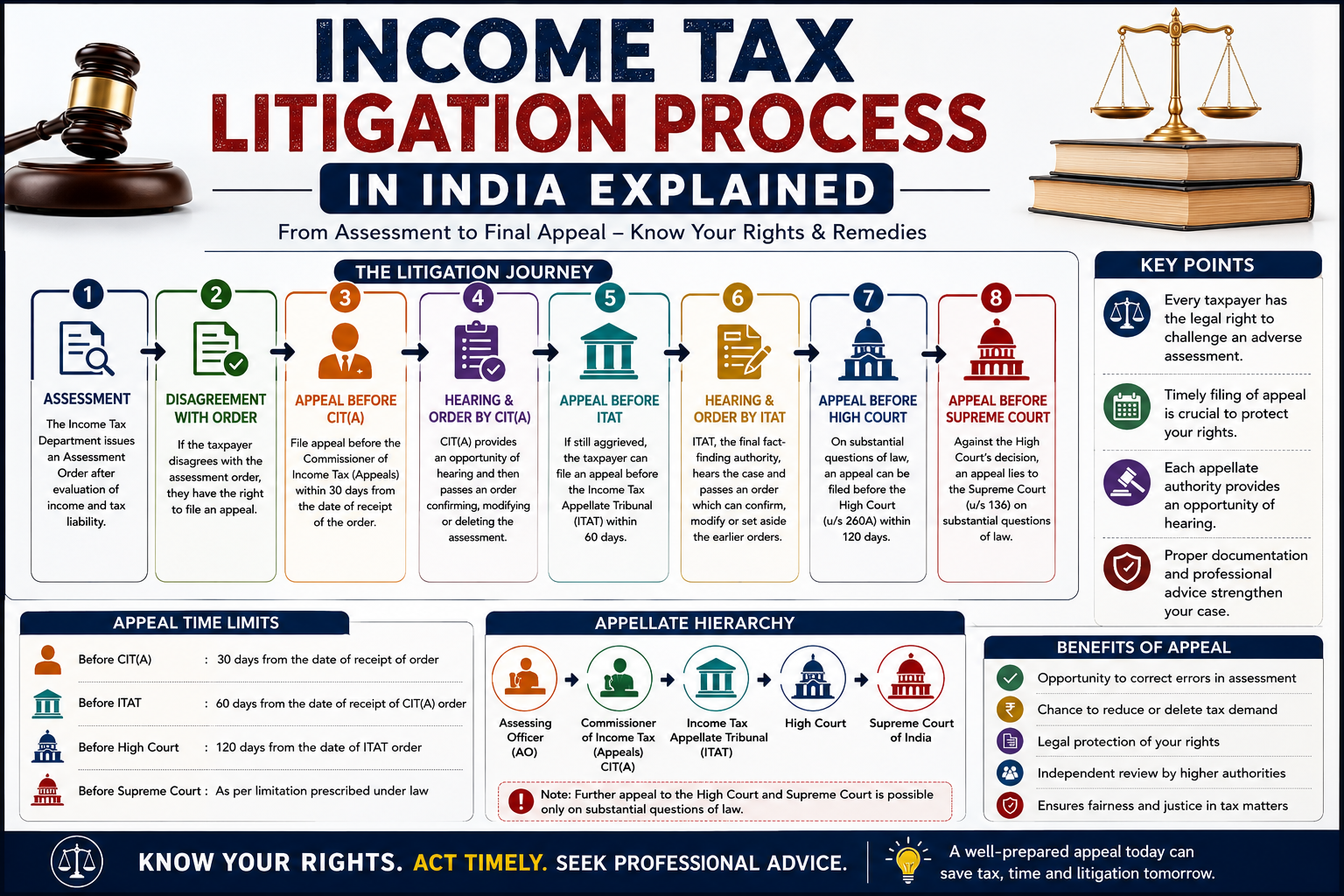
Income Tax Litigation Hierarchy in India
The broad appellate structure is:
Assessing Officer → JCIT(A)/CIT(A) → ITAT → High Court → Supreme Court
The Income Tax Department states that the Income-tax Act, 2025 does not structurally change this hierarchy.
| Stage | Authority | Broad Role |
|---|---|---|
| 1 | Assessing Officer | Assessment / reassessment / tax determination |
| 2 | JCIT(A) / CIT(A) | First appellate review |
| 3 | ITAT | Appellate review by the Income Tax Appellate Tribunal |
| 4 | High Court | Appeals involving substantial questions of law |
| 5 | Supreme Court | Further appeal in cases satisfying statutory requirements |
The precise route depends upon the order being challenged, the tax year, the statutory provision involved and the facts of the case.
Step 1: Assessment or Other Adverse Order
Income Tax litigation commonly begins with an order or determination by the Income Tax Department.
The taxpayer may receive an assessment, reassessment, penalty or another order that results in:
- Additional tax liability
- Reduction of refund
- Disallowance of a claim
- Addition to income
- Penalty
- Other adverse consequences
The first step should be to carefully examine the order, demand notice, computation, reasons recorded and supporting documents.
A taxpayer should not simply focus on the amount of tax demanded. The legal basis and factual reasoning behind the order are equally important.
Step 2: Examine Whether an Appeal Is Available
The next question is whether the particular order is appealable and which appellate authority has jurisdiction.
Under the Income-tax Act, 2025, Section 357 deals with orders appealable before the Commissioner (Appeals), while Sections 356–360 cover the first appellate framework involving the Joint Commissioner (Appeals) and Commissioner (Appeals).
For proceedings governed by the Income-tax Act, 1961, Section 246A contains the principal provisions concerning orders appealable before the Commissioner (Appeals).
Therefore, the tax year and transition provisions must be checked before deciding which statutory provision applies.
Step 3: Appeal Before JCIT(A) / CIT(A)
The first appellate stage is generally before the Joint Commissioner (Appeals) or Commissioner (Appeals), depending on the applicable provision and jurisdiction.
The Income Tax Department’s current framework provides for first appeals under Sections 356–360 of the Income-tax Act, 2025.
The appellate authority can examine the grounds raised by the taxpayer and exercise statutory appellate powers.
Under Section 360 of the Income-tax Act, 2025, the appellate authority may, depending on the case, confirm, reduce, enhance or annul an assessment, and may also deal with penalty orders and other matters within its statutory jurisdiction.
What should the taxpayer prepare?
A strong first appeal normally requires:
- Copy of the disputed order
- Notice of demand, where applicable
- Statement of Facts
- Grounds of Appeal
- Relevant documentary evidence
- Details of tax payments
- Appeal fee
- Supporting explanations
- Relevant correspondence with the Department
The exact documents depend on the nature of the dispute.
Step 4: Observe the Appeal Limitation Period
Limitation is one of the most important aspects of Income Tax litigation.
For appeals to the JCIT(A)/CIT(A) under the Income-tax Act, 2025, Section 358 provides a 30-day limitation period, calculated according to the statutory trigger applicable to the particular appeal. The provision also allows condonation where sufficient cause for delay is established.
For assessment or penalty matters, the period is generally calculated from the service of the notice of demand; other appeals may run from service of the relevant order/intimation.
For proceedings governed by the Income-tax Act, 1961, Section 249 similarly provides a 30-day limitation framework, subject to its statutory conditions and provisions concerning condonation.
Do not calculate limitation merely from the date printed on an order. The legally relevant date may depend on service or communication of the order/demand.
Step 5: ITAT Appeal
If the taxpayer or Department remains aggrieved by an appeal order that is appealable to the Tribunal, the next major appellate forum is the Income Tax Appellate Tribunal (ITAT).
Under the Income-tax Act, 2025, appeals to the Appellate Tribunal are covered by Sections 361–364.
ITAT is an important forum because tax disputes may involve detailed examination of:
- Facts
- Documentary evidence
- Accounting records
- Tax provisions
- Findings of lower authorities
- Judicial precedents
- Questions arising from assessment and first appellate orders
The ITAT can therefore play a significant role in resolving both factual and legal disputes within its statutory jurisdiction.
Step 6: Appeal Before the High Court
A High Court appeal is not simply a second opportunity to re-argue every factual issue.
Under Section 365 of the Income-tax Act, 2025, an appeal from an order of the Appellate Tribunal lies to the High Court where the case involves a substantial question of law. The appeal must state the substantial question of law involved.
The statutory limitation for an appeal under Section 365(2) is 120 days from receipt of the relevant ITAT order by the assessee or specified tax authority, subject to the statutory provisions concerning delay.
The High Court generally focuses on the legal question that satisfies the statutory threshold rather than functioning as another general fact-finding appellate forum.
Step 7: Supreme Court
The Supreme Court represents the highest judicial level in the ordinary statutory appellate hierarchy.
Under Section 367 of the Income-tax Act, 2025, an appeal may lie to the Supreme Court from a High Court judgment in an appeal concerning an order of the Appellate Tribunal where the statutory requirements for such appeal are satisfied, including the required certification.
The Supreme Court may therefore become relevant where an important legal issue reaches the highest appellate forum.
A Supreme Court proceeding is considerably different from an ordinary first appeal. The question involved, statutory route and maintainability must be examined carefully before proceeding.
Income Tax Litigation Process: At a Glance
Assessment / Adverse Order
↓
Examine Order, Demand & Grounds
↓
First Appeal — JCIT(A) / CIT(A)
↓
Appellate Order
↓
ITAT
↓
High Court — Substantial Question of Law
↓
Supreme Court — Where Statutory Requirements Are Satisfied
This hierarchy is broadly retained under the Income-tax Act, 2025.
What Happens During an Income Tax Appeal?
An appeal is not merely the submission of a form.
Depending on the forum, the process may involve:
- Filing the appeal within limitation.
- Identifying the disputed issues.
- Preparing the Statement of Facts.
- Drafting precise Grounds of Appeal.
- Submitting supporting documents.
- Responding to notices or queries.
- Presenting legal and factual arguments.
- Considering additional evidence where legally permissible.
- Addressing departmental submissions.
- Receiving the appellate order.
The quality of the grounds, evidence and legal reasoning can materially affect how effectively a dispute is presented.
Important Documents for Income Tax Litigation
A taxpayer should generally preserve a complete litigation file containing:
- Income Tax return
- Computation of income
- Financial statements
- Tax audit report, where applicable
- Assessment order
- Reassessment notices/orders, where applicable
- Notice of demand
- Show-cause notices
- Replies submitted to the Department
- Documentary evidence
- Bank statements
- Invoices and agreements
- Correspondence with tax authorities
- Previous appellate orders
- Judicial decisions relied upon
- Proof of tax payments
- Appeal forms and acknowledgements
The documents required will vary depending on the dispute.
What Are the Most Common Mistakes in Tax Litigation?
1. Missing the limitation period
A taxpayer may have a strong case but create unnecessary procedural difficulty by delaying the appeal.
2. Filing vague grounds
Grounds of appeal should identify the actual grievance instead of merely stating that the order is incorrect.
3. Ignoring the assessment record
The appellate authority needs to understand what happened during the original proceedings.
4. Submitting documents without explanation
Evidence is more useful when its relevance to the disputed issue is clearly explained.
5. Confusing factual and legal issues
The nature of the dispute becomes particularly important when a matter is proposed to be taken to the High Court.
6. Treating every tax dispute as identical
The correct remedy depends on the order, tax year, statutory provision and facts.
7. Ignoring transition from the 1961 Act to the 2025 Act
This is especially important after 1 April 2026.
Income-tax Act, 1961 vs Income-tax Act, 2025: Why the Transition Matters
The Income-tax Act, 2025 came into force from 1 April 2026. However, the old Income-tax Act, 1961 continues to govern proceedings relating to tax years beginning before 1 April 2026 under the transition provisions.
The Income Tax Department specifically explains that:
- Pending proceedings continue under the old Act.
- Proceedings initiated after 1 April 2026 relating to tax years beginning before 1 April 2026 can also continue under the old Act.
- A taxpayer does not have to file a fresh appeal merely because the new Act came into force.
- The basic appellate hierarchy remains substantially unchanged.
This means that the applicable law cannot be determined merely from the date on which an appeal is filed. The relevant tax year and transition provisions must also be considered.