
How to Challenge an Income Tax Demand Notice in India

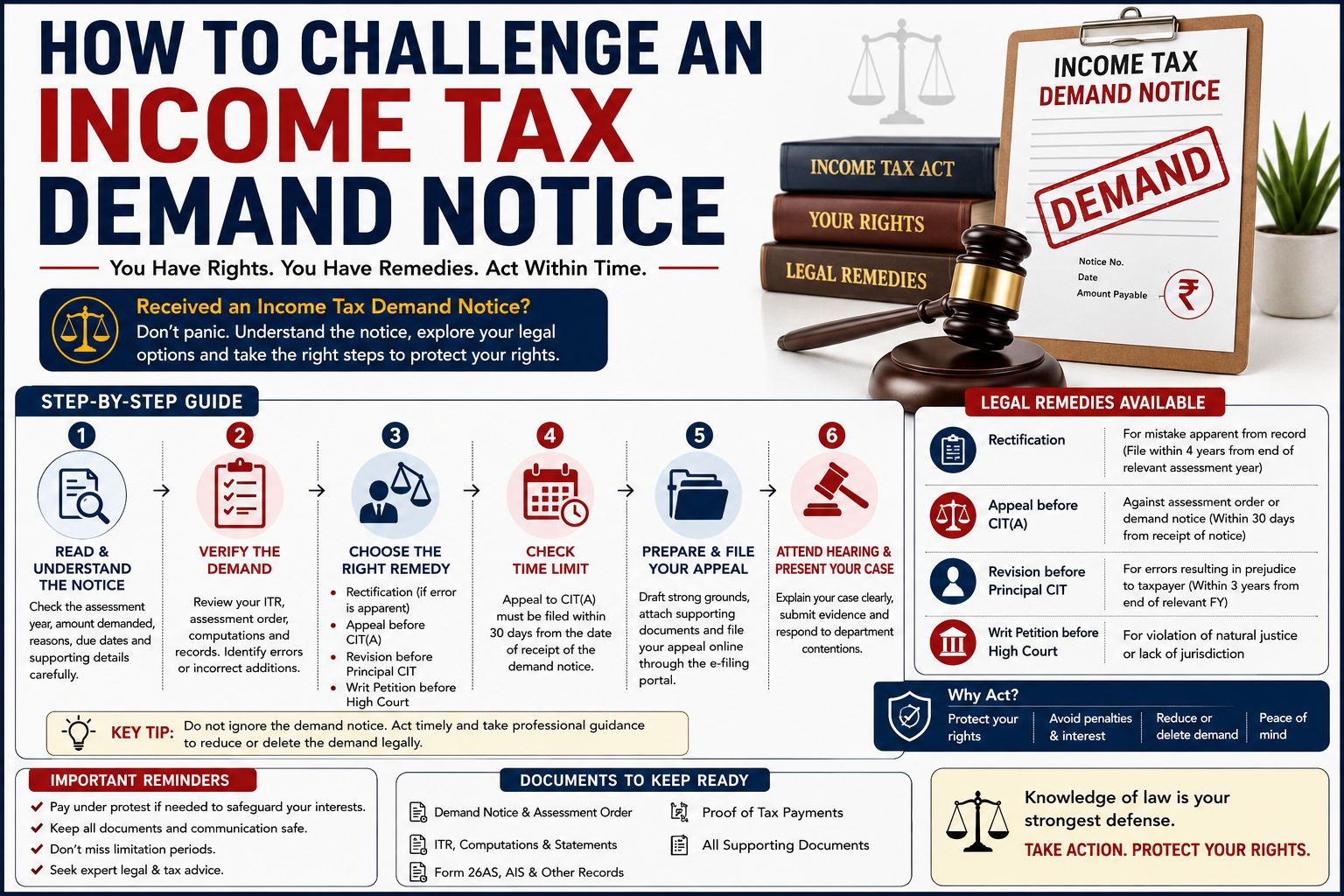
An Income Tax demand should not be ignored simply because the taxpayer believes it is incorrect. The appropriate response depends on why the demand has been raised. Depending on the facts, the taxpayer may seek rectification of an apparent mistake, file an appeal against the underlying order, respond to the demand through the Income Tax e-filing system, or pursue another applicable statutory remedy.
For tax years beginning before 1 April 2026, transitional provisions can continue to apply the Income-tax Act, 1961 to relevant proceedings. For tax years beginning on or after 1 April 2026, the Income-tax Act, 2025 applies. The Income Tax Department has specifically stated that pending proceedings and proceedings relating to earlier tax years continue under the 1961 Act framework in specified circumstances.
Important: A demand notice is generally the consequence of an underlying assessment, intimation, penalty or other order. Therefore, challenging the underlying order or mistake giving rise to the demand is often more important than merely disputing the demand figure.
What Is an Income Tax Demand Notice?
An Income Tax demand notice communicates that a taxpayer has an amount payable to the Income Tax Department.
Under the Income-tax Act, 1961, Section 156 provides for a notice of demand where tax, interest, penalty, fine or another sum becomes payable as a consequence of an order. Certain intimations are also treated as notices of demand.
For the Income-tax Act, 2025, the corresponding demand mechanism is contained in Section 289. The prescribed Form 103 is used for a demand arising under the new Act.
The demand may arise because of:
- an adjustment while processing the return;
- an assessment order;
- disallowance of a deduction or expenditure;
- mismatch in tax credits;
- income treated as taxable by the Department;
- reassessment;
- interest computation;
- penalty proceedings; or
- another order resulting in tax becoming payable.
Why Should You Check an Income Tax Demand Notice Carefully?
A demand does not necessarily mean that the taxpayer actually owes the amount shown.
For example, a demand may arise because:
- TDS or TCS credit has not been properly reflected;
- advance tax or self-assessment tax has not been matched;
- income has been incorrectly reported;
- a deduction has been disallowed;
- a computational error has occurred;
- the same income has effectively been considered twice;
- an assessment order contains an apparent mistake; or
- the taxpayer disagrees with the legal or factual basis of the assessment.
The first task is therefore to reconcile the demand with the return, tax records and underlying order.
Step-by-Step: How to Challenge an Income Tax Demand Notice
Step 1: Read the Demand and Identify Its Source
First identify:
- Tax Year/Assessment Year;
- DIN or communication reference;
- amount demanded;
- tax component;
- interest component;
- penalty, if any;
- order or intimation that generated the demand;
- date of communication;
- payment due date; and
- appellate authority or available remedy.
Do not begin with the assumption that every demand should be challenged in the same manner.
Step 2: Compare the Demand With Your Tax Records
Collect the relevant records and reconcile the figures.
Depending on the case, examine:
- ITR acknowledgement;
- computation of income;
- assessment/intimation;
- Form 26AS;
- AIS;
- TIS;
- TDS certificates;
- advance-tax challans;
- self-assessment-tax challans;
- previous correspondence with the Department;
- notices and replies; and
- assessment or penalty orders.
The objective is to determine exactly why the demand differs from the taxpayer’s calculation.
Step 3: Determine Whether There Is an Apparent Mistake
If the demand has resulted from a mistake apparent from the record, rectification may be an appropriate remedy.
For CPC-related processing, the Income Tax Department provides an online rectification facility for matters including mistakes in an intimation under Section 143(1), an order under Section 154 and certain assessment-related errors.
Examples may include:
- incorrect tax-credit treatment;
- an obvious computational error;
- incorrect data being considered;
- an apparent mistake in the record.
Rectification is not a substitute for an appeal where the taxpayer is actually disputing a substantive legal or factual determination.
Step 4: Consider Filing an Appeal
If the taxpayer disagrees with the assessment or another appealable order, an appeal may be the appropriate remedy.
Under the Income-tax Act, 2025, Section 357 specifies orders appealable before the Commissioner (Appeals), while Section 358 deals with the form, fee and limitation for appeals. An appeal relating to assessment or penalty is generally to be presented within 30 days from service of the notice of demand, subject to the statutory provisions regarding extension/condonation.
The appellate hierarchy continues broadly as:
Assessing Officer → JCIT(A)/CIT(A) → ITAT → High Court → Supreme Court
The Income Tax Department’s transition FAQ confirms that the new Act retains this appellate architecture.
Step 5: Check Whether Recovery Needs to Be Addressed
Challenging a demand and dealing with recovery of the demand are related but distinct issues.
Under the 1961 Act, Section 220 generally provides a 30-day period for payment of a demand under Section 156, subject to the statutory exceptions and powers concerning a shorter period.
Under the 2025 Act, Form 103 similarly states that the default payment period is generally 30 days from service, although the Assessing Officer can modify the period subject to the statutory requirements.
Therefore, a taxpayer who intends to dispute a demand should not simply assume that filing a rectification or appeal automatically resolves recovery.
The appropriate application/request concerning recovery or stay should be considered according to the applicable law and stage of proceedings.
Step 6: File the Appropriate Response or Remedy
The precise procedure depends on the source of the demand.
A simplified decision framework is:
| Situation | Possible course |
|---|---|
| Obvious record/computation mistake | Rectification |
| CPC processing error | Online rectification, where applicable |
| Disagreement with assessment | Appeal |
| Disagreement with penalty order | Applicable appeal/revision remedy |
| Demand already under recovery | Address recovery/stay separately |
| Substantial legal question after ITAT | High Court appeal, where statutory conditions are met |
| Further substantial legal issue | Supreme Court remedy, where maintainable |
The correct remedy should be determined from the actual order, tax year and applicable legislation.
What Are the Time Limits for Challenging an Income Tax Demand?
Time limits are critical.
For appeals against an assessment or penalty under the Income-tax Act, 2025, Section 358 provides a 30-day limitation period from service of the notice of demand. The appellate authority can admit a delayed appeal where sufficient cause is established.
The Income-tax Act, 1961 similarly contains a 30-day limitation framework for relevant first appeals under Section 249.
However, do not calculate the deadline merely from the date printed on a demand notice without examining the underlying order, service details and applicable statutory provision.
A delay can complicate the litigation considerably.
Can an Income Tax Demand Be Challenged Through Rectification?
Short Answer
Yes, where the demand results from a mistake apparent from the record and the statutory conditions for rectification are satisfied.
Rectification is particularly relevant where the problem is an identifiable mistake rather than a full-scale dispute requiring reconsideration of evidence or legal interpretation.
For example, if the Department has failed to give credit for a tax payment that is clearly available in the relevant records, rectification may be considered.
The Income Tax Department’s e-filing guidance expressly provides an online rectification mechanism for specified CPC and assessment-related errors.
Can You Appeal Against an Income Tax Demand?
Short Answer
Yes, where the demand arises from an appealable order and the statutory requirements for filing an appeal are satisfied.
The important distinction is that the taxpayer should identify the order creating the disputed liability.
For example:
Assessment Order → Demand → Appeal against the appealable assessment/order
The appeal should contain properly formulated grounds explaining why the assessment or other appealable order is incorrect.
What Documents Should Be Kept Ready?
Before challenging the demand, maintain a complete document file containing:
- Demand notice;
- Assessment/intimation/order;
- ITR acknowledgement;
- Computation of income;
- Form 26AS;
- AIS/TIS;
- Form 16/Form 16A, where applicable;
- Tax payment challans;
- TDS/TCS records;
- Books of account, where applicable;
- Relevant invoices and supporting documents;
- Previous notices and replies;
- Appeal/rectification documents;
- Relevant correspondence with the Department.
A properly organised record helps identify whether the issue is factual, computational, procedural or legal.
Common Mistakes Taxpayers Make
1. Ignoring the demand
An incorrect demand should still be addressed promptly.
2. Looking only at the demand amount
The underlying order or intimation may contain the actual reason for the demand.
3. Missing the appeal limitation
A taxpayer may have a strong case but create unnecessary procedural difficulty by filing late.
4. Filing rectification when an appeal is required
Rectification is designed for appropriate mistakes apparent from the record. It should not automatically be used for every disagreement.
5. Assuming an appeal automatically stops recovery
The taxpayer should separately examine the applicable recovery/stay position.
6. Not reconciling tax credits
TDS, TCS and tax-payment mismatches are common sources of apparent demand.
7. Submitting incomplete evidence
A properly documented factual position is generally much easier to establish than an unsupported objection.
Practical Hypothetical Example
Example:
Suppose Mr. A files his return declaring income of ₹8 lakh and claims TDS credit of ₹80,000. An intimation subsequently reflects a demand because only ₹30,000 of TDS has been credited.
Mr. A should not immediately assume that he must pay the entire demand.
He should first:
- Examine the intimation and demand calculation.
- Compare the TDS credit with Form 26AS/AIS and TDS certificates.
- Verify whether the missing credit is actually reflected in the Department’s records.
- Determine whether the issue is capable of rectification.
- If the dispute arises from an appealable order rather than a simple record mistake, consider the appropriate appellate remedy.
- Separately review the applicable payment/recovery position.
This is only a hypothetical example. The appropriate remedy depends on the actual documents and facts.
What Happens If You Do Nothing About an Income Tax Demand?
Ignoring a demand can lead to avoidable consequences.
Under the 1961 Act, Section 220 provides for interest where an amount specified in a demand is not paid within the prescribed period.
The Department also has mechanisms for recovery of outstanding tax.
Therefore, receiving a demand should trigger a prompt review of the underlying order and available remedies, rather than simply waiting for recovery action.
Does Filing an Appeal Automatically Cancel the Demand?
No.
An appeal challenges the disputed order, but the taxpayer should separately consider the legal position concerning collection and recovery.
The Income Tax Department’s transition material confirms that the appellate framework and mechanisms concerning stay remain part of the overall remedial structure under the new Act.
The precise relief available depends on the applicable Act, order, stage of proceedings and facts.
When Should Professional Tax Assistance Be Considered?
Professional assistance can be particularly useful where:
- the demand is substantial;
- multiple years are involved;
- reassessment is involved;
- the issue concerns complex additions/disallowances;
- tax credits are disputed;
- limitation is approaching;
- an appeal needs to be drafted;
- recovery proceedings have begun; or
- the dispute involves a substantial question of law.
An experienced tax professional can help identify the source of the demand, appropriate remedy, limitation period, supporting evidence and procedural requirements.
For taxpayers in Bihar or Patna, such assistance may include reviewing the assessment records and determining whether the matter requires rectification, first appeal or further tax litigation.
9. FAQs
1. What is an Income Tax demand notice?
An Income Tax demand notice communicates an amount payable by the taxpayer as tax, interest, penalty or another statutory amount. Under the 1961 Act, Section 156 governs notices of demand; under the 2025 Act, Section 289 contains the corresponding demand provision.
2. Can I challenge an incorrect Income Tax demand?
Yes. The appropriate remedy depends on the reason for the demand and may include rectification, appeal or another statutory remedy.
3. What is the time limit for filing an Income Tax appeal?
For relevant first appeals under the Income-tax Act, 2025, Section 358 generally provides 30 days from service of the demand notice for an appeal relating to assessment or penalty.
4. Can I request rectification of an Income Tax demand?
Yes, where the issue involves a mistake apparent from the record and the applicable statutory requirements are satisfied. The e-filing portal provides rectification functionality for specified matters.
5. Does an Income Tax demand mean that I have committed an offence?
No. A demand simply indicates that the Department has determined an amount payable. The legal consequences depend on the underlying facts, order and applicable provisions.
6. Can TDS mismatch cause an Income Tax demand?
Yes. A mismatch or non-credit of TDS can result in a demand even where tax has already been deducted, making reconciliation of Form 26AS, AIS and TDS records important.
7. Should I pay the demand if I want to appeal?
The answer depends on the applicable provisions and circumstances. The taxpayer should examine the statutory preconditions for appeal and the separate recovery/stay position rather than assuming that payment or non-payment has no consequences.
8. Can a delayed Income Tax appeal be accepted?
A delayed appeal may be admitted where the relevant appellate authority is satisfied that sufficient cause exists, subject to the applicable statutory provision. Section 358 of the 2025 Act expressly provides for such condonation in appropriate cases.
9. What happens after an appeal against the demand?
The appellate authority examines the appeal and may provide appropriate relief according to its statutory powers. Further appeal may be available to the ITAT, High Court or Supreme Court depending on the order and legal requirements.
10. Can I challenge a demand before the High Court directly?
A direct High Court remedy is not automatically available for every tax demand. The appropriate statutory appellate route and circumstances must be examined, although writ jurisdiction may arise in appropriate cases involving issues such as jurisdiction or violation of legal rights.