
How Long Does an Income Tax Appeal Take?
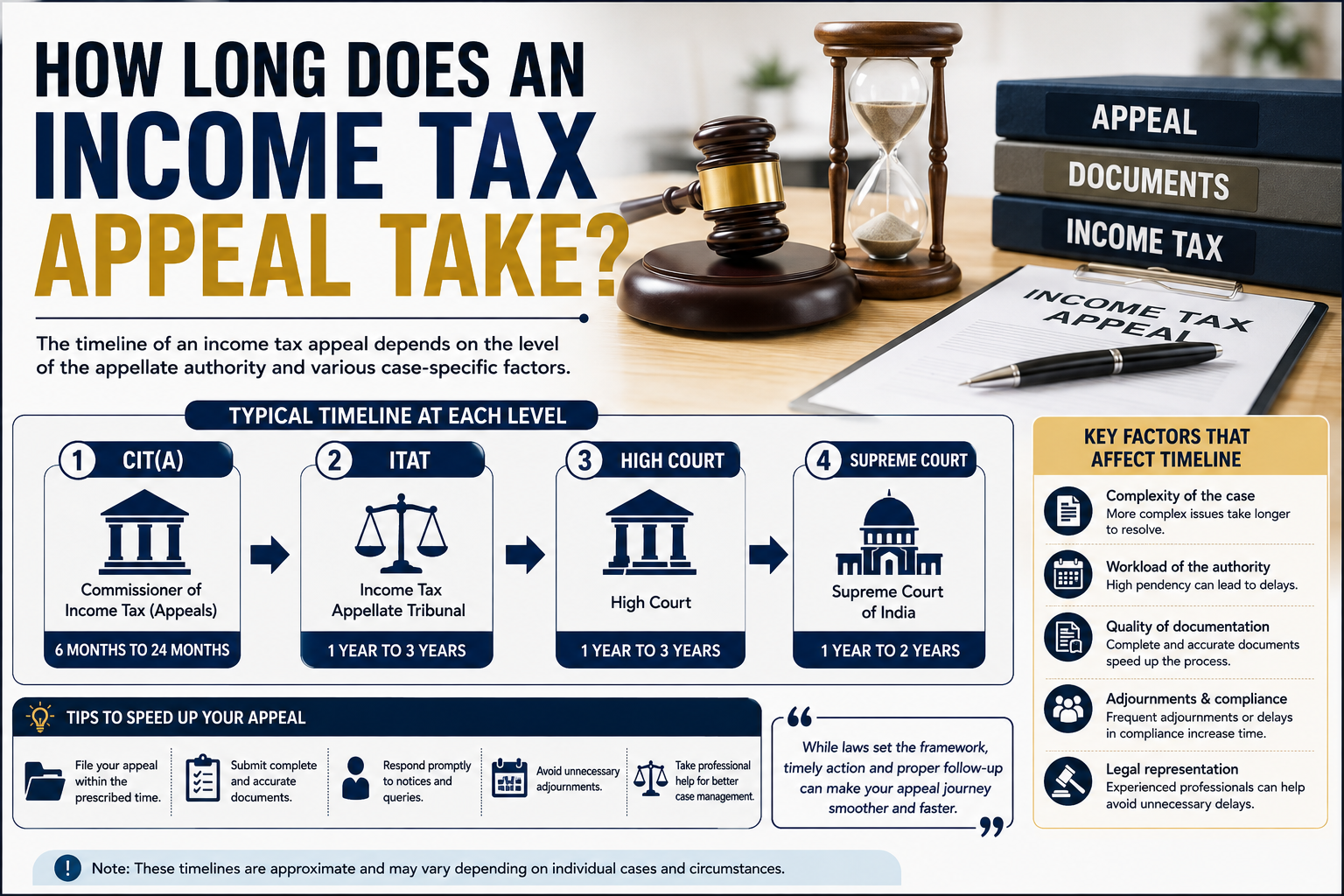
An Income Tax appeal does not have one fixed timeline applicable to every case.
The time required depends on which appellate authority is hearing the matter, the complexity of the dispute, the number of hearings, additional evidence or remand proceedings, departmental responses, and the workload of the appellate forum.
For a first appeal before the Joint Commissioner (Appeals) or Commissioner (Appeals), the law provides that, where possible, the appeal may be heard and decided within one year from the end of the financial year in which the appeal is filed or transferred. This is a statutory target expressed as “where it is possible”, not a guarantee that every appeal will be decided within one year. Section 359 of the Income-tax Act, 2025 contains the corresponding provision for appeals under the new Act.
Therefore, taxpayers should distinguish between:
- the time limit for filing an appeal, and
- the time taken by the appellate authority to decide the appeal.
These are two different issues.
Is There a Fixed Time Limit for Deciding an Income Tax Appeal?
No. There is no single fixed disposal period for every Income Tax appeal.
The first appellate authority is expected, where possible, to hear and decide an appeal within one year from the end of the financial year in which the appeal is filed or transferred. However, the actual disposal time can vary depending on the circumstances of the case.
For example, an appeal involving a straightforward mathematical or factual dispute may require less procedural work than an appeal involving:
- complicated additions;
- unexplained cash or investments;
- reassessment;
- transfer pricing;
- capital gains;
- TDS disputes;
- multiple grounds of appeal;
- additional evidence;
- remand proceedings; or
- substantial questions of law.
Consequently, it would be misleading to tell every taxpayer that an Income Tax appeal will necessarily be decided within a particular number of months.
Income Tax Appeal Timeline at a Glance
| Stage | What Happens | Important Time Point |
|---|---|---|
| Assessment / Order | Taxpayer receives an appealable order or demand | Starting point |
| First Appeal | Appeal filed before JCIT(A) / CIT(A), where applicable | Generally 30 days for first appeal |
| Appellate Proceedings | Notices, submissions, hearings and possible further inquiry | Duration varies |
| First Appellate Order | JCIT(A)/CIT(A) passes written order | Where possible, within one year from end of FY of filing/transfer |
| ITAT Appeal | Further appeal may lie to ITAT where permitted | Generally two months under the 2025 Act |
| High Court | Appeal may lie on a substantial question of law | Generally 120 days under the 2025 Act |
| Supreme Court | Further appeal may arise according to applicable law | Depends on statutory and constitutional requirements |
The applicable law can differ depending on the relevant tax year and transition provisions. Pending proceedings and proceedings relating to pre-transition years may continue under the Income-tax Act, 1961.
What Is the Time Limit for Filing the First Income Tax Appeal?
The filing deadline should not be confused with the disposal timeline.
Under the Income-tax Act, 2025, an appeal before the Joint Commissioner (Appeals) or Commissioner (Appeals) is generally required to be presented within 30 days from the relevant date specified in section 358.
For an assessment or penalty appeal, the 30-day period generally runs from the date of service of the notice of demand. In other cases, it generally runs from the date on which the relevant order is served. The appellate authority may admit a delayed appeal where the statutory conditions for condonation are satisfied.
For appeals governed by the Income-tax Act, 1961, the corresponding first-appeal limitation was also generally 30 days. The Income Tax Department confirms this in its Form 35 guidance.
Important
A taxpayer should not wait for the last few days merely because the appeal may take a long time to decide.
The first priority is to determine the correct limitation period and file the appeal within time.
How Long Does a CIT(A) or JCIT(A) Appeal Take?
For appeals before the Joint Commissioner (Appeals) or Commissioner (Appeals), section 359 of the Income-tax Act, 2025 states that, where possible, the appeal may be heard and decided within one year from the end of the financial year in which the appeal is filed or transferred.
This wording is important.
It does not mean that every appeal must be completed exactly one year after filing.
The provision uses the expression “where it is possible”, recognising that actual disposal depends upon the circumstances of appellate proceedings.
Example
Suppose an appeal is filed during Financial Year 2026–27.
The relevant financial year ends on 31 March 2027.
The statutory framework therefore refers to a period of one year from the end of that financial year, where it is possible for the appellate authority to decide the matter within that period.
However, hearings, additional inquiries, remand reports or other procedural developments can affect the actual time taken.
What Happens During an Income Tax Appeal?
The appeal does not normally move directly from filing to final order.
The appellate process can involve several stages.
1. Filing of Appeal
The taxpayer files the appeal in the prescribed form along with the relevant grounds and supporting information.
For appeals under the Income-tax Act, 2025, section 358 governs the form, fee and limitation framework.
2. Verification of Appeal
The appeal and accompanying documents are processed through the applicable electronic appellate system.
3. Notice / Opportunity of Hearing
The appellate authority provides an opportunity to the taxpayer and, where applicable, the Assessing Officer.
Section 359 specifically provides for hearing rights of the appellant and the Assessing Officer.
4. Written Submissions
The taxpayer may need to explain:
- the facts;
- grounds of appeal;
- disputed additions;
- legal arguments;
- supporting documents; and
- why the assessment or penalty order should be modified or cancelled.
5. Further Inquiry or Remand
The appellate authority may make further inquiry or direct the Assessing Officer to make further inquiry and submit a report.
Such additional procedural steps can increase the time required to conclude the appeal.
6. Final Appellate Order
The appellate authority passes a written order setting out the points for determination, the decision and the reasons for the decision.
Why Can an Income Tax Appeal Take Longer?
Several factors may affect the time required for disposal.
1. Complexity of the Case
A simple dispute may require fewer submissions and hearings than a case involving multiple legal and factual issues.
2. Additional Evidence
If relevant evidence needs to be examined, the proceedings may require additional consideration.
3. Remand Report
Where the appellate authority calls for a report or further inquiry from the Assessing Officer, the proceedings may take additional time.
4. Multiple Grounds of Appeal
An appeal involving several additions, legal issues and factual disputes can require more detailed examination.
5. Hearing Adjournments
Adjournments can extend the overall timeline.
6. Departmental Response
The response or report from the Assessing Officer may become relevant to the disposal of the appeal.
7. Appellate Authority Workload
The number of pending matters and administrative workload can affect actual disposal time.
Does Faceless Appeal Make the Process Faster?
Faceless and electronic appellate mechanisms are designed to improve efficiency, transparency and resource utilisation.
However, taxpayers should not interpret the faceless nature of proceedings as a guarantee of disposal within a particular number of days or months.
The Income Tax Department’s current guidance confirms that the appellate framework under the Income-tax Act, 2025 retains the established appellate hierarchy and procedural structure.
The quality and completeness of submissions therefore remain important.
How Long Does an ITAT Income Tax Appeal Take?
An appeal from the first appellate authority may, where legally maintainable, proceed to the Income Tax Appellate Tribunal (ITAT).
Under the Income-tax Act, 2025, the appellate hierarchy continues as:
Assessing Officer → JCIT(A)/CIT(A) → ITAT → High Court → Supreme Court.
The Act specifies limitation periods for filing further appeals, but the time required for the Tribunal to finally dispose of an individual appeal can depend on the nature of the case and the Tribunal’s proceedings.
Therefore, there is no responsible basis for promising a universal disposal period for every ITAT appeal.
The taxpayer should separately monitor:
- filing limitation;
- appeal number;
- hearing dates;
- adjournments;
- paper-book or document requirements;
- stay applications, where applicable; and
- final order.
How Long Does an Income Tax Appeal to the High Court Take?
A High Court appeal is different from a routine factual appeal.
Under section 365 of the Income-tax Act, 2025, an appeal lies to the High Court from an order of the Appellate Tribunal where the High Court is satisfied that the case involves a substantial question of law. The statutory filing period is generally 120 days from receipt of the relevant Tribunal order.
The 120-day period is a filing limitation, not a guarantee that the High Court will decide the matter within 120 days.
The actual duration of High Court litigation can depend on:
- whether the appeal is admitted;
- identification of the substantial question of law;
- court workload;
- interim applications;
- complexity of legal issues;
- adjournments; and
- subsequent proceedings.
Does Filing an Appeal Automatically Cancel the Tax Demand?
No. Filing an appeal and obtaining protection from recovery are separate issues.
A taxpayer should not assume that merely filing an appeal automatically removes or suspends the demand.
Where a demand is disputed, the taxpayer should separately examine the applicable provisions and available remedies concerning recovery, stay or treatment of the demand during the appellate proceedings.
This is particularly important where the disputed demand is substantial and recovery action may have financial consequences.
What Documents Can Help Avoid Unnecessary Delay?
A well-prepared appeal can make the issues easier to understand and may help avoid procedural complications.
Depending on the nature of the dispute, relevant material may include:
- assessment or penalty order;
- notice of demand;
- statement of facts;
- grounds of appeal;
- relevant income-tax return;
- computation of income;
- supporting financial statements;
- books of account;
- invoices and agreements;
- bank statements;
- TDS records;
- correspondence with the Income Tax Department;
- notices and replies;
- documentary evidence supporting disputed claims; and
- previous appellate orders, where relevant.
For first appeals, the Income Tax Department’s Form 35 guidance specifically refers to documents such as the order, demand notice, statement of facts, grounds of appeal and documentary evidence.
For appeals under the Income-tax Act, 2025, the corresponding first-appeal framework uses Form 99.
What Happens If an Income Tax Appeal Is Delayed?
A delay in disposal does not necessarily mean that the taxpayer has lost the appeal.
However, a taxpayer should actively monitor the proceedings rather than assuming that the matter will automatically be resolved.
Depending on the circumstances, professional advice may be appropriate regarding:
- checking the current status of the appeal;
- responding to pending notices;
- submitting additional information;
- dealing with demand-related issues;
- seeking appropriate procedural relief; or
- considering further legal remedies where available.
The correct remedy depends on the stage and nature of the proceedings.
How Can Taxpayers Avoid Unnecessary Delays?
A taxpayer can reduce avoidable procedural problems by following a disciplined approach.
1. File Within the Limitation Period
Do not delay filing while waiting to prepare every possible argument.
The limitation period should be identified immediately.
2. Prepare Clear Grounds of Appeal
Each ground should address a specific disputed issue.
3. Organise Supporting Evidence
Documents should be arranged according to the disputed additions or issues.
4. Respond to Notices on Time
Ignoring an appellate notice can create unnecessary complications.
5. Maintain Consistent Facts
The facts presented in the appeal should be consistent with the assessment record and supporting evidence.
6. Track the Appeal
Keep records of:
- filing;
- acknowledgement;
- notices;
- submissions;
- hearings;
- adjournments; and
- orders.
7. Review the Order Carefully
After the appellate order is received, determine whether the dispute has been fully resolved or whether a further statutory remedy may be available.
Practical Example: How Long Might an Appeal Take?
Hypothetical example:
Suppose an individual receives an assessment order creating an additional tax demand.
The taxpayer believes that an addition has been made incorrectly.
The taxpayer:
- reviews the assessment order;
- determines the applicable appeal limitation;
- prepares the statement of facts and grounds;
- files the first appeal;
- responds to appellate notices;
- provides supporting documents;
- participates in the appellate proceedings; and
- waits for the appellate order.
If further inquiry or a remand report becomes necessary, the proceedings may require additional time.
Therefore, the correct answer to “How long will my appeal take?” cannot be determined solely from the date of filing.
The nature of the dispute and procedural developments must also be considered.
Income Tax Act, 2025 and the Transition from the Income-tax Act, 1961
This point is particularly important in 2026.
The Income-tax Act, 2025 is now the principal statutory framework for the new tax regime, but the transition provisions preserve the operation of the Income-tax Act, 1961 for specified earlier proceedings and tax years.
The Income Tax Department has clarified that an appeal pending on 1 April 2026 continues under the Income-tax Act, 1961 and does not require a fresh appeal merely because the new Act has commenced. It has also clarified that proceedings initiated after 1 April 2026 concerning a tax year beginning before 1 April 2026 can continue under the repealed Act in accordance with the transition provisions.
Therefore, before discussing the timeline or applicable provision for a particular appeal, it is important to identify:
- the relevant assessment/tax year;
- date of the order;
- date of filing;
- whether the appeal was pending on 1 April 2026; and
- which statutory framework applies.