
Income Tax Notice for Cash Deposits: What Should You Do?

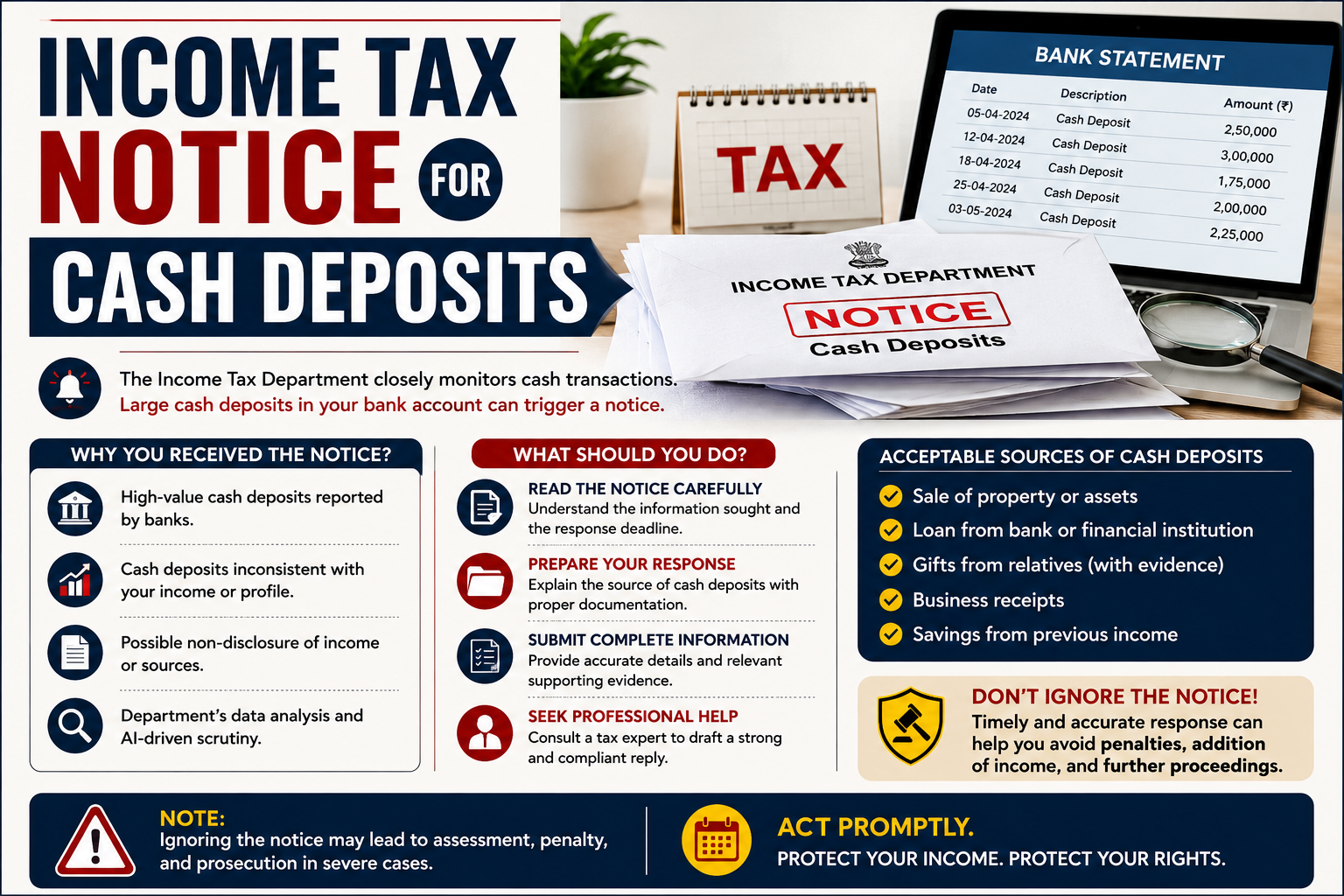
Receiving an Income Tax notice for cash deposits does not automatically mean that the deposited amount is taxable income or that the taxpayer has committed an offence. The Department may seek an explanation because information relating to bank transactions can be available through reporting mechanisms such as the Annual Information Statement (AIS) and Statement of Financial Transactions (SFT). AIS specifically displays SFT information received from reporting entities.
The critical issue is whether the taxpayer can satisfactorily establish the nature and source of the cash and reconcile it with books of account, income disclosed in the return, business records, withdrawals, or other legitimate sources.
For taxpayers whose earlier years are governed by the Income-tax Act, 1961, unexplained money may attract Section 69A where the statutory conditions are satisfied.
Important transition point: From 1 April 2026, the Income-tax Act, 2025 applies to Tax Year 2026–27 onwards, while proceedings relating to earlier tax years continue under the earlier law subject to transitional provisions. Therefore, the exact statutory section and procedure applicable to a cash-deposit notice must be identified from the relevant tax year and notice.
What Is an Income Tax Notice for Cash Deposits?
An Income Tax notice relating to cash deposits is a communication from the tax authorities seeking information, clarification, evidence or compliance concerning cash deposited in a bank or other account.
A notice may arise because information available to the Department appears inconsistent with the taxpayer’s return, reported income or other information available with the Department.
A cash deposit can have several legitimate explanations, including:
- Cash sales of a disclosed business
- Cash withdrawn earlier from the same or another bank account
- Agricultural receipts, where legally applicable and supported by evidence
- Sale of an asset
- Cash received from a genuine transaction
- Loan or advance, subject to applicable legal requirements
- Cash accumulated from disclosed sources
- Re-deposit of previously withdrawn funds
- Other legitimate and document-supported sources
The existence of a cash deposit by itself does not establish that it is unexplained income. The taxpayer should, however, be prepared to establish the source with credible evidence.
Why Does the Income Tax Department Question Cash Deposits?
The Department may have access to financial information reported by banks and other reporting entities. AIS contains SFT information along with other taxpayer information.
A notice may therefore be triggered where, for example:
- Cash deposits appear disproportionate to the income reported.
- The taxpayer has deposited substantial cash but has not disclosed corresponding business receipts.
- Bank deposits do not reconcile with books of account.
- There is a mismatch between the return and third-party information.
- The Department seeks verification of a particular transaction.
- The taxpayer’s explanation in an earlier proceeding was incomplete.
- The source of cash cannot be established from the records submitted.
The Department’s assessment process is designed to verify information furnished by the taxpayer and other information available to the tax authorities.
Is Every Cash Deposit Taxable as Income?
No. A cash deposit is not automatically taxable merely because it was deposited in a bank account.
The tax treatment depends on the actual source and nature of the money.
For example, suppose a shopkeeper deposits ₹8 lakh during the year. If the taxpayer can establish through books, invoices, sales records, stock records and bank reconciliation that the amount represents disclosed business receipts, the deposit cannot simply be treated as unexplained money merely because it is a cash deposit.
On the other hand, if substantial money is found to belong to the taxpayer and the taxpayer cannot satisfactorily explain its nature and source of acquisition, the unexplained-money provisions may become relevant.
What Is Section 69A and How Can It Affect Cash Deposits?
For periods governed by the Income-tax Act, 1961, Section 69A deals with unexplained money, bullion, jewellery and other valuable articles.
Broadly, where a taxpayer is found to be the owner of money that is not recorded in the books, and the taxpayer does not provide a satisfactory explanation regarding its nature and source of acquisition, the amount may be deemed to be income for that financial year.
This is important in cash-deposit cases because the Department may examine whether the deposited cash represents:
- Recorded business receipts;
- Previously disclosed funds;
- Genuine loans or gifts;
- Sale proceeds;
- Agricultural or other legitimate receipts; or
- Money for which the taxpayer cannot establish a satisfactory source.
The factual evidence is therefore extremely important.
What Happens if the Cash Deposit Is Treated as Unexplained Income?
For the relevant provisions of the Income-tax Act, 1961, income covered by Sections 68, 69, 69A, 69B, 69C and 69D can fall within the special-rate framework of Section 115BBE. The Income Tax Department’s current material describes taxation at 60%, with applicable surcharge and cess, and refers to penalty consequences under Section 271AAC in specified circumstances.
This is why a cash-deposit notice should not be ignored.
The final tax consequence depends on:
- The relevant tax year;
- The nature of the deposit;
- The evidence available;
- Whether the amount is already reflected in the return/books;
- The assessment proceedings involved;
- The applicable statutory provisions; and
- The taxpayer’s response.
What Should You Do After Receiving an Income Tax Notice for Cash Deposits?
Step 1: Read the Notice Carefully
First identify:
- Notice number;
- Assessment year or tax year;
- Date of issue;
- Provision under which the notice has been issued;
- Amount or transactions questioned;
- Information/document requested;
- Response deadline;
- Method of submitting the response.
Do not respond merely by saying that the deposits are “genuine.” The explanation should address the specific transactions raised in the notice.
Step 2: Download and Review AIS
Check the taxpayer’s AIS and compare the relevant information with:
- Bank statements;
- Books of account;
- Income-tax return;
- TDS information;
- SFT information;
- Cash book;
- Sales records.
AIS contains information received from reporting entities, including SFT information.
Step 3: Prepare a Cash-Deposit Reconciliation
Create a transaction-wise reconciliation.
| Date | Bank Account | Cash Deposit | Proposed Source | Supporting Evidence |
|---|---|---|---|---|
| 05-Apr | Bank A | ₹1,20,000 | Business receipts | Cash book + sales records |
| 18-Apr | Bank A | ₹80,000 | Earlier cash withdrawal | Previous bank statement |
| 10-May | Bank A | ₹2,00,000 | Asset sale | Sale agreement + payment evidence |
The objective is to demonstrate a logical connection between the deposit and its source.
Step 4: Collect Supporting Documents
Depending on the facts, documents may include:
- Complete bank statements;
- Cash book;
- Ledger accounts;
- Sales invoices;
- Purchase records;
- Stock register;
- GST records, where applicable;
- Previous bank withdrawal statements;
- Sale agreements;
- Loan confirmations;
- Loan bank statements;
- Gift documentation, where applicable;
- Agricultural records, where relevant;
- ITR acknowledgements;
- Financial statements;
- Capital account;
- Books of account;
- Other documentary evidence establishing the source.
Step 5: Prepare a Clear Written Reply
The response should generally explain:
- What the deposits represent;
- Where the money came from;
- How the source is recorded;
- Why the deposit is consistent with the taxpayer’s financial records;
- What documents support the explanation.
If a particular deposit cannot be explained, it is better to identify the issue and obtain professional advice rather than submit an unsupported explanation.
What Documents Are Needed to Explain Cash Deposits?
There is no universal document list because the required evidence depends on the source of the cash.
If the cash represents business receipts
Consider:
- Cash book;
- Sales register;
- Invoices;
- GST returns;
- Stock records;
- Daily collection records;
- Bank reconciliation.
If the cash was withdrawn earlier
Provide:
- Earlier bank statement;
- Withdrawal entry;
- Cash availability/reconciliation;
- Explanation of why the cash was retained and subsequently deposited.
If the cash came from a loan
Evidence may include:
- Loan confirmation;
- Identity and PAN details;
- Bank statement of lender;
- Loan agreement;
- Repayment terms;
- Evidence demonstrating the lender’s financial capacity and genuineness.
If the cash relates to sale of an asset
Documents may include:
- Sale agreement;
- Ownership documents;
- Buyer details;
- Payment evidence;
- Capital-gain computation, where applicable.
The evidence should tell a consistent story. A document submitted in isolation may not adequately establish the source.
Can Earlier Cash Withdrawals Explain Later Cash Deposits?
Yes, potentially—but the explanation must be supported by facts and evidence.
For example, if ₹5 lakh was withdrawn from a bank account and ₹4 lakh was subsequently deposited in cash, the taxpayer may explain that the later deposit came from the earlier withdrawal.
However, the explanation should be commercially and factually credible.
The Department may consider factors such as:
- Date of withdrawal;
- Amount withdrawn;
- Date of re-deposit;
- Cash withdrawals and other cash usage between the two dates;
- Availability of cash;
- Books of account;
- Nature of the taxpayer’s activities.
Simply pointing to an old withdrawal without explaining the intervening period may not always be sufficient.
What If the Cash Deposit Is Business Turnover?
This is a common situation for retailers, traders and other cash-intensive businesses.
A taxpayer should not assume that a bank cash deposit equals additional undisclosed income when the amount is actually part of recorded turnover.
The taxpayer should reconcile:
Sales → Cash collections → Cash book → Bank deposit → Bank statement → ITR/financial statements
Any mismatch should be identified before responding to the notice.
Where applicable, GST records, sales invoices and stock records can provide useful corroboration.
What If the Cash Deposit Is Not Recorded in the Books?
This situation requires greater caution.
An omission from the books does not automatically determine the final tax treatment without considering the complete facts, but it can create a significant evidentiary problem.
The taxpayer should identify:
- Why the transaction was omitted;
- Whether the corresponding income was otherwise disclosed;
- Whether the cash represents a non-income receipt;
- Whether accounting records need correction;
- Whether any other statutory compliance issue arises.
A professional should review the facts before filing a response where substantial amounts are involved.
What If You Ignore the Income Tax Notice?
Ignoring a notice can make the situation substantially more difficult.
Depending on the type of proceeding and the applicable law, the Department may proceed on the basis of available information or make an assessment where the taxpayer does not adequately comply.
The Income Tax Department explains that assessment proceedings can involve verification of information and that best-judgment assessment may apply where statutory requirements are not complied with.
Therefore:
Do not ignore the notice.
Even if the cash deposits are completely legitimate, the taxpayer should respond within the prescribed time or seek an appropriate extension/remedy where legally available.
What Are the Common Mistakes in Cash-Deposit Notice Cases?
1. Giving a one-line explanation
“These are genuine deposits” is generally not enough when detailed information has been requested.
2. Providing incomplete bank statements
A partial statement can make reconciliation difficult.
3. Failing to reconcile the cash book
Every significant deposit should have an identifiable source.
4. Creating documents after receiving the notice
Documents should reflect genuine transactions. Artificial or backdated documentation can create serious problems.
5. Ignoring AIS/SFT information
The taxpayer should compare departmental information with their own records.
6. Treating every cash deposit as taxable income
The source and nature of the money must be examined.
7. Missing the response deadline
A valid explanation may lose its practical value if the taxpayer does not comply with the applicable proceeding.
Hypothetical Example: Cash Deposit Notice
This is a hypothetical example only.
Mr. A runs a retail business. During the year, he deposits ₹18 lakh in cash into his bank account.
The Department asks him to explain the deposits.
Mr. A reviews his records and finds:
- ₹12 lakh represents recorded cash sales;
- ₹3 lakh represents cash withdrawn earlier from his bank account;
- ₹2 lakh represents a documented sale of a personal asset;
- ₹1 lakh cannot currently be reconciled.
Instead of merely stating that all ₹18 lakh is genuine, Mr. A prepares a transaction-wise reconciliation and submits supporting evidence for the identifiable sources.
The unexplained ₹1 lakh requires separate professional review.
This illustrates an important principle: a good response should separate explained transactions from genuinely disputed or unexplained amounts rather than make unsupported blanket assertions.
Can an Income Tax Notice for Cash Deposits Be Challenged?
Yes, depending on the nature of the notice, the stage of proceedings and the facts of the case, statutory remedies may be available.
The appropriate remedy depends on what has actually been issued.
Possible routes may include:
- Filing a response to the notice;
- Seeking rectification where a statutory rectification provision applies;
- Filing an appeal against an appealable order;
- Further appellate proceedings before the ITAT;
- High Court proceedings on substantial questions of law where the statutory requirements are satisfied;
- Appropriate writ proceedings in exceptional cases where judicial review is available.
The remedy should be selected only after examining the actual notice or order.
Does the New Income-tax Act Change the Analysis?
Yes, the transition must be considered carefully.
The Income-tax Act, 2025 came into force from 1 April 2026. The Department states that the 1961 Act continues to govern tax years beginning before 1 April 2026, while the new Act applies to Tax Year 2026–27 onwards. Proceedings relating to earlier years continue under the applicable transitional framework.
Accordingly, a taxpayer should not assume that a section number appearing in an older article automatically applies to a notice relating to a new tax year.
Always identify the relevant tax year and the statute cited in the notice before preparing the reply.
Frequently Asked Questions
1. I received an Income Tax notice for a cash deposit. Is the money automatically taxable?
No. A cash deposit is not automatically taxable merely because it was deposited into a bank account. The taxpayer should establish the nature and source of the money.
2. What is the main issue in a cash-deposit notice?
The central issue is generally whether the taxpayer can satisfactorily explain the source and nature of the cash and reconcile it with available records.
3. Can business cash sales be deposited into a bank account?
Yes, legitimate business cash receipts can be deposited, subject to applicable tax, accounting, GST and other legal requirements. Proper books and supporting records are important.
4. Can earlier bank withdrawals explain later cash deposits?
They can potentially do so, but the taxpayer should establish the connection through bank statements, cash availability and other relevant evidence.
5. What documents should I submit?
The documents depend on the source. Bank statements, cash books, sales records, invoices, loan documents, asset-sale documents and other evidence may be relevant.
6. What happens if I cannot explain the cash deposit?
The consequences depend on the applicable law and facts. For earlier tax years, unexplained money provisions such as Section 69A may become relevant where their statutory conditions are satisfied.
7. Is there a special tax rate for unexplained income?
For specified unexplained income under the Income-tax Act, 1961, Section 115BBE provides a special tax framework. The Department’s current material states a 60% rate, with applicable surcharge and cess, subject to the statutory provisions and circumstances.
8. What if the Department’s information is incorrect?
The taxpayer should identify the discrepancy and submit documentary evidence explaining why the information is incorrect or does not represent undisclosed income.
9. Should I respond myself or consult a professional?
For a straightforward information request with well-maintained records, a taxpayer may be able to respond appropriately. Professional assistance becomes particularly useful where the amount is substantial, records are incomplete, Section 69A or other unexplained-income provisions are involved, or an assessment/order has already been passed.
10. Can an Income Tax order relating to cash deposits be appealed?
An appeal may be available depending on the nature of the order and statutory conditions. The exact appellate authority and limitation period should be checked from the order and applicable law.
Final CTA
If you have received an Income Tax notice concerning cash deposits, do not respond with assumptions or incomplete explanations. The correct response depends on the tax year, wording of the notice, source of the cash and supporting evidence.
Bihar Tax Consultant
BIIT Campus, near Sanchira Mandir, New Azimabad Colony, Patna, Bihar 800006
Mobile: 8789155395
Email: [email protected]
For assistance in reviewing the notice, reconciling cash deposits and preparing an appropriate response, Book a Consultation.