
Capital Gain Tax on Sale of Property in India: Rates, Calculation, Exemptions & Rules

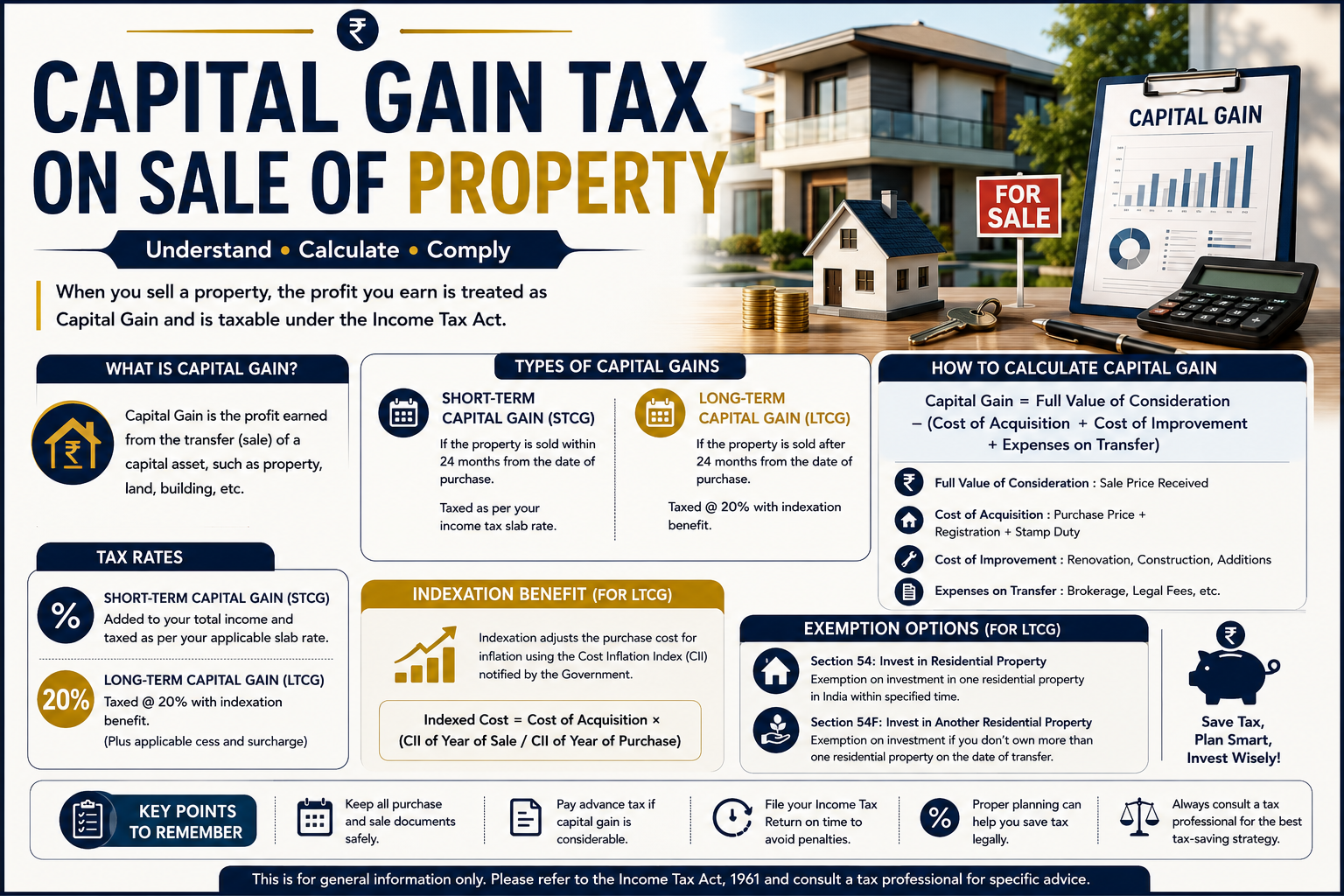
Is Capital Gain Tax Applicable on Sale of Property?
Yes. Profit arising from the transfer of a property that is held as a capital asset is generally taxable under the head “Capital Gains”, subject to applicable exemptions, deductions, exclusions and special rules.
For immovable property such as land or a building, the period of holding is important. Property held for more than 24 months is generally treated as a long-term capital asset, while property held for 24 months or less is generally short-term. The tax treatment then depends on the date of transfer, the taxpayer’s status and the applicable law.
The rules changed significantly from 23 July 2024. For long-term capital gains, the general rate was changed to 12.5% without indexation. However, a beneficial protection applies to a resident individual or HUF transferring land or building acquired before 23 July 2024: the tax payable cannot exceed the tax that would have resulted under the earlier 20% indexed-cost method.
Because the Income-tax Act, 2025 applies from tax years beginning on or after 1 April 2026, the exact provision applicable to a property sale should also be checked against the relevant tax year and transitional rules.
Introduction
Selling a house, flat, plot of land, commercial property or other immovable property can have significant income-tax consequences.
A common misconception is that tax is calculated simply by applying a percentage to the sale price.
That is generally not how capital gains tax works.
The calculation can involve:
- Sale consideration
- Stamp duty value
- Cost of acquisition
- Cost of improvement
- Expenses connected with the transfer
- Period of holding
- Applicable tax rate
- Indexation, where legally available
- Reinvestment-based exemptions
- Capital losses
- The taxpayer’s residential status
- The date on which the property was acquired and sold
A property transaction can therefore require careful tax planning before the sale as well as accurate reporting after the transaction.
This article explains the major rules in simple language and highlights the important changes applicable to property transactions.
What Is Capital Gain Tax on Sale of Property?
Capital gain is broadly the profit arising from the transfer of a capital asset.
A house, land or building held as a capital asset may therefore give rise to capital gains when transferred.
The basic concept can be expressed as:
Capital Gain = Full Value of Consideration – Allowable Transfer Expenses – Cost of Acquisition – Cost of Improvement
The precise computation depends on the applicable law and the nature and date of the transaction. Under the Income-tax Act, 2025, the statutory computation provision similarly starts with the full value of consideration and permits deduction of qualifying transfer expenditure, cost of acquisition and cost of improvement.
Is Sale of Every Property Taxable?
Not necessarily.
The tax treatment depends on several factors.
For example:
- A property may be held as a capital asset.
- Property may be held as stock-in-trade by a real-estate business.
- A transaction may fall within a specific exemption.
- The taxpayer may have a capital loss instead of a gain.
- Special provisions may affect the deemed sale consideration.
Therefore, simply receiving money from the sale of property does not by itself determine the final amount of taxable capital gain.
Short-Term vs Long-Term Capital Gain on Property
How long must property be held to become a long-term capital asset?
For land or building, the relevant holding period is generally more than 24 months for classification as a long-term capital asset. The Income Tax Department confirms that the holding period for immovable property was reduced from 36 months to 24 months with effect from AY 2018-19.
| Period of holding | General classification |
|---|---|
| 24 months or less | Short-term capital asset |
| More than 24 months | Long-term capital asset |
This distinction is important because short-term and long-term capital gains can be taxed differently.
What Is Short-Term Capital Gain on Sale of Property?
If the property does not satisfy the required holding period for long-term classification, the resulting gain is generally treated as Short-Term Capital Gain (STCG).
For example, if a taxpayer purchases a property and sells it before completing the applicable long-term holding period, the gain may be treated as short-term capital gain.
The tax treatment should be determined based on the applicable provisions for the relevant tax year rather than assuming that every property sale automatically receives long-term capital-gain treatment.
What Is Long-Term Capital Gain on Sale of Property?
Where land or building is held for more than the applicable 24-month period, the gain is generally classified as Long-Term Capital Gain (LTCG).
Long-term treatment can be significant because special capital-gains rates and certain reinvestment exemptions may apply.
For property transactions, the date of transfer and date of acquisition are therefore critical.
What Is the Capital Gains Tax Rate on Property Sale?
The tax rate depends on the type of capital gain and the applicable law.
For long-term capital gains, the rate was changed from 20% with indexation to 12.5% without indexation for transfers on or after 23 July 2024.
However, there is an important exception for resident individuals and HUFs.
For a resident individual or HUF transferring land or building acquired before 23 July 2024, the Income-tax Act, 2025 provides that the excess tax under the 12.5% method is ignored when compared with the tax computed using the 20% indexed-cost method. In practical terms, this preserves a beneficial comparison for eligible taxpayers.
Important point
The 12.5% rate should not be interpreted as meaning that every property sale is automatically taxed at 12.5%.
The classification of the gain, applicable tax year, taxpayer status, acquisition date, transfer date and available exemptions must all be considered.
What Happened to Indexation on Property Sale?
Indexation became one of the major issues following the capital-gains changes effective from 23 July 2024.
For many long-term capital assets transferred on or after that date, the general regime moved to 12.5% taxation without indexation.
However, for eligible resident individuals and HUFs selling land or building acquired before 23 July 2024, the law provides a comparison mechanism with the earlier 20% indexed-cost method.
This means taxpayers should not simply assume that indexation is either universally available or universally unavailable.
Example
Suppose a resident individual purchased a house several years before 23 July 2024 and sells it after that date.
The taxpayer may need to compare:
Method A:
Capital gain under the 12.5% regime without indexation.
Method B:
Capital gain using indexed cost and the 20% rate.
The statutory beneficial provision ensures that, for an eligible taxpayer and property, the excess tax under Method A over Method B is ignored.
How Is Capital Gain on Sale of Property Calculated?
A simplified calculation can be understood through the following structure:
Sale consideration
Less: Eligible transfer expenses
Less: Cost of acquisition
Less: Eligible cost of improvement
= Capital gain
The actual computation can be modified by provisions dealing with deemed consideration, exemptions, losses and the applicable rate.
What Is Section 50C and Why Is It Important?
One of the most important provisions in property transactions is Section 50C of the Income-tax Act, 1961, which deals with situations where the declared consideration for transfer of land or building is lower than the prescribed stamp valuation.
The current ITR framework reflects the rule that, where the stamp valuation does not exceed 110% of the actual consideration, the actual consideration can be adopted; otherwise the prescribed stamp-value mechanism can apply.
Example
Suppose:
- Actual sale consideration = ₹70 lakh
- Stamp valuation = ₹75 lakh
The stamp value is approximately 107.14% of the actual consideration.
Because it does not exceed 110%, the relevant safe-harbour mechanism may permit the actual consideration to be used, subject to the applicable law and facts.
If the difference exceeds the prescribed threshold, the deemed consideration rules may become relevant.
Why this matters
A taxpayer cannot always calculate capital gain simply using the amount written in the sale deed.
The stamp duty value must also be examined.
Can the Stamp Duty Value Be Challenged?
In appropriate circumstances, the taxpayer may have statutory mechanisms to dispute or seek reference regarding the valuation adopted for tax purposes.
The correct approach depends on the facts, the valuation issue and the applicable statutory procedure.
Therefore, where there is a substantial difference between the actual transaction price and stamp valuation, the taxpayer should obtain professional advice before filing the return.
What Expenses Can Be Deducted While Calculating Capital Gains?
Subject to the applicable law, expenses incurred wholly and exclusively in connection with the transfer can be relevant in computing capital gains.
Examples may include qualifying:
- Brokerage
- Legal expenses
- Transfer-related professional charges
- Other directly connected transfer expenditure
The taxpayer should retain documentary evidence for every claimed expense.
Personal expenditure or expenses that do not satisfy the statutory conditions should not automatically be deducted.
What Is Cost of Improvement?
Cost of improvement can include qualifying capital expenditure incurred to improve the property.
For example, depending on the facts and applicable law, substantial capital additions or improvements may form part of the relevant cost.
Routine repairs and ordinary maintenance should not automatically be treated as capital improvement.
Proper invoices, payment records and supporting documents should therefore be preserved.
What If the Property Was Purchased Many Years Ago?
Old-property transactions can be more complicated.
The taxpayer may need to establish:
- Original purchase date
- Original purchase price
- Acquisition documents
- Improvement expenditure
- Ownership history
- Succession or inheritance details
- Previous transfers
- Applicable valuation rules
If the property was acquired by inheritance or gift, the tax computation can involve additional rules concerning the previous owner’s cost and period of holding.
Therefore, old property should not be treated as a straightforward “sale price minus purchase price” calculation.
What If the Property Was Inherited?
Inherited property can have special tax implications.
The fact that the present owner did not personally pay the original purchase price does not mean that the entire sale proceeds are automatically taxable.
The relevant rules may require examination of the previous owner’s cost and the applicable period of holding.
The documents that establish the previous ownership and succession should therefore be retained.
Can I Claim Exemption From Capital Gains Tax by Buying Another House?
Yes, certain provisions can provide relief where specified conditions are satisfied.
One important provision under the Income-tax Act, 1961 is Section 54, which provides relief in specified cases where an individual or HUF transfers a qualifying residential house and invests in another residential house, subject to statutory conditions.
Another important provision is Section 54F, which concerns specified long-term capital gains arising from transfer of assets other than a residential house, where the taxpayer invests in one residential house in India and satisfies the prescribed conditions.
The precise exemption depends on:
- Nature of the original asset
- Taxpayer status
- Amount of capital gain
- Date of purchase
- Date of construction
- Number of residential houses owned
- Amount reinvested
- Other statutory conditions
The exemption should therefore be calculated rather than assumed.
What Is Section 54?
Section 54 is particularly relevant when an eligible individual or HUF sells a qualifying residential house and reinvests the capital gain in another residential house, subject to the statutory conditions.
Broadly, the law provides specified purchase/construction windows for the new residential property.
The exemption is subject to conditions, including restrictions relating to transfer of the new asset and other statutory requirements.
For transactions spanning the transition from the Income-tax Act, 1961 to the Income-tax Act, 2025, the transitional provisions also need to be considered. The Income Tax Department has specifically explained that exemptions claimed under the old Act can continue to have consequences under the new Act if conditions are violated after 1 April 2026.
What Is Section 54F?
Section 54F applies in a different situation.
It can provide relief to an eligible individual or HUF where a long-term capital asset other than a residential house is transferred and the taxpayer purchases or constructs one residential house in India within the prescribed period, subject to conditions.
The exemption is not necessarily equal to the entire capital gain in every case; the statutory formula can depend on the amount invested compared with the net consideration.
What Is the Capital Gains Account Scheme?
Sometimes a taxpayer intends to use the capital gain for an eligible investment but cannot complete the purchase or construction within the relevant statutory period before the return-filing deadline.
In qualifying situations, the Capital Gains Account Scheme (CGAS) may become relevant.
However, depositing money into the scheme does not by itself guarantee exemption.
The taxpayer must satisfy the underlying exemption provision and use the deposited amount within the prescribed period.
The Income Tax Department has also clarified how deposits made under the old Act interact with the transition to the Income-tax Act, 2025.
What About Section 54EC Bonds?
In specified circumstances, long-term capital gains from transfer of land or building may qualify for relief through investment in specified bonds under Section 54EC, subject to the statutory conditions and investment limits applicable to the transaction.
The taxpayer should verify:
- Whether the asset qualifies
- Whether the taxpayer is eligible
- Applicable investment ceiling
- Prescribed investment period
- Lock-in requirements
- Relevant issuing institutions
This option should be evaluated before the statutory investment window expires.
Is TDS Applicable When Selling Property?
Yes, in specified property transactions, the buyer may be required to deduct tax at source.
Under the current framework, TDS on transfer of immovable property becomes relevant where the consideration or prescribed value meets the statutory threshold of ₹50 lakh.
The Income Tax Department’s current Form 141 guidance confirms that TDS is required where the value exceeds ₹50 lakh and requires reporting of the property consideration and stamp duty value.
Important distinction
TDS is not the same as the final capital-gains tax.
TDS is a tax collection mechanism.
The seller must still correctly calculate and report the capital gain in the income-tax return.
What Documents Should Be Kept After Selling Property?
A taxpayer should ideally preserve:
Acquisition documents
- Original purchase deed
- Allotment letter
- Previous sale deed
- Payment records
Sale documents
- Sale deed
- Agreement to sell
- Sale consideration details
- Registration documents
Valuation documents
- Stamp valuation details
- Valuation report, where relevant
Improvement documents
- Construction bills
- Renovation invoices
- Architect/contractor bills
- Payment evidence
Tax documents
- TDS certificate/details
- Form 26AS
- AIS
- Income-tax return
- Capital-gain computation
Exemption documents
- New-property purchase documents
- Construction records
- Capital Gains Account Scheme documents
- Section 54EC investment certificates, where applicable
Step-by-Step: How to Calculate Capital Gain on Sale of Property
Step 1: Identify the property
Determine whether the asset is:
- Residential property
- Commercial property
- Land
- Land and building
- Another form of immovable property
Step 2: Determine the acquisition date
Find the date on which the taxpayer acquired the property.
Step 3: Determine the transfer date
The date of transfer is important for determining the applicable capital-gains regime.
Step 4: Determine the holding period
Check whether the property qualifies as short-term or long-term.
For land or building, the general long-term threshold is more than 24 months.
Step 5: Determine the full value of consideration
Check both:
- Actual sale consideration
- Applicable stamp duty value
Step 6: Calculate eligible costs
Consider:
- Cost of acquisition
- Eligible cost of improvement
- Eligible transfer expenses
Step 7: Check the applicable tax rate
The rate depends on the nature of the gain and the applicable legal framework.
Step 8: Check available exemptions
Consider whether provisions such as Section 54, 54F or 54EC are applicable under the relevant law.
Step 9: Account for TDS
Reconcile the TDS reflected in the taxpayer’s records and Form 26AS/AIS.
Step 10: Report the transaction correctly
The capital gain should be disclosed in the appropriate income-tax return and schedule.
Hypothetical Example: Sale of a Residential Property
This is a hypothetical example for illustration only.
Mr. A, a resident individual, purchased a residential property before 23 July 2024.
He sells the property after 23 July 2024.
The transaction involves:
- Sale consideration
- Stamp duty value
- Original purchase cost
- Eligible improvement expenditure
- Brokerage
- Potential reinvestment in another residential property
Mr. A should not simply calculate:
Sale price – purchase price = taxable gain
Instead, he should:
- Determine the correct holding period.
- Examine the stamp duty value.
- Calculate the gain under the applicable 12.5% regime.
- Determine whether the beneficial 20% indexed-cost comparison applies to him.
- Consider eligible transfer expenses.
- Examine whether Section 54 or another exemption applies.
- Account for TDS.
- Report the final position correctly in the return.
The final tax liability can therefore differ significantly depending on the facts.
Common Mistakes in Property Capital-Gains Tax
1. Assuming tax is calculated on the sale price
Capital gains are generally based on the taxable gain, not simply the gross sale proceeds.
2. Ignoring stamp duty value
Section 50C and related rules can affect the deemed consideration.
3. Applying 20% indexation automatically
The rules changed from 23 July 2024. Indexation treatment must be examined based on the taxpayer, asset and transaction date.
4. Assuming 12.5% always means lower tax
A taxpayer must calculate the actual gain and examine applicable exemptions and beneficial provisions.
5. Missing reinvestment deadlines
Exemptions under provisions such as Section 54 and Section 54F have specific conditions and time limits.
6. Not maintaining improvement records
Without adequate evidence, claimed improvement costs may become difficult to substantiate.
7. Ignoring TDS
TDS deducted by the buyer should be reconciled with the seller’s tax records.
8. Treating inherited property like an ordinary purchase
Inheritance can involve special rules concerning cost and holding period.
9. Filing the return without checking the capital-gain schedule
Property transactions should be reconciled carefully before filing.
10. Assuming the tax position is identical for every seller
Resident individuals, HUFs, companies, firms and non-residents can have different tax consequences.
What Happens If the Sale Price Is Lower Than the Stamp Value?
This is one of the most important questions in property taxation.
Where the declared consideration is lower than the prescribed stamp valuation, the deemed-consideration provisions can apply.
However, the law also contains a tolerance mechanism. The current ITR framework reflects the 110% threshold for Section 50C purposes.
Therefore, the taxpayer should compare the actual consideration and stamp valuation before calculating capital gains.
Does Selling a Property Automatically Mean 12.5% Tax?
No.
The 12.5% rate is relevant to specified long-term capital gains under the post-23 July 2024 regime, but the final tax computation depends on:
- Whether the gain is short-term or long-term
- Date of transfer
- Date of acquisition
- Taxpayer status
- Applicable law
- Stamp-duty provisions
- Allowable costs
- Exemptions
- Losses
- Other relevant provisions
For eligible resident individuals/HUFs selling land or building acquired before 23 July 2024, the beneficial comparison with the 20% indexed-cost method can be relevant.
Capital Gains on Property in 2026: Why the Tax Year Matters
The tax system entered an important transition in 2026.
The Income-tax Act, 2025 applies to tax years beginning on or after 1 April 2026, while the Income-tax Department has provided specific transition and savings rules for matters arising under the repealed Income-tax Act, 1961.
This matters particularly where:
- The property was purchased before 1 April 2026.
- The property was sold after 1 April 2026.
- A Section 54/54F exemption was claimed under the old Act.
- A Capital Gains Account Scheme deposit was made under the old Act.
- The prescribed lock-in or utilisation period extends into the new Act.
The Department’s transition guidance specifically explains that an exemption claimed under the old Act can have tax consequences under the new Act if the conditions attached to that exemption are subsequently violated.
Therefore, property transactions crossing the 2026 legislative transition should be reviewed carefully.
Frequently Asked Questions
1. How is capital gain tax calculated on sale of property?
Capital gain is broadly calculated by deducting eligible transfer expenses, cost of acquisition and eligible cost of improvement from the relevant full value of consideration. Special rules may apply to stamp duty value, exemptions and long-term gains.
2. How long should I hold property to qualify as long-term?
For land or building, the general threshold is more than 24 months.
3. What is the current LTCG rate on property?
For specified long-term capital gains under the post-23 July 2024 regime, the rate is 12.5% without indexation. Eligible resident individuals/HUFs selling land or building acquired before 23 July 2024 receive a beneficial comparison with the earlier 20% indexed-cost method.
4. Is indexation available on property sold after 23 July 2024?
The general regime removed indexation for such transfers, but eligible resident individuals and HUFs selling land or building acquired before 23 July 2024 have the statutory beneficial comparison with the 20% indexed-cost method.
5. What is Section 50C?
Section 50C of the Income-tax Act, 1961 provides rules for determining the deemed full value of consideration in specified transfers of land or building where the stamp valuation exceeds the declared consideration.
6. Can I avoid capital gains tax by buying another house?
Certain exemptions, including Section 54 and Section 54F in the appropriate circumstances, can provide relief when specified conditions are satisfied. The exemption is not automatic and depends on the exact transaction.
7. Is TDS applicable when selling property?
TDS can apply to specified transfers of immovable property where the statutory threshold is met. The current Income Tax Department guidance states that TDS is required where the value exceeds ₹50 lakh.
8. Is capital gains tax applicable to inherited property?
A sale of inherited property can give rise to capital gains. The computation may involve special rules concerning the previous owner’s cost and holding period.
9. Can brokerage and legal expenses reduce capital gains?
Eligible expenditure incurred wholly and exclusively in connection with the transfer can generally be relevant to the capital-gain computation, subject to the applicable law and supporting evidence.
10. Can I claim both indexation and a Section 54 exemption?
The answer depends on the applicable legal regime and the particular exemption. The computation should be performed under the relevant provisions rather than assuming that every benefit can automatically be combined.
11. What if the stamp duty value is higher than my sale price?
The deemed-consideration provisions may apply. However, the statutory tolerance threshold can be relevant, so the actual consideration and stamp valuation should both be examined.
12. Can capital gain tax be reduced legally?
Potentially, yes. Proper computation of acquisition/improvement costs, eligible transfer expenses, applicable exemptions, losses and statutory reliefs can affect the final tax liability. Tax planning should be undertaken before or at the time of the transaction wherever possible.
Key Takeaways
- Selling property can trigger capital gains tax.
- Land and buildings generally become long-term capital assets after more than 24 months of holding.
- The long-term capital-gains regime changed from 23 July 2024.
- The general LTCG rate is 12.5% without indexation under the current framework.
- Eligible resident individuals/HUFs selling land or buildings acquired before 23 July 2024 have a beneficial comparison with the earlier 20% indexed-cost method.
- Stamp duty value must be checked because Section 50C can affect the computation.
- Section 54, Section 54F and Section 54EC may provide relief in qualifying cases.
- TDS can apply to specified property transactions above the statutory threshold.
- Property transactions involving inheritance, old acquisitions, undervaluation or reinvestment require additional care.
- Transactions crossing the 2026 transition to the Income-tax Act, 2025 should be reviewed under the applicable transitional rules.
Professional Assistance
Property transactions often involve substantial amounts and can create tax consequences long after the sale has been completed.
A tax professional can help review:
- Capital-gain computation
- Stamp-duty valuation
- Acquisition and improvement costs
- Section 54/54F/54EC eligibility
- TDS reconciliation
- Inherited-property taxation
- Capital Gains Account Scheme requirements
- Income-tax return reporting
- Notices or disputes concerning property transactions
For taxpayers in Patna and Bihar, obtaining professional advice before finalising the tax treatment can help identify issues that may otherwise become difficult to correct later.