
Step-by-Step Guide to Filing an Appeal Before ITAT (2026 Procedure)

Receiving an unfavourable order from the Commissioner of Income Tax (Appeals) — or CIT(A) — is not the end of the road. The Income Tax Act gives every aggrieved taxpayer, and in appropriate cases the Department itself, a further right of appeal to the Income Tax Appellate Tribunal (ITAT), the second and final fact-finding authority in the income-tax appellate hierarchy.
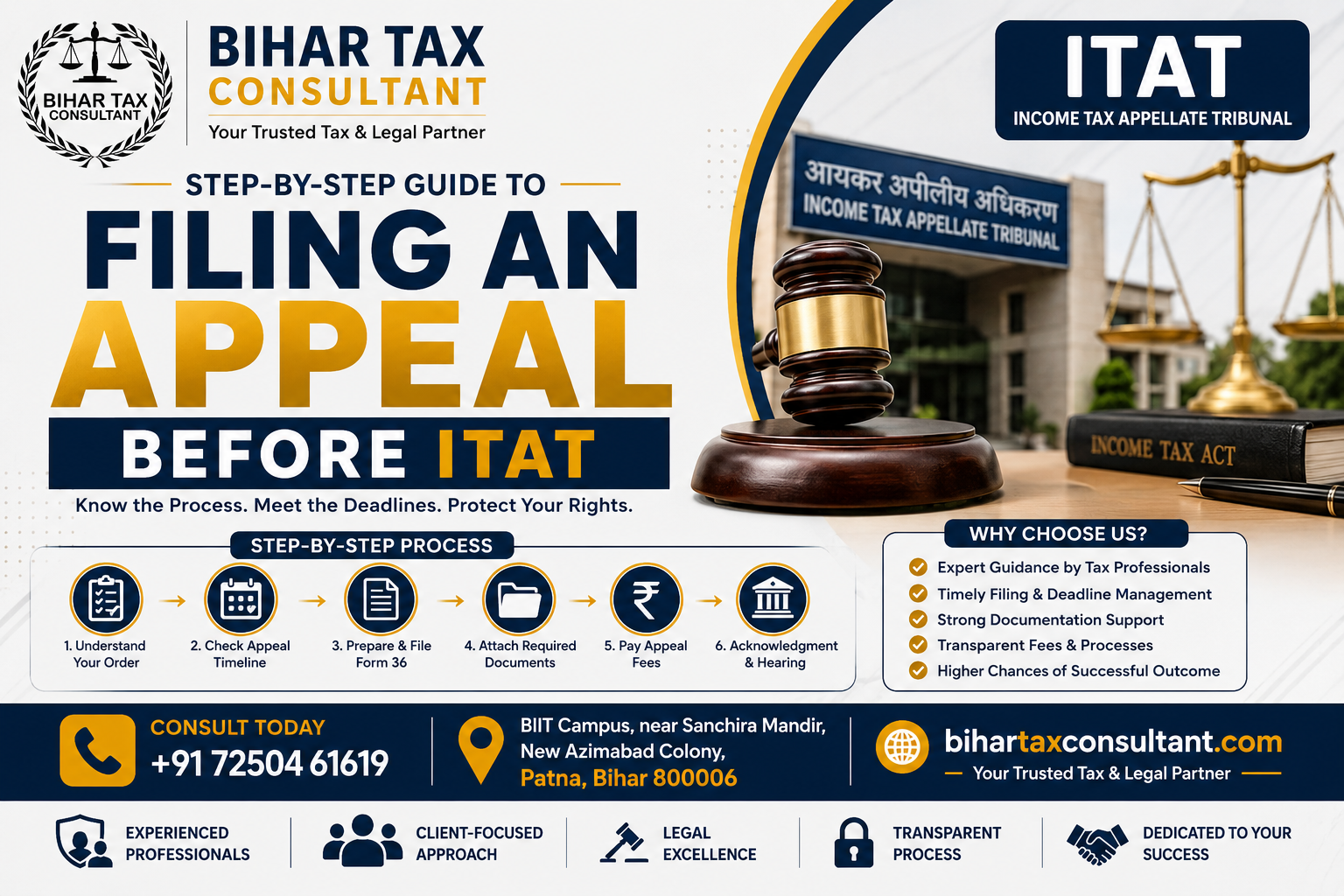
This guide is written for individual taxpayers, businesses, professionals and firms who have either already received a CIT(A)/JCIT(A) order, a penalty order, or a revision order under the Act, and want to understand — in plain language — how an ITAT appeal is actually filed, what documents are needed, what it costs, and what mistakes to avoid.
A word of caution before we begin: 2026 has been a year of genuine transition in Indian direct tax law. The Income-tax Act, 2025 has come into force from 1 April 2026, alongside a parallel move to fully digital, DSC-based filing before the ITAT. Depending on which assessment year or tax year your order relates to, either the old 1961 Act or the new 2025 Act may govern your appeal. We explain this below so that you file under the correct legal framework.
What Is an Appeal Before ITAT?
An appeal before ITAT is the legal remedy available to a taxpayer (or the tax department) who is dissatisfied with certain orders passed by income-tax authorities — most commonly an order of the CIT(A)/JCIT(A) disposing of a first appeal, but also penalty orders, certain revision orders, and orders passed pursuant to directions of the Dispute Resolution Panel (DRP) in transfer-pricing or international-tax cases. ITAT Benches, headed by judicial and accountant members, independently examine the facts and the law and pass a reasoned order — which itself can be further appealed to the jurisdictional High Court, but only on a substantial question of law.
Which Law Governs Your ITAT Appeal — 1961 Act or 2025 Act?
This is genuinely important and often misunderstood, so it deserves a dedicated section rather than a footnote.
The Income-tax Act, 2025 replaces the 1961 Act with effect from 1 April 2026, and renumbers the appeal provisions — the familiar Section 253 (right of appeal to ITAT) now corresponds to Section 362 of the 2025 Act, with detailed procedure prescribed under Rule 193 of the Income-tax Rules, 2026.
However, the transitional (repeal and savings) provisions of the new Act make clear that:
- If your dispute relates to a tax year/assessment year beginning before 1 April 2026 (broadly, AY 2026-27 and earlier), the appeal continues to be governed substantively by the Income-tax Act, 1961, even if you are filing the appeal today, in 2026 or later.
- If your dispute relates to Tax Year 2026-27 onward, the appeal is governed by the Income-tax Act, 2025.
Separately, and applicable to both categories, the ITAT’s own procedural rules were amended with effect from 3 January 2026, making electronic filing through Form No. 115, authenticated by a Digital Signature Certificate, mandatory for all appeals instituted on or after that date. Physical filing of appeals is no longer valid for appeals instituted after this date. In practice, this means most appeals being filed right now use Form 115 on the ITAT e-filing portal, regardless of whether the underlying dispute is governed by the old or new Act.
Practical takeaway: Most appeals being filed in 2026 still relate to earlier assessment years and are therefore governed by the substantive provisions of the 1961 Act, but must follow the new digital Form 115 filing process. Because this is a genuinely evolving area, it is worth having a professional confirm which framework applies to your specific order before you file.
Who Can File an Appeal Before ITAT?
- The assessee (taxpayer) — an individual, HUF, firm, company, trust or any other entity aggrieved by an order of the CIT(A)/JCIT(A), a penalty order, certain revision orders, or an assessment order passed pursuant to DRP directions.
- The Income Tax Department — through the jurisdictional Principal Commissioner/Commissioner of Income Tax, where relief granted by the CIT(A) is considered erroneous in law or on facts. Departmental appeals are generally not filed where the “tax effect” is below the monetary threshold currently fixed at Rs. 60 lakh under CBDT Circular No. 9/2024 (dated 17 September 2024), subject to specified exceptions.
- The respondent, by way of a cross-objection, where the other side has already filed an appeal and the respondent wishes to raise its own grievance against the same order without filing a separate appeal.
Step-by-Step Procedure to File an Appeal Before ITAT
- Obtain and examine the order to be appealed. Get a certified copy of the CIT(A)/JCIT(A) order (or the penalty/revision order, as applicable) and note the exact date it was communicated to you — this date starts the limitation clock.
- Evaluate whether an appeal is the right remedy. Confirm that ITAT is the correct forum (as opposed to, say, a rectification application or a writ petition) and that the order is of a type that is appealable under Section 253 of the 1961 Act / Section 362 of the 2025 Act, depending on the assessment year involved.
- Prepare the grounds of appeal. Draft concise, legally precise grounds — each ground should identify a specific error of fact or law in the order under challenge. Vague or argumentative grounds are routinely criticised by Benches and can weaken the appeal.
- Prepare the statement of facts. This should set out the factual background of the assessment, the additions/disallowances in dispute, and the findings of the CIT(A), in a chronological and readable format.
- Compute and pay the appeal fee. The fee depends on the assessed total income for the relevant year (details below) and must be paid before filing, with proof of payment attached to the form.
- Fill and authenticate Form No. 115 (the current prescribed form, which has replaced the earlier Form No. 36) with the required particulars — details of the appellant, the order appealed against, disputed amounts, and grounds of appeal.
- Attach the supporting documents — certified copy of the CIT(A)/JCIT(A) order, the underlying assessment/penalty order, the grounds of appeal and statement of facts filed before the CIT(A), the notice of demand (where applicable), and proof of fee payment.
- File electronically on the ITAT e-filing portal, authenticated with a valid Digital Signature Certificate, within the prescribed time limit. Since 3 January 2026, this digital mode is mandatory; physical filing is no longer legally valid.
- Serve/send an intimation to the respondent (the jurisdictional Commissioner, where the taxpayer is the appellant, or the assessee, where the Department is the appellant) as required by the applicable rules.
- Track the appeal number and hearing notices. Once registered, the Tribunal Registry allots an appeal number and, in due course, issues a notice of hearing before the relevant Bench.
- Prepare and file a paper book (compilation of relevant documents relied upon) and attend the hearing, either personally, through an authorised representative, or through a chartered accountant/advocate.
- Receive and act on the Tribunal’s order. Depending on the outcome, you may need to give effect to the order at the assessing officer’s level, or consider a further appeal to the High Court on a substantial question of law.
Documents Required for Filing an ITAT Appeal
- Certified copy of the order appealed against (CIT(A)/JCIT(A) order, penalty order, or revision order)
- Copy of the original assessment/penalty order passed by the Assessing Officer
- Grounds of appeal and statement of facts as filed before the CIT(A)
- Notice of demand, where applicable
- Form No. 115, duly filled and digitally signed
- Proof of payment of the prescribed appeal fee
- Power of attorney/authorisation letter, where represented by a professional
- Any additional evidence sought to be relied upon (subject to Tribunal’s rules on admission of additional evidence)
Time Limit for Filing an Appeal Before ITAT
The appeal must ordinarily be filed within two months from the end of the month in which the order sought to be appealed against is communicated to the taxpayer, or to the Principal Commissioner/Commissioner, as the case may be. For example, if a CIT(A) order is communicated on 15 May, the limitation period runs to the end of July.
This “two months from month-end” formulation replaced the earlier straightforward 60-calendar-day limitation with effect from 1 October 2024, and continues under the corresponding provision of the 2025 Act for appeals governed by that Act.
The ITAT has the discretion to condone delay and admit an appeal filed beyond the limitation period if it is satisfied that there was sufficient cause for the delay — but this is not a right, and delay should never be treated casually.
ITAT Appeal Fees
Where the appeal relates to an assessed total income, the fee (under the corresponding fee provision of the applicable Act) is generally:
| Assessed Total Income | Appeal Fee |
|---|---|
| Up to Rs. 1,00,000 | Rs. 500 |
| More than Rs. 1,00,000 but up to Rs. 2,00,000 | Rs. 1,500 |
| More than Rs. 2,00,000 | 1% of the assessed total income, subject to a maximum of Rs. 10,000 |
| Appeals not involving computation of assessed income (e.g., certain penalty matters) | Rs. 500 |
| Stay applications and miscellaneous applications | Rs. 500 |
No fee is generally payable on a cross-objection. Departmental appeals are also exempt from this fee structure.
What Happens After the Appeal Is Filed
Filing the appeal does not automatically suspend recovery of the disputed demand. If you need protection from recovery proceedings while the appeal is pending, you must separately apply for a stay of demand. The Tribunal may grant a stay — typically for up to 180 days at a time — usually on the condition that the taxpayer deposits a specified percentage of the disputed tax (commonly around 20%) or furnishes equivalent security, and the Tribunal is expected to dispose of the appeal within the period of stay granted.
At the hearing stage, both sides present their case, the Bench may seek clarifications or additional material, and eventually a written order is passed — confirming, modifying, or setting aside/remanding the order under appeal.
Taxpayer Rights and Further Remedies
- Rectification of the ITAT’s own order for a mistake apparent from the record, through a miscellaneous application.
- Appeal to the High Court, but only on a substantial question of law, generally within 120 days of the ITAT order (under the provision corresponding to the earlier Section 260A).
- Further appeal to the Supreme Court, in appropriate cases.
- Cross-objections, allowing a respondent to raise its own grievance once the other side has filed an appeal, without a separate limitation clock or, generally, a separate fee.
Common Mistakes Taxpayers Make While Filing ITAT Appeals
- Missing the limitation period because the “date of communication” of the order was calculated incorrectly.
- Filing vague, repetitive or argumentative grounds of appeal instead of specific, well-drafted grounds.
- Continuing to attempt physical filing after the 3 January 2026 digital-filing mandate, resulting in an appeal that does not legally exist.
- Not applying separately for a stay of demand, and then facing coercive recovery action despite a pending, genuine appeal.
- Failing to reconcile which Act — 1961 or 2025 — actually governs the appeal, leading to confusion over forms, fees or provisions cited.
- Not maintaining a properly indexed paper book, causing avoidable delay or an adverse impression at the hearing.
- Treating the CIT(A)’s findings of fact as automatically open to fresh argument, without appreciating that ITAT is generally the final fact-finding authority.
Practical Example (Hypothetical)
This is a hypothetical illustration only, intended to help explain the concept — it is not based on any real taxpayer or case.
Suppose a Patna-based trading firm’s assessment for Assessment Year 2024-25 resulted in an addition of Rs. 18 lakh towards unexplained cash credits under Section 68 of the 1961 Act. The firm’s appeal before the CIT(A) was partly allowed, but an addition of Rs. 9 lakh was sustained. The CIT(A)’s order was communicated to the firm on 10 June 2026.
Because the dispute relates to Assessment Year 2024-25 (a tax year beginning before 1 April 2026), it continues to be governed by the Income-tax Act, 1961. The firm’s assessed income places it in the “above Rs. 2,00,000” fee slab, so the fee payable would be 1% of the assessed total income, capped at Rs. 10,000. The firm must file Form No. 115 electronically, with a Digital Signature Certificate, on the ITAT portal by 31 August 2026 — i.e., within two months from the end of June 2026, the month in which the order was communicated — along with the CIT(A)’s order, the assessment order, the grounds and statement of facts filed earlier, and proof of fee payment.
Professional Assistance
Filing an ITAT appeal correctly — under the right legal framework, within the limitation period, with well-drafted grounds and a properly compiled paper book — genuinely benefits from professional guidance, particularly given the ongoing transition between the 1961 Act and the 2025 Act and the shift to mandatory digital filing.
Bihar Tax Consultant, based at BIIT Campus, near Sanchira Mandir, New Azimabad Colony, Patna, Bihar 800006, assists taxpayers across Patna and Bihar with income tax assessments, CIT(A) appeals, ITAT appeals and related litigation. If you have received a CIT(A) order, a penalty order, or any other order you believe is incorrect, it is worth having the order reviewed promptly, given the limitation period involved.
Book a Consultation: Call 8789155395 or write to [email protected]. More details are available at bihartaxconsultnt.com.
This article is intended for general information and does not constitute legal advice. The outcome of any appeal depends on the specific facts of the case, and readers should consult a qualified professional before taking any action.
9. FAQs
Q1. What is the time limit for filing an appeal before ITAT? An appeal must generally be filed within two months from the end of the month in which the order appealed against is communicated to the taxpayer or the Commissioner. The Tribunal may condone delay for sufficient cause.
Q2. Which form is used to file an ITAT appeal? Form No. 115 is the current prescribed form, filed electronically with a Digital Signature Certificate on the ITAT e-filing portal. It replaced the earlier Form No. 36 as part of the ITAT’s digital filing framework effective 3 January 2026.
Q3. Is physical filing of an ITAT appeal still allowed? No. For appeals instituted on or after 3 January 2026, only electronic, DSC-authenticated filing through Form No. 115 is valid. Physically filed appeals after this date do not legally exist as validly instituted appeals.
Q4. How much is the ITAT appeal fee? The fee generally ranges from Rs. 500 to Rs. 10,000, depending on the assessed total income for the year in dispute, with a flat Rs. 500 fee for matters not involving computation of assessed income and for stay applications.
Q5. Does filing an ITAT appeal stop the tax department from recovering the disputed demand? No. Filing an appeal does not automatically stay recovery. A separate stay application must be made, and the Tribunal may grant a stay, typically on deposit of a portion of the disputed demand or furnishing of security.
Q6. Who can file an appeal before ITAT? The aggrieved assessee, or the Income Tax Department (through the Commissioner), can file an appeal. A respondent can also file a cross-objection once the other party has appealed.
Q7. Is a fresh appeal to ITAT the same as a writ petition? No. An ITAT appeal challenges the correctness of an appealable order on facts and law before the Tribunal. A writ petition before the High Court is a separate, discretionary remedy generally used where no adequate statutory remedy exists or there is a jurisdictional error.
Q8. Which law applies to my ITAT appeal — the old Income-tax Act, 1961, or the new Income-tax Act, 2025? If your dispute relates to a tax year/assessment year beginning before 1 April 2026, the appeal continues to be governed substantively by the Income-tax Act, 1961. If it relates to Tax Year 2026-27 or later, the Income-tax Act, 2025 applies. The digital Form 115 filing process applies to appeals filed after 3 January 2026 either way.
Q9. Can the ITAT’s order be further appealed? Yes. An order of the ITAT can be appealed to the jurisdictional High Court, but only on a substantial question of law, and in appropriate cases further to the Supreme Court.
Q10. What happens if I miss the ITAT appeal deadline? You may apply for condonation of delay, explaining the sufficient cause for the delay. The Tribunal has discretion to admit a delayed appeal, but there is no guarantee it will do so, which makes timely filing important.
Q11. Is legal representation compulsory before ITAT? No, an assessee may appear in person, but given the procedural and legal complexity, appeals are usually filed and argued through a chartered accountant or advocate experienced in tax litigation.
Q12. Does the ITAT re-examine all facts afresh? ITAT primarily reviews whether the CIT(A)’s findings and the underlying assessment are correct in law and on the material on record. It is generally regarded as the final fact-finding authority, so factual findings are not lightly disturbed by higher courts absent perversity or lack of evidence