
GST Appeal Pre-Deposit: How Much Do You Need to Pay?
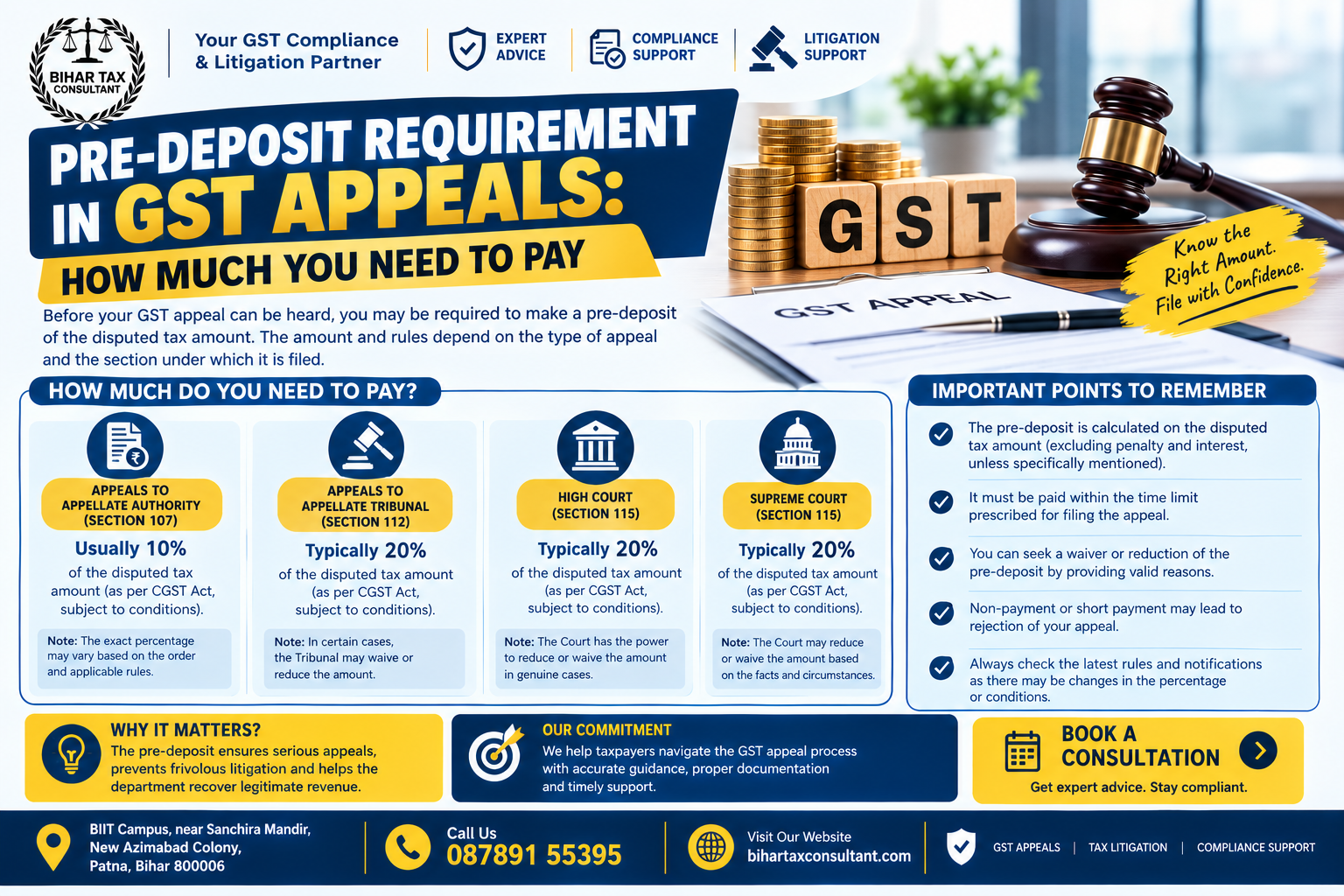
For a normal appeal against a GST demand before the Appellate Authority under Section 107 of the CGST Act, the appellant generally has to:
- Pay the full amount of tax, interest, fine, fee and penalty that is admitted; and
- Pay 10% of the remaining disputed amount of tax, subject to the applicable statutory ceiling.
The pre-deposit is a condition for filing the appeal. Once the statutory payment requirement is satisfied, recovery of the balance disputed amount is subject to the statutory stay mechanism.
The exact amount therefore depends on how much liability is admitted and how much tax remains disputed.
What Is GST Appeal Pre-Deposit?
GST appeal pre-deposit is the amount that a taxpayer is legally required to pay before an appeal can be filed or maintained against certain GST orders.
It is important to understand that the pre-deposit is not simply 10% of the entire demand shown in the order.
The calculation generally starts by separating:
- Amount admitted by the taxpayer
- Tax remaining in dispute
- Interest
- Penalty
- Fine
- Fee
- Other components of the demand
For an ordinary Section 107 appeal, the statutory formula focuses the 10% calculation on the remaining amount of tax in dispute.
This distinction can materially affect the amount payable.
GST Appeal Pre-Deposit Under Section 107
Section 107 deals with appeals to the Appellate Authority against orders passed by an adjudicating authority.
For the taxpayer’s appeal, the basic payment requirement consists of two components:
1. Admitted liability
The appellant must pay in full the portion of the amount arising from the order that the appellant admits.
This can include admitted:
- Tax
- Interest
- Fine
- Fee
- Penalty
2. Pre-deposit on disputed tax
The appellant must additionally pay 10% of the remaining amount of tax in dispute, subject to the applicable statutory maximum.
Therefore:
GST Appeal Pre-Deposit = Admitted liability + 10% of remaining disputed tax
The two components should not be confused.
How Much GST Appeal Pre-Deposit Do You Need to Pay?
A simple example makes the calculation easier.
Hypothetical Example 1
Suppose a GST order contains:
| Particular | Amount |
|---|---|
| Tax demand | ₹10,00,000 |
| Interest | ₹1,00,000 |
| Penalty | ₹1,00,000 |
| Total demand | ₹12,00,000 |
Assume the taxpayer:
- admits ₹2,00,000 of tax; and
- disputes ₹8,00,000 of tax.
The taxpayer would generally need to consider:
Admitted amount: ₹2,00,000, along with other admitted components as applicable.
10% of disputed tax:
₹8,00,000 × 10% = ₹80,000
Thus, the statutory pre-deposit component based on disputed tax would be ₹80,000, in addition to the amount of liability admitted and required to be paid.
The exact portal computation should always be checked before filing because the demand ledger and payments already made can affect the amount still payable.
Is GST Appeal Pre-Deposit Calculated on Interest and Penalty?
For the ordinary Section 107 tax-demand appeal, the 10% percentage component is calculated with reference to the remaining tax in dispute, rather than simply taking 10% of the entire demand including interest and penalty.
However, the separate requirement to pay the amount admitted by the appellant can include admitted tax, interest, fine, fee and penalty.
This is why a taxpayer should not simply take the total amount appearing in a DRC-07 and multiply it by 10%.
The demand should first be analysed component-wise.
What Is the Maximum GST Appeal Pre-Deposit?
The statutory ceiling applicable to the 10% disputed-tax component for a Section 107 appeal is ₹20 crore, subject to the structure of the applicable tax component and the governing provision.
The ceiling was reduced from the earlier higher limit with effect from 1 November 2024.
Therefore, for very large GST disputes, the 10% calculation does not continue indefinitely without regard to the statutory ceiling.
For high-value disputes, the exact tax-head-wise calculation should be verified carefully before filing.
What About an Appeal Against Only a Penalty?
Penalty-only GST appeals require special attention because the law changed from 1 October 2025.
The amended framework introduced a specific pre-deposit requirement for an order demanding penalty without involving a demand of tax.
For such cases, the applicable provision provides for a 10% pre-deposit of the penalty, subject to the statutory framework applicable to the appeal.
This means that taxpayers should not automatically apply the ordinary “10% of disputed tax” formula to every GST appeal.
The nature of the impugned order must first be identified.
Important distinction
| Type of dispute | Relevant calculation |
|---|---|
| Tax demand being disputed | Generally 10% of remaining disputed tax for Section 107 |
| Admitted liability | Full payment of admitted amount as required by Section 107 |
| Penalty-only order | Special penalty pre-deposit provision may apply |
| Tribunal appeal | Separate Section 112 requirements apply |
The effective date and nature of the order are particularly important for penalty-only disputes.
GST Appeal Pre-Deposit Under Section 112
Section 112 deals with appeals to the Appellate Tribunal against specified appellate/revisional orders.
The Tribunal-level pre-deposit is different from the first appellate stage.
For a tax dispute, Section 112 generally requires:
- Payment of the amount admitted by the appellant; and
- An additional pre-deposit calculated as 10% of the remaining disputed tax, in addition to the amount already paid under Section 107, subject to the applicable statutory ceiling.
Therefore, the amount paid at the first appellate stage does not necessarily mean that no additional pre-deposit is required before the Tribunal.
The taxpayer must examine the amount already deposited under Section 107 and the additional requirement under Section 112.
Section 107 vs Section 112 GST Pre-Deposit
| Particular | First Appeal | Tribunal Appeal |
|---|---|---|
| Provision | Section 107 | Section 112 |
| Appeal form | GST APL-01 | GST APL-05 |
| Main forum | Appellate Authority | Appellate Tribunal |
| Disputed tax pre-deposit | Generally 10% | Additional 10% under Section 112 |
| Admitted liability | Pay as required by law | Pay as required by law |
| Maximum ceiling | Statutory ceiling applies | Statutory ceiling applies |
| Balance recovery | Subject to statutory stay after compliance | Subject to statutory stay after compliance |
The exact calculation should be checked against the order, previous payments and the applicable version of the law.
Does Paying the GST Appeal Pre-Deposit Stop Recovery?
Yes, subject to the statutory conditions.
Under Section 107, once the appellant has paid the required amount under the pre-deposit provisions, recovery proceedings for the balance amount are deemed to be stayed.
This does not mean that the disputed demand has been finally cancelled.
It means that the statutory recovery protection applies to the balance amount while the appeal is being dealt with, subject to the law.
The GST Portal also indicates that, once the appeal is admitted, the balance disputed amount is flagged as non-recoverable on the portal.
Is the Pre-Deposit Refundable?
The pre-deposit is not the same thing as a final acceptance of the tax liability.
Its treatment depends on the outcome of the proceedings and applicable law.
Where an appeal is decided in favour of the taxpayer, CBIC has specifically clarified that the statutory restriction on certain refunds does not apply to refund of an amount paid as pre-deposit under Section 107(6) or Section 112(8) at the time of filing an appeal.
Therefore, taxpayers should preserve the payment records and appeal documentation carefully.
What If You Already Paid Money Through DRC-03?
This is an important practical issue.
A taxpayer may have voluntarily deposited money during investigation or proceedings through FORM GST DRC-03.
Later, when filing an appeal against the resulting demand order, the GST portal may still require a pre-deposit if the earlier payment has not been appropriately adjusted against the relevant demand.
The GST Portal has issued an advisory explaining that payments made through DRC-03 may not automatically be linked to the demand ID in the Electronic Liability Register.
Where an amount has already been paid, taxpayers should therefore verify:
- The amount paid
- Payment form
- Date of payment
- Demand ID
- Electronic Liability Register
- Whether the payment was adjusted against the demand
- Remaining amount required for the appeal
Do not assume that every previous DRC-03 payment automatically satisfies the appeal pre-deposit requirement.
How Is GST Appeal Pre-Deposit Paid?
Before filing the appeal, the taxpayer should identify:
Step 1: Obtain the impugned order
Review the order carefully and identify:
- Tax demanded
- Interest
- Penalty
- Fine
- Fee
- Amount admitted
- Amount disputed
Step 2: Determine the disputed tax
Calculate the tax amount that remains under dispute after accounting for any amount admitted.
Step 3: Calculate the statutory pre-deposit
For an ordinary Section 107 tax dispute:
10% × remaining disputed tax
Subject to the applicable statutory ceiling.
Step 4: Check previous payments
Verify whether amounts have already been credited or adjusted against the demand.
Step 5: Make the required payment
The payment should be made through the mechanism prescribed by the GST portal and reflected appropriately against the demand.
Step 6: File FORM GST APL-01
The first appeal is filed using FORM GST APL-01.
Step 7: Verify the acknowledgement
The appeal process includes provisional and final acknowledgement requirements. The GST Rules provide for submission of supporting documents and final acknowledgement in FORM GST APL-02 in the prescribed circumstances.
GST Appeal Pre-Deposit: Common Mistakes
1. Calculating 10% of the total demand
This is one of the most common calculation mistakes.
The ordinary Section 107 formula relates to the remaining disputed tax, not simply 10% of the total demand including every component.
2. Ignoring the admitted amount
The taxpayer cannot treat the entire demand as disputed if part of it is actually admitted.
The admitted liability has a separate payment requirement.
3. Treating interest as disputed tax
Interest may form part of the overall demand, but it should not automatically be included in the 10% disputed-tax calculation.
The components of the demand should be separated.
4. Assuming DRC-03 automatically satisfies pre-deposit
Earlier payments must be checked against the relevant demand.
A payment that exists in the records does not necessarily mean that the portal has adjusted it against the demand ID for appeal purposes.
5. Ignoring the statutory ceiling
For large disputes, applying 10% mechanically without checking the applicable maximum can produce an incorrect figure.
6. Using the wrong formula for a penalty-only appeal
Penalty-only orders have a specific legal treatment, particularly after the amendments effective from October 2025.
The taxpayer should identify whether there is a tax demand or only a penalty demand before calculating the amount.
7. Filing without checking the portal payment status
A taxpayer may have deposited the amount into a cash ledger but failed to properly debit or apply it in the manner required for the appeal.
The Jharkhand High Court has recently dealt with a dispute involving an appellant who had deposited money in the cash ledger but had not debited the required amount from it for the appeal. This illustrates why payment and actual utilisation/adjustment should be verified rather than assumed.
Practical GST Appeal Pre-Deposit Calculation
Hypothetical Example 2
Assume a taxpayer receives a GST order containing:
- Tax: ₹50 lakh
- Interest: ₹5 lakh
- Penalty: ₹5 lakh
- Total demand: ₹60 lakh
The taxpayer accepts ₹10 lakh of tax but disputes ₹40 lakh of tax.
The calculation for the ordinary Section 107 tax component would be:
Disputed tax = ₹40 lakh
10% of disputed tax = ₹4 lakh
The taxpayer must then separately account for the amount admitted and payable under Section 107(6)(a), along with the applicable ₹4 lakh disputed-tax pre-deposit.
The taxpayer should not calculate the pre-deposit as:
10% of ₹60 lakh = ₹6 lakh
because the 10% component is tied to the remaining disputed tax, not simply the total demand.
What Documents Should Be Checked Before Calculating the Pre-Deposit?
Before filing a GST appeal, keep the following ready:
- Original adjudication order
- DRC-07 or relevant demand summary
- Show Cause Notice
- Reply to the SCN
- Supporting documents submitted during adjudication
- Ledger/payment records
- DRC-03 challans, where applicable
- Electronic Liability Register details
- Demand ID
- Tax-wise and head-wise demand breakup
- Calculation of admitted liability
- Calculation of disputed tax
- Grounds of appeal
- Relevant invoices and books of account
- Relevant GST returns
- Reconciliation statements
- Previous appellate orders, if applicable
What Happens If the Required Pre-Deposit Is Not Paid?
The statutory pre-deposit is a condition attached to filing the appeal.
Therefore, an appellant should not assume that the appellate authority can simply ignore the statutory requirement because the taxpayer disputes the demand or faces temporary financial difficulty.
The legal position is that the appeal mechanism contains prescribed payment conditions.
For this reason, the pre-deposit should be calculated and arranged before the appeal filing deadline, rather than leaving it until the last moment.
GST Appeal Pre-Deposit and the Appeal Deadline
For an ordinary taxpayer appeal under Section 107, the appeal is generally required to be filed within three months from the date on which the decision or order is communicated.
The Appellate Authority may allow a further period of one month where sufficient cause is established.
The pre-deposit requirement does not replace the limitation period.
In practical terms:
Deadline + pre-deposit + documentation + appeal drafting should all be planned together.
A taxpayer should not wait until the final days to determine the amount payable.
Can You Challenge the Pre-Deposit Requirement?
The pre-deposit is a statutory requirement rather than merely an administrative fee.
Courts have considered challenges involving inability or unwillingness to make the statutory deposit. Recent decisions have reiterated that the statutory pre-deposit requirement must be complied with for maintaining the appeal, subject to the facts and legal issues of the particular case.
Whether an exceptional constitutional or procedural remedy may be available depends heavily on the facts.
A taxpayer should therefore distinguish between:
- Disagreement with the tax demand;
- Dispute regarding calculation of pre-deposit;
- Technical portal/payment problem;
- Limitation issue;
- Jurisdictional issue; and
- A genuine challenge to the statutory condition itself.
These are legally different questions.
GST Appeal Pre-Deposit Checklist
Before submitting the appeal, verify:
- Correct impugned order identified
- Date of communication recorded
- Appeal limitation calculated
- Total tax demand identified
- Admitted tax identified
- Disputed tax identified
- Admitted interest identified
- Admitted penalty identified
- 10% disputed-tax amount calculated
- Applicable statutory ceiling checked
- Previous DRC-03 payments verified
- Demand ID checked
- Electronic Liability Register checked
- Required amount actually paid/debited
- FORM GST APL-01 prepared
- Grounds of appeal reviewed
- Supporting documents compiled
- Final acknowledgement requirements checked
Why Professional Review Can Be Useful
GST pre-deposit calculations can look straightforward, but the amount can become complicated where:
- Multiple tax heads are involved;
- Part of the demand is admitted;
- DRC-03 payments were made;
- Multiple orders are involved;
- Interest and penalty are separately disputed;
- The order involves detention/confiscation;
- The appeal is being filed before the Tribunal;
- The dispute involves only penalty;
- A previous appeal has already been filed; or
- There is a limitation or portal-related issue.
A proper pre-deposit calculation should be based on the actual order, demand breakup, payment history and applicable statutory provision rather than a generic percentage.
FAQs
1. What is the GST appeal pre-deposit?
Short answer: It is the statutory amount that must be paid before filing a GST appeal.
For a normal Section 107 appeal involving disputed tax, the taxpayer generally pays the admitted liability plus 10% of the remaining disputed tax, subject to the applicable statutory ceiling.
2. Is GST appeal pre-deposit 10% of the total demand?
No, not ordinarily.
The 10% component under Section 107 is calculated on the remaining tax in dispute. The admitted portion of the liability is dealt with separately.
3. Is interest included in the 10% GST pre-deposit calculation?
For an ordinary tax-demand appeal, the 10% component is based on the remaining disputed tax, not simply the entire demand including interest.
However, admitted interest may have to be paid separately.
4. What is the maximum pre-deposit under Section 107?
The current statutory ceiling for the 10% disputed-tax component under Section 107 is ₹20 crore, subject to the applicable structure of the law and tax heads.
5. Is the GST pre-deposit mandatory?
For the statutory appeal mechanism, the prescribed payment is a condition for filing the appeal.
The taxpayer should therefore calculate and pay the applicable amount before filing.
6. What if I already paid the amount through DRC-03?
The previous payment should be checked to determine whether it has been properly adjusted against the relevant demand.
The GST Portal has specifically addressed situations where DRC-03 payments are not linked to the demand ID for purposes of calculating the appeal requirement.
7. Does paying the pre-deposit stay GST recovery?
Once the statutory requirements are fulfilled, recovery of the balance disputed amount is subject to the statutory stay mechanism.
This does not mean that the underlying demand has been finally decided in favour of the taxpayer.
8. Is the pre-deposit refundable if the taxpayer wins the appeal?
The pre-deposit is not the same as final acceptance of liability. Where the taxpayer succeeds, applicable law provides for treatment/refund of the pre-deposit subject to the relevant procedure.
CBIC has clarified that the restriction under Section 150 of the Finance (No. 2) Act, 2024 does not apply to refund of amounts paid as statutory appeal pre-deposits in the specified circumstances.
9. Is there a different pre-deposit for a penalty-only GST order?
Yes. The law applicable from 1 October 2025 introduced specific provisions for appeals against orders demanding penalty without involving a tax demand.
The applicable provision should be checked based on the date and nature of the order.
10. Is the Tribunal pre-deposit the same as the first appeal pre-deposit?
No.
Section 112 contains a separate requirement for an appeal to the Appellate Tribunal. An additional pre-deposit may be required in addition to the amount already paid under Section 107.
11. Can I file a GST appeal without paying the pre-deposit?
Ordinarily, the statutory appeal cannot be filed without satisfying the applicable pre-deposit requirement.
A taxpayer facing a payment, portal or legal issue should obtain advice on the specific circumstances rather than assuming that the requirement can simply be waived.
12. How should I calculate my GST appeal pre-deposit?
Start with the impugned order and separate:
- Admitted liability;
- Remaining disputed tax;
- Interest;
- Penalty;
- Fine;
- Fee;
- Previous payments; and
- Applicable statutory ceiling.
Then apply the formula under the relevant appellate provision.
Key Takeaways
- GST appeal pre-deposit is a statutory requirement, not merely a filing fee.
- For a normal Section 107 tax dispute, the key percentage component is generally 10% of the remaining disputed tax.
- The amount admitted by the taxpayer has to be dealt with separately.
- The 10% calculation should not automatically be applied to the entire demand including interest and penalty.
- The current Section 107 ceiling is ₹20 crore for the applicable 10% disputed-tax component.
- Penalty-only orders require separate consideration under the law applicable from 1 October 2025.
- A Tribunal appeal under Section 112 has its own additional pre-deposit requirement.
- Previous DRC-03 payments should be checked against the demand ID rather than assumed to satisfy the appeal requirement.
- Correct payment and debit/adjustment are as important as calculating the amount.
- The appeal deadline should be monitored independently of the payment calculation.
- The exact amount should always be verified against the impugned order, demand ledger and current law.
Final CTA
If you have received a GST demand order and are planning an appeal, the pre-deposit should be calculated from the actual demand, admitted liability, disputed tax and previous payments.
Bihar Tax Consultant can assist with GST appeal preparation, demand analysis, pre-deposit calculation and appellate documentation for taxpayers and businesses in Bihar.
Book a Consultation
Bihar Tax Consultant
BIIT Campus, near Sanchira Mandir, New Azimabad Colony, Patna, Bihar 800006
Mobile: 8789155395
Email: [email protected]