
How to File a GST First Appeal Under Section 107: Procedure, Time Limit & Pre-Deposit

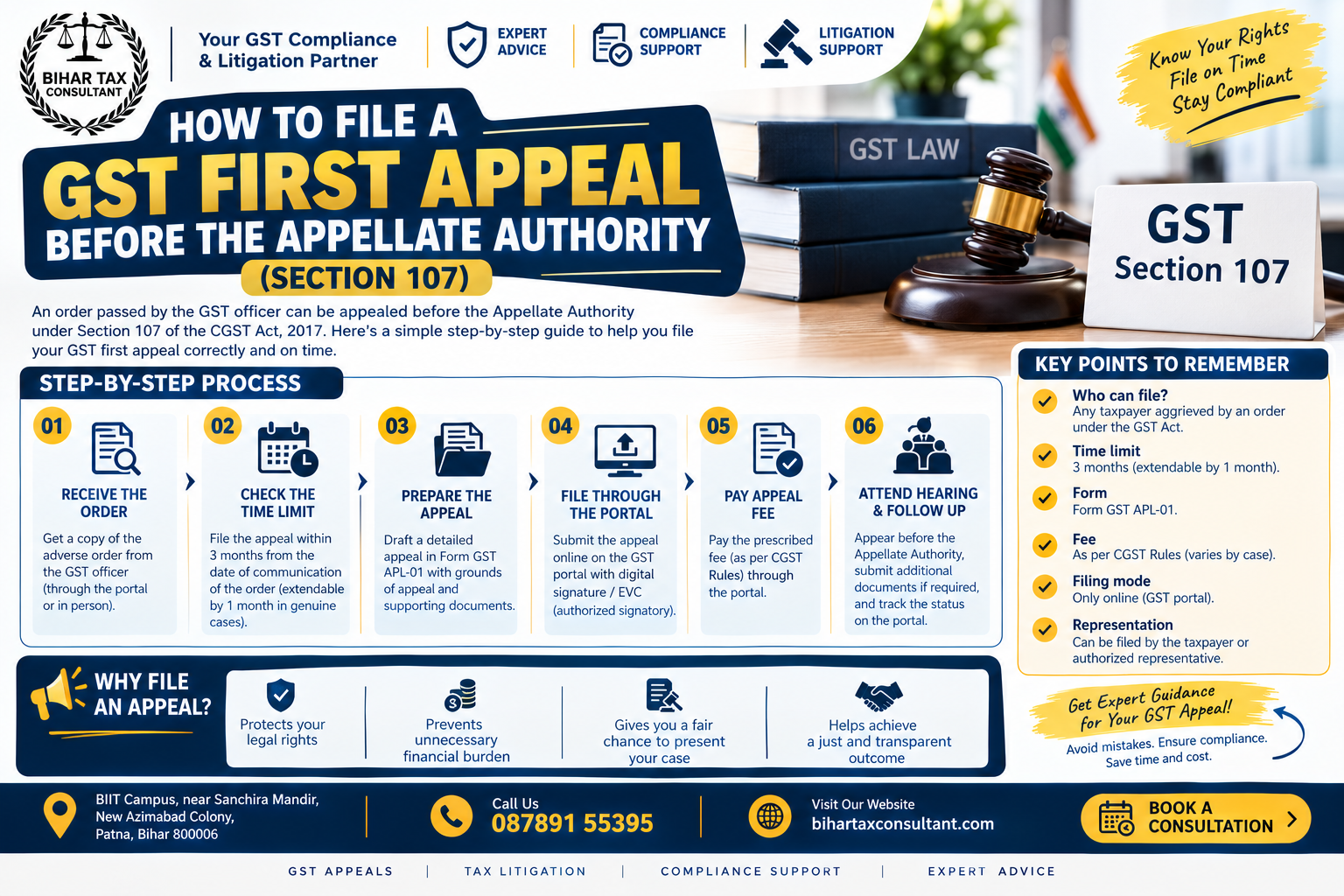
How Do You File a GST First Appeal?
A person aggrieved by a decision or order passed by a GST adjudicating authority may file a first appeal before the Appellate Authority under Section 107 of the CGST Act, 2017, subject to the applicable provisions of the corresponding State/UT GST law.
For a taxpayer, the normal limitation period is three months from the date on which the decision or order is communicated. Where sufficient cause is established, the Appellate Authority can allow the appeal to be presented within a further period of one month.
The appeal is generally filed electronically in FORM GST APL-01. The appellant must also satisfy the statutory payment/pre-deposit requirements before the appeal can be filed. The GST Portal states that the minimum pre-deposit for a normal demand appeal is 10% of the remaining disputed tax, after payment in full of the amount admitted by the appellant.
A GST first appeal should not be treated as a simple form-filing exercise. The grounds of appeal, factual explanation, supporting evidence, limitation and pre-deposit should all be checked carefully before submission.
What Is a GST First Appeal Under Section 107?
A GST first appeal is the statutory remedy available to a person who is aggrieved by a decision or order passed by an adjudicating authority.
Section 107 provides that an aggrieved person may appeal to the prescribed Appellate Authority within three months from the date on which the decision or order is communicated.
The first appeal is different from an appeal before the GST Appellate Tribunal.
The usual appellate hierarchy can be understood broadly as:
Adjudicating Authority → First Appellate Authority → Appellate Tribunal → High Court, where legally maintainable
The first appeal is therefore an important stage at which the taxpayer can challenge the factual findings, tax demand, interest, penalty, ITC denial or other adverse conclusions recorded in the original order.
Who Can File a GST First Appeal?
A person aggrieved by an appealable decision or order passed by an adjudicating authority can generally file an appeal under Section 107.
This can include, depending on the nature of the order:
- Registered taxpayers
- Businesses
- Companies
- Partnership firms
- LLPs
- Individuals
- Other persons affected by an appealable GST order
- In specified situations, unregistered persons
The GST Portal’s current appeal FAQ specifically states that a taxpayer or an unregistered person aggrieved by a decision or order passed by an adjudicating authority may appeal to the Appellate Authority within three months from communication of the order.
However, not every GST decision is automatically appealable. The nature of the order should be examined before filing.
Which GST Orders Can Be Challenged in First Appeal?
The GST Portal identifies several categories of orders that can be appealed.
These include, among others:
- Assessment orders under Section 62
- Assessment orders under Section 63
- Assessment orders under Section 64
- Orders relating to proceedings under Sections 73 and 74
- Orders relating to proceedings under Section 74A
- Orders under Section 76
- Certain penalty orders
- Rectification orders
- Rejection of rectification applications
- Certain enforcement-related demand orders
- Orders relating to detention, seizure and confiscation proceedings where appeal is provided
The GST Portal’s current FAQ specifically lists appealable assessment, enforcement, penalty, rectification and proceedings under Sections 73, 74, 74A and 76.
Therefore, the taxpayer should first identify the exact statutory provision under which the impugned order was passed.
What Is the Time Limit for Filing a GST First Appeal?
The normal time limit for an aggrieved taxpayer is:
3 months from the date on which the order or decision is communicated.
Section 107 also permits the Appellate Authority to condone delay for a further period of one month where the appellant establishes sufficient cause for not filing within the original three-month period.
In simple terms:
| Situation | Time |
|---|---|
| Normal taxpayer appeal | 3 months |
| Additional condonable period | Up to 1 month |
| Total possible period under Section 107(4) | 3 + 1 months |
The additional month is not an automatic extension. The Appellate Authority must be satisfied that sufficient cause prevented timely filing.
From Which Date Is the GST Appeal Period Calculated?
The limitation period is linked to the date on which the decision or order is communicated to the person.
This makes proper identification of the communication date important.
The taxpayer should preserve:
- Order copy
- Date of order
- Date of communication/upload
- Portal records
- Email/SMS communication, where relevant
- Downloaded copy of the order
A limitation calculation should be performed from the actual facts rather than assuming that the order date and communication date are always identical.
What Is FORM GST APL-01?
FORM GST APL-01 is the prescribed appeal form used by a taxpayer/person to file an appeal before the Appellate Authority under Section 107(1).
The GST Rules provide for filing the appeal in FORM GST APL-01, electronically or otherwise as notified.
The GST Portal’s current process directs taxpayers to:
Services → User Services → My Applications → Appeal to Appellate Authority → New Application
The taxpayer can then select the relevant order type and proceed with the appeal application.
Step-by-Step: How to File GST First Appeal Online
Step 1: Obtain and Read the Impugned Order
Before starting the appeal, obtain the complete order and identify:
- Order number
- Order date
- Communication date
- Tax period
- Tax demanded
- Interest
- Penalty
- ITC disputed
- Findings of the adjudicating authority
- Legal provisions invoked
- Reasons for confirming the demand
Do not prepare an appeal merely by looking at the DRC-07 summary if the detailed adjudication order is available.
The detailed order is generally essential for identifying the actual findings that need to be challenged.
Step 2: Calculate the Limitation Period
Calculate the three-month period from communication of the order.
If the normal period has expired, determine whether the appeal can still fall within the additional one-month period available for condonation.
A delay should be supported by a specific explanation of the circumstances that prevented timely filing.
Step 3: Determine the Amount Admitted and Disputed
Separate the demand into:
Amount admitted by taxpayer
and
Amount disputed by taxpayer
This distinction matters because Section 107 requires payment in full of the admitted amount specified by the provision, while the statutory pre-deposit is calculated with reference to the remaining disputed tax.
What Is the GST First Appeal Pre-Deposit?
For a normal Section 107 appeal, the taxpayer must:
- Pay in full the amount of tax, interest, fine, fee and penalty arising from the order that is admitted; and
- Pay the prescribed percentage of the remaining disputed tax as pre-deposit.
Following the amendment effective from 1 November 2024, the first-appellate pre-deposit was reduced to 10% of the disputed tax, with a statutory monetary ceiling under Section 107. The current statutory ceiling for the CGST component is ₹20 crore.
Important distinction
The 10% pre-deposit is generally calculated on the disputed tax, not automatically on the combined figure of tax, interest and penalty.
The GST Portal itself describes the requirement as a minimum 10% of the disputed tax.
What Happens After Paying the Pre-Deposit?
Once the statutory payment requirement is satisfied, the recovery proceedings for the balance amount are deemed to be stayed under Section 107, subject to the statutory conditions.
This does not mean that every liability in the order disappears.
It means that the statutory stay of recovery applies to the balance amount covered by the appeal after the required payment has been made.
Special Issue: Orders Under Section 129
Detention and seizure cases under Section 129 require particular attention because the statute contains a separate pre-deposit requirement for specified appeals against orders under Section 129(3).
Therefore, a taxpayer should not automatically apply the ordinary 10%-of-disputed-tax calculation to every GST appeal.
The exact provision under which the impugned order was passed should be identified first.
How Should GST Appeal Grounds Be Drafted?
A strong GST appeal should not merely say:
“The order passed by the officer is incorrect.”
The grounds should explain why the order is legally or factually unsustainable.
Useful categories of grounds can include:
1. Error of fact
Example:
The officer treated a transaction as taxable even though the underlying documents demonstrate that the transaction had already been correctly reported.
2. Incorrect interpretation of GST law
The taxpayer may contend that the statutory provision has been incorrectly interpreted or applied.
3. Incorrect ITC denial
The taxpayer may challenge denial of input tax credit where the statutory conditions and supporting records establish eligibility.
4. Reconciliation error
The demand may have arisen from a mismatch between:
- GSTR-1
- GSTR-3B
- GSTR-2B
- Books of account
- E-invoices
- E-way bills
- Supplier data
A reconciliation can demonstrate whether the alleged difference is genuine.
5. Procedural violation
Depending on the facts, the taxpayer may challenge issues such as inadequate opportunity, failure to consider a response, or other procedural defects.
6. Incorrect computation
The taxpayer may challenge:
- Tax rate
- Taxable value
- Interest
- Penalty
- ITC amount
- Turnover
- Period
- Mathematical calculation
Can Additional Evidence Be Submitted Before the Appellate Authority?
The general rule is that an appellant should not simply introduce entirely new evidence at the appellate stage when that evidence could have been produced before the adjudicating authority.
However, the GST Rules recognise specified circumstances in which additional evidence may be admitted.
These include situations where:
- The adjudicating authority refused to admit evidence that should have been admitted;
- The appellant was prevented by sufficient cause from producing evidence that was called for; or
- The appellant was prevented by sufficient cause from producing relevant evidence before the adjudicating authority.
The rules contain further specified circumstances and conditions concerning additional evidence.
Practical lesson
Do not deliberately hold back important documents during adjudication merely with the intention of producing them in appeal.
If important evidence was not submitted earlier, the appeal should explain why it could not be submitted earlier.
What Documents Are Required for a GST First Appeal?
A practical appeal file may include:
Core documents
- Copy of impugned order
- Show-cause notice
- Statement of demand/DRC-07, where relevant
- Earlier replies
- Personal-hearing records
- Relevant GST notices
Financial records
- Tax invoices
- Purchase invoices
- Sales invoices
- Ledgers
- Trial balance
- Bank statements
- Electronic cash/credit ledger extracts
GST records
- GSTR-1
- GSTR-3B
- GSTR-2B
- GSTR-9/9C, where applicable
- E-way bills
- E-invoice records
- Relevant GST portal screenshots/reports
Legal documents
- Relevant statutory provisions
- Notifications
- Circulars
- Applicable judicial decisions
- Reconciliation statements
The exact documents depend on the grounds of appeal.
How to Write a GST Appeal Statement of Facts
The Statement of Facts should tell the Appellate Authority what actually happened.
A useful structure is:
Paragraph 1 — Background
Identify the taxpayer and business.
Paragraph 2 — Transaction
Explain the relevant transaction or tax issue.
Paragraph 3 — Proceedings
Describe the notice and the response filed before the adjudicating authority.
Paragraph 4 — Impugned order
Explain what the adjudicating authority decided.
Paragraph 5 — Why the order is disputed
Identify the factual, legal and procedural errors.
Paragraph 6 — Relief requested
State precisely what the appellant wants the Appellate Authority to do.
The Statement of Facts and Grounds of Appeal should complement each other rather than repeating the same paragraphs unnecessarily.
What Relief Can the Appellate Authority Grant?
Under Section 107, the Appellate Authority can pass an order confirming, modifying or annulling the decision or order appealed against, subject to the statutory safeguards.
The Appellate Authority cannot simply remand the case back to the same adjudicating authority under the statutory scheme.
Where an adverse enhancement or other specified adverse action is contemplated, the statute requires the appellant to be given the prescribed opportunity to show cause.
The appellate order is required to state the points for determination, the decision and the reasons for the decision.
What Happens After GST APL-01 Is Filed?
The GST Portal identifies several stages/statuses in the appeal process, including:
- Appeal Submitted
- Appeal Admitted
- Appeal Rejected
- Hearing Notice Issued
- Reply Submitted
- Adjournment Granted
- Show Cause Notice Issued
- Appeal Order Passed
- Rectification-related statuses
- Remand-related statuses
The exact progression depends on the case.
The taxpayer should therefore continue monitoring the GST portal after filing the appeal.
What Is FORM GST APL-02?
FORM GST APL-02 is the final acknowledgement issued by the Appellate Authority.
The GST Rules provide that after the prescribed filing requirements are completed, the final acknowledgement indicating the appeal number is issued in FORM GST APL-02.
The GST Portal also explains that if the order is not uploaded, a self-certified copy may have to be submitted within seven days of filing APL-01; where this is not done within that period, the filing date can be affected under the prescribed procedure.
Important practical point
Keep the:
- ARN
- Provisional acknowledgement
- APL-02
- Payment challan
- Pre-deposit details
- Uploaded appeal
- Attachments
- Subsequent notices
in one appeal file.
Is DSC Required for GST First Appeal?
The GST Portal states that an appeal can be filed using DSC or EVC, with DSC being mandatory for companies and LLPs.
Before filing, the authorised signatory should therefore ensure that the appropriate authentication method is available and functional.
Can a GST First Appeal Be Withdrawn?
The GST Portal permits withdrawal of an appeal subject to the procedural stage.
According to the current GST Portal FAQ, an appeal can generally be withdrawn until a notice is issued or an appeal order is passed. Once a notice has been issued, the application cannot be withdrawn through that functionality.
A taxpayer should therefore consider the legal and financial consequences before withdrawing an appeal.
Can a Rejected GST Appeal Be Re-filed?
The GST Portal states that an appeal application rejected at the admission stage can be re-filed once through the portal using the original Order ID, subject to the applicable process.
This should not be misunderstood as a general extension of limitation.
If an appeal has a limitation problem, the taxpayer should separately examine the statutory limitation and condonation provisions.
What Happens During the GST Appeal Hearing?
The Appellate Authority gives the appellant an opportunity of being heard.
The hearing may involve discussion of:
- Grounds of appeal
- Documents
- Reconciliation
- Legal provisions
- Case law
- Computation
- Pre-deposit
- Procedural issues
- Specific findings in the impugned order
A taxpayer or authorised representative should be prepared to explain the disputed issues concisely and answer questions arising from the record.
Can New Grounds Be Added During the Appeal?
Section 107 permits the Appellate Authority, at the hearing stage, to allow an appellant to add a ground of appeal that was not specified initially if it is satisfied that omission of that ground was not wilful or unreasonable.
However, it is better practice to identify all material grounds before filing rather than relying on a later request to introduce them.
Common Grounds in GST First Appeals
Depending on the facts, GST first appeals may involve disputes relating to:
Input Tax Credit
- Supplier mismatch
- Documentation
- Eligibility
- Reversal
- Blocked credit
- Time limitation
- Reconciliation
Taxability
- Classification
- Rate of tax
- Place of supply
- Exemption
- Composite/mixed supply
- Valuation
Demand
- Wrong turnover
- Difference in returns
- Third-party data
- Bank transactions
- E-way bill differences
- E-invoice mismatch
Penalty
- Absence of statutory conditions
- Incorrect computation
- Procedural defects
- Incorrect application of the relevant penal provision
Interest
- Incorrect tax period
- Incorrect principal amount
- Incorrect calculation
The correct grounds depend entirely on the facts and the provisions invoked in the order.
Hypothetical Example: GST Demand Appeal
This is a hypothetical example for educational purposes only.
ABC Traders receives a GST order creating the following demand:
- Tax: ₹10 lakh
- Interest: ₹2 lakh
- Penalty: ₹1 lakh
ABC Traders disputes the entire ₹10 lakh tax demand.
The taxpayer reviews the order and discovers that the officer treated certain purchase transactions as ineligible ITC without considering reconciliation and supporting documents.
The taxpayer may consider filing a Section 107 appeal by:
- Identifying the communication date.
- Calculating the three-month limitation period.
- Preparing the Statement of Facts.
- Drafting specific Grounds of Appeal.
- Collecting invoices and reconciliation.
- Paying the amount required under Section 107.
- Filing FORM GST APL-01.
- Monitoring the appeal status.
- Attending the hearing.
- Responding to any subsequent communication.
The example demonstrates why a first appeal requires both procedural compliance and substantive preparation.
What Are the Most Common GST Appeal Mistakes?
Mistake 1: Missing the three-month deadline
The taxpayer assumes that there is automatically an additional month.
Better approach: Treat three months as the primary deadline and use condonation only where legally available and supported by sufficient cause.
Mistake 2: Calculating pre-deposit incorrectly
The taxpayer calculates the percentage on the entire demand instead of examining the disputed tax and statutory requirements.
Better approach: Prepare a demand reconciliation before making the payment.
Mistake 3: Challenging the DRC-07 without analysing the order
A summary does not necessarily explain every finding.
Better approach: Read the detailed adjudication order.
Mistake 4: Filing generic grounds
Statements such as “the order is illegal and arbitrary” without factual explanation may not adequately present the case.
Better approach: Link each ground to a specific finding in the order.
Mistake 5: Ignoring reconciliation
Many GST disputes involve data mismatches.
Better approach: Prepare a transaction-level reconciliation wherever relevant.
Mistake 6: Holding back evidence
Important evidence may be difficult to introduce later.
Better approach: Place relevant evidence on record at the earliest appropriate stage and explain any unavoidable omission.
Mistake 7: Failing to monitor the portal
Filing the appeal is not necessarily the end of the process.
Better approach: Monitor notices, hearing dates and orders regularly.
Mistake 8: Treating every appeal as identical
A Section 73 demand, Section 74/74A dispute, ITC issue, penalty order and detention matter can involve different legal considerations.
Better approach: Identify the exact provision and nature of the impugned order before drafting.
GST First Appeal Checklist
Before filing, verify:
Order
☐ Complete order obtained
☐ Order number recorded
☐ Tax period identified
☐ Communication date identified
Limitation
☐ Three-month deadline calculated
☐ Delay, if any, separately analysed
☐ Condonation requirement considered
Demand
☐ Tax amount checked
☐ Interest checked
☐ Penalty checked
☐ Admitted amount identified
☐ Disputed amount identified
Pre-Deposit
☐ Statutory amount calculated
☐ Payment completed correctly
☐ Relevant ledger/payment records preserved
Appeal Draft
☐ Statement of Facts prepared
☐ Grounds of Appeal prepared
☐ Relief/prayer drafted
☐ Supporting documents indexed
☐ Relevant legal provisions checked
Filing
☐ FORM GST APL-01 completed
☐ Authentication completed
☐ Attachments uploaded
☐ ARN preserved
☐ APL-02/final acknowledgement monitored
Post-Filing
☐ Hearing notices monitored
☐ Additional submissions prepared if required
☐ Appeal order preserved
☐ Further remedy considered if adverse
What Happens If the First Appeal Is Decided Against the Taxpayer?
If the taxpayer remains aggrieved after the first appellate order, the next statutory remedy may be an appeal before the GST Appellate Tribunal, subject to the applicable provisions, limitation and pre-deposit requirements.
The first appellate order should therefore be reviewed carefully before deciding whether further litigation is appropriate.
The exact appellate route depends on the nature of the order and the statutory framework applicable at that time.
Why the First GST Appeal Is Important
A GST first appeal is not merely a procedural step to stop recovery.
It is an opportunity to place the taxpayer’s factual and legal case before the Appellate Authority.
A well-prepared appeal should answer four basic questions:
1. What did the adjudicating authority decide?
Identify the exact adverse findings.
2. Why is that finding disputed?
Explain the factual and legal errors.
3. What evidence supports the taxpayer’s position?
Connect documents to individual grounds.
4. What relief is being requested?
State precisely what should be modified, annulled or otherwise corrected.
GST First Appeal in Bihar and Patna
Businesses in Bihar may face GST disputes involving:
- ITC mismatch
- Tax demands
- Classification
- E-way bill issues
- GSTR-1/GSTR-3B differences
- Section 73/74/74A proceedings
- Penalties
- Registration-related orders
- Recovery proceedings
The first appeal should be filed before the appropriate Appellate Authority having jurisdiction over the relevant order, rather than assuming that every appeal goes to the same office.
The correct appellate authority should therefore be verified from the impugned order, jurisdiction and applicable notification before filing.
Frequently Asked Questions
1. What is a GST First Appeal under Section 107?
It is the statutory appeal available to a person aggrieved by an appealable decision or order passed by a GST adjudicating authority. The appeal is made to the prescribed Appellate Authority under Section 107.
2. What is the time limit for GST First Appeal?
A taxpayer generally has three months from the date the decision or order is communicated. The Appellate Authority may allow a further period of up to one month where sufficient cause is established.
3. Which form is used for GST First Appeal?
A taxpayer normally files the appeal in FORM GST APL-01.
4. How much pre-deposit is required for a GST First Appeal?
For a normal demand appeal, the statutory requirement includes payment of the admitted amount and 10% of the remaining disputed tax, subject to the applicable statutory ceiling. The current CGST ceiling for the first appellate stage is ₹20 crore.
5. Is the 10% pre-deposit calculated on penalty and interest?
The statutory 10% component is linked to the remaining amount of tax in dispute. Admitted tax, interest, fine, fee and penalty are separately dealt with under the payment requirement.
6. Does filing an appeal stop GST recovery?
Once the statutory payment/pre-deposit requirement is satisfied, recovery of the balance amount is deemed to be stayed under Section 107, subject to the statutory conditions.
7. Can an appeal be filed after three months?
A further period of up to one month may be permitted where the Appellate Authority is satisfied that sufficient cause prevented timely filing.
8. What is APL-02?
FORM GST APL-02 is the final acknowledgement issued by the Appellate Authority after the appeal filing process is completed as prescribed.
9. Can I file a GST appeal electronically?
Yes. The GST Portal provides an electronic process for filing appeals to the Appellate Authority through the taxpayer’s account.
10. Can I submit additional evidence during GST appeal?
Additional evidence is restricted by the GST Rules, but specified exceptions exist where, for example, evidence was wrongly refused or the appellant was prevented by sufficient cause from producing relevant evidence earlier.
11. Can additional grounds be added later?
The Appellate Authority may allow an additional ground at the hearing where it is satisfied that omission of that ground was not wilful or unreasonable.
12. What happens after the GST First Appeal?
The Appellate Authority may confirm, modify or annul the impugned order, subject to the statutory framework. If the taxpayer remains aggrieved, a further appeal may be available before the GST Appellate Tribunal subject to applicable conditions.
Key Takeaways
- Section 107 provides the main statutory route for a GST first appeal.
- A taxpayer generally has three months from communication of the order.
- A further one month may be condoned where sufficient cause is established.
- FORM GST APL-01 is used for the taxpayer’s first appeal.
- The taxpayer must pay the admitted amount as required and the prescribed 10% pre-deposit of disputed tax for a normal demand appeal.
- The current CGST first-appellate pre-deposit ceiling is ₹20 crore following the 2024 amendment.
- Filing the appeal after satisfying the statutory payment requirement results in the statutory stay of recovery of the balance amount.
- A good appeal should contain a clear Statement of Facts, Grounds of Appeal, supporting evidence and specific relief sought.
- The detailed adjudication order should be analysed rather than relying only on a demand summary.
- Additional evidence is subject to specific conditions.
- GST Portal monitoring should continue after filing because notices, hearings and orders may follow.
- The exact appellate strategy depends on the provision under which the order was passed and the facts of the dispute.