
How to Respond to a GST Show Cause Notice (SCN) Under Section 73/74

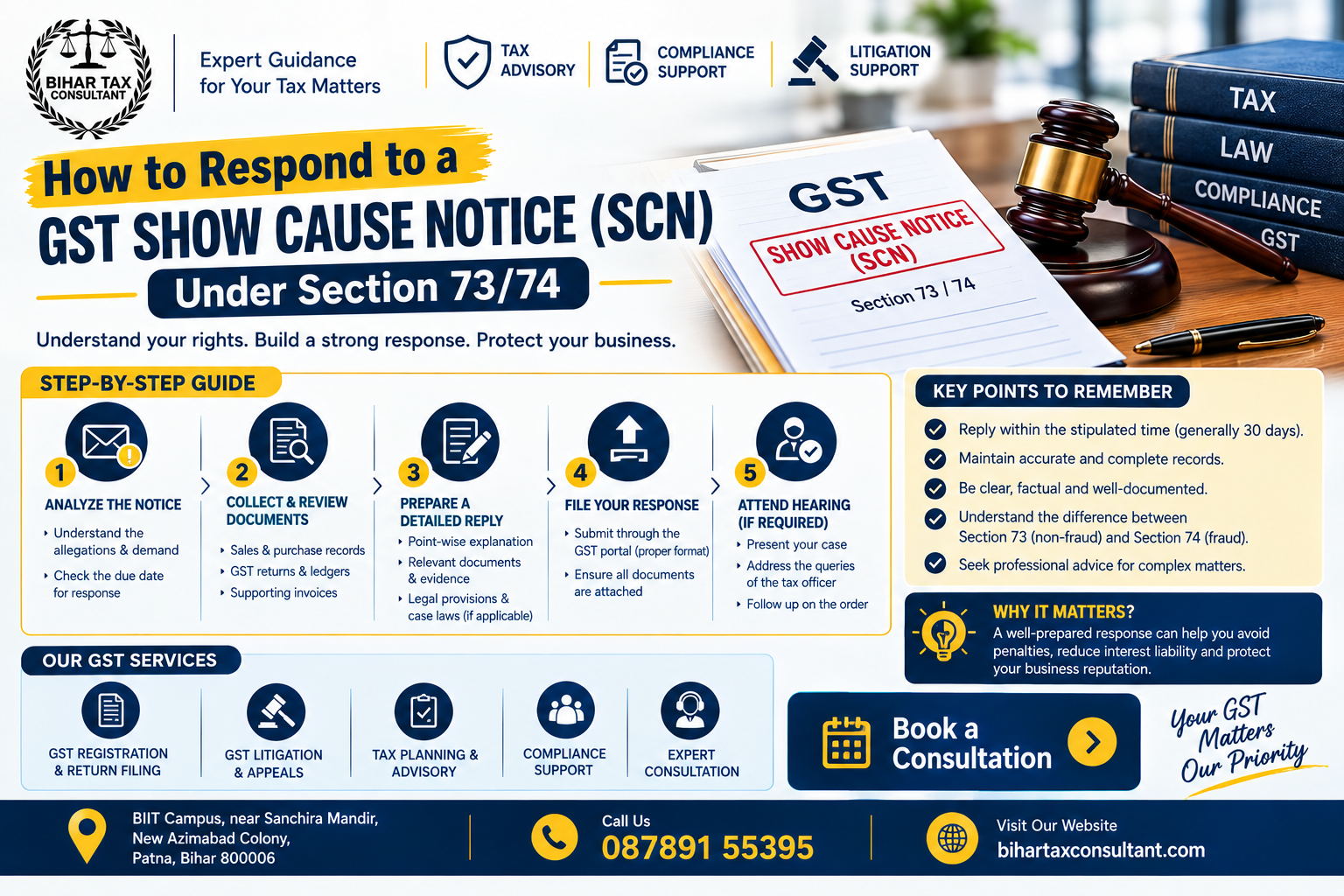
What Should You Do After Receiving a GST Show Cause Notice?
Read the notice carefully, identify the tax period and allegations, collect supporting documents, prepare a point-by-point reply and submit it through the prescribed GST portal within the specified time.
A GST Show Cause Notice (SCN) is a formal communication from the GST authorities explaining proposed tax demand, interest and applicable penalty, and asking the taxpayer to explain why the proposed action should not be taken.
A notice under Section 73 generally concerns tax not paid, short-paid, erroneously refunded or input tax credit wrongly availed or utilised for reasons other than fraud, wilful misstatement or suppression of facts to evade tax.
Section 74 applies to specified cases involving fraud, wilful misstatement or suppression of facts to evade tax. For financial years 2024–25 onward, Section 74A is the relevant demand provision for these categories, subject to the applicable law.
Do not ignore a GST SCN. A well-prepared response can help establish the correct facts, challenge an incorrect demand, substantiate eligible input tax credit and protect the taxpayer’s position.
Introduction
Receiving a GST Show Cause Notice can be stressful for any business owner, company, trader, service provider or registered taxpayer.
The notice may allege:
- Non-payment of GST.
- Short payment of tax.
- Wrongly availed or utilised Input Tax Credit (ITC).
- Excess or erroneous refund.
- Mismatch between GST returns and other records.
- Incorrect classification of goods or services.
- Failure to comply with GST provisions.
- Alleged fraud, wilful misstatement or suppression of facts.
Many taxpayers make the mistake of treating the notice as an ordinary departmental communication.
It is not.
A GST SCN is part of a formal demand and adjudication process. The taxpayer must carefully examine the allegations and submit a legally and factually supported response.
This article explains how to respond to a GST Show Cause Notice under Section 73/74, what documents to collect, how to prepare a reply, what happens after submission and when professional assistance may be required.
What Is a GST Show Cause Notice (SCN)?
A GST Show Cause Notice is a formal notice issued by the proper officer proposing action under the applicable provisions of the GST law.
The notice generally sets out:
- The taxpayer’s GSTIN and details.
- Relevant financial year or tax period.
- Alleged tax short payment or other default.
- Applicable statutory provisions.
- Proposed tax demand.
- Interest, where applicable.
- Penalty, where applicable.
- Grounds and supporting facts.
- Time and manner for filing a reply.
- Details of the adjudicating authority or proceeding.
The notice asks the taxpayer to explain why the proposed tax, interest and penalty should not be determined against them.
A taxpayer should therefore examine not only the amount demanded but also the legal basis and evidence supporting the allegation.
Section 73 vs Section 74 of the CGST Act
What Is Section 73?
Section 73 of the CGST Act, 2017 deals with determination of tax not paid, short-paid, erroneously refunded or input tax credit wrongly availed or utilised for reasons other than fraud, wilful misstatement or suppression of facts to evade tax.
It is generally associated with non-fraud cases for the relevant tax periods.
Examples may include:
- Incorrect tax calculation.
- Genuine reporting errors.
- Certain ITC discrepancies.
- Incorrect classification.
- Tax short payment without an allegation of fraud.
- Other specified non-fraud situations.
What Is Section 74?
Section 74 deals with specified cases where tax has not been paid, has been short-paid, has been erroneously refunded or input tax credit has been wrongly availed or utilised by reason of fraud, wilful misstatement or suppression of facts to evade tax.
This distinction is important because allegations of fraud or suppression can have serious consequences for tax demand, penalty and limitation.
A taxpayer should not accept a fraud allegation merely because it appears in the notice.
The Department must establish the relevant statutory grounds in accordance with the applicable law.
What Changed From FY 2024–25?
Section 74A was introduced for specified demands relating to financial years 2024–25 onward.
Section 74A covers tax not paid, short-paid, erroneously refunded or input tax credit wrongly availed or utilised, whether or not fraud, wilful misstatement or suppression of facts is involved.
Therefore, the first step in reviewing a GST notice in 2026 is to identify:
- Financial year.
- Tax period.
- Provision invoked.
- Whether the notice is under Section 73, Section 74 or Section 74A.
- Applicable limitation period.
- Relevant payment and reply provisions.
Do not automatically apply Section 73/74 rules to a notice relating to FY 2024–25 or later.
What Is the Difference Between Section 73 and Section 74?
| Particulars | Section 73 | Section 74 |
|---|---|---|
| Nature of case | Other than fraud, wilful misstatement or suppression to evade tax | Fraud, wilful misstatement or suppression to evade tax |
| Typical issue | Tax short payment, ITC or refund issues | Tax short payment, ITC or refund issues involving specified fraud-related allegations |
| Penalty | Applicable according to the statutory framework | Generally more serious consequences |
| Limitation | Shorter period under the relevant law | Extended period under the relevant law |
| Taxpayer response | Explanation, documents and legal grounds | Explanation, documents and challenge to allegations where appropriate |
For FY 2024–25 onward, Section 74A must be examined instead of assuming that Section 73/74 continues to govern every demand.
What Are the Common Reasons for Receiving a GST SCN?
1. Wrongly Availed or Utilised ITC
The Department may allege that a taxpayer has claimed ITC without satisfying the applicable conditions.
Possible issues include:
- Missing or incorrect invoices.
- Supplier-related discrepancies.
- Ineligible credit.
- Credit relating to blocked goods or services.
- Timing or documentation issues.
- Difference between GSTR-3B and other GST records.
The taxpayer should reconcile the ITC claim with purchase registers, invoices, supplier information and applicable legal provisions.
2. GST Short Payment
A notice may allege that the taxpayer charged or paid less GST than required.
Possible reasons include:
- Incorrect GST rate.
- Wrong classification.
- Omitted invoices.
- Incorrect place of supply.
- Tax calculation errors.
- Unreported taxable supplies.
3. Mismatch in GST Returns
The notice may refer to differences between:
- GSTR-1.
- GSTR-3B.
- GSTR-9.
- GSTR-9C, where applicable.
- Books of account.
- E-invoice records.
- E-way bill information.
- Other departmental data.
A mismatch does not automatically establish tax evasion. The taxpayer should explain the reason and provide reconciliation.
4. Excess or Erroneous Refund
The Department may propose recovery where a refund was allegedly granted incorrectly.
The taxpayer should review the refund application, supporting documents, export records, invoices, shipping bills and relevant computation.
5. Alleged Fraud or Suppression
Under Section 74, the notice may allege fraud, wilful misstatement or suppression of facts to evade tax.
Such allegations require serious attention because they can affect penalty and limitation.
The taxpayer should specifically examine whether the allegation is supported by facts and evidence.
How to Respond to a GST Show Cause Notice: Step-by-Step
Step 1: Read the Entire Notice
Do not rely only on the first page or the demand amount.
Read:
- Allegations.
- Tax period.
- Relevant provisions.
- Computation.
- Evidence.
- Reply deadline.
- Hearing details.
- Payment instructions.
Check whether the notice includes annexures or supporting documents.
Step 2: Verify the Notice
Check the notice through the official GST portal and verify:
- GSTIN.
- Reference number.
- Issuing authority.
- Tax period.
- Nature of proceeding.
- Whether the notice is genuine.
- Whether any previous communication is referred to.
Keep a complete copy of the notice and attachments.
Step 3: Identify the Exact Allegation
Prepare a separate list of each allegation.
For example:
| Allegation | Your response |
|---|---|
| ITC mismatch | Reconcile purchase register and invoices |
| Short payment | Verify tax rate and turnover |
| Supplier discrepancy | Check invoices and available supplier evidence |
| Wrong classification | Review applicable rate and legal provisions |
| Fraud allegation | Examine evidence and statutory grounds |
A point-by-point approach is generally stronger than a generic denial.
Step 4: Collect Supporting Documents
Depending on the issue, collect:
- GST returns.
- Purchase and sales registers.
- Tax invoices.
- Credit and debit notes.
- E-way bills.
- E-invoice records.
- Bank statements.
- Ledger accounts.
- Agreements.
- Contracts.
- Payment evidence.
- Supplier confirmations.
- Reconciliation statements.
- Previous replies.
- Relevant legal documents.
Step 5: Reconcile the Figures
Check the notice calculation against your records.
For example:
Taxable turnover as per books
Less: Exempt or non-GST supplies, where applicable
Add: Omitted taxable supplies, if any
Compare with: GSTR-1 and GSTR-3B
Verify: Tax rate and tax liability
For ITC disputes:
ITC as per purchase register
Compare with: GSTR-2B and other relevant records
Verify: Invoice eligibility
Check: Payment and statutory conditions
Identify: Reconciliation differences
Step 6: Examine the Legal Provisions
Check whether the correct statutory provision has been invoked.
Important questions include:
- Is Section 73 or Section 74 applicable?
- Is Section 74A relevant?
- Is the tax period correctly stated?
- Is the notice within limitation?
- Are the allegations supported?
- Is the computation correct?
- Are the relevant exemption or ITC provisions correctly applied?
Step 7: Prepare a Written Reply
A GST SCN reply should generally contain:
- Heading and notice reference.
- GSTIN and taxpayer details.
- Brief facts.
- Preliminary submissions, where relevant.
- Point-by-point response.
- Reconciliation and computation.
- Supporting evidence.
- Legal submissions.
- Prayer or request.
- List of annexures.
Step 8: Submit Through the Prescribed GST Portal
Where the applicable process requires electronic submission, use the prescribed GST portal form and procedure.
Form GST DRC-06 is commonly used for filing a reply to a show cause notice under the demand provisions.
Check the actual notice and portal instructions before submission.
Step 9: Attend the Personal Hearing
If a hearing is scheduled or a personal hearing is requested where legally permissible, attend it with the necessary documents and submissions.
The hearing should be treated as an important opportunity to explain the taxpayer’s position.
Step 10: Preserve Acknowledgement
Keep:
- Filed reply.
- ARN or submission reference.
- Uploaded documents.
- Notice copy.
- Hearing records.
- Subsequent communications.
This evidence can become important if the matter proceeds to an appeal.
What Is Form GST DRC-01?
Form GST DRC-01 is used for communicating a summary of a show cause notice under the applicable GST demand provisions.
It may show:
- Tax amount.
- Interest.
- Penalty.
- Other relevant demand details.
The taxpayer should examine the underlying notice and supporting documents rather than relying only on the summary displayed in DRC-01.
What Is Form GST DRC-06?
Form GST DRC-06 is used for submitting a reply to a show cause notice under the applicable demand procedure.
A reply should be complete, accurate and supported by relevant evidence.
Simply filing DRC-06 without a proper explanation may not adequately protect the taxpayer’s position.
What Documents Are Required for a GST SCN Reply?
The documents depend on the allegations.
For ITC-related disputes
- Purchase register.
- Tax invoices.
- GSTR-2B.
- Supplier details.
- Payment records.
- Goods receipt evidence.
- E-way bills.
- Reconciliation statement.
For turnover or tax short-payment disputes
- Sales register.
- GSTR-1.
- GSTR-3B.
- GSTR-9.
- Books of account.
- Tax calculation.
- Invoices.
- Credit/debit notes.
For classification disputes
- Product or service description.
- HSN/SAC details.
- Contracts.
- Technical literature.
- Relevant rate notifications.
- Applicable legal provisions.
For refund disputes
- Refund application.
- Supporting invoices.
- Export documents, where applicable.
- Shipping bills.
- Bank realisation documents, where relevant.
- Refund computation.
For fraud or suppression allegations
- Complete transaction records.
- Correspondence.
- Invoices.
- Accounting records.
- Previous disclosures.
- Relevant explanations.
- Evidence addressing the specific allegation.
How to Draft a Strong GST SCN Reply
A strong reply should be clear, organised and evidence-based.
Suggested structure
1. Heading
Reply to Show Cause Notice under Section 73/74 of the CGST Act, 2017
Include:
- GSTIN.
- Legal name.
- Notice number.
- Date.
- Tax period.
2. Preliminary Submission
Explain briefly:
- That the reply is being submitted within the prescribed period.
- That the taxpayer disputes the allegations, where applicable.
- That the reply is based on the records and facts available.
3. Facts of the Case
Provide a short factual background.
For example:
“The taxpayer is engaged in the business of trading goods. The notice alleges excess availment of ITC for the relevant period. The taxpayer has reviewed the purchase register, tax invoices and relevant GST records.”
4. Point-by-Point Reply
Respond to each allegation separately.
5. Reconciliation
Provide tables where necessary.
6. Legal Submissions
Explain the relevant provisions and why the demand is not sustainable, fully or partly.
7. Prayer
Request that the proper officer:
- Drop the proposed demand, where justified.
- Accept the reconciliation.
- Consider the documents.
- Remove unsupported allegations.
- Grant appropriate relief under the applicable law.
8. Annexures
List all supporting documents.
Sample GST SCN Reply Format
Illustrative format only. It must be customised to the actual notice and legal facts.
To,
The Proper Officer
Goods and Services Tax Department
Subject: Reply to Show Cause Notice under Section 73/74 of the CGST Act, 2017
GSTIN: [GSTIN]
Legal Name: [Business Name]
Notice Reference: [Reference Number]
Date of Notice: [Date]
Tax Period: [Relevant Period]
Respected Sir/Madam,
With reference to the above-mentioned Show Cause Notice, the taxpayer respectfully submits this reply against the allegations and proposed demand.
1. Preliminary Submission
The taxpayer has examined the notice and relevant records. The allegations and proposed demand are disputed to the extent stated in this reply.
2. Brief Facts
The taxpayer is engaged in [nature of business]. The relevant GST returns were filed for the applicable tax periods.
3. Reply to Allegation No. 1
Allegation: [Insert allegation from SCN]
Reply: [Explain the facts and legal position.]
Supporting Documents:
Annexure 1 – [Description]
Annexure 2 – [Description]
4. Reply to Allegation No. 2
Allegation: [Insert allegation]
Reply: [Provide reconciliation and explanation.]
5. Legal Submissions
The taxpayer respectfully submits that the proposed demand should be examined in light of the applicable provisions, facts, records and evidence.
6. Prayer
In view of the above facts and submissions, the taxpayer respectfully requests that the proposed demand be dropped to the extent legally and factually justified.
The taxpayer also requests that the supporting documents and explanations be considered before passing any order.
Yours faithfully,
[Name]
[Designation]
[Business Name]
[Date]
Important: This is a general educational template, not a ready-to-file legal reply. The actual notice, facts, tax period and applicable provisions must be reviewed before submission.
What Happens After Filing a GST SCN Reply?
After the reply is submitted, the proper officer may:
- Examine the reply.
- Review supporting documents.
- Ask for additional information.
- Conduct verification.
- Schedule or conduct a personal hearing.
- Drop the proceedings.
- Confirm the demand wholly or partly.
- Pass an order under the applicable law.
The taxpayer should continue monitoring GST portal communications.
Filing a reply does not necessarily mean the proceedings are over.
Can You Request a Personal Hearing?
Yes, a taxpayer should examine the applicable statutory provisions and notice procedure regarding personal hearing.
Section 75 of the CGST Act contains important principles concerning adjudication, hearing and determination of tax.
A personal hearing can be particularly important where:
- A substantial demand is proposed.
- The taxpayer disputes the facts.
- Fraud or suppression is alleged.
- Legal interpretation is involved.
- Documents require explanation.
- The taxpayer seeks to clarify reconciliation.
If a hearing is scheduled, prepare a concise written submission and carry supporting documents.
What Happens If You Do Not Reply to the GST SCN?
Ignoring the notice can result in the proceedings continuing without the taxpayer’s complete explanation.
Potential consequences include:
- Adverse findings.
- Confirmation of tax demand.
- Interest liability.
- Penalty.
- Recovery proceedings.
- Difficulty presenting evidence later.
- Need to pursue an appeal.
The taxpayer should therefore respond within the prescribed time or seek appropriate relief where an extension or other procedural remedy is legally available.
What Are the Penalties Under Section 73 and Section 74?
The penalty depends on the applicable statutory provision, facts and timing of payment.
For Section 73, the law provides specified consequences for tax and interest paid before or after the notice within the prescribed period.
For Section 74, the law provides different payment and penalty consequences because the provision concerns fraud, wilful misstatement or suppression of facts to evade tax.
For FY 2024–25 onward, Section 74A must be examined for the relevant demand.
Do not calculate the penalty merely by applying a standard percentage without checking the exact provision, tax period and payment date.
Can a GST SCN Be Challenged?
Yes, a taxpayer may challenge a notice or demand where there are valid legal or factual grounds.
Potential grounds may include:
- Incorrect facts.
- Wrong tax calculation.
- Unsupported ITC denial.
- Incorrect classification.
- Wrong statutory provision.
- Limitation issues.
- Lack of proper opportunity.
- Failure to consider evidence.
- Unsupported fraud allegation.
- Procedural irregularity.
The appropriate remedy depends on the stage of the proceeding.
A response to an SCN is different from an appeal against a final adjudication order.
What If the GST Demand Is Incorrect?
If the demand is incorrect, the taxpayer should not simply ignore it.
Instead:
- Identify the disputed amount.
- Explain the error.
- Provide reconciliation.
- Attach supporting evidence.
- Challenge incorrect legal assumptions.
- Request dropping of the demand.
- Consider professional review if the amount is substantial.
Where only part of the demand is disputed, the taxpayer should clearly distinguish:
- Accepted amount.
- Disputed amount.
- Reasons for dispute.
- Payment or adjustment, if legally appropriate.
Can You Pay the GST Demand Instead of Filing a Reply?
Payment may be an option in appropriate cases, but the taxpayer should understand the legal consequences before choosing payment.
Where the taxpayer accepts the liability, the applicable payment provisions and prescribed forms should be reviewed.
Where the demand is disputed, paying the amount without considering the available legal position may not always be the best approach.
A tax professional can help evaluate whether the matter should be settled, contested or partly accepted.
GST SCN Example: ITC Mismatch
Hypothetical example only.
A registered business receives a GST notice alleging that ₹4 lakh of ITC was wrongly availed.
The taxpayer reviews:
- Purchase register.
- Tax invoices.
- GSTR-2B.
- Supplier details.
- Payment records.
- Goods receipt documents.
After reconciliation, the taxpayer discovers:
- ₹2.5 lakh is supported by valid invoices and records.
- ₹1 lakh relates to a timing difference.
- ₹50,000 requires further verification.
The taxpayer prepares a detailed reply explaining the ₹2.5 lakh supported credit, the timing difference and the unresolved amount.
The taxpayer requests that the supported credit be accepted and that the remaining issue be examined on the basis of the evidence.
Lesson: A proper reconciliation can help separate genuine discrepancies from sustainable ITC claims.
Common Mistakes in GST SCN Replies
1. Ignoring the notice
The taxpayer assumes the notice will disappear.
Better approach: Review and respond within the prescribed time.
2. Filing a generic reply
A simple denial may not address the allegations.
Better approach: Reply point-by-point.
3. Not checking the tax period
The wrong provision may be applied to the relevant year.
Better approach: Identify whether Section 73, 74 or 74A is applicable.
4. Failing to reconcile figures
The taxpayer does not compare the notice with books and returns.
Better approach: Prepare a reconciliation statement.
5. Uploading incomplete documents
Important invoices or payment records are missing.
Better approach: Create an annexure checklist.
6. Ignoring fraud allegations
The taxpayer responds only to the tax amount.
Better approach: Specifically address the allegation of fraud, wilful misstatement or suppression.
7. Missing the personal hearing
The taxpayer fails to attend a scheduled hearing.
Better approach: Track the hearing date and prepare in advance.
8. Using the wrong reply format
The taxpayer submits documents without following the prescribed portal process.
Better approach: Verify the correct GST form and filing procedure.
9. Not saving acknowledgement
The taxpayer cannot prove what was submitted.
Better approach: Preserve the complete submission and reference.
10. Waiting until the last day
The taxpayer faces technical issues or missing documents.
Better approach: Start preparing as soon as the notice is received.
GST SCN Under Section 73/74: Important Legal Considerations
Limitation
The limitation period depends on the statutory provision, relevant financial year, nature of demand and applicable amendments or notifications.
For Section 73 and Section 74, the CGST Act contains different time limits for issuing notices and passing orders.
For Section 74A, separate statutory timelines apply.
Always calculate limitation from the actual facts and applicable law.
Burden of Explanation
The taxpayer should provide a clear explanation supported by records.
Where the notice alleges fraud, wilful misstatement or suppression, the taxpayer should specifically examine the basis of those allegations.
Natural Justice
The taxpayer should be given the procedural opportunities required under the applicable law, including the opportunity to respond and hearing where required.
Separate Tax Components
The demand may involve:
- CGST.
- SGST/UTGST.
- IGST.
- Compensation cess, where applicable.
- Interest.
- Penalty.
The computation should be checked component-wise.
GST SCN and Appeal: What If the Order Is Passed Against You?
If the proper officer passes an adverse order, the taxpayer should immediately review:
- Date of order.
- Tax demand.
- Interest.
- Penalty.
- Findings.
- Evidence considered.
- Whether the reply was properly addressed.
- Available appellate remedy.
- Statutory limitation period.
- Pre-deposit requirements, where applicable.
Section 107 of the CGST Act provides the framework for appeals to the Appellate Authority, subject to the statutory conditions and time limits.
An appeal is not the same as replying to an SCN. The taxpayer should examine the order and determine the correct legal remedy.
Frequently Asked Questions
1. What is a GST Show Cause Notice?
A GST Show Cause Notice is a formal notice asking a taxpayer to explain why proposed tax, interest or penalty should not be determined under the applicable GST law.
2. What is Section 73 of the CGST Act?
Section 73 concerns specified tax, refund and ITC demands for reasons other than fraud, wilful misstatement or suppression of facts to evade tax.
3. What is Section 74 of the CGST Act?
Section 74 concerns specified demands involving fraud, wilful misstatement or suppression of facts to evade tax.
4. Is Section 73/74 applicable to every GST notice in 2026?
No. Section 74A applies to specified demands relating to FY 2024–25 onward. The actual notice and relevant tax period must be checked.
5. How do I reply to a GST SCN?
Read the notice, identify the allegations, collect documents, prepare a point-by-point reply and submit it through the prescribed GST portal procedure within the applicable deadline.
6. What is DRC-01?
DRC-01 is used for communicating the summary of a GST show cause notice under the applicable demand provisions.
7. What is DRC-06?
DRC-06 is used for submitting a reply to a GST show cause notice under the applicable demand procedure.
8. Can I challenge an incorrect GST notice?
Yes, depending on the facts and stage of proceedings, a taxpayer may raise factual, legal or procedural objections in the reply and consider available remedies.
9. What happens if I do not reply to a GST SCN?
The proceedings may continue and an adverse order may be passed based on the available record, subject to the applicable statutory procedure.
10. Can I request a personal hearing?
A taxpayer should examine the applicable statutory provisions and notice procedure regarding personal hearing. Where the law requires or permits a hearing, it should be used to explain the facts and evidence.
11. What documents should I attach to the reply?
Documents depend on the allegation. Common examples include GST returns, invoices, purchase registers, sales registers, bank statements, reconciliation statements and relevant agreements.
12. Can a GST SCN be issued for ITC mismatch?
Yes, ITC discrepancies can be the subject of GST proceedings. However, a mismatch should be examined in light of the actual facts, applicable legal requirements and supporting evidence.
13. Is professional help necessary for a GST SCN?
Not every notice requires professional assistance. However, professional review can be useful for substantial demands, ITC disputes, fraud allegations, complex legal issues and potential appeals.
14. What is the time limit for replying to a GST SCN?
The reply deadline is specified in the notice and must be checked carefully. The applicable statutory framework may prescribe minimum procedural periods, but the actual deadline should be determined from the notice and relevant law.
15. Can I appeal a GST demand order?
Yes, Section 107 of the CGST Act provides an appellate framework, subject to applicable conditions, limitation and pre-deposit requirements.
Key Takeaways
- A GST Show Cause Notice is a formal tax proceeding.
- Do not ignore the notice or its response deadline.
- Section 73 generally concerns non-fraud demand cases for relevant tax periods.
- Section 74 concerns specified fraud, wilful misstatement or suppression cases.
- Section 74A is relevant to specified demands relating to FY 2024–25 onward.
- Prepare a point-by-point reply.
- Reconcile GST returns, books, invoices and ITC records.
- Specifically address allegations of fraud or suppression.
- Submit the reply through the prescribed GST procedure.
- Preserve acknowledgement and all supporting documents.
- Attend the personal hearing where applicable.
- Review the final order and consider an appeal if necessary.
- Professional tax or legal assistance can be valuable in complex GST disputes.
Need Help With a GST Show Cause Notice?
A GST SCN can involve substantial tax liability, interest, penalty and potential litigation.
If you have received a GST notice under Section 73, Section 74 or Section 74A, a careful review of the allegations, documents, computation and applicable law is essential.
Bihar Tax Consultant can assist with GST notice review, reply preparation, ITC reconciliation, tax demand disputes and GST litigation-related support.
Address: BIIT Campus, near Sanchira Mandir, New Azimabad Colony, Patna, Bihar 800006
Website: bihartaxconsultant.com
Book a Consultation to discuss your GST Show Cause Notice and available legal options.