
GST Summons and Investigation: Your Rights, Legal Options & How to Respond in India

What Should You Do If You Receive a GST Summons?
A GST summons is a formal direction issued under Section 70 of the Central Goods and Services Tax Act, 2017, requiring a person to give evidence or produce documents in an inquiry. The person receiving it should verify its authenticity, understand the allegations or subject matter, prepare relevant records, and comply with the lawful requirements within the specified time.
Do not ignore a genuine GST summons. At the same time, a summons does not automatically mean that the recipient has committed a GST offence or that tax liability has already been established.
The appropriate response depends on the contents of the summons, the nature of the investigation, the recipient’s role, and the documents or information requested.
Introduction
GST investigations can create serious concerns for business owners, directors, partners, accountants and other persons connected with a business.
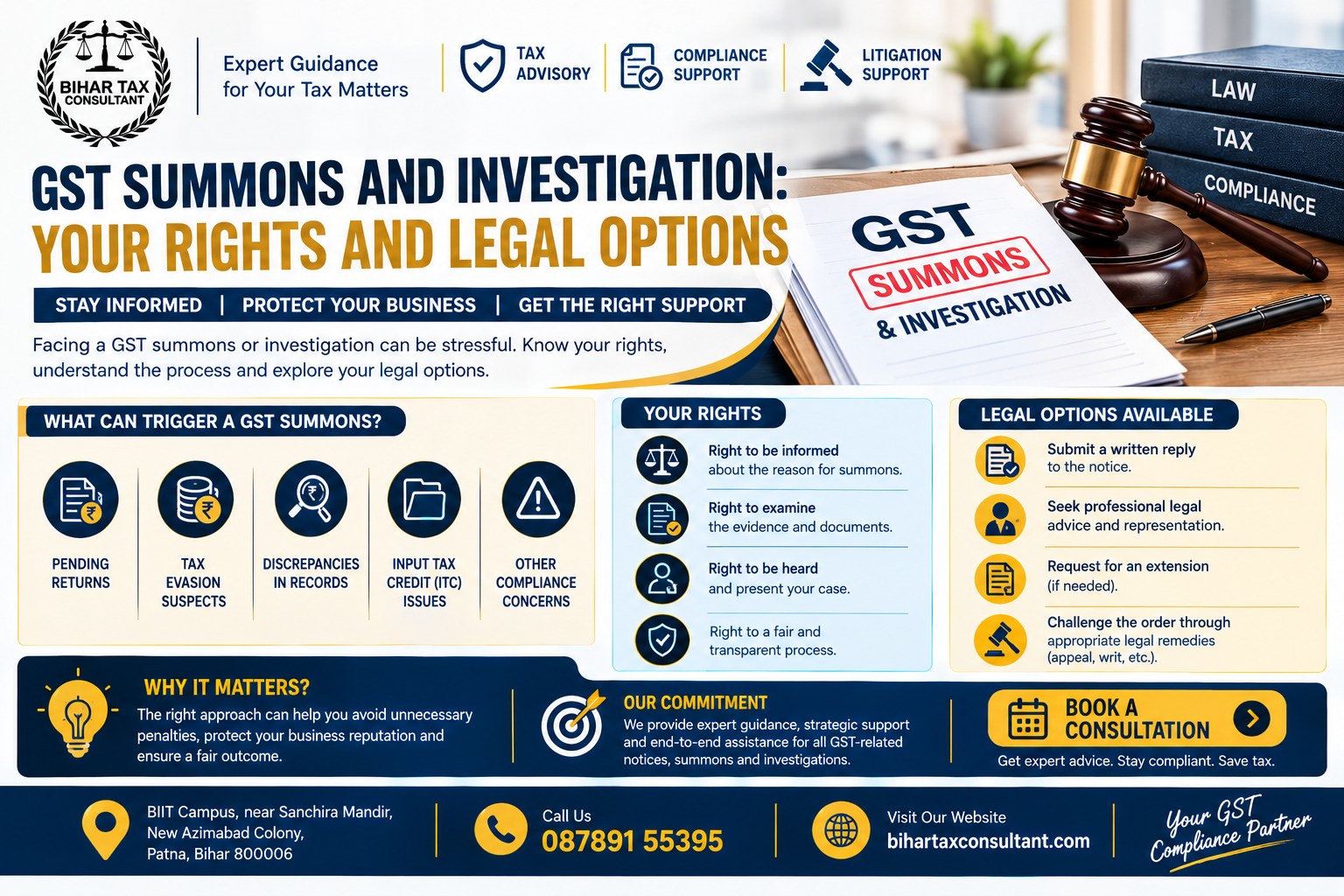
A summons may arrive when the GST Department is examining issues such as:
- Suspected wrongful availment or utilisation of Input Tax Credit (ITC).
- Fake invoices or circular trading.
- Undisclosed taxable supplies.
- Differences between GST returns and books of account.
- E-way bill discrepancies.
- Mismatch between GSTR-1, GSTR-3B and other records.
- Supplier or customer transactions under investigation.
- Suspected tax evasion.
- Issues involving multiple GST registrations or related entities.
Many recipients are unsure whether they must personally attend, whether they can take professional assistance, what documents they should carry, or what happens if they do not cooperate.
This article explains the statutory framework, practical response steps, taxpayer rights and possible legal options.
Legal note: This is general information about Indian GST law, not a case-specific legal opinion. The actual summons, facts, applicable legislation and current departmental instructions must be examined before taking action.
What Is a GST Summons?
A GST summons is a formal notice requiring a person to attend before a GST officer or produce documents or other things in connection with an inquiry.
The principal statutory provision is Section 70 of the CGST Act, 2017.
Under Section 70, the proper officer has the power to summon any person whose attendance is considered necessary to give evidence or produce a document or other thing in an inquiry. The inquiry is treated as a judicial proceeding for the purposes specified in the Act.
The provision can apply to persons who are not themselves registered taxpayers, depending on their relevance to the inquiry.
Who can receive a GST summons?
A summons may be issued to:
- A registered taxpayer.
- A proprietor.
- A partner of a firm.
- A director of a company.
- An employee or accountant.
- A supplier or customer.
- A transporter or other relevant person.
- Any other person whose evidence or documents are considered necessary for the inquiry.
Receiving a summons does not, by itself, establish guilt or tax evasion. It indicates that the Department considers the recipient’s attendance, evidence or documents relevant to an inquiry.
Under Which Section Is a GST Summons Issued?
Section 70 of the CGST Act, 2017
Section 70 is the principal provision dealing with the power to summon persons during a GST inquiry.
It authorises the proper officer to summon a person whose attendance is necessary for:
- Giving evidence.
- Producing documents.
- Producing other relevant things.
The provision also states that the inquiry is deemed to be a judicial proceeding within the meaning of the relevant provisions of the Indian Penal Code, now read in the context of the applicable criminal law framework.
What does this mean in practice?
A GST officer may require a person to explain transactions, produce records or answer questions relevant to an investigation.
The summons should therefore be read carefully rather than treated as an ordinary request for information.
GST Summons vs GST Notice: What Is the Difference?
A summons and a show-cause notice are not the same thing.
| GST Summons | GST Show-Cause Notice |
|---|---|
| Primarily used to require attendance, evidence or documents during an inquiry. | Used to communicate proposed tax, interest, penalty or other action under the applicable provision. |
| Commonly associated with Section 70. | May arise under provisions such as Sections 73, 74, 74A, 122 or other applicable provisions. |
| Can be issued to persons connected with an investigation. | Generally concerns a proposed determination or statutory action against the relevant person. |
| May involve statement recording and document production. | Requires a response addressing the allegations or proposed liability. |
A summons may precede a demand notice, but it does not automatically result in a demand.
Similarly, a person may receive a show-cause notice without having previously received a summons.
Why Does the GST Department Issue Summons?
A GST investigation may be initiated for several reasons.
The Department may be examining:
1. Input Tax Credit discrepancies
Examples include:
- ITC claimed in excess of eligible credit.
- Differences between purchase records and GST returns.
- Transactions involving suppliers under investigation.
- Questions regarding receipt of goods or services.
2. Fake invoicing or circular transactions
The Department may investigate whether invoices represent genuine supplies or whether transactions were created to pass on inadmissible ITC.
3. Suppression of taxable turnover
An investigation may examine whether taxable supplies were omitted from returns or whether the correct tax was not paid.
4. E-way bill and transport discrepancies
Differences between invoices, e-way bills, transport records and books may lead to inquiries.
5. Transactions involving related entities
The Department may examine transactions between connected businesses, including valuation, ITC and the actual nature of supplies.
6. Information received from another investigation
A recipient may be called because a supplier, customer, transporter or other entity is under investigation.
Important: These are examples of issues that may be examined. The exact reason must be determined from the summons and the relevant investigation records.
How to Respond to a GST Summons: Step-by-Step Procedure
Step 1: Verify the authenticity of the summons
Before sharing confidential business information, verify that the communication is genuine.
Check:
- Name and designation of the issuing officer.
- Department or commissionerate.
- Summons reference number.
- Date of issue.
- Subject matter.
- Attendance date and location.
- Documents requested.
- Official contact details.
A summons or other investigation communication issued by an officer under the CBIC framework is generally required to carry a valid Document Identification Number (DIN), subject to the applicable exceptions and instructions.
CBIC Circular No. 122/41/2019-GST introduced the requirement that specified communications, including summons, carry a computer-generated DIN. The circular also provides a mechanism for verifying the genuineness of communications. Official CBIC Circular
If the communication appears suspicious, verify it through official departmental channels before proceeding.
Step 2: Understand the subject matter
Read the summons carefully.
Identify:
- Which financial year or tax period is involved.
- Which GSTIN or entity is referred to.
- What transactions are under inquiry.
- Whether attendance is required.
- Whether documents must be produced.
- Whether the recipient is being called as a taxpayer, director, employee, supplier or another person.
A person should not assume that every question concerns the same issue.
Step 3: Collect the relevant records
Prepare documents connected with the inquiry.
Possible records include:
- GST registration details.
- GSTR-1 and GSTR-3B returns.
- Purchase and sales registers.
- Input Tax Credit reconciliation.
- Tax invoices.
- E-way bills.
- E-invoice records, where applicable.
- Bank statements.
- Ledger accounts.
- Agreements and contracts.
- Delivery challans and transport records.
- Correspondence with suppliers or customers.
- Relevant accounting and ERP records.
The exact documents should depend on the summons.
Step 4: Prepare a factual chronology
A short chronology can help explain the transaction.
For example:
- Date of purchase.
- Date of invoice.
- Date of receipt of goods.
- Date of payment.
- Date of ITC claim.
- Date of sale.
- Date of return filing.
This is particularly useful where the inquiry concerns ITC or alleged mismatch.
Step 5: Attend or respond as required
If personal attendance is required, arrange to attend on the specified date unless a lawful alternative or extension has been accepted.
If the recipient genuinely cannot attend, a written request for an alternative date or other appropriate arrangement may be considered.
Do not assume that simply sending an email automatically cancels the attendance requirement.
Step 6: Give accurate answers
Statements made during an investigation can become important later.
Answers should be:
- Truthful.
- Based on records.
- Clear.
- Limited to matters within the person’s knowledge.
- Consistent with the documents.
If the recipient does not know an answer, it is better to say so and offer to verify the records than to guess.
Step 7: Preserve records of compliance
Keep:
- Copy of the summons.
- Written correspondence.
- Documents submitted.
- Acknowledgement of submission.
- Attendance details.
- Copies of statements or other records provided, where available.
What Documents Are Required for a GST Investigation?
There is no single document checklist for every GST investigation.
The required documents depend on the subject matter.
For ITC investigations
- Purchase invoices.
- GSTR-2B or relevant ITC records.
- Purchase register.
- Goods receipt records.
- Payment evidence.
- Supplier details.
- Reconciliation statements.
For sales or turnover investigations
- Sales register.
- Tax invoices.
- GSTR-1 and GSTR-3B.
- E-invoices.
- E-way bills.
- Bank statements.
- Customer ledger.
For fake invoice allegations
- Purchase agreements.
- Purchase orders.
- Transport records.
- Delivery evidence.
- Stock records.
- Correspondence.
- Payment trail.
- Relevant supplier documents.
For director or partner summons
- Board resolutions, where relevant.
- Authority and role documents.
- Financial records relevant to the inquiry.
- Communications concerning the transactions.
- Records showing the person’s actual involvement.
Practical point: Do not destroy, alter or fabricate records. Preserve original electronic and physical records relevant to the investigation.
What Are Your Rights During a GST Investigation?
The GST Department has statutory investigation powers, but those powers are not unlimited.
The recipient should understand the following principles.
1. Right to understand the summons
The person should be able to identify the issuing authority, the subject matter and the attendance or document requirement from the communication.
If the summons is unclear, an appropriate written clarification may be requested.
2. Right to truthful and accurate representation
A person should be able to provide their factual explanation and relevant records.
The recipient should not be compelled to invent facts or provide knowingly false information.
3. Right to professional assistance
A taxpayer may seek assistance from a GST practitioner, Chartered Accountant, tax lawyer or other appropriate professional.
The exact manner in which a representative may participate in statement recording or attendance must be considered under the applicable law and departmental procedure.
Professional assistance does not necessarily mean that the recipient is excused from personal attendance.
4. Right to protect confidential business information
Business records may contain confidential commercial information.
A recipient should provide the information lawfully required, while considering appropriate document handling and confidentiality issues.
5. Right to retain relevant records of the investigation
Keep copies of submissions, correspondence and other records wherever possible.
These may become important if a later tax demand or legal dispute arises.
6. Right to challenge unlawful action
Where the Department takes action beyond its legal powers or violates applicable procedural requirements, the person may consider appropriate statutory or judicial remedies.
The remedy depends on the particular action and the facts.
Can GST Officers Search Premises During an Investigation?
Yes. The CGST Act provides statutory powers of inspection, search and seizure in specified circumstances.
Section 67 of the CGST Act, 2017 deals with inspection, search and seizure.
Where the statutory conditions are satisfied, an authorised officer may inspect premises, search for relevant goods, documents or other things, and seize materials in accordance with the Act.
The law also provides protections relating to seized documents and records.
For example, Section 67 contains provisions concerning access to documents and the ability to make copies or take extracts from seized documents, subject to the statutory conditions and the officer’s assessment of whether copying would prejudice the investigation.
The relevant statutory framework is available through the official CBIC GST law portal: Section 67 — Inspection, Search and Seizure.
What should a taxpayer do during a search?
- Cooperate lawfully with the authorised officers.
- Verify the search authorisation where appropriate.
- Do not obstruct the search.
- Preserve the integrity of records.
- Do not delete electronic information.
- Read documents carefully before signing.
- Keep records of documents taken or seized.
- Seek professional assistance promptly.
Can GST Officers Seize Documents or Electronic Devices?
The GST law permits seizure of specified documents, books or things in accordance with Section 67.
The exact scope of seizure depends on the statutory conditions and the facts.
A taxpayer should not assume that every document or electronic device can automatically be seized without legal authority.
Where documents are seized, the relevant statutory provisions concerning copies, extracts and return of documents should be examined.
A taxpayer should preserve records of:
- What was taken.
- The date of seizure.
- The authority involved.
- Any panchnama or inventory.
- Copies of documents received.
- Subsequent communications.
Can a Person Be Arrested During a GST Investigation?
Yes, arrest is possible in specified circumstances under the CGST Act, but receiving a summons does not automatically mean that arrest will follow.
Section 69 of the CGST Act deals with the power to arrest in specified cases.
The statutory conditions, applicable offences, authorisation requirements and procedural safeguards must be examined before drawing conclusions about arrest risk.
GST prosecution is separately dealt with under Section 132, which identifies specified offences and provides for criminal proceedings in the circumstances set out in the Act.
The seriousness of an investigation therefore depends on the facts, the evidence and the legal provisions involved.
If arrest is a concern
A person facing a serious investigation should obtain prompt legal advice, particularly where the matter involves:
- Alleged fake invoices.
- Large ITC disputes.
- Repeated summons.
- Alleged suppression of turnover.
- Alleged involvement in organised tax evasion.
- Threat of arrest.
- A statement that may have criminal consequences.
Can a GST Summons Be Challenged?
A summons is a statutory investigative tool. It should not be assumed that every summons can simply be cancelled.
However, the legality of a particular summons or investigation may depend on:
- Whether the issuing officer has jurisdiction.
- Whether the statutory conditions are satisfied.
- Whether the summons is relevant to a lawful inquiry.
- Whether there is an abuse of process.
- Whether the action is arbitrary or without legal authority.
- Whether there are exceptional circumstances justifying judicial intervention.
In appropriate cases, a person may seek relief before the High Court under Article 226 of the Constitution of India.
However, the existence of a summons alone does not mean that a writ petition will succeed.
Courts generally examine the statutory framework, the facts and the availability of alternative remedies before deciding whether to intervene.
A legal professional should review the actual summons and investigation circumstances before recommending litigation.
What Happens If You Ignore a GST Summons?
Ignoring a genuine summons can create additional legal and procedural risks.
Section 70 is a statutory power to require attendance or production of evidence/documents.
The consequences of non-compliance depend on the facts and applicable law. A recipient should not assume that ignoring the summons will end the inquiry.
Possible consequences may include:
- Further summons.
- Escalation of the investigation.
- Adverse procedural consequences.
- Proceedings under applicable legal provisions.
- Questions concerning non-cooperation.
Where attendance is genuinely difficult, the better approach is generally to communicate in writing and seek an appropriate alternative rather than simply remaining silent.
Can a GST Summons Lead to a Tax Demand?
A summons itself is not the same as a tax demand.
An investigation may later result in proceedings involving tax, interest or penalty if the Department forms the view that the statutory conditions for such action are satisfied.
The applicable demand framework may involve provisions such as:
- Section 73, for specified periods and cases not involving fraud or wilful misstatement/suppression to evade tax.
- Section 74, for specified periods and cases involving fraud, wilful misstatement or suppression of facts to evade tax.
- Section 74A, applicable to relevant periods under the amended framework.
- Section 75, dealing with general provisions relating to determination of tax.
- Section 122, dealing with specified penalties.
The precise provision, limitation period, notice procedure and available remedies depend on the tax period and facts.
A summons should therefore be treated as part of an inquiry, not as proof that a final demand has already been established.
GST Summons for Directors: What Should Directors Know?
Directors may receive summons in investigations concerning a company.
A director’s role, knowledge, authority and actual involvement may be relevant to the inquiry.
A director should carefully identify:
- Whether the summons is issued to the company or personally.
- The period and transactions under examination.
- The director’s role during that period.
- Whether the director has access to the requested records.
- Whether the questions concern personal knowledge or company records.
A director should not assume that every company-related allegation automatically establishes personal liability.
Conversely, a director should not assume that company registration alone removes the need to cooperate with a lawful summons.
Professional advice may be useful where the investigation involves potential personal liability, arrest or prosecution.
GST Summons for Accountants, Employees and Other Persons
A GST summons can be issued to persons other than the registered taxpayer where their attendance or documents are considered necessary.
For example:
- Accountant handling the books.
- Employee responsible for invoicing.
- Supplier involved in a disputed transaction.
- Transporter with delivery records.
- Consultant who prepared GST returns.
Such a person should answer based on their own knowledge and records.
If the person was not involved in the transaction, that fact should be stated clearly and accurately.
The recipient should not make assumptions about the company’s position or provide unsupported statements on behalf of another person.
Practical Example: GST Investigation of a Business
Hypothetical example for illustration only.
ABC Traders, a registered business, receives a GST summons requiring its proprietor to appear and produce purchase invoices, GSTR-3B returns, ITC reconciliation and bank statements for a particular financial year.
The proprietor believes that the summons relates to differences in ITC.
What should the proprietor do?
- Verify the summons and issuing authority.
- Identify the relevant financial year and GSTIN.
- Obtain the purchase register and relevant invoices.
- Reconcile the ITC claimed with the available records.
- Identify any genuine discrepancies.
- Prepare a written factual explanation.
- Attend as required or request an appropriate alternative if necessary.
- Provide accurate answers.
- Keep copies of the documents submitted.
- Obtain professional advice if the matter involves substantial tax exposure, suspected fake invoices or potential prosecution.
What should the proprietor avoid?
- Ignoring the summons.
- Fabricating purchase records.
- Deleting accounting information.
- Guessing answers.
- Signing an inaccurate statement.
- Making unsupported allegations against suppliers.
- Assuming that payment of tax automatically ends every possible investigation.
The outcome depends on the actual facts, evidence and applicable provisions.
Common Mistakes During GST Investigation
Mistake 1: Ignoring the summons
A genuine summons should be taken seriously.
Mistake 2: Attending without preparation
Unorganised records can make it difficult to explain transactions accurately.
Mistake 3: Giving speculative answers
Do not guess when you do not know the answer.
Mistake 4: Signing without reading
Read statements and documents carefully before signing.
Mistake 5: Destroying or altering records
This can create serious legal and evidentiary problems.
Mistake 6: Assuming the summons proves guilt
A summons is an investigative step, not a final finding of liability.
Mistake 7: Treating ITC reconciliation casually
ITC disputes can involve several records and legal conditions.
Mistake 8: Ignoring the possibility of later proceedings
A summons may be followed by further investigation, notices or other statutory action.
Mistake 9: Delaying legal advice in serious matters
Where arrest, prosecution or major tax exposure is involved, early professional review can be important.
Mistake 10: Relying on generic internet advice
GST investigations are fact-sensitive. A response suitable for one taxpayer may not be suitable for another.
GST Summons and Investigation: Legal Options
The appropriate legal option depends on the stage and nature of the matter.
1. Compliance with the summons
Where the summons is lawful, the recipient should comply with its requirements.
2. Written clarification or request for time
If the summons is unclear or attendance on the specified date is genuinely difficult, an appropriate written request may be considered.
3. Professional representation and assistance
A GST practitioner, Chartered Accountant or tax lawyer may assist in preparing records and reviewing the legal issues.
4. Response to subsequent show-cause notice
If the investigation results in a statutory tax notice, the taxpayer may need to submit a detailed reply under the applicable provision.
5. Statutory appeal
If an adverse adjudication order is passed, the appropriate GST appellate remedy may be available, subject to the statutory conditions and limitation period.
6. High Court writ remedy
In exceptional cases involving jurisdictional or serious procedural issues, a writ remedy may be considered.
Important: There is no single remedy that applies to every GST summons. The actual communication and procedural stage must be reviewed.
GST Investigation: What Should You Do Before Your Appearance?
Use this practical checklist.
- Verify the summons.
- Identify the issuing officer.
- Read the subject matter.
- Note the date and time.
- Identify the GSTIN and tax period.
- Collect relevant records.
- Prepare a transaction chronology.
- Reconcile GST returns and books.
- Review the questions likely to arise.
- Seek professional assistance where appropriate.
- Preserve copies of documents.
- Attend or communicate appropriately.
- Give accurate answers.
- Read documents before signing.
- Preserve records of compliance.
Frequently Asked Questions
1. What is a GST summons under Section 70?
A GST summons under Section 70 of the CGST Act, 2017 is a formal direction requiring a person to attend and give evidence or produce documents or other things in connection with an inquiry.
2. Can a GST summons be issued to a non-registered person?
Yes. Section 70 applies to any person whose attendance or documents are considered necessary for the inquiry. This may include employees, accountants, suppliers, customers or other relevant persons.
3. Does receiving a GST summons mean I am guilty?
No. A summons is an investigative communication. It does not by itself establish tax evasion, fraud or criminal liability.
4. Can I ask for more time to attend?
Where there is a genuine difficulty in attending on the specified date, a written request for an alternative date or other appropriate arrangement may be considered. The request should not be assumed to have been accepted until confirmed.
5. Can a GST officer record my statement?
Yes. Section 70 empowers the proper officer to summon persons to give evidence or produce documents during an inquiry. The statement should be truthful and carefully reviewed before signing.
6. Can I take a GST lawyer or Chartered Accountant with me?
Professional assistance may be sought. The precise role of a representative during attendance or statement recording depends on the applicable law and departmental procedure. Professional assistance does not automatically excuse personal attendance.
7. What happens if I do not attend a GST summons?
Non-compliance can create legal and procedural consequences. The recipient should not ignore a genuine summons. If attendance is difficult, communicate in writing and seek an appropriate alternative.
8. Can GST officers search my business premises?
Yes, in specified circumstances under Section 67 of the CGST Act. Search and seizure powers are subject to statutory conditions and procedural requirements.
9. Can GST officers arrest someone during investigation?
Arrest is possible in specified circumstances under Section 69 read with the relevant provisions of the CGST Act. A summons alone does not automatically mean that arrest will occur.
10. Can a GST summons be challenged in the High Court?
In appropriate cases, judicial review under Article 226 may be considered. Whether intervention is justified depends on the facts, statutory authority, procedural issues and applicable judicial principles.
11. Can a GST investigation lead to a tax demand?
Yes, an investigation may lead to subsequent statutory proceedings if the Department determines that tax, interest or penalty is payable under the applicable provisions. A summons itself is not a final tax demand.
12. What documents should I carry to a GST investigation?
Carry the records specifically requested in the summons and other relevant documents necessary to explain the transactions. These may include invoices, GST returns, ITC reconciliation, bank statements, ledgers and transport records.
Key Takeaways
- A GST summons is a formal investigative communication.
- Section 70 of the CGST Act, 2017 is the principal summons provision.
- A summons does not automatically establish guilt or tax liability.
- Verify the authenticity and contents of the communication.
- Prepare relevant documents and a factual explanation.
- Give truthful, accurate and carefully considered answers.
- Do not ignore a genuine summons.
- Search and seizure powers are governed by statutory provisions.
- Arrest is possible only in specified circumstances.
- A summons is different from a show-cause notice or final demand.
- Legal remedies depend on the nature of the action and the stage of the investigation.
- Professional advice can be valuable in complex or high-risk investigations.
Conclusion
GST summons and investigations should be approached with both compliance and legal awareness.
A recipient should cooperate with lawful requirements while carefully protecting the accuracy of statements, integrity of documents and ability to explain the relevant transactions.
For business owners, directors, partners and professionals, early review of the summons and supporting records can help identify the actual issue and determine the appropriate next step.
Where the investigation involves substantial ITC disputes, alleged fake invoices, potential arrest, prosecution or significant tax exposure, professional tax and legal assistance should be considered promptly.
Bihar Tax Consultant can assist taxpayers and businesses in reviewing GST investigation matters, organising records, preparing explanations and understanding the available legal options.
Received a GST Summons or Facing a GST Investigation?
A GST summons can involve important documents, financial records and legal questions. A timely review can help you understand the subject matter, prepare an accurate response and consider the appropriate legal options.
Bihar Tax Consultant
Address: BIIT Campus, near Sanchira Mandir, New Azimabad Colony, Patna, Bihar 800006
Mobile: 8789155395
Email: [email protected]
Book a Consultation to discuss your GST summons, investigation or related tax dispute.