
Introduction: Your Right to Appeal Against an Income Tax OrderHow to File Income Tax Appeal Before CIT(A) | Form 35 Guide 2026

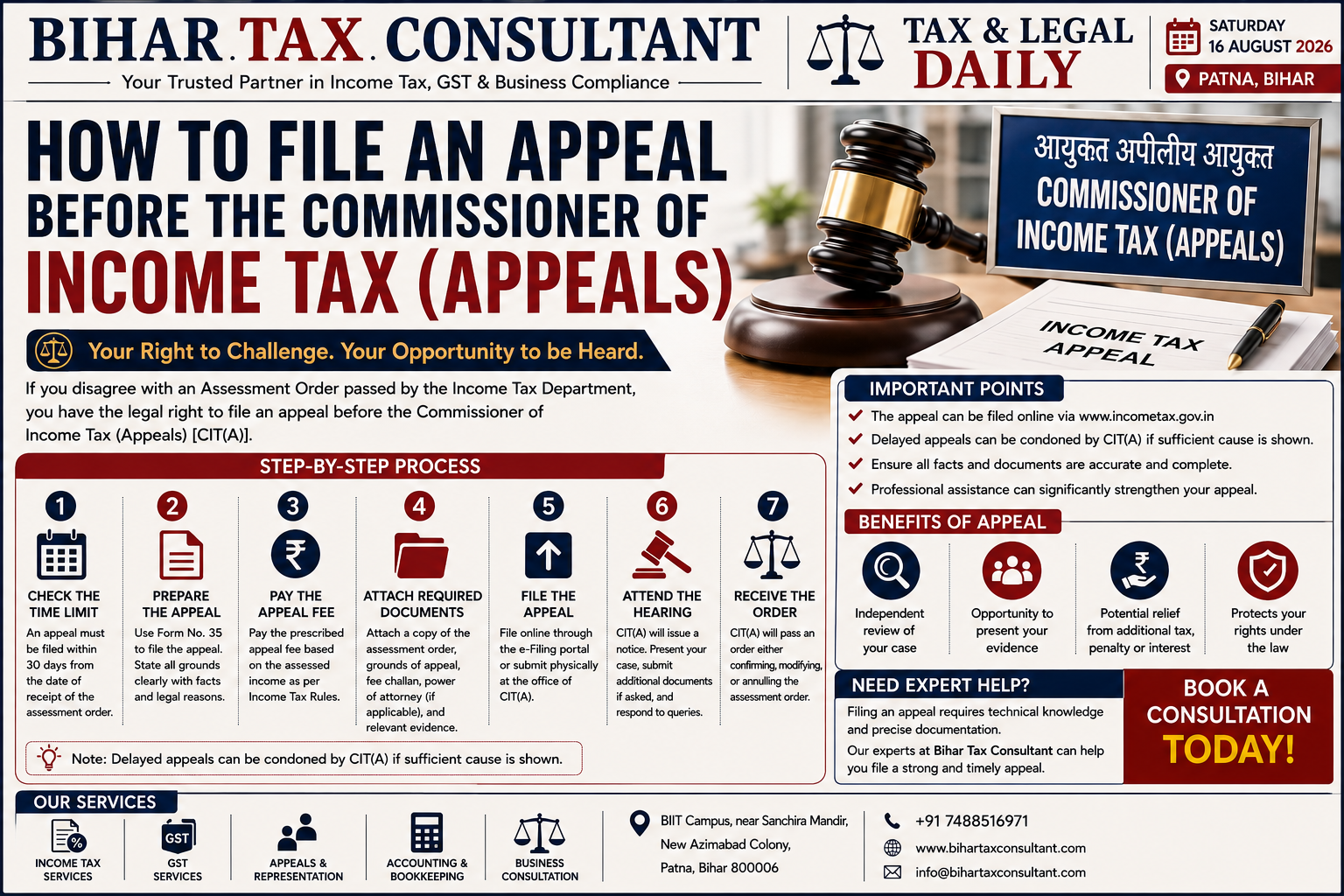
Receiving an unfavourable assessment order, penalty order, or demand notice from the Income Tax Department does not mean you must accept it. The Income Tax Act, 1961 (and the newly enacted Income Tax Act, 2025 for future years) grants every assessee a statutory right to challenge such orders by filing an appeal before the Commissioner of Income Tax (Appeals) — commonly known as CIT(A).
The CIT(A) is the first appellate authority in the income tax appellate hierarchy. An appeal before the CIT(A) is often the most cost-effective and efficient way to reverse erroneous additions, disallowances, or penalties made by the Assessing Officer (AO).
Whether you are an individual taxpayer, a business owner, a company, or a trust in Bihar, this guide explains exactly how to file an appeal before the CIT(A), including Form 35, fees, documents, the e-filing process, timelines, and common mistakes to avoid.
Need expert help filing your income tax appeal in Patna or Bihar?
Contact Bihar Tax Consultant — experienced tax litigation professionals practising before the Patna High Court.
📍 Address: BIIT Campus, near Sanchira Mandir, New Azimabad Colony, Patna, Bihar 800006
📞 Mobile: 8789155395 | 📧 Email: [email protected]
🌐 Website: bihartaxconsultnt.com
What Is an Appeal Before CIT(A)?
An appeal before the Commissioner of Income Tax (Appeals) is a formal legal remedy available to a taxpayer who is aggrieved by an order passed by an Assessing Officer or other income tax authority. The appeal is filed in Form 35 under Rule 45 of the Income Tax Rules.
The CIT(A) has the power to:
- Confirm the AO’s order
- Reduce the assessment or penalty
- Annul the assessment
- Enhance the assessment or penalty (after issuing a show-cause notice)
The appellate hierarchy remains unchanged even under the Income Tax Act, 2025:
Assessing Officer → CIT(A)/JCIT(A) → ITAT → High Court → Supreme Court
Which Orders Can Be Appealed Before CIT(A)? [Section 246A]
Not every order is appealable. Under Section 246A of the Income Tax Act, 1961, you can file an appeal before CIT(A) against the following orders:
Table
| Order Type | Section | Description |
|---|---|---|
| Scrutiny Assessment Order | 143(3) | Order passed after detailed examination of return |
| Best Judgment Assessment | 144 | Order passed when taxpayer fails to comply with notices |
| Reassessment Order | 147 | Order passed after reopening assessment |
| Intimation with Adjustment | 143(1)/(1B) | Where adjustments create a fresh demand |
| Rectification Order | 154 / 155 | Where rectification creates fresh liability |
| Penalty Order | 270A, 271, 271A, 272A, etc. | Orders imposing penalties |
| TDS Default Order | 201(1) / 206C(6A) | Treating deductor as assessee-in-default |
| Trust Registration/Exemption | 12AA / 12AB / 10(23C) | Refusal or cancellation of registration |
| Search Assessment | 153A / 158BC | Assessment orders in search cases |
| HUF Partition Order | 171 | Order recording partition decision |
⚠️ Important: Intimations under Section 143(1) that merely accept the returned income (with no demand or adjustment) are not appealable.
Step-by-Step Guide: How to File Form 35 Appeal Before CIT(A)
Step 1: Determine Whether You Need to File Before CIT(A) or JCIT(A)
For smaller disputes (typically where the disputed demand does not exceed ₹10 lakh), the first appeal may lie before the Joint Commissioner (Appeals) [JCIT(A)] instead of CIT(A). For larger demands and complex matters, the appeal is filed before CIT(A). Confirm the correct forum from your assessment order or demand notice.
Step 2: Gather All Required Documents
Before logging into the e-filing portal, prepare the following documents:
Table
| Document | Purpose |
|---|---|
| Certified copy of the order appealed against | The assessment/penalty order |
| Notice of Demand (Section 156) | Original notice demanding tax |
| Proof of tax payment | Challan for tax paid on returned income |
| Statement of Facts | Chronological narrative of the case |
| Grounds of Appeal | Numbered legal/factual grounds challenging the order |
| Power of Attorney | If filing through an authorised representative (CA/Advocate) |
| Condonation Application | If filing after 30 days |
Step 3: Draft Precise Grounds of Appeal
This is the most critical part of your appeal. Vague or omnibus grounds like “the order is bad in law” add no value and may be rejected. Each ground should:
- Identify the specific addition/disallowance
- Cite the section invoked by the AO
- State the amount disputed
- Explain the legal/factual error
Example of a well-drafted ground:
“Ground 1: The learned Assessing Officer erred in treating ₹90,00,000 of share premium as unexplained cash credit under Section 68 despite the appellant having furnished the identity, creditworthiness, and genuineness of the subscribers through PAN, bank statements, and audited financials.”
Step 4: Calculate and Pay the Appeal Fee
The appeal fee depends on the total income assessed by the AO:
Table
| Assessed Total Income | Appeal Fee |
|---|---|
| Up to ₹1,00,000 | ₹250 |
| ₹1,00,001 to ₹2,00,000 | ₹500 |
| Above ₹2,00,000 | ₹1,000 |
| Any other matter (non-income) | ₹250 |
💡 Tip: Pay the fee through the e-filing portal or generate a challan. Keep the payment proof safe — you must upload it with Form 35.
Step 5: File Form 35 Online on the Income Tax E-Filing Portal
All taxpayers who are required to e-file their ITR must also e-file Form 35. Here’s how:
- Log in to incometax.gov.in using your PAN and password
- Navigate to: e-File → Income Tax Forms → File Income Tax Forms
- Search for “Form 35” and select it
- Alternatively: Pending Actions → E-Proceedings → File Appeal
- Enter order details (section, date, DIN, AO designation)
- Enter assessed income and demand amount
- Input grounds of appeal (mention amount for each ground)
- Upload attachments (assessment order, demand notice, statement of facts, grounds, fee challan, PoA)
- Pay fee and submit
- E-verify using DSC, Aadhaar OTP, or EVC
⚠️ Critical: An appeal that is submitted but not e-verified is treated as incomplete and will not be processed.
Step 6: Apply for Stay of Demand (If Required)
If the AO has raised a substantial demand, you should immediately file a stay of demand application under Section 220(6) with the CIT(A) to prevent recovery actions (bank attachment, TDS adjustments) while the appeal is pending.
Typically, the CIT(A) may require a pre-deposit of 20% of the disputed demand as a condition for granting stay. In exceptional cases, this can be negotiated lower if you can demonstrate prima facie merit in your appeal.
Step 7: Track Your Appeal and Prepare for Hearing
After filing:
- Monitor status under Pending Actions → E-Proceedings
- The CIT(A) will issue a hearing notice within 2–8 weeks
- You can appear personally or through an authorised representative (CA, advocate, or tax practitioner)
- Carry a signed authorisation on stamp paper if appearing through a representative
During the hearing:
- Present your case issue-by-issue
- Submit additional evidence only if permitted (the AO must be given a chance to comment)
- Request adjournments only when genuinely necessary
Timeline & Key Deadlines for CIT(A) Appeal
Table
| Event | Time Limit | Legal Basis |
|---|---|---|
| Filing Form 35 | 30 days from date of service of order/demand notice | Section 249(2) |
| Condonation of delay | After 30 days (if sufficient cause shown) | Section 249(3) |
| Stay application | Immediately after filing appeal | Section 220(6) |
| CIT(A) hearing notice | 2–8 weeks (varies by workload) | — |
| CIT(A) order | 1–12 months (case-dependent) | Section 250 |
| Appeal to ITAT | 60 days from CIT(A) order | Section 253 |
🚨 Warning: Missing the 30-day deadline is the #1 reason appeals are dismissed. Calculate the deadline from the date of service of the order, not the date printed on the order.
What Is “Condonation of Delay”? [Section 249(3)]
If you miss the 30-day window, your appeal is not automatically dead. Under Section 249(3), the CIT(A) can condone the delay if you demonstrate “sufficient cause”.
Acceptable reasons include:
- Serious illness or hospitalisation
- Unavoidable absence from India
- Postal failure or natural disaster
- Change of counsel/accountant with proper handover issues
How to apply: File a condonation application alongside Form 35, clearly stating:
- The length of delay
- The exact reason
- Supporting documents (medical certificates, travel records, etc.)
Common Mistakes to Avoid When Filing CIT(A) Appeal
Table
| Mistake | Consequence | Solution |
|---|---|---|
| Missing the 30-day deadline | Appeal dismissed as time-barred | File immediately; apply for condonation if late |
| Vague/omnibus grounds | Grounds rejected; weak appeal | Draft specific, issue-wise grounds |
| Wrong jurisdictional CIT(A) | Transfer delays | Verify jurisdiction from demand notice |
| Failure to e-verify | Appeal not processed | Complete e-verification immediately after submission |
| Incorrect fee payment | Processing delay/rejection | Cross-check assessed income before paying |
| Non-PDF attachments | Portal rejection | Convert all docs to PDF |
| Not applying for stay | Recovery action during appeal | File stay application simultaneously |
| Self-filing complex appeals | Poorly drafted grounds limit relief | Hire an experienced tax consultant or advocate |
Changes in 2026: Income Tax Rules, 2026 & New Portal Features
The CBDT’s Notification No. 22/2026 introduced the Income-tax Rules, 2026. Key changes affecting appeals:
- Form Navigator Tool: The e-filing portal now helps identify the correct Form 35 version (legacy vs. new)
- Enhanced Disclosures: Appellants must now disclose the amount involved per ground and whether the same ground was raised in prior proceedings
- Transitional Guidance: Appeals for AY 2025-26 and earlier continue under the old Rules; AY 2026-27 onwards follow the 2026 Rules
📌 Practical Tip: Always check the Department’s published guidance notes before filing to ensure you are using the correct form version.
Why Hire a Tax Consultant for Your CIT(A) Appeal?
While the portal allows self-filing, complex assessments involving:
- Large tax demands (₹10 lakh+)
- Transfer pricing adjustments
- Penalty proceedings under Section 270A
- Search & seizure assessments (Section 132/153A)
- International taxation issues
…require professional expertise. A specialist tax consultant can:
- Draft legally sound grounds of appeal
- Apply for stay of demand strategically
- Present case law and precedents effectively
- Handle remand proceedings if the CIT(A) sends the case back to the AO
- Escalate to ITAT, High Court, or Supreme Court if needed
About Bihar Tax Consultant — Your Trusted Tax Litigation Partner in Patna
At Bihar Tax Consultant, we specialise in income tax appeals, litigation, and dispute resolution before the CIT(A), ITAT, and the Patna High Court.
Why Choose Us?
✅ High Court Practitioners: Our team includes advocates practising before the Patna High Court with deep expertise in tax law
✅ End-to-End Appeal Management: From drafting Form 35 to final hearing and ITAT escalation
✅ Stay of Demand Experts: We secure favourable stay orders to protect your cash flow
✅ Faceless Appeal Specialists: Navigating the new faceless appellate scheme seamlessly
✅ Local Presence, National Standards: Based in Patna, serving clients across Bihar and India
✅ End-to-End Appeal Management: From drafting Form 35 to final hearing and ITAT escalation
✅ Stay of Demand Experts: We secure favourable stay orders to protect your cash flow
✅ Faceless Appeal Specialists: Navigating the new faceless appellate scheme seamlessly
✅ Local Presence, National Standards: Based in Patna, serving clients across Bihar and India
Contact Us Today
📍 Office: BIIT Campus, near Sanchira Mandir, New Azimabad Colony, Patna, Bihar 800006
📞 Call/WhatsApp: 8789155395
📧 Email: [email protected]
🌐 Website: bihartaxconsultnt.com
📞 Call/WhatsApp: 8789155395
📧 Email: [email protected]
🌐 Website: bihartaxconsultnt.com
Frequently Asked Questions (FAQ)
Q1. Can I file a CIT(A) appeal in paper form?
If you are not mandatorily required to e-file your return, you may file Form 35 in paper form. However, most taxpayers must e-file through the portal.
Q2. What happens if I don’t pay the appeal fee?
The CIT(A) may refuse to admit the appeal. The fee is a mandatory prerequisite under Rule 45.
Q3. Can I add new grounds later?
The CIT(A) has discretion to admit additional grounds under Section 251(1) if they arise from the same facts. However, it is best to include all grounds in Form 35 initially.
Q4. How long does CIT(A) take to decide?
Typically 6 months to 2 years, depending on the complexity and the CIT(A)’s workload.
Q5. Can CIT(A) increase my tax liability?
Yes, but only after issuing a show-cause notice and giving you an opportunity to be heard.
Q6. What if I lose before CIT(A)?
You can file a second appeal before the Income Tax Appellate Tribunal (ITAT) within 60 days using Form 36.
Conclusion
Filing an appeal before the Commissioner of Income Tax (Appeals) is your statutory right and often the most effective way to challenge an erroneous tax order. The key to success lies in timely filing, precise drafting of grounds, and proper documentation.
Don’t let a flawed assessment order drain your resources. Act within 30 days, file Form 35 correctly, and consider professional help for complex matters.
Ready to file your income tax appeal?
Call Bihar Tax Consultant today at 8789155395 or visit us at BIIT Campus, New Azimabad Colony, Patna. Let our experienced tax lawyers protect your rights.