
How to Save Capital Gain Tax Legally in India: 10+ Tax-Saving Strategies

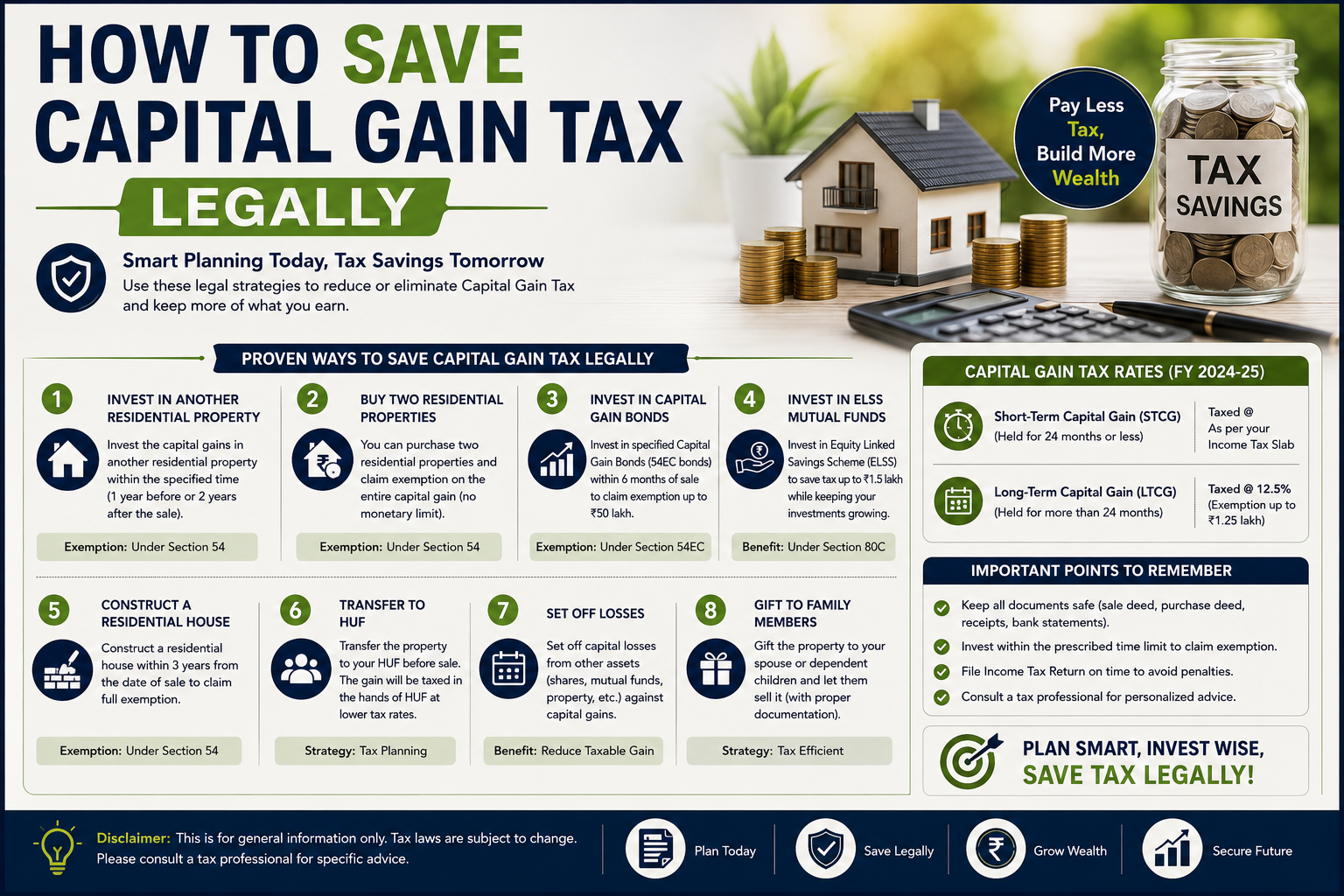
How Can You Save Capital Gain Tax Legally?
Capital gain tax can be reduced legally by using exemptions and deductions specifically provided under the Income-tax law, correctly claiming eligible acquisition/improvement and transfer expenses, utilising eligible capital losses, and planning qualifying reinvestments within the prescribed time limits.
For example, depending on the asset and taxpayer, provisions such as Section 54, Section 54F and Section 54EC may provide relief from eligible long-term capital gains. The Capital Gains Account Scheme (CGAS) can also help where an eligible taxpayer intends to make a qualifying investment but cannot complete it before the relevant return-filing deadline. The Income Tax Department currently lists several capital-gains exemptions, including Sections 54, 54B, 54EC and 54F.
However, there is no universal method that eliminates capital-gains tax.
The correct strategy depends on:
- Type of asset sold
- Date of acquisition
- Date of transfer
- Holding period
- Taxpayer status
- Amount of capital gain
- Reinvestment plans
- Applicable exemption
- Stamp-duty value, where relevant
- Capital losses
- The tax year and applicable law
The objective should therefore be legal tax planning, not concealment of income or artificial transactions.
Introduction
Selling a property, shares, land, mutual funds or another investment can create a substantial capital gain.
A taxpayer may then ask:
“How can I reduce my capital gain tax legally?”
The answer is not to hide the transaction or manipulate the sale price.
Indian income-tax law itself provides several legitimate mechanisms through which taxpayers can reduce, defer or otherwise manage their capital-gains tax liability when the statutory conditions are satisfied.
For example, a taxpayer selling a qualifying residential house may consider Section 54. A taxpayer selling another long-term capital asset may potentially consider Section 54F. Investment in specified bonds may be relevant under Section 54EC, while the Capital Gains Account Scheme may help preserve eligibility for certain exemptions where the qualifying investment cannot immediately be completed.
The important point is timing.
Capital-gains tax planning should ideally begin before the transaction is completed—not after the return-filing deadline has passed.
What Does “Saving Capital Gain Tax Legally” Mean?
Legal tax planning means using provisions that Parliament has specifically provided to reduce or defer tax.
Examples include:
- Claiming a valid capital-gains exemption.
- Reinvesting the capital gain in an eligible asset.
- Investing in qualifying bonds.
- Using the Capital Gains Account Scheme where permitted.
- Claiming eligible transfer expenses.
- Claiming eligible acquisition or improvement costs.
- Setting off eligible capital losses.
- Carrying forward eligible losses.
- Applying the correct capital-gains rate.
- Taking advantage of specific beneficial provisions where the law permits.
This is different from tax evasion.
Legal tax planning
Income is disclosed + transaction is genuine + statutory benefit is claimed.
Tax evasion
Income or transaction is concealed or manipulated to avoid tax.
Only the first approach is lawful.
1. Claim Section 54 Exemption Where You Sell a Residential House
One of the most important provisions for individuals and HUFs selling a qualifying residential house is Section 54.
Broadly, where eligible long-term capital gain arises from the transfer of a residential house and the taxpayer invests in another qualifying residential house within the prescribed conditions and time limits, relief may be available.
The Income Tax Department’s current capital-gains exemption material lists Section 54 as an exemption applicable to individuals and HUFs for long-term capital gains arising from a residential house, with investment in a residential house in India.
Example
Suppose:
- Sale of residential house: ₹1.50 crore
- Eligible long-term capital gain: ₹40 lakh
- Taxpayer purchases another qualifying residential house as permitted under Section 54.
Subject to satisfying all statutory conditions, the taxpayer may be able to claim exemption against the eligible capital gain.
Important
Buying another property does not automatically make the entire capital gain exempt.
The taxpayer must satisfy the conditions of the applicable provision.
2. Consider Section 54F When Selling Another Long-Term Capital Asset
Section 54F can be relevant when an individual or HUF transfers a long-term capital asset other than a residential house and invests in a qualifying residential house in India.
The statutory framework provides for purchase within one year before or two years after the transfer, or construction within three years after the transfer, subject to the other conditions of the provision.
For example, this provision may become relevant when a taxpayer sells:
- Land
- Commercial property
- Certain investments
- Another qualifying long-term capital asset
and intends to invest in a residential house.
Important limitation
Section 54F contains conditions concerning ownership of other residential houses and the amount invested.
The exemption can also be proportionate where the entire net consideration is not invested.
The Income Tax Department currently explains the calculation as:
Exemption = Long-Term Capital Gain × Eligible Investment / Net Consideration
subject to the statutory limits and conditions.
3. Invest in Specified Bonds Under Section 54EC
For eligible long-term capital gains arising from transfer of land or building, Section 54EC can be an important tax-planning option.
The Income Tax Department lists Section 54EC among the capital-gains exemptions and identifies qualifying investments in specified bonds, including National Highways Authority of India and Rural Electrification Corporation bonds, subject to the applicable rules.
This option can be useful where the taxpayer:
- Does not want to purchase another house.
- Wants a specified investment route.
- Can meet the applicable investment deadline.
- Understands the lock-in and other statutory conditions.
Important
The exemption is subject to statutory investment limits and conditions.
Therefore, a taxpayer should calculate the eligible exemption before investing.
4. Use the Capital Gains Account Scheme
What happens if you qualify for an exemption but have not yet purchased or constructed the replacement property?
The Capital Gains Account Scheme (CGAS) may become relevant where the applicable exemption provision permits such treatment.
Instead of allowing the statutory period to expire without taking action, the taxpayer may be able to deposit the unutilised amount into the prescribed Capital Gains Account Scheme within the relevant deadline.
However:
A CGAS deposit is not itself a permanent tax exemption.
The money must subsequently be utilised according to the conditions of the relevant exemption provision.
The Income Tax Department has specifically addressed CGAS deposits made before 1 April 2026 and explained how unused amounts can be treated during the transition to the Income-tax Act, 2025.
5. Claim Eligible Transfer Expenses
Capital gain is not necessarily calculated simply as:
Sale price – purchase price
Eligible expenditure incurred wholly and exclusively in connection with the transfer can be relevant in computing the capital gain.
Depending on the facts, this can include qualifying:
- Brokerage
- Legal charges
- Transfer-related professional fees
- Certain other direct transfer expenses
The key requirement is documentation.
Keep:
- Invoices
- Receipts
- Bank payment records
- Agreements
- Bills
Do not claim personal or unrelated expenses simply to reduce taxable income.
6. Claim Eligible Cost of Improvement
A taxpayer may also be able to include qualifying capital expenditure incurred to improve the asset.
For property, this could potentially involve documented capital improvements.
However, ordinary repairs, maintenance and personal expenses should not automatically be classified as capital improvements.
Good documentation can include:
- Contractor invoices
- Architect bills
- Material invoices
- Bank statements
- Payment receipts
- Building approvals, where relevant
The better the documentation, the easier it becomes to substantiate the computation if the transaction is subsequently examined.
7. Correctly Apply the 2024 Capital-Gains Changes
A major mistake is using an outdated capital-gains calculation.
For transfers on or after 23 July 2024, the general long-term capital-gains rate was changed to 12.5% without indexation for relevant assets. The Income Tax Department’s current guidance confirms the 12.5% rate and removal of the general indexation benefit.
However, an important beneficial provision applies to eligible resident individuals/HUFs transferring land or building acquired before 23 July 2024.
For such taxpayers, the law provides a comparison with the earlier 20% indexed-cost method, so that the tax payable under the new method does not exceed the tax under the specified old method. The 2026 ITR framework expressly contains this computation for eligible residents where acquisition occurred before 23 July 2024.
Practical lesson
Do not automatically assume:
“12.5% is always better.”
Calculate both applicable methods where the beneficial comparison is available.
8. Set Off Eligible Capital Losses
Capital losses can sometimes be used to reduce taxable capital gains, subject to the statutory rules governing the type of loss and gain.
For example:
- Long-term capital loss may be subject to specific set-off restrictions.
- Short-term capital loss can have broader set-off treatment under the applicable provisions.
Eligible losses may also be carried forward subject to the prescribed conditions.
Therefore, taxpayers with multiple investments should review their complete capital-gains position rather than looking at one profitable transaction in isolation.
9. Plan the Timing of the Sale
The date of transfer can affect the tax treatment.
This is particularly important after the capital-gains changes introduced from 23 July 2024.
For example, the rate applicable to long-term gains changed from the earlier regime to 12.5% for transfers on or after that date.
Therefore, where a transaction has not yet been completed, the taxpayer should evaluate:
- Date of acquisition
- Expected date of sale
- Holding period
- Applicable rate
- Available exemptions
- Potential loss set-off
- Reinvestment options
Important
Tax planning should not be based solely on trying to choose a date.
Commercial considerations, market conditions and the actual legal requirements must also be considered.
10. Check the Stamp Duty Value Before Selling Property
Property sellers should examine the stamp duty value before finalising a transaction.
Under the applicable deemed-consideration rules, a difference between actual consideration and stamp valuation can affect the capital-gains computation.
The current ITR framework reflects the relevant tolerance threshold for immovable property transactions.
Example
Suppose:
- Actual sale price = ₹90 lakh
- Stamp valuation = ₹95 lakh
The taxpayer should not immediately assume that ₹90 lakh alone will necessarily be the relevant value for capital-gains purposes.
The applicable deemed-consideration rules and tolerance provisions should be checked.
11. Use Section 54F Carefully: Full Investment Is Not Always Required
A common misconception is:
“If I buy another house, my entire capital gain automatically becomes tax-free.”
That is incorrect.
Under Section 54F, the exemption can depend on the proportion of net consideration invested.
The Income Tax Department explains that where the entire net consideration is invested in the new house or deposited in CGAS, the eligible capital gain can be fully exempt; where only part is invested, the exemption is proportionate, subject to the statutory ₹10 crore ceiling.
Therefore, before buying a replacement property, calculate:
Net consideration
and compare it with:
Amount proposed to be invested.
12. Don’t Forget TDS on Property Transactions
TDS deducted by the buyer is not itself a capital-gains exemption.
It is a tax collection mechanism.
The seller must still calculate and report the actual capital gain.
Therefore, after selling property, reconcile:
- Sale deed
- TDS
- Form 26AS
- AIS
- Bank receipt
- Capital-gains computation
A mismatch can create unnecessary tax complications.
13. Maintain Documents for Old Properties
Tax planning is much easier when the acquisition records are available.
For an old property, preserve:
- Original purchase deed
- Acquisition cost
- Registration expenses
- Improvement bills
- Previous ownership documents
- Inheritance documents
- Valuation reports, where relevant
- Sale agreement
- Sale deed
If the original purchase documents are missing, reconstructing the cost can become difficult.
14. Consider Inherited Property Rules Before Selling
Inherited property can involve special rules regarding:
- Previous owner’s cost
- Period of holding
- Date of acquisition
- Improvement expenditure
- Succession documents
A taxpayer should therefore avoid treating inherited property simply as:
Sale price – ₹0 purchase cost
The applicable statutory rules must be examined.
15. Don’t Assume Every Tax-Saving Investment Is Eligible
One of the biggest risks in capital-gains planning is investing money first and checking the tax provision later.
For example:
“I purchased a property, so my capital gain is exempt.”
That conclusion may be wrong if the taxpayer:
- Purchased the wrong type of property.
- Missed the statutory deadline.
- Did not satisfy ownership conditions.
- Invested an insufficient amount.
- Violated the lock-in requirement.
- Used the funds for a non-qualifying purpose.
Tax exemption follows the law—not merely the intention to save tax.
16. What Happens If You Sell the New Property Too Early?
Tax-saving provisions can contain lock-in conditions.
If the new asset is transferred before the prescribed period, the earlier exemption can be affected.
This is particularly important for taxpayers who claimed exemptions under the Income-tax Act, 1961 but dispose of the new asset after 1 April 2026.
The Income Tax Department has explained that where an exemption under Sections 54, 54B, 54F and similar provisions was claimed under the old Act, violation of the conditions after 1 April 2026 can result in the earlier exempted amount being taxed under the new Act’s transition provisions.
Therefore:
Claiming an exemption is not the end of the compliance process.
The taxpayer must continue to satisfy the applicable conditions.
17. Capital Gains Tax Planning for Property Sellers
For someone selling a property, a practical checklist is:
Before the sale
- Determine acquisition date.
- Determine acquisition cost.
- Collect improvement records.
- Check expected stamp valuation.
- Estimate capital gain.
- Determine whether the gain is short-term or long-term.
- Check the applicable tax rate.
- Identify possible Section 54/54F/54EC relief.
- Consider CGAS if relevant.
- Review existing capital losses.
After the sale
- Preserve the sale documents.
- Reconcile TDS.
- Calculate final capital gain.
- Complete eligible reinvestment within the prescribed period.
- Maintain proof of investment.
- File the correct income-tax return.
- Continue complying with lock-in conditions.
18. Hypothetical Example: Saving Capital Gain Tax on Sale of a House
This is a hypothetical illustration only.
Mrs. A, a resident individual, sells a residential house and earns an eligible long-term capital gain of ₹50 lakh.
Instead of simply paying tax without considering available reliefs, she reviews:
- Section 54 eligibility
- Cost of improvement
- Transfer expenses
- Applicable capital-gains rate
- Possible capital losses
- Reinvestment options
- CGAS requirements
Suppose she makes a qualifying investment under Section 54 within the prescribed period and satisfies all statutory conditions.
The eligible capital gain may then receive relief under the exemption provision.
The exact exemption depends on the transaction and the statutory conditions.
Lesson
Tax planning should begin with the capital-gain calculation and then identify which statutory reliefs actually apply.
19. What Is the Difference Between Tax Saving and Tax Avoidance?
This distinction is important.
| Legal tax planning | Illegal tax evasion |
|---|---|
| Uses statutory exemptions | Conceals income |
| Reports the transaction | Suppresses sale consideration |
| Maintains genuine documents | Creates false documents |
| Uses permitted deductions | Claims fictitious expenses |
| Makes genuine qualifying investments | Creates artificial transactions |
| Discloses capital gains | Hides capital gains |
A taxpayer should always remain on the legal side of this distinction.
20. Common Mistakes While Trying to Save Capital Gains Tax
Mistake 1: Waiting until return filing
By then, some reinvestment deadlines may already have passed.
Mistake 2: Buying property without checking Section 54/54F conditions
The investment may not qualify.
Mistake 3: Ignoring CGAS
A taxpayer may lose an exemption opportunity if an applicable statutory deadline is missed.
Mistake 4: Using outdated indexation rules
The capital-gains framework changed from 23 July 2024.
Mistake 5: Ignoring stamp duty value
This can distort the capital-gains calculation for property.
Mistake 6: Claiming unsupported improvement costs
Every significant claim should be backed by evidence.
Mistake 7: Assuming every capital loss can be adjusted against every gain
Set-off rules must be checked carefully.
Mistake 8: Selling the replacement asset too early
This can trigger consequences under the applicable exemption rules.
Mistake 9: Confusing TDS with final tax liability
TDS is not the final capital-gains calculation.
Mistake 10: Treating tax planning as a post-sale exercise
The best opportunities are often identified before the transaction is completed.
Frequently Asked Questions
1. How can I save capital gain tax legally in India?
You can potentially reduce or defer capital-gains tax by claiming applicable exemptions such as Sections 54, 54F or 54EC, using eligible transfer/improvement expenses, utilising eligible capital losses and following the Capital Gains Account Scheme where applicable. The exact option depends on the asset and taxpayer.
2. How can I save capital gains tax on sale of property?
Depending on the facts, consider Section 54, Section 54F, Section 54EC, CGAS, eligible expenses and capital-loss set-off. The property type, acquisition date, sale date and taxpayer status must be examined first.
3. Can I save capital gain tax by buying another house?
Potentially, yes. Section 54 can provide relief to eligible individuals/HUFs transferring a qualifying residential house and reinvesting as prescribed. Section 54F may apply to certain long-term assets other than a residential house.
4. What is Section 54F?
Section 54F provides specified relief where an individual or HUF transfers a qualifying long-term capital asset other than a residential house and invests in a residential house in India, subject to statutory conditions.
5. What is Section 54EC?
Section 54EC provides an exemption route for eligible long-term capital gains from specified transfers through investment in qualifying bonds, subject to the applicable conditions and limits.
6. What is the Capital Gains Account Scheme?
CGAS is a mechanism that can allow eligible taxpayers to deposit unutilised capital gains where the relevant exemption provision permits it, instead of immediately completing the qualifying investment. The deposited amount must subsequently be used according to the applicable conditions.
7. Is indexation still available for property?
The general indexation benefit was removed for long-term transfers on or after 23 July 2024. However, eligible resident individuals/HUFs transferring land or building acquired before 23 July 2024 have a beneficial comparison with the earlier 20% indexed-cost method.
8. What is the current LTCG rate?
For relevant long-term capital gains on transfers on or after 23 July 2024, the general rate is 12.5% without indexation. Special rules and exemptions can change the final tax payable.
9. Can capital losses reduce capital gains tax?
Eligible capital losses may be set off against capital gains according to the statutory rules. Eligible unabsorbed losses may also be carried forward subject to the prescribed conditions.
10. Can I claim exemption after selling the property?
Some exemptions have post-sale investment windows. For example, Section 54F permits specified purchase or construction periods around the date of transfer, subject to its conditions.
11. Can I save capital gains tax by investing the entire sale proceeds?
Not automatically. The relevant exemption provision may require investment of the capital gain or net consideration depending on the provision. Section 54F, for example, uses a proportionate formula where the entire net consideration is not invested.
12. Is tax planning legal?
Yes. Claiming genuine exemptions, deductions and statutory reliefs is legitimate tax planning. Concealing income, fabricating expenses or creating false transactions is not.
Key Takeaways
- Capital gain tax can be reduced legally, but only by using provisions allowed by the Income-tax law.
- Section 54 can be important for qualifying residential-house transactions.
- Section 54F can apply to specified long-term capital assets other than a residential house.
- Section 54EC can provide a bond-investment route for qualifying long-term capital gains.
- CGAS can be relevant where an eligible investment cannot immediately be completed.
- Eligible transfer expenses and improvement costs should be properly documented.
- Capital losses can potentially reduce taxable gains subject to set-off rules.
- The general LTCG rate for relevant transfers from 23 July 2024 is 12.5% without indexation.
- Eligible resident individuals/HUFs selling land or building acquired before 23 July 2024 have a beneficial comparison with the earlier indexed-cost method.
- Tax-saving investments must satisfy all statutory conditions and deadlines.
- The best tax planning is usually done before the sale or investment decision, not after the return is filed.
Final Word
Saving capital gain tax legally is not about finding a loophole.
It is about understanding the law before the transaction, calculating the gain correctly and using the exemptions, reinvestment provisions and other reliefs for which the taxpayer genuinely qualifies.
Where a property transaction involves a substantial gain, inherited property, old acquisition documents, stamp-duty valuation issues, multiple properties or a large reinvestment, professional review can help prevent an incorrect exemption claim or avoidable tax liability.