
Notice under Section 148 — What Every Taxpayer Should Do
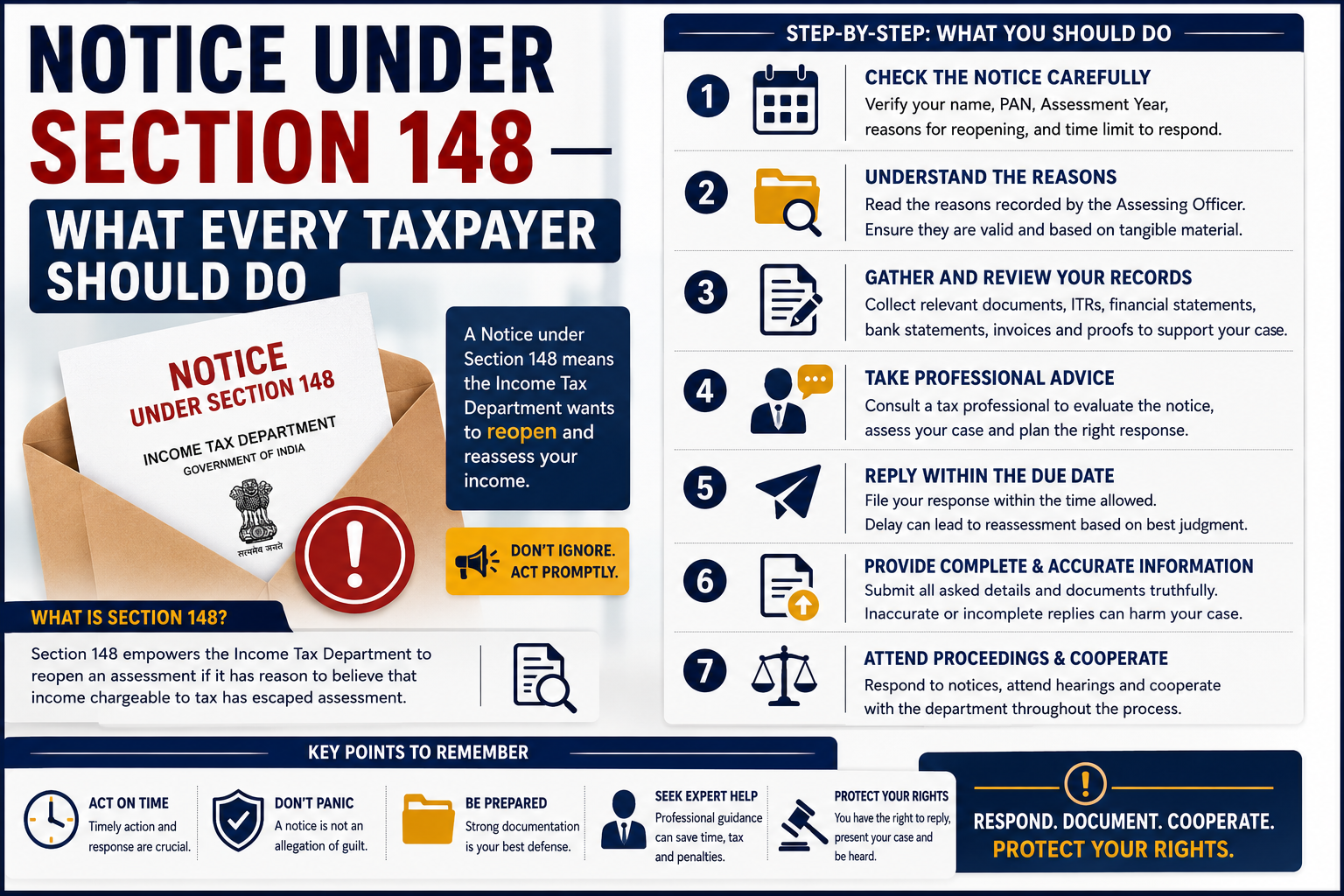
A notice under Section 148 of the Income-tax Act, 1961 is issued when the Assessing Officer seeks to assess, reassess or recompute income that is believed to have escaped assessment. A taxpayer should not ignore the notice. The first step is to verify the assessment year, notice details, statutory basis and the information relied upon, then file the required return and respond within the prescribed time. The validity of the reopening and the additions proposed can depend heavily on the facts and the applicable limitation provisions.
However, there is an important 2026 transition: the Income-tax Act, 2025 came into force from 1 April 2026. For tax years beginning before 1 April 2026, reassessment proceedings continue under the Income-tax Act, 1961. The new reassessment framework applies to Tax Year 2026-27 and subsequent tax years.
What Is a Notice under Section 148?
A notice under Section 148 of the Income-tax Act, 1961 is a statutory notice issued by the Assessing Officer before making an assessment, reassessment or recomputation under the reassessment provisions where income is believed to have escaped assessment.
In simple terms, the Income Tax Department may believe that taxable income was not properly assessed for a particular assessment year. Section 148 provides the mechanism through which the taxpayer is required to furnish a return in response to the reassessment proceedings.
The statutory provision requires the Assessing Officer to serve a notice requiring the assessee to furnish the return in the prescribed manner before making the reassessment.
Why can a taxpayer receive a Section 148 notice?
Possible reasons may include information suggesting that taxable income was not properly assessed, discrepancies in reported information, information obtained through departmental sources, audit-related information, information from other authorities, or other legally relevant material.
Receiving the notice does not automatically mean that the taxpayer has committed tax evasion. The taxpayer should first understand the basis and scope of the reassessment.
Important 2026 Change: Is Section 148 Still Applicable?
Yes, but the answer depends on the relevant tax year.
The Income-tax Act, 2025 introduced a new framework for tax years beginning on or after 1 April 2026. Under the new Act, the reassessment provisions are contained in Sections 279–286, with Section 280 corresponding to the old Section 148.
For tax years beginning before 1 April 2026, proceedings continue under the Income-tax Act, 1961, including where proceedings are initiated after 1 April 2026 subject to the applicable transitional provisions and limitation requirements.
Therefore, when someone searches for a “Section 148 notice in 2026”, it is essential to identify the relevant assessment year/tax year before determining which statutory framework applies.
What Should a Taxpayer Do After Receiving a Section 148 Notice?
A taxpayer should avoid immediately accepting or contesting the notice without examining the underlying facts.
A practical approach is:
Step 1: Verify the Notice
Check:
- PAN and taxpayer details
- Assessment Year
- Date of notice
- Document Identification Number (DIN), where applicable
- Issuing Assessing Officer
- Statutory section mentioned
- Time allowed for compliance
- Whether the notice is digitally available through the Income Tax e-Filing portal
- Whether the notice relates to the correct taxpayer and assessment year
A basic factual error can become important when determining how the proceedings should be handled.
Step 2: Identify the Assessment Year
This is particularly important in 2026 because of the transition from the Income-tax Act, 1961 to the Income-tax Act, 2025.
A notice concerning an earlier assessment year may continue to be governed by the old Act, whereas tax years beginning from 1 April 2026 are governed by the new Act.
The Income Tax Department specifically states that proceedings relating to tax years beginning before 1 April 2026 continue under the repealed 1961 Act under the transitional provisions.
Step 3: Check Whether There Was a Previous Assessment
Determine whether the relevant year involved:
- No return
- Return filed and processed
- Scrutiny assessment
- Earlier reassessment
- Intimation under the relevant provision
- Assessment order
- Appeal or revision proceedings
The legal implications can differ depending on what happened previously.
Step 4: Examine the Basis of Reassessment
Do not look at the notice in isolation.
Review the information, documents or reasons supplied through the reassessment proceedings and determine:
- What income is alleged to have escaped assessment?
- What transaction is being questioned?
- Which financial year does it relate to?
- Was the income already disclosed?
- Was tax already paid?
- Was the transaction incorrectly reported by another party?
- Is the information factually correct?
- Is the proposed reassessment within the statutory limitation period?
This factual examination is often the most important stage.
Step 5: Collect Supporting Documents
Depending on the issue, the taxpayer may need:
- Original ITR
- Computation of income
- Financial statements
- Bank statements
- Form 26AS
- AIS/TIS information
- TDS certificates
- Invoices
- Sale and purchase documents
- Capital-gain working
- Books of account
- GST records, where relevant
- Loan documentation
- Investment records
- Property documents
- Previous assessment orders
- Earlier submissions made to the Department
The documents should be organized assessment-year-wise and transaction-wise.
Step 6: File the Required Return
Where the Section 148 notice requires the taxpayer to furnish a return, the taxpayer should comply within the time specified in the notice and applicable law.
For proceedings under the old Act, the Income Tax Department states that where a Section 148 notice was issued before 1 April 2026, the return continues to be governed by the old Act even if the response occurs after 1 April 2026.
Step 7: Prepare a Proper Response
A response should address the actual issue rather than merely stating that the taxpayer disagrees.
A useful response generally explains:
- The relevant facts.
- The taxpayer’s position.
- Supporting documents.
- The applicable legal provisions.
- Why the alleged escaped income is incorrect, if applicable.
- Any procedural or jurisdictional objections that are legally sustainable.
Where substantial amounts or complicated legal issues are involved, professional review can be appropriate before submitting the response.
What Is Section 148A and How Is It Related to Section 148?
Under the Income-tax Act, 1961, Section 148A formed an important part of the reassessment procedure.
Broadly, the Assessing Officer would generally examine information suggesting escaped income and, subject to statutory exceptions and requirements, provide the taxpayer an opportunity before issuing a Section 148 notice.
The exact procedure and applicability depend on the assessment year and the statutory provisions applicable to that proceeding.
Importantly, taxpayers should not assume that every Section 148 notice issued in 2026 follows the same procedure. The transition to the Income-tax Act, 2025 means that the relevant tax year and transitional provisions must first be identified.
What Information Can Trigger Reassessment?
The Income Tax Department’s current reassessment guidance identifies several categories of information under the new framework, including risk-management information, certain audit objections, information received under international agreements, information obtained through specified schemes, information requiring action pursuant to Tribunal or Court orders, survey-related information and findings or directions contained in certain orders.
For an individual taxpayer, the practical question is not simply “Why did I receive a notice?” but:
What specific information has led the Department to believe that taxable income may have escaped assessment?
That information should be examined carefully against the taxpayer’s records.
What Are the Common Reasons for Reassessment Issues?
Depending on the facts, reassessment proceedings may involve matters such as:
- Undisclosed income
- Undisclosed bank transactions
- Property transactions
- Capital gains
- TDS/TCS discrepancies
- High-value financial transactions
- Interest or other income not properly reported
- Mismatch between the return and third-party information
- Incorrect claims or deductions
- Information received from another authority
- Transactions reflected in AIS/TIS but not properly explained
A mismatch does not necessarily establish taxable income. The taxpayer should establish the factual position with documentary evidence.
What Happens After a Section 148 Notice?
A simplified reassessment sequence under the old framework may involve:
Information suggesting escaped income → statutory reassessment procedure → Section 148 notice → return by taxpayer → reassessment proceedings → examination of evidence → reassessment order
The precise procedure depends upon the assessment year, applicable statutory provisions, notices issued and facts of the case.
For proceedings already initiated under Sections 147/148 of the old Act and pending on 1 April 2026, the Income Tax Department confirms that they continue under the Income-tax Act, 1961.
What If the Taxpayer Believes the Section 148 Notice Is Invalid?
A taxpayer should not assume that every notice is automatically valid simply because it has been issued by the Department.
Potential issues may arise regarding:
- Jurisdiction
- Limitation
- Statutory preconditions
- Applicable reassessment procedure
- Incorrect assessment year
- Incorrect factual assumptions
- Procedural compliance
- Authority or approval requirements
- Failure to consider relevant material
- Other legal defects
Whether such an objection succeeds depends on the applicable statutory provisions and the specific facts.
A taxpayer considering a legal challenge should therefore have the complete notice, supporting information, previous assessment records and relevant correspondence reviewed.
Can a Section 148 Notice Be Challenged?
Potentially, yes.
The appropriate remedy depends on the stage of proceedings and the nature of the defect.
Depending on the circumstances, a taxpayer may have statutory or judicial remedies available in relation to reassessment proceedings, including objections before the Assessing Officer and, where legally appropriate, further remedies through appellate or constitutional proceedings.
However, a taxpayer should not automatically file litigation merely because a Section 148 notice has been received. First determine whether the issue can be resolved through a factual explanation, documentary evidence or statutory response.
Common Mistakes Taxpayers Should Avoid
1. Ignoring the Notice
Ignoring a reassessment notice can result in proceedings continuing without the taxpayer’s effective participation.
2. Assuming the Notice Is a Tax Demand
A Section 148 notice is part of reassessment proceedings. It should not simply be treated as an ordinary demand notice.
3. Filing a Blind Response
A generic response without examining the underlying transaction may fail to address the actual issue.
4. Ignoring AIS and TIS
Information appearing in AIS/TIS should be reconciled with the taxpayer’s books, bank records and ITR.
5. Providing Incomplete Documents
If a transaction is legitimate, supporting documentation can be critical to establishing the factual position.
6. Missing the Response Deadline
The taxpayer should carefully check the deadline specified in the notice and applicable statutory framework.
7. Using an Old Legal Position Without Checking the Assessment Year
This is particularly important in 2026 because of the transition to the Income-tax Act, 2025.
8. Treating Every Reassessment as Automatically Illegal
The validity of reassessment must be examined on the actual facts and applicable law.
Hypothetical Example
Mr. A filed his income-tax return for an earlier assessment year and disclosed his income and investments.
Several years later, he receives a notice under Section 148 alleging that certain financial information indicates income may have escaped assessment.
Mr. A should not immediately accept the allegation.
He should first:
- Verify the assessment year.
- Examine the notice and accompanying information.
- Check AIS/TIS and Form 26AS.
- Review bank statements and books.
- Identify the transaction referred to by the Department.
- Determine whether the amount was already disclosed.
- Collect documentary evidence.
- File the required return.
- Submit a factually and legally reasoned response.
- Obtain professional advice if the matter involves significant tax exposure or a complex legal issue.
The example is hypothetical. The correct response will depend on the actual notice and facts.
Frequently Asked Questions
1. What is a Section 148 notice?
A Section 148 notice under the Income-tax Act, 1961 is a notice requiring the taxpayer to furnish a return in connection with reassessment proceedings where the Assessing Officer proposes to assess, reassess or recompute income that is believed to have escaped assessment.
2. Does receiving a Section 148 notice mean I have committed tax evasion?
No. Receiving the notice means that reassessment proceedings have been initiated or proposed under the applicable legal framework. The taxpayer should examine the information and respond with the relevant facts and evidence.
3. What should I do first after receiving a Section 148 notice?
First verify the assessment year, notice details, applicable law, information relied upon and response deadline. Then collect the relevant tax and financial records before preparing the response.
4. Is Section 148 still applicable after 1 April 2026?
For tax years beginning before 1 April 2026, reassessment proceedings can continue under the Income-tax Act, 1961. For Tax Year 2026-27 and subsequent tax years, the new Income-tax Act, 2025 framework applies, including Section 280 as the corresponding reopening-notice provision.
5. What is the relationship between Section 148A and Section 148?
Under the old Income-tax Act, 1961 framework, Section 148A provided an important pre-notice reassessment procedure in applicable cases, while Section 148 concerned the notice for reassessment. The exact sequence depends on the assessment year, statutory exceptions and transitional provisions.
6. Can a Section 148 notice be challenged?
Potentially, depending on the facts and legal defects involved. Issues such as limitation, jurisdiction, statutory compliance and factual inaccuracies may require examination. The appropriate remedy depends on the circumstances.
7. What documents should I keep ready?
Depending on the issue, relevant documents can include the ITR, computation, financial statements, bank statements, AIS/TIS, Form 26AS, TDS records, invoices, investment records, property documents and previous tax proceedings.
8. What happens if I do not respond?
Failure to respond can adversely affect the taxpayer because reassessment proceedings may continue without a proper explanation or supporting evidence from the taxpayer. The exact consequences depend on the proceedings and applicable law.
9. Can the Department reopen an old assessment after 1 April 2026?
Yes, for certain earlier tax years, proceedings under the Income-tax Act, 1961 may still be initiated after 1 April 2026, subject to the applicable statutory conditions and limitation provisions. The Income Tax Department specifically confirms that earlier tax years remain governed by the old framework in accordance with the transitional provisions.
10. Should I consult a tax professional after receiving a Section 148 notice?
Professional assistance can be useful where the notice involves substantial tax exposure, complex transactions, limitation issues, jurisdictional questions, previous assessments or potential litigation.
Key Takeaways
- A Section 148 notice should never be ignored.
- First identify the assessment year and applicable statutory framework.
- Review the information that allegedly indicates escaped income.
- Reconcile the allegation with your ITR, AIS/TIS, Form 26AS, bank statements and other records.
- File the required return within the applicable time.
- Prepare a factual and legally supported response.
- Examine limitation, jurisdiction and procedural requirements where relevant.
- The 2026 transition between the Income-tax Act, 1961 and Income-tax Act, 2025 is important.
- For tax years beginning before 1 April 2026, the old Act continues to govern relevant proceedings under the transitional provisions.
- Complex or high-value reassessment matters may require professional tax and legal review.
Final CTA
If you have received a Section 148 notice, the most important step is to examine the notice, assessment year, underlying information and applicable legal provisions before responding.
For taxpayers and businesses in Patna and Bihar, Bihar Tax Consultant can be approached for professional assistance with income-tax notices, reassessment matters and related tax compliance or litigation issues.
Book a Consultation and have the notice and relevant records reviewed before taking the next step.
Bihar Tax Consultant
BIIT Campus, near Sanchira Mandir, New Azimabad Colony, Patna, Bihar 800006
Mobile: 8789155395
Email: [email protected]
Website: bihartaxconsultnt.com