
Income Tax Scrutiny Notice under Section 143(2): Complete Guide

What is a Section 143(2) Notice?
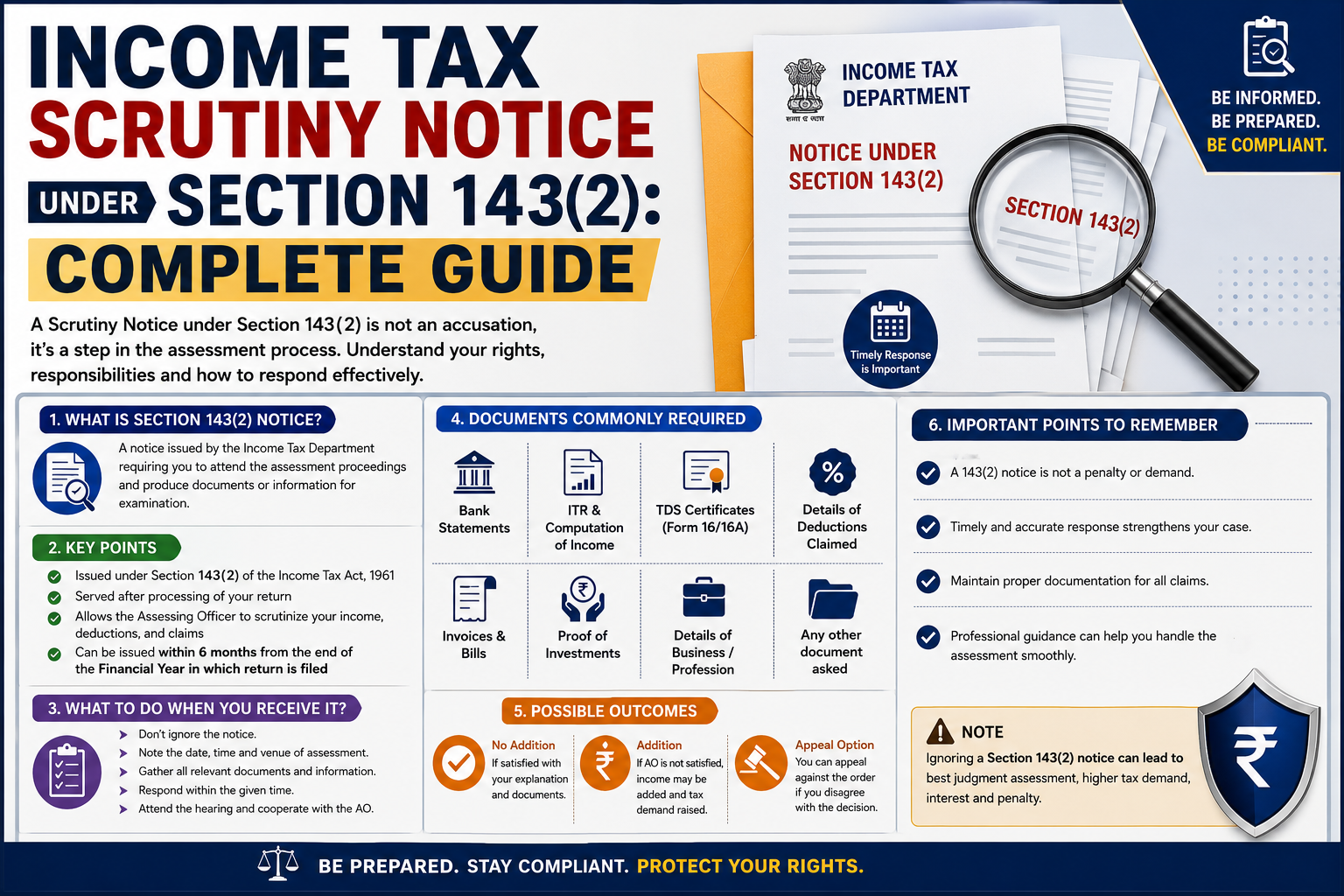
An Income Tax Notice under Section 143(2) of the Income-tax Act, 1961 is a scrutiny notice issued when the Income Tax Department wants to examine the correctness and completeness of a taxpayer’s return and supporting evidence. The notice requires the taxpayer to provide information, documents or evidence supporting the return filed.
Receiving a Section 143(2) notice does not by itself mean that the taxpayer has committed tax evasion or that additional tax has already been determined. It means that the return has been selected for scrutiny and the taxpayer must participate in the assessment proceedings.
For AY 2026-27 and earlier assessment years, scrutiny proceedings continue under the Income-tax Act, 1961 even after the new income-tax law came into force from 1 April 2026. The Income Tax Department has specifically clarified this transition position.
1. What Is an Income Tax Scrutiny Notice under Section 143(2)?
Section 143(2) empowers the Assessing Officer or prescribed income-tax authority to require the taxpayer to attend proceedings or produce evidence in support of the return where scrutiny is considered necessary to ensure that income has not been understated, excessive loss has not been claimed, or tax has not been underpaid.
In practical terms, a Section 143(2) notice means:
The Income Tax Department wants to verify selected aspects of the return before completing the assessment.
The scrutiny may involve questions relating to income, deductions, exemptions, investments, expenses, transactions, tax credits, business results or information available with the Department.
The exact scope depends on the notice and subsequent questionnaires or communications issued during the assessment.
2. Why Does the Income Tax Department Issue a 143(2) Notice?
A return may be selected for scrutiny based on risk parameters, information available with the Department, specific circumstances prescribed under CBDT scrutiny-selection guidelines, or other legally permitted selection mechanisms.
The Department’s assessment guidance explains that scrutiny assessment is intended to examine the correctness and completeness of the return.
Possible areas that may require verification include:
- Significant differences between reported income and information available with the Department
- Large deductions or exemptions
- High-value financial transactions
- Capital gains
- Unusual business expenses
- Cash transactions
- Tax deducted or collected at source
- Foreign income or assets
- Investment-related information
- Discrepancies involving AIS, Form 26AS or other information
- Issues identified under applicable scrutiny-selection parameters
However, the mere receipt of a scrutiny notice should not be treated as proof that the taxpayer has made an incorrect claim.
3. What Is the Difference Between Section 143(1) and Section 143(2)?
These two provisions are frequently confused.
| Section | Broad Purpose | Nature |
|---|---|---|
| 143(1) | Processing of the return | Primarily return processing/intimation |
| 143(2) | Selection and initiation of scrutiny | Detailed verification |
| 143(3) | Passing the scrutiny assessment order | Final assessment after scrutiny |
Section 143(2) is therefore an important procedural step before a scrutiny assessment under Section 143(3).
The Department describes Section 143(1) as return processing, while Section 143(2) initiates scrutiny where further verification is considered necessary.
4. What Is the Time Limit for Issuing a Section 143(2) Notice?
The current time limit
For proceedings governed by the Income-tax Act, 1961, Section 143(2) provides that the notice cannot be served after the expiry of three months from the end of the financial year in which the return is furnished.
The CBDT has also explained that the Finance Act, 2021 reduced the period for service of a Section 143(2) notice to three months from the end of the financial year in which the return is filed.
Example
Suppose a taxpayer files a return during FY 2026-27.
The relevant financial year ends on 31 March 2027.
The three-month period ends on 30 June 2027.
Therefore, for a proceeding governed by the 1961 Act, the Section 143(2) notice would ordinarily have to be served within the statutory period ending 30 June 2027.
The exact limitation position should always be checked against the relevant assessment year, return date, applicable statutory provisions and facts of the case.
5. Important 2026 Transition: Which Law Applies?
This point is particularly important in 2026.
The new income-tax law applies to tax years beginning on or after 1 April 2026, but proceedings relating to AY 2026-27 and earlier years continue under the Income-tax Act, 1961 under the transition provisions.
The Income Tax Department has specifically clarified that if a taxpayer filed a return for AY 2026-27 and subsequently receives a Section 143(2) scrutiny notice under the old Act, the scrutiny assessment will continue under the Income-tax Act, 1961.
Therefore, a taxpayer should not assume that every notice received after 1 April 2026 is automatically governed by the new Act.
The assessment year and applicable transitional provisions matter.
6. What Happens After Receiving a 143(2) Notice?
A scrutiny assessment generally involves several stages.
Step 1: Verify the notice
Check:
- PAN
- Assessment Year
- Date of notice
- DIN, where applicable
- Section under which the notice has been issued
- Authority issuing the notice
- Issues or information requested
- Compliance date
- Mode of response
Do not ignore the notice simply because the taxpayer believes the return was correctly filed.
Step 2: Understand the scope of scrutiny
Read the notice carefully and identify exactly what the Department is asking.
For example, the issue may relate to:
- Business turnover
- Unsecured loans
- Cash deposits
- Property transactions
- Capital gains
- Deductions
- TDS mismatch
- Foreign transactions
- Expenses
- Investments
The response should address the actual questions rather than submitting a large quantity of unrelated documents.
Step 3: Collect supporting evidence
Documents should be organized according to the issues raised.
Step 4: Prepare the response
The response should be:
- Factually accurate
- Legally supported
- Consistent with the return
- Supported by documentary evidence
- Clear and point-wise
Step 5: Submit through the prescribed electronic process
Scrutiny assessments are generally conducted electronically under the faceless assessment framework where applicable. The Income Tax Department states that Section 144B provides the framework for faceless scrutiny assessment.
Step 6: Respond to further questionnaires
The first response may not be the final communication. The Department may seek additional information or clarification during assessment.
Step 7: Assessment order
After considering the taxpayer’s submissions and relevant material, the assessment may result in an order under Section 143(3), determining the assessed income and resulting tax liability/refund as applicable.
7. What Documents May Be Required?
There is no universal document list for every scrutiny case. The required documents depend on the issues identified in the notice.
Depending on the case, a taxpayer may need:
For salary income
- Form 16
- Salary slips
- Form 26AS
- AIS/TIS information
- Bank statements
- Investment/deduction documents
For business or professional income
- Books of account
- Profit and Loss Account
- Balance Sheet
- Sales and purchase records
- GST returns
- Bank statements
- Expense supporting documents
- Debtors and creditors details
- Stock records, where relevant
For capital gains
- Purchase documents
- Sale documents
- Brokerage details
- Cost records
- Improvement expenses
- Capital gain computation
- Relevant supporting evidence
For loans and investments
- Loan confirmations
- Bank statements
- Confirmation from lenders
- Investment statements
- Relevant agreements
- Source-of-funds documentation
For tax credits
- Form 26AS
- AIS
- TDS certificates
- TDS/TCS details
- Advance-tax challans
- Self-assessment tax challans
The correct approach is to prepare documents issue-wise, rather than sending every document available.
8. Can a Taxpayer Challenge an Invalid 143(2) Notice?
Potentially, yes—but the answer depends on the specific defect and facts.
Issues concerning:
- Limitation
- Proper service
- Jurisdiction
- Statutory requirements
- Procedural irregularity
may require legal examination.
However, Section 292BB creates an important statutory rule concerning participation in assessment proceedings. The Income Tax Department explains that where an assessee has participated in the proceedings without objecting to the validity of the notice before completion of assessment, certain objections concerning non-service, late service or improper service may be restricted.
Therefore, do not deliberately ignore a notice while assuming that its validity can automatically be challenged later.
A jurisdictional or limitation objection should be evaluated promptly and raised at the appropriate stage where legally available.
9. What Happens If You Do Not Respond to a 143(2) Notice?
Ignoring a scrutiny notice can create significant procedural risk.
If the taxpayer does not provide the required information or does not properly participate in the proceedings, the assessment may potentially proceed on the basis of available material and may lead to a best judgment assessment under Section 144, subject to the statutory requirements. The Income Tax Department specifically notes non-compliance with scrutiny proceedings as a situation that may lead to best judgment assessment.
Possible consequences can include:
- Adverse additions to income
- Disallowance of deductions or expenses
- Additional tax liability
- Interest consequences
- Penalty exposure where independently attracted
- Further litigation
The exact consequence depends on the facts and the nature of non-compliance.
10. How Should You Reply to a Section 143(2) Notice?
A good response should follow a structured approach.
Recommended format
1. Identify the notice
Mention the assessment year, notice date and relevant reference/DIN.
2. Respond issue-wise
Address every question separately.
3. Explain the facts
Give a concise factual explanation.
4. Provide supporting documents
Attach or submit the relevant evidence.
5. Reconcile discrepancies
If there is a mismatch between the return and information available with the Department, explain the reason with evidence.
6. State the legal position where necessary
Where the issue involves interpretation of law, provide the relevant statutory provision or applicable judicial principle after verifying its applicability.
7. Make a clear concluding submission
State what the taxpayer is requesting the Assessing Officer to accept or take on record.
Avoid making unsupported statements or submitting inconsistent explanations.
11. Practical Example — Hypothetical
This is a hypothetical example for educational purposes.
Suppose Mr. A files an income-tax return declaring:
- Salary income: ₹12 lakh
- Capital gains: ₹4 lakh
- Deduction claims: ₹2 lakh
Later, he receives a Section 143(2) notice asking for information concerning his capital gains and certain deductions.
Mr. A should not assume that the notice means the Department has already rejected his return.
Instead, he should:
- Read the specific issues mentioned in the notice.
- Obtain purchase and sale documents for the relevant asset.
- Prepare the capital-gain computation.
- Collect evidence supporting the deductions.
- Reconcile the relevant information with AIS/Form 26AS and other records.
- Submit a clear point-wise response.
- Preserve proof of submission.
- Respond to any subsequent clarification sought during assessment.
If the Department ultimately makes an adverse addition, the taxpayer should examine the assessment order and available statutory remedies rather than assuming that the original notice itself is the final decision.
12. What Is the Time Limit for Completing a Scrutiny Assessment?
The time limit for completion is different from the time limit for issuing the Section 143(2) notice.
For assessment years commencing on or after 1 April 2022, Section 153 provides that an assessment order under Section 143 or Section 144 is generally to be made within 12 months from the end of the assessment year in which the income was first assessable, subject to statutory exclusions, extensions and special provisions.
This distinction is important:
- Section 143(2) → time limit for initiating scrutiny through the notice.
- Section 143(3) → assessment order after scrutiny.
- Section 153 → limitation for completing the assessment, subject to applicable provisions.
13. Common Mistakes Taxpayers Make
Mistake 1: Ignoring the notice
A scrutiny notice should never be ignored without understanding its legal consequences.
Mistake 2: Submitting irrelevant documents
More documents do not necessarily mean a better response. Evidence should be relevant to the issues raised.
Mistake 3: Giving inconsistent explanations
The response should remain consistent with the return, books, financial statements and documentary evidence.
Mistake 4: Failing to reconcile AIS/Form 26AS
Differences should be investigated and explained instead of being overlooked.
Mistake 5: Missing the response deadline
A taxpayer should monitor the compliance date carefully.
Mistake 6: Treating every notice as a tax demand
A Section 143(2) notice initiates scrutiny; it is not itself equivalent to a final assessment order determining additional tax.
Mistake 7: Raising legal objections too late
Where there is a genuine limitation, jurisdiction or service issue, it should be examined promptly.
Mistake 8: Assuming that a correct return needs no response
Even if the taxpayer believes the return is completely correct, the scrutiny proceedings still require appropriate participation.
14. Taxpayer Rights During Scrutiny
A taxpayer facing scrutiny should understand that assessment proceedings are not simply about supplying documents.
The taxpayer should:
- Understand the precise issue being examined.
- Provide relevant evidence supporting the return.
- Give factual and legally supported explanations.
- Maintain records of submissions.
- Examine subsequent notices carefully.
- Seek clarification where a communication is unclear.
- Raise legally available objections at the appropriate stage.
- Consider professional assistance where the issue is complex.
The objective should be to ensure that the assessment is completed on the basis of accurate facts, relevant evidence and the applicable law.
15. When Should You Consult a Tax Professional?
Professional assistance can be particularly useful where scrutiny involves:
- Large proposed additions
- Complex business transactions
- Capital gains
- Unexplained investments or cash deposits
- Foreign income or assets
- Multiple-year issues
- Transfer-pricing matters
- Complex deductions
- Significant AIS/Form 26AS discrepancies
- Questions involving legal interpretation
- Potential penalty or prosecution implications
- A proposed adverse assessment order
A tax professional can help with document review, reconciliation, factual submissions, legal analysis and procedural compliance.