
Top 10 Reasons GST Notices Are Issued in India & How to Avoid Them

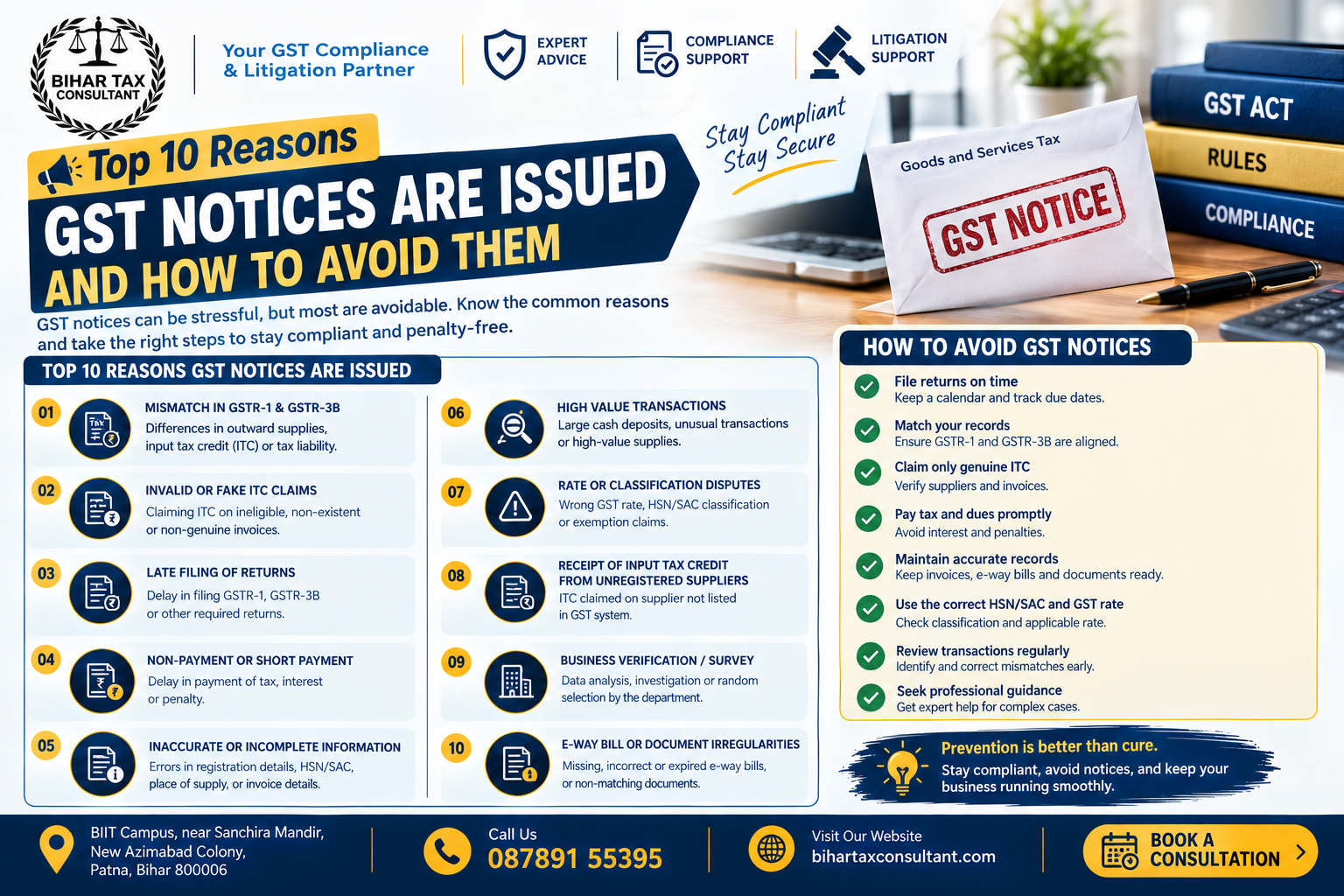
Why Are GST Notices Issued?
GST notices are generally issued when the GST authorities identify a discrepancy, non-compliance, unpaid or short-paid tax, questionable input tax credit, registration issue, return-related problem or other matter requiring clarification or action.
Common triggers include:
- GSTR-1 and GSTR-3B mismatches
- ITC differences involving GSTR-2B and GSTR-3B
- Incorrect or excess ITC claims
- Late or non-filing of GST returns
- Unreported or under-reported outward supplies
- E-way bill and invoice discrepancies
- GST registration or business-address issues
- Differences between books and GST returns
- Incorrect classification, tax rate or place-of-supply treatment
- Failure to respond to earlier GST communications or comply with GST requirements
The GST framework specifically permits scrutiny of returns and communication of discrepancies. Under Section 61 of the CGST Act, the proper officer may scrutinize a return and seek an explanation for discrepancies.
Importantly, receiving a GST notice does not by itself establish that tax is payable. The nature of the notice, allegation, legal provision, evidence and taxpayer’s response all matter.
Introduction
A GST notice can arrive even when a business believes that its GST compliance is generally under control.
Why?
Because GST compliance is no longer based only on what a taxpayer reports in one return.
The GST system can compare information across multiple sources, including:
- GSTR-1
- GSTR-1A, where applicable
- GSTR-3B
- GSTR-2B
- E-way bill data
- GST registration details
- Tax payment records
- Books of accounts
- Supplier and recipient information
- Other information available to the tax authorities
The GST Portal itself uses system-generated information from GSTR-1/1A and GSTR-2B to assist taxpayers in preparing GSTR-3B and reducing mismatches.
That means a small reporting difference can become a compliance issue if it remains unexplained.
The good news is that many GST notice triggers can be reduced through regular reconciliation, accurate reporting, proper documentation and timely responses.
What Is a GST Notice?
A GST notice is a formal communication from the GST authorities requiring a taxpayer to provide information, clarification, documents, explanation or, in appropriate proceedings, to show cause why a proposed action should not be taken.
The exact meaning depends on the form and statutory provision involved.
For example:
- ASMT-10 may communicate discrepancies identified during scrutiny of returns.
- REG-03 can seek clarification or documents in connection with registration-related matters.
- DRC-01 is used for the electronic summary of specified demand notices.
- DRC-01B / DRC-01C can communicate specified return or ITC mismatch issues through GST Portal compliance mechanisms.
Under Rule 99, where a return is selected for scrutiny and discrepancies are identified, the proper officer may issue FORM GST ASMT-10 and seek an explanation.
The form therefore matters.
A taxpayer should identify the exact notice, section, tax period, allegation and response deadline before deciding how to reply.
Top 10 Reasons GST Notices Are Issued
1. GSTR-1 and GSTR-3B Mismatch
One of the most common compliance problems is a difference between outward supplies reported in GSTR-1 and tax liability reported in GSTR-3B.
For example, a business may report taxable sales of ₹50 lakh in GSTR-1 but disclose a different taxable turnover or tax liability in GSTR-3B.
Such differences can arise because of:
- Missed invoices
- Incorrect amendments
- Credit/debit note differences
- Timing differences
- Wrong reporting tables
- Data-entry errors
- Incorrect tax calculations
The GST Portal has specifically introduced system-based compliance mechanisms for liability mismatches between GSTR-1 and GSTR-3B.
How to reduce the risk
Before filing GSTR-3B:
- Reconcile outward supplies with GSTR-1.
- Compare tax liability with books.
- Review amendments and credit/debit notes.
- Check previous-period adjustments.
- Investigate unusual differences.
The GST Portal also provides GSTR-1A as an optional amendment facility before filing GSTR-3B for the same tax period, subject to the applicable system rules.
2. ITC Mismatch Between GSTR-2B and GSTR-3B
Input Tax Credit is another major source of GST compliance issues.
GSTR-2B is an auto-drafted ITC statement based on information furnished by suppliers and other specified sources. The GST Portal advises taxpayers to reconcile GSTR-2B with their own records and books.
A mismatch can arise where:
- Supplier has not filed the relevant statement.
- Invoice details are incorrect.
- Invoice is reported in a different tax period.
- ITC is claimed before satisfying applicable conditions.
- ITC is claimed twice.
- Reversal requirements are missed.
- An invoice appears in GSTR-2B but is not eligible under another provision.
The GST Portal specifically advises taxpayers to ensure that credit is not availed twice and that reversals required under the GST law are made in GSTR-3B.
How to reduce the risk
Maintain a monthly ITC reconciliation:
Purchase Register → GSTR-2B → Eligible ITC → Ineligible ITC → Reversal → GSTR-3B
Do not treat every amount appearing in GSTR-2B as automatically claimable ITC. The Portal itself notes that other legal restrictions may apply even where a credit is reflected in the statement.
3. Excess or Ineligible Input Tax Credit
A GST notice may also arise where the Department believes that ITC has been:
- Wrongly availed
- Excessively claimed
- Availed twice
- Claimed despite statutory restrictions
- Not properly reversed
- Claimed on transactions that do not satisfy the legal conditions
The distinction between “ITC appearing in GSTR-2B” and “ITC legally available to the taxpayer” is important.
GSTR-2B itself states that there may be circumstances where ITC is not available even though the system does not identify it as unavailable. Taxpayers are advised to self-assess such credit and reverse it where required.
How to reduce the risk
Create an ITC checklist covering:
- Valid tax invoice
- Receipt of goods/services
- Business use
- Supplier reporting
- GSTR-2B reconciliation
- Section 16 conditions
- Blocked-credit provisions
- Reversal requirements
- Duplicate-credit checks
4. Late Filing or Non-Filing of GST Returns
Failure to file GST returns on time can result in compliance action.
Non-filing is particularly important because the GST law contains specific consequences for registered persons who fail to furnish required returns.
For example, Section 62 deals with assessment of non-filers after the prescribed notice process. The current provision also provides mechanisms concerning filing of a valid return after an assessment order, subject to the statutory conditions.
Why this can become serious
A taxpayer who ignores return filing may face:
- Late fee
- Interest
- Restrictions affecting subsequent compliance
- Assessment proceedings
- Additional correspondence from the Department
- Potential demand proceedings
How to reduce the risk
Maintain a compliance calendar covering:
- GSTR-1
- GSTR-3B
- GSTR-9, where applicable
- GSTR-9C, where applicable
- TDS/TCS-related GST obligations, where applicable
- Other applicable statements and forms
Do not wait until the final day to discover that books, invoices or reconciliation data are incomplete.
5. Under-Reported or Unreported Sales
GST authorities may question a taxpayer where information indicates that outward supplies may not have been completely reported.
Possible triggers include differences between:
- Sales ledger and GSTR-1
- GSTR-1 and GSTR-3B
- E-way bill data and reported turnover
- Invoices and return data
- Books and GST returns
Example
A business’s accounting records show taxable sales of ₹80 lakh, while its GST returns reflect only ₹68 lakh.
The ₹12 lakh difference may require explanation.
It could be a genuine timing difference, exempt supply, cancelled transaction, credit-note adjustment or accounting classification issue.
But if there is no supporting reconciliation, the discrepancy can become a GST compliance problem.
How to reduce the risk
Perform a monthly:
Books → Sales Register → GSTR-1 → GSTR-3B → E-way Bill
reconciliation.
Do not wait for a GST notice to discover a turnover difference.
6. E-Way Bill and Invoice Discrepancies
E-way bill information can become relevant to GST compliance, particularly where transportation details do not correspond with invoice or return records.
Potential issues can include:
- Incorrect GSTIN
- Incorrect invoice number
- Incorrect taxable value
- Wrong vehicle details
- Incorrect HSN
- Incorrect place of supply
- E-way bill generated for a transaction that was subsequently cancelled
- Goods transported without the required documentation
- Differences between e-way bill and books
The GST Rules contain specific requirements concerning e-way bills, including their validity and cancellation. For example, an e-way bill may generally be cancelled electronically within 24 hours where the goods are not transported or are not transported according to the details furnished, subject to the applicable conditions.
How to reduce the risk
Before movement of goods, verify:
- Supplier GSTIN
- Recipient GSTIN
- Invoice number
- Invoice date
- Taxable value
- Tax amount
- HSN
- Place of supply
- Transporter details
- Vehicle number
7. GST Registration or Business-Address Issues
GST registration information should remain consistent with the actual business situation.
A notice can arise where authorities identify issues concerning:
- Principal place of business
- Additional place of business
- Nature of business
- Registration particulars
- Documents submitted for registration
- Amendment applications
- Physical verification
- Non-functioning business premises
The GST registration rules provide for electronic clarification notices during registration and also contain procedures concerning cancellation where specified grounds exist.
For example, the rules provide for a notice in FORM GST REG-03 where clarification, information or documents are required in connection with a registration application.
How to reduce the risk
Keep registration details updated when there is a genuine change in:
- Address
- Partners/directors
- Business activity
- Bank details
- Additional places of business
- Other registered particulars
8. Differences Between Books of Accounts and GST Returns
Your GST returns should be capable of being reconciled with your books.
A mismatch does not automatically mean tax evasion or incorrect reporting.
However, unexplained differences can attract questions.
Common differences include:
- Sales recorded in books but not reported in GST return
- Purchase records differing from ITC claimed
- Credit notes recorded differently
- Advances accounted for differently
- Year-end adjustments
- Wrong ledger classification
- Tax-inclusive versus tax-exclusive calculations
How to reduce the risk
Conduct a monthly reconciliation rather than waiting for the annual return.
At minimum, compare:
Books → GSTR-1 → GSTR-3B → GSTR-2B → E-way bills
For larger businesses, reconciliation should be supported by an audit trail explaining significant differences.
9. Incorrect Tax Rate, HSN, SAC or Place-of-Supply Treatment
A GST notice can arise when the Department questions the tax treatment adopted for a supply.
Possible issues include:
- Wrong GST rate
- Incorrect HSN classification
- Incorrect SAC classification
- Incorrect place of supply
- IGST reported instead of CGST/SGST
- CGST/SGST reported instead of IGST
- Incorrect treatment of exempt or zero-rated supplies
- Incorrect reverse-charge treatment
Classification disputes can become complicated because the correct GST treatment may depend on the precise nature of the goods or services and the applicable notifications and statutory provisions.
How to reduce the risk
For products or services with recurring classification issues:
- Identify the exact goods/services.
- Determine the applicable HSN/SAC.
- Verify the applicable rate and exemption notification.
- Review place-of-supply rules.
- Document the basis of the tax treatment.
- Revisit the position when there is a legal or notification change.
Do not rely solely on an old invoice or a previous accountant’s classification.
10. Failure to Respond to an Earlier GST Communication
Sometimes the biggest compliance problem is not the original discrepancy.
It is the failure to respond.
A taxpayer may receive a GST communication and assume that it is only an informational message.
That can be risky.
Depending on the proceeding, the taxpayer may be required to provide:
- Explanation
- Documents
- Reconciliation
- Payment details
- Legal submissions
- Evidence
- Clarification
- Show-cause response
Under the scrutiny mechanism, for example, a taxpayer can respond to a discrepancy communicated through ASMT-10, and an acceptable explanation can result in the matter being closed through the prescribed process.
How to reduce the risk
Every GST notice should be reviewed for:
- Notice number
- Form number
- Section
- Tax period
- Allegation
- Amount involved
- Documents requested
- Response deadline
- Mode of response
Never assume that an electronic notice can safely be ignored.
GST Notice vs GST Show Cause Notice: What Is the Difference?
The words “GST notice” are often used broadly.
However, not every GST communication has the same legal effect.
A communication may be:
- A request for information
- A return-scrutiny discrepancy
- A registration clarification
- An intimation of mismatch
- A show-cause notice
- A demand-related proceeding
- An assessment communication
- A recovery communication
- A penalty proceeding
For example, under Rule 142, specified demand notices under Sections 73, 74 and 74A are accompanied by an electronic summary in FORM GST DRC-01. The taxpayer’s representation to such a notice is furnished electronically in FORM GST DRC-06, while orders are summarized in FORM GST DRC-07.
Therefore, the correct response depends on the exact form and statutory provision involved.
What Are Sections 73, 74 and 74A in GST?
These provisions are important in demand proceedings.
Section 73
Historically, Section 73 deals with determination of tax not paid, short paid, erroneously refunded or ITC wrongly availed/utilised for reasons other than fraud, wilful misstatement or suppression of facts to evade tax.
Section 74
Section 74 applies to specified cases involving fraud, wilful misstatement or suppression of facts to evade tax.
Section 74A
Section 74A was introduced through the Finance (No. 2) Act, 2024 as part of the revised demand framework. Current CBIC material and Rule 142 now expressly refer to Section 74A.
Important: The correct demand provision depends on the relevant tax period and the circumstances of the case. A taxpayer should not automatically assume that an old Section 73/74 framework applies to every current GST demand.
What Is DRC-01C?
DRC-01C is an important GST Portal compliance mechanism concerning an ITC mismatch between GSTR-2B and ITC claimed in GSTR-3B where the difference exceeds the applicable predefined limit.
The GST Portal states that the mismatch details are provided in Part A and that the taxpayer is required to provide the necessary response in Part B.
The Portal further states that failure to file the response to DRC-01C Part B can prevent filing of GSTR-1/IFF for the subsequent tax period.
This makes regular ITC reconciliation especially important.
What Is DRC-01B?
DRC-01B is associated with a liability mismatch between GSTR-1/IFF and GSTR-3B.
The GST Portal provides a specific return-compliance mechanism for this mismatch and requires the taxpayer to provide the relevant response where applicable.
This is another reason businesses should reconcile outward liability before finalising returns.
How to Avoid GST Notices: A Practical Compliance System
Avoiding every GST notice cannot be guaranteed.
Tax authorities may legitimately seek clarification even where a taxpayer has acted in good faith.
The practical objective should therefore be:
Reduce preventable discrepancies + detect errors early + maintain evidence + respond correctly.
A useful compliance system is:
Monthly
- Reconcile GSTR-1 with sales register.
- Reconcile GSTR-3B with tax liability.
- Reconcile GSTR-2B with purchase records.
- Review ITC reversals.
- Check e-way bill differences.
- Review unusual credit/debit notes.
- Check tax payment.
Quarterly
- Review recurring classification issues.
- Review customer/vendor GSTINs.
- Check place-of-supply treatment.
- Review registration particulars.
- Analyse significant return variances.
Annually
- Reconcile annual turnover.
- Review ITC differences.
- Prepare GSTR-9/9C data, where applicable.
- Investigate unresolved differences.
- Preserve supporting documentation.
What Should You Do When You Receive a GST Notice?
Step 1: Do Not Panic
A notice is a formal communication, but the allegation must still be examined.
Step 2: Identify the Notice
Check the:
- Form
- Section
- Tax period
- Notice date
- Reference number
- Issuing authority
Step 3: Understand the Allegation
Do not draft a response before understanding exactly what the Department has questioned.
Step 4: Reconcile the Figures
Compare the notice with:
- Books
- GSTR-1
- GSTR-3B
- GSTR-2B
- E-way bills
- Invoices
- Tax payments
Step 5: Collect Evidence
Relevant evidence may include:
- Invoices
- Purchase records
- Sales records
- Bank statements
- E-way bills
- Agreements
- Ledger extracts
- Reconciliation statements
- Tax payment challans
- Supplier confirmations
Step 6: Determine Whether the Difference Is Genuine
A mismatch may result from:
- Timing
- Amendment
- Accounting treatment
- Reporting error
- Supplier delay
- Credit/debit note
- Actual tax short-payment
These situations should not automatically be treated as identical.
Step 7: Prepare a Point-by-Point Reply
A strong reply should correspond to the specific allegations.
Step 8: Attach Supporting Documents
Do not merely make assertions when documentary evidence is available.
Step 9: Submit Within the Applicable Time
The deadline in the notice should be carefully checked.
Step 10: Preserve the Complete Record
Keep:
- Notice
- Reply
- Attachments
- ARN/acknowledgement
- Payment evidence
- Subsequent communications
Hypothetical Example: ITC Mismatch
This example is hypothetical and is provided only to explain the process.
A company claims ₹18 lakh of ITC in GSTR-3B.
Its GSTR-2B reflects ₹16 lakh.
The difference is ₹2 lakh.
The company should not immediately assume that the ₹2 lakh is wrongly claimed.
It should investigate whether the difference relates to:
- Timing
- Supplier reporting
- Amendments
- Credit notes
- Reversals
- Ineligible credit
- Other legitimate reconciliation items
If a DRC-01C intimation is generated, the business should prepare the prescribed response with the relevant reconciliation and supporting information. The GST Portal specifically requires a response to Part B where the DRC-01C mechanism applies.
The important lesson is:
A mismatch is a signal to investigate—not a substitute for reconciliation.
Common GST Compliance Mistakes That Increase Notice Risk
Mistake 1: Filing returns without reconciliation
Returns are filed based on estimates or incomplete records.
Mistake 2: Treating GSTR-2B as automatic ITC approval
ITC eligibility still needs to be examined under the GST law.
Mistake 3: Ignoring small mismatches
Repeated small differences can accumulate.
Mistake 4: Relying entirely on accounting software
Software can identify differences, but the legal treatment still requires review.
Mistake 5: Not maintaining an audit trail
When a difference occurs months later, the business may struggle to explain why.
Mistake 6: Ignoring GST Portal communications
A notice or intimation should be reviewed promptly.
Mistake 7: Using the same reply for every notice
GST notices can involve different provisions and factual issues.
Mistake 8: Paying without understanding the allegation
Payment may have legal and accounting consequences; the taxpayer should first understand the nature of the liability.
Mistake 9: Missing amendments
Invoice amendments and credit/debit notes can affect multiple returns.
Mistake 10: Not taking professional advice in complex matters
High-value ITC disputes, classification disputes, fraud allegations, registration cancellation and demand proceedings may require detailed legal analysis.
Can a GST Notice Be Avoided Completely?
No one can guarantee that a taxpayer will never receive a GST notice.
GST authorities may issue legitimate communications for clarification, verification or scrutiny even where a taxpayer is generally compliant.
The practical goal is to reduce preventable notices and be prepared to respond to legitimate queries quickly and accurately.
A strong GST compliance process therefore focuses on:
Accuracy + Reconciliation + Documentation + Timely Filing + Timely Response
GST Notice Prevention Checklist
Before closing each tax period, ask:
Returns
☐ Is GSTR-1 reconciled with the sales register?
☐ Is GSTR-3B reconciled with GSTR-1?
☐ Are tax payments correctly reflected?
ITC
☐ Is GSTR-2B reconciled with purchase records?
☐ Has duplicate ITC been checked?
☐ Have required reversals been made?
☐ Has blocked/ineligible ITC been reviewed?
Sales
☐ Are all taxable supplies reported?
☐ Are credit/debit notes correctly reported?
☐ Are amendments accurate?
E-Way Bills
☐ Do e-way bills correspond with invoices?
☐ Are cancelled or expired transactions reviewed?
☐ Are GSTIN and vehicle details correct?
Registration
☐ Are business addresses current?
☐ Are registration amendments updated?
☐ Are business activities correctly reflected?
Notices
☐ Has the GST Portal been checked?
☐ Have previous notices been closed?
☐ Are response deadlines tracked?
Frequently Asked Questions
1. Why is a GST notice issued?
A GST notice may be issued because of a return discrepancy, ITC issue, tax short-payment, registration problem, documentation issue, non-filing, classification question or other compliance matter.
2. What is the most common reason for a GST notice?
Return and ITC discrepancies are important notice triggers, including differences involving GSTR-1, GSTR-3B and GSTR-2B. The GST Portal has dedicated compliance mechanisms for specified liability and ITC mismatches.
3. Does receiving a GST notice mean I have to pay tax?
Not necessarily. A notice may seek clarification or documents. Whether tax, interest or penalty is actually payable depends on the facts, evidence and applicable law.
4. What is ASMT-10?
ASMT-10 is the form used to communicate discrepancies identified during scrutiny of a GST return and seek an explanation from the registered person.
5. What is DRC-01C?
DRC-01C is a GST Portal intimation concerning a specified difference between ITC available in GSTR-2B and ITC claimed in GSTR-3B. Where applicable, the taxpayer must provide the prescribed response.
6. What is DRC-01B?
DRC-01B is associated with specified liability mismatches between GSTR-1/IFF and GSTR-3B and provides a mechanism for the taxpayer to respond to the discrepancy.
7. Can a GST notice be issued for an e-way bill mismatch?
Yes. E-way bill and invoice information can become relevant to GST compliance, particularly where transportation and transaction records do not correspond.
8. Can a GST notice be issued for incorrect ITC?
Yes. Wrongly availed or utilised ITC can become the subject of scrutiny or demand proceedings, depending on the circumstances and applicable statutory provision.
9. What happens if I ignore a GST notice?
The consequences depend on the type of notice and proceeding. Failure to respond can result in further action, including assessment or demand proceedings where the law permits.
10. How should I reply to a GST notice?
First identify the form, section, tax period and allegation. Then reconcile the relevant figures, collect evidence and prepare a point-by-point response within the applicable deadline.
11. Can a GST notice be cancelled or dropped?
In appropriate cases, proceedings may be closed where the taxpayer’s explanation or corrective action is accepted. For example, under the scrutiny process, an acceptable explanation can lead to communication that no further action is required through the prescribed mechanism.
12. Do I need a GST lawyer to reply to a notice?
Not every GST communication requires a lawyer. However, professional assistance can be useful where the notice involves substantial tax, disputed ITC, classification, fraud/suppression allegations, registration cancellation, demand proceedings or potential litigation.
Key Takeaways
- GST notices can arise from data mismatches, tax issues, ITC problems, registration issues and procedural non-compliance.
- GSTR-1, GSTR-3B and GSTR-2B should be reconciled regularly.
- GSTR-2B is an important ITC reconciliation tool, but appearing in GSTR-2B does not by itself make every credit legally claimable.
- DRC-01B and DRC-01C provide specific GST Portal compliance mechanisms for certain liability and ITC mismatches.
- E-way bill and invoice information should be consistent.
- GST registration information should reflect the actual business position.
- Books and GST returns should be reconciled periodically.
- A GST notice should never be ignored merely because it was received electronically.
- The correct response depends on the notice form, statutory provision, tax period and facts.
- Sections 73, 74 and 74A should be distinguished according to the applicable period and circumstances.
- Good GST compliance is not just about filing returns—it is about maintaining a reconciled and documented compliance trail.