
Top Mistakes Taxpayers Make During Income Tax Appeals in India (2026)
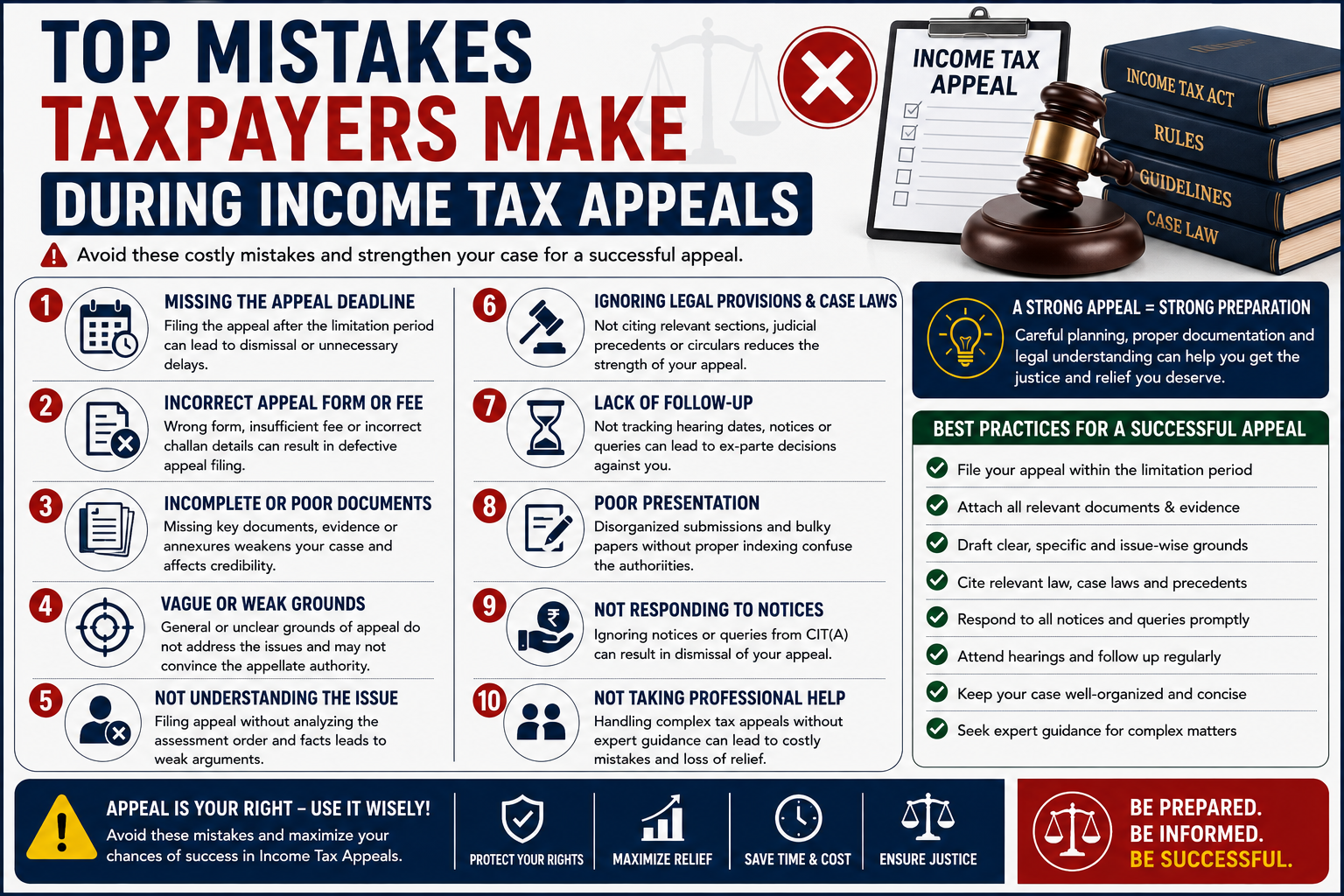
An Income Tax appeal is not simply a matter of submitting a form and stating that the assessment order is wrong. A taxpayer generally needs to identify the disputed issues, formulate appropriate grounds, support the case with relevant documents and evidence, comply with procedural requirements and observe the applicable limitation period.
One of the most serious mistakes is assuming that every appeal follows the same provisions. Since the Income-tax Act, 2025 is now applicable for tax years beginning on or after 1 April 2026, while the repealed Income-tax Act, 1961 continues to govern specified proceedings relating to earlier tax years, the applicable legal framework must be identified before preparing an appeal. Section 536 of the Income-tax Act, 2025 contains the transition and savings framework.
For example, proceedings relating to a tax year beginning before 1 April 2026 can continue under the repealed Income-tax Act, 1961, including appellate proceedings.
This makes legal accuracy, limitation, documentation and proper grounds of appeal particularly important.
What Are the Most Common Mistakes in Income Tax Appeals?
The most common mistakes include:
- Missing the applicable appeal deadline.
- Filing an appeal without properly understanding the impugned order.
- Writing vague or poorly framed grounds of appeal.
- Failing to explain the factual background clearly.
- Not submitting relevant documentary evidence.
- Ignoring additional-evidence requirements.
- Treating the appeal as an opportunity to introduce an entirely new case without understanding the applicable rules.
- Failing to respond properly to appellate notices.
- Not checking tax-payment and appeal-fee requirements.
- Choosing the wrong remedy or appellate forum.
- Ignoring the transition between the Income-tax Act, 1961 and Income-tax Act, 2025.
- Assuming that filing an appeal automatically stays recovery of the disputed demand.
The exact requirements depend on the assessment year/tax year, the order being challenged, the statutory framework applicable to that proceeding and the appellate authority involved.
1. Missing the Appeal Limitation Period
Why is delay in filing an Income Tax appeal a serious mistake?
Because an appeal normally has to be filed within the statutory limitation period. For appeals to the Joint Commissioner (Appeals) or Commissioner (Appeals), section 358 of the Income-tax Act, 2025 provides a 30-day period, subject to the statutory rules regarding computation and condonation of delay.
The Income Tax Department’s current Form 99 guidance also states that an appeal before the JCIT(Appeals) or CIT(Appeals) is generally required to be filed within 30 days from the applicable date, such as service of the demand notice in an assessment or penalty matter.
For older proceedings governed by the Income-tax Act, 1961, section 249 similarly provides a 30-day limitation period for relevant appeals before the first appellate authority.
Common mistake
A taxpayer receives an assessment order but waits several weeks before consulting a professional because the taxpayer assumes that the demand can be challenged whenever convenient.
Better approach
Immediately record:
- Date of order
- Date of service/communication
- Date of demand notice
- Applicable tax year/assessment year
- Applicable Income-tax Act
- Last date for filing the appeal
If the appeal is delayed, the taxpayer should examine whether the applicable law permits condonation of delay and whether sufficient cause can be established.
2. Not Reading the Assessment Order Properly
An appeal should respond to the reasoning and findings contained in the order.
A common mistake is to read only the final demand amount and ignore the reasoning used by the Assessing Officer.
The order may contain several separate issues, such as:
- Unexplained credits
- Disallowance of expenses
- Cash deposits
- Capital gains
- TDS mismatch
- Business income additions
- Reassessment-related issues
- Penalty-related issues
- Procedural objections
Each issue may require a different factual and legal response.
Better approach
Prepare an issue-wise analysis:
| Issue | AO’s finding | Taxpayer’s position | Evidence | Legal ground |
|---|---|---|---|---|
| Addition A | Amount treated as unexplained | Transaction is genuine | Bank statement, confirmation | Relevant legal provision |
| Disallowance B | Expense disallowed | Expense incurred for business | Invoice, payment proof | Relevant provision |
| Adjustment C | Credit denied | Credit is reflected in records | AIS/Form/documentary evidence | Applicable law |
This makes the appeal more coherent and easier to evaluate.
3. Filing Vague Grounds of Appeal
One of the biggest mistakes is submitting grounds such as:
“The Assessing Officer has wrongly passed the order.”
That statement does not adequately identify the grievance.
Grounds should identify the specific issue being challenged and the nature of the alleged error, while remaining appropriately framed for the appellate proceedings.
Better approach
Instead of making broad allegations, identify:
- Which finding is challenged
- Which addition/disallowance is disputed
- What legal or factual error is alleged
- What relief is sought
The Statement of Facts and Grounds of Appeal serve different purposes. The current Form 99 guidance specifically requires taxpayers to provide the Statement of Facts and Grounds of Appeal along with relevant documentary evidence.
4. Confusing Statement of Facts With Grounds of Appeal
These are not necessarily interchangeable.
Statement of Facts
The Statement of Facts should explain the relevant factual background in a clear and chronological manner.
It may explain:
- Return filing
- Proceedings before the Assessing Officer
- Notices received
- Responses submitted
- Evidence furnished
- Findings in the assessment order
- Nature of the disputed addition
Grounds of Appeal
Grounds identify the specific grievances against the order.
A taxpayer who simply copies the assessment order into the appeal may fail to present the actual dispute effectively.
5. Not Submitting Supporting Evidence
A legal argument without supporting evidence may be insufficient to establish the factual position.
Depending on the case, relevant evidence may include:
- Bank statements
- Invoices
- Agreements
- Purchase and sales records
- Books of account
- Ledger accounts
- Tax invoices
- TDS certificates
- Form 16
- AIS/TIS information
- Correspondence
- Confirmation letters
- Proof of payment
- Property documents
- Capital-gain computation
- Previous submissions before the Assessing Officer
The evidence should be connected to the specific grounds rather than uploaded randomly.
6. Ignoring the Rules on Additional Evidence
A taxpayer may sometimes possess documents that were not submitted during assessment proceedings.
That does not mean that every new document can simply be introduced without explanation.
The taxpayer should identify:
- What additional evidence is being submitted.
- Why it was not submitted earlier.
- Why it is relevant.
- Which ground it supports.
- Whether the applicable appellate procedure requires a specific application or explanation.
The current Form 99 process expressly contains an Additional Evidence section.
Therefore, taxpayers should not treat additional evidence as an informal document-upload exercise.
7. Choosing the Wrong Appellate Remedy or Forum
Not every tax dispute should automatically be taken to the same authority.
Depending on the order and applicable law, appellate remedies may involve:
- Joint Commissioner (Appeals)
- Commissioner (Appeals)
- Income Tax Appellate Tribunal (ITAT)
- High Court
- Other statutory remedies
Under the Income-tax Act, 2025, section 357 identifies orders appealable before the Commissioner (Appeals), while section 360 deals with the powers of the Joint Commissioner (Appeals) or Commissioner (Appeals).
An appeal to the High Court from an ITAT order is subject to the requirement that the case involve a substantial question of law under section 365 of the Income-tax Act, 2025.
Common mistake
The taxpayer decides the forum based only on the amount of demand rather than examining the statutory appeal mechanism.
Better approach
First identify:
Order → Applicable Act → Appealable provision → Appellate authority → Limitation → Filing requirements → Relief sought
8. Ignoring the Transition Between the Two Income-Tax Acts
This is particularly important in 2026.
The Income-tax Act, 2025 has replaced the Income-tax Act, 1961, but the transition is not simply a matter of replacing every old section number with a new one.
Section 536 of the Income-tax Act, 2025 provides that proceedings relating to tax years beginning before 1 April 2026 can continue under the repealed Income-tax Act, 1961. This expressly includes assessment, reassessment, rectification, penalty, revision and appellate proceedings.
Therefore, an appeal concerning an earlier tax year may still need to be analysed under the 1961 Act.
Practical lesson
Before citing a section in an appeal, verify:
- Relevant tax year
- Date of proceeding
- Applicable statute
- Transitional provision
- Current procedural requirements
This prevents incorrect section references and procedural confusion.
9. Assuming That Filing an Appeal Automatically Stops Recovery
Another common misconception is:
“I have filed an appeal, so the demand cannot be recovered.”
Taxpayers should not make this assumption.
The existence of an appeal and the question of recovery/stay are related but distinct procedural issues. A taxpayer facing a demand should separately examine the applicable recovery and stay position and take appropriate action where necessary.
Ignoring recovery correspondence while focusing only on the appeal can create unnecessary complications.
10. Not Responding to Appellate Notices
An appeal does not necessarily end with filing the form.
The appellate authority may require:
- Written submissions
- Clarifications
- Supporting documents
- Responses to specific issues
- Additional evidence
- Further explanations
- Hearing-related participation
Ignoring an appellate notice can weaken the taxpayer’s opportunity to present the case.
The current Form 99 guidance also provides for Statement of Facts, Grounds of Appeal and documentary evidence as part of the appeal process.
Better approach
Maintain a dedicated appeal file containing every:
- Notice
- Submission
- Attachment
- Acknowledgement
- Order
- Communication
- Hearing record
11. Not Maintaining a Clear Evidence Trail
Documents are more useful when their relevance is clear.
For example, instead of submitting 200 pages of bank statements without explanation, identify:
- Relevant account
- Relevant transaction
- Date
- Amount
- Source
- Corresponding ledger entry
- Supporting invoice/document
- Ground of appeal supported
A clear evidence trail helps connect the factual record to the legal argument.
12. Using Emotional or Personal Arguments Instead of Legal Grounds
An appeal should focus primarily on the legality and correctness of the disputed order.
Statements such as:
- “The department is harassing me.”
- “The demand is unfair.”
- “I have already paid many taxes.”
- “I am an honest taxpayer.”
may provide context, but they do not automatically establish that an addition or disallowance is legally unsustainable.
A stronger appeal identifies:
Fact + Evidence + Legal provision + Error + Relief
13. Not Identifying the Exact Relief Sought
An appeal should make it clear what the taxpayer wants the appellate authority to decide.
Depending on the facts, the taxpayer may seek appropriate relief such as:
- Deletion of an addition
- Reduction of an addition
- Cancellation/reduction of penalty
- Correction of an erroneous adjustment
- Other relief legally available under the applicable appellate provisions
The relief should correspond with the grounds raised.
14. Assuming That Every New Argument Will Automatically Be Accepted
Tax litigation involves procedural rules as well as substantive law.
A taxpayer may discover a new legal argument after the assessment order. However, whether and how a new ground can be raised depends on the applicable law and appellate principles.
Therefore, taxpayers should not assume that a new argument or new evidence can always be introduced without considering procedural requirements.
15. Not Taking Professional Advice in a Complex Dispute
Not every tax appeal requires the same level of assistance.
Professional advice can be particularly useful where the dispute involves:
- Large tax demands
- Reassessment
- Search-related proceedings
- Complex business transactions
- Capital gains
- Transfer-pricing issues
- TDS disputes
- Penalties
- Multiple assessment years
- Multiple appellate proceedings
- Questions involving statutory interpretation
The objective should not simply be to file an appeal, but to understand the dispute, preserve the taxpayer’s rights and present the case in a legally and procedurally appropriate manner.
Practical Example: How a Taxpayer Can Avoid These Mistakes
Hypothetical Example
Suppose a taxpayer receives an assessment order containing a substantial addition relating to a bank transaction.
The taxpayer believes the transaction represents a genuine business receipt and has:
- Bank statements
- Sales invoices
- Ledger records
- GST records
- Customer confirmation
- Corresponding accounting entries
A weak approach would be to file an appeal saying:
“The addition is wrong and should be deleted.”
A stronger approach would involve:
- Identifying the exact finding in the assessment order.
- Checking the applicable limitation period.
- Determining the applicable Income-tax Act based on the relevant tax year and transition rules.
- Preparing a factual chronology.
- Identifying the precise ground of grievance.
- Linking the bank transaction with the books and invoices.
- Explaining why the evidence establishes the taxpayer’s position.
- Submitting the required documents in the prescribed procedure.
- Responding to subsequent appellate notices.
- Clearly stating the relief sought.
The example is hypothetical. The appropriate legal position will depend on the actual facts, documents and applicable statutory provisions.
Income Tax Appeal Mistakes: A Practical Checklist
Before filing or responding to an Income Tax appeal, a taxpayer should consider:
Have I identified the exact order being challenged?
Have I verified the relevant tax year/assessment year?
Have I determined which Income-tax Act applies?
Have I calculated the applicable limitation period?
Have I checked whether delay requires a condonation request?
Have I identified the correct appellate authority?
Are the grounds of appeal specific and relevant?
Is the Statement of Facts clear and chronological?
Have I collected supporting evidence?
Have I identified any additional evidence?
Have I checked the applicable appeal fee?
Have I retained proof of filing?
Am I monitoring appellate notices?
Have I separately considered the demand/recovery position?
Is the relief sought clearly stated?
What Should a Taxpayer Do After Receiving an Assessment Order?
The safest practical approach is to act promptly rather than waiting until the limitation period is about to expire.
Start by preserving the complete assessment record, including:
- Assessment order
- Demand notice
- Notices issued during proceedings
- Previous submissions
- Evidence submitted
- Tax-payment records
- Relevant financial records
Then obtain a structured review of the order and identify the issues that may require challenge.
The current Income Tax Department guidance for Form 99 requires documents including the order, demand notice, appeal-fee details, tax-payment details, Statement of Facts, Grounds of Appeal and documentary evidence.